

TL;DR:
- California law protects workers from retaliation when reporting wage violations, with Culver City offering some of the strongest safeguards.
- Retaliation includes adverse actions like firing, demotion, or schedule changes occurring after protected activities such as reporting unpaid wages or participating in audits.
- Employees should document all incidents promptly, consult an attorney early, and file claims under the appropriate laws within strict deadlines to effectively combat retaliation.
You reported late paychecks, missing overtime, or minimum wage violations at your job. Then something shifted. Your hours were cut. Your boss started piling on criticism. Maybe you were let go without explanation. A lot of workers assume they just have to live with it, but that assumption is wrong. California law gives you real, enforceable protections against workplace retaliation when you report wage violations, and Culver City employees have access to some of the strongest worker safeguards in the country. This guide breaks down exactly what those protections look like and what you can do right now.
Table of Contents
- What counts as retaliation after reporting wage violations?
- Common scenarios: How retaliation unfolds in Culver City workplaces
- What laws protect you from retaliation and what makes Culver City unique?
- Taking action: What to do if you face retaliation after reporting wage violations
- The truth about fighting retaliation claims in Culver City
- How a Culver City employment lawyer can help you stand up for your rights
- Frequently asked questions
Key Takeaways
| Point | Details |
|---|---|
| Retaliation is illegal | California law protects employees in Culver City from retaliation for reporting wage violations. |
| Know the warning signs | Retaliation includes firing, demotion, reduced hours, or other adverse actions after a complaint. |
| Multiple laws may apply | Filing options and deadlines differ based on your case, so legal advice is vital. |
| Take action quickly | Document retaliation and take steps right away to safeguard your rights. |
| Legal help is crucial | An employment lawyer can maximize your remedies and help you navigate complex overlap in wage and retaliation laws. |
What counts as retaliation after reporting wage violations?
Retaliation happens when your employer takes a negative action against you because you engaged in a protected activity, like reporting wage theft or raising a pay dispute. The key word is “because.” Your employer doesn’t have to announce that the action is punishment. Timing, shifting explanations, and patterns of behavior can all be used as evidence of retaliatory intent.
Protected activities related to wage disputes include:
- Complaining to your manager or HR about unpaid wages or missing overtime
- Filing a report with the California Labor Commissioner
- Participating in a wage investigation or audit
- Discussing pay with coworkers to uncover discrepancies
- Threatening to file a complaint or hire an attorney
Once you engage in any of those activities, any negative change in your job conditions becomes suspect. California courts and agencies look at whether adverse actions followed protected conduct closely in time, especially without a credible business reason.
Common retaliatory actions include firing, demotion, reduced hours, undesirable schedule changes, sudden negative performance reviews, exclusion from meetings, and hostile supervision. Even minor but persistent negative treatment can add up to an actionable pattern.
Wage retaliation disputes in Culver City may overlap with other legal theories, including whistleblower frameworks and FEHA (the Fair Employment and Housing Act) for certain protected characteristics, which means that filing deadlines and administrative prerequisites can differ depending on which laws apply to your specific facts.
It is important to understand that retaliation is legally separate from the underlying wage violation. Even if your employer disputes the wage claim itself, they still cannot lawfully punish you for raising it. You can read more about how workplace retaliation in Los Angeles plays out under California law more broadly, or explore a specific case study involving workplace retaliation at Sony Pictures to see how these legal principles apply in a high-profile Culver City context.
Common scenarios: How retaliation unfolds in Culver City workplaces
Culver City is home to a wide range of industries, from entertainment and tech startups to healthcare, retail, and hospitality. Each industry brings its own patterns of wage retaliation. Once you know retaliation can take many forms, it is critical to spot how it often plays out in real workplaces around Culver City.
Consider these common situations. A warehouse worker reports that her employer has not been paying proper overtime rates. Within two weeks, her shift is moved to a less desirable time, and she is told her position is being “restructured.” A junior developer at a tech company raises a complaint about missed meal break premiums. He is passed over for a promotion that was previously discussed. A restaurant server files a wage claim for tips that were allegedly skimmed by management. Within a month, he is written up for performance issues that were never raised before.

These are not rare exceptions. They are typical patterns that employment attorneys see regularly.
| Protected conduct | Typical retaliation | Example case outcome |
|---|---|---|
| Reporting unpaid overtime | Reduction in scheduled hours | Employee recovers lost wages plus penalty damages |
| Filing minimum wage complaint | Demotion to lower title | Employee reinstated with back pay and attorney fees awarded |
| Raising tip theft concerns | Termination | Employer settles retaliation and wage claims together |
| Discussing pay with coworkers | Hostile supervision or exclusion | Hostile work environment claim added to retaliation case |
| Participating in Labor Commissioner audit | Negative performance review | Review treated as evidence of retaliatory motive |
Cases involving retaliation claims in Culver City startups often follow especially fast-moving timelines because smaller companies may act impulsively after a complaint. Similarly, employment disputes in Culver City tech can involve layoffs or reorganizations used to mask retaliatory motives. Understanding the specific dynamics of your industry matters.
Pro Tip: Start a detailed log the day you make any wage complaint. Record every conversation, schedule change, supervisor interaction, and performance comment, even if it seems minor. Minor incidents often form the backbone of a successful retaliation case. Employees who document consistently are far better positioned when they pursue retaliation after reporting in Culver City.
What laws protect you from retaliation and what makes Culver City unique?
Recognizing how retaliation shows up is one thing. But it is even more important to know exactly which laws protect you and why Culver City’s approach often adds extra layers of employee security.
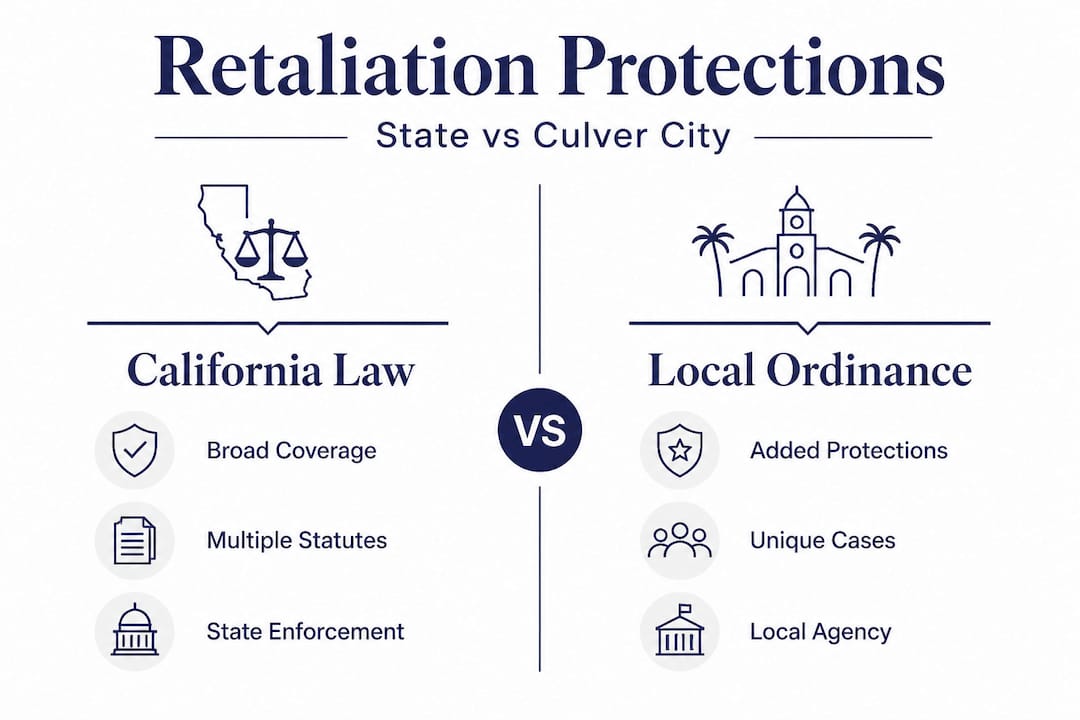
California offers some of the broadest anti-retaliation protections in the country. Several overlapping statutes apply when you report wage violations.
| Law or ordinance | What it covers | Enforcing agency |
|---|---|---|
| California Labor Code Section 98.6 | Protects employees who file or threaten wage claims | California Labor Commissioner |
| California Labor Code Section 1102.5 | Whistleblower protection for reporting legal violations | Labor Commissioner or civil court |
| Fair Employment and Housing Act (FEHA) | Protects against retaliation tied to a protected characteristic | California Civil Rights Department |
| Culver City Minimum Wage Ordinance | Local minimum wage protections above state floor | Culver City Community Development |
| California Private Attorney General Act (PAGA) | Allows employees to sue on behalf of the state for labor violations | Civil court with PAGA notice |
Beyond state law, Culver City has its own minimum wage ordinance that sets a local floor above the California state minimum. Employers who violate that local standard and then retaliate against employees who complain about it face claims under both city and state law. That can mean greater leverage and, in some cases, greater total remedies for the affected employee.
Key protections employees often overlook include:
- PAGA claims allow you to act as a private attorney general, recovering civil penalties that go beyond standard wage recovery
- Section 1102.5 covers external reporting to government agencies as well as internal complaints to supervisors
- FEHA may apply when the retaliation is also tied to a characteristic like gender, national origin, or disability, which can trigger its own deadlines and remedies
- Attorney fees are often available to prevailing employees in retaliation cases, meaning your employer may pay your legal costs
The overlap between retaliation protections in Los Angeles and Culver City’s local ordinances creates a layered system of rights. As wage retaliation cases increasingly intersect with whistleblower and FEHA frameworks, filing deadlines and administrative steps become case-specific and can vary significantly.
Pro Tip: Consulting an employment lawyer in Culver City early allows you to identify which legal theories apply, so you file with the right agency under the right deadline rather than losing claims by guessing.
Taking action: What to do if you face retaliation after reporting wage violations
Armed with knowledge of your legal protections, here is how you can act quickly and effectively if you suspect retaliation.
-
Document everything immediately. Write down dates, times, names, and details of every retaliatory action or comment. Save all relevant emails, texts, performance reviews, and schedules. Print or screenshot anything stored digitally at work if you are permitted to do so.
-
Preserve your evidence carefully. Do not delete communications, even if they seem negative. Contradictory or hostile messages from supervisors can support your case. Store copies somewhere your employer cannot access, such as a personal email account or external drive.
-
Report internally if it is safe to do so. File a complaint with HR or follow your company’s internal reporting process. This creates a formal record. Keep copies of everything you submit and any responses you receive.
-
File a complaint with the appropriate agency. Depending on your situation, that might be the California Labor Commissioner, the Civil Rights Department (for FEHA-based claims), or the Culver City enforcement office for ordinance violations. Deadlines vary by claim type, and some are as short as six months from the retaliatory act.
-
Consult an employment attorney before you file. This is not optional. The order in which you file, and under which statute you file, can change your available remedies and your deadline. An attorney can identify whether your case involves only wage retaliation or also triggers whistleblower or FEHA protections. Employees who fight workplace retaliation in LA tech and similar industries often discover overlapping claims that would have been missed without legal guidance.
-
Do not resign unless absolutely necessary. Quitting can complicate your case unless you are experiencing conditions so intolerable that any reasonable person would feel forced to leave. That concept is called constructive discharge. If you feel unsafe or unable to continue, discuss the situation with an attorney before you make any decisions.
As noted by legal professionals familiar with Culver City cases, wage retaliation disputes may overlap with whistleblower frameworks and FEHA claims, each carrying different deadlines and administrative prerequisites. Strategic filing under the right statutes can significantly affect the strength and value of your case.
Pro Tip: The sooner you get legal counsel, the more options you preserve. Missing a deadline does not just slow your case down. In many situations, it ends it entirely.
The truth about fighting retaliation claims in Culver City
After you know what steps to take, it helps to learn from those who have navigated these battles before, including what most guides will not tell you.
Most employees who come to us after a wage retaliation experience have the same belief: “My case is straightforward.” They reported a wage problem, they were fired or demoted, so the connection is obvious. That reasoning is understandable. But it misses how employer-side attorneys will build a defense.
Employers routinely argue that adverse actions were driven by budget cuts, performance issues, or restructuring that had nothing to do with the complaint. They create documentation after the fact. They pull old emails. They interview coworkers. A case that looks clear on day one can become significantly more complicated by the time formal proceedings begin.
Here is what experience teaches us. The employees who come out ahead are not necessarily those with the strongest underlying facts. They are the ones who documented early, filed under the right framework, and got strategic legal advice before they made moves that narrowed their options.
Conventional thinking tells employees to file fast with whatever agency comes to mind first. The reality is that choosing between the Labor Commissioner, the Civil Rights Department, and civil court litigation matters enormously. FEHA claims, for example, allow for emotional distress damages and attorney fees that basic wage retaliation claims may not. Whistleblower claims under Labor Code Section 1102.5 can carry punitive damages. Choosing correctly often requires understanding executive retaliation strategies and general principles that apply across all employee levels.
The uncomfortable truth is that the law is genuinely on your side in California. But the legal process rewards preparation, timing, and strategy. Employees who treat retaliation as a simple matter too often leave significant remedies on the table.
How a Culver City employment lawyer can help you stand up for your rights
If this process sounds complex, partnering with a skilled employment lawyer in Culver City or Los Angeles can turn the legal maze into a clear path toward recovery. At Shirazi Law Office, we help employees identify every potential claim available to them, whether that includes wage recovery, whistleblower protection, FEHA-based retaliation, or all three together. We help you meet every filing deadline, gather the evidence that matters most, and build a strategy designed for your specific facts.
Brian Y. Shirazi brings deep experience with California employment law and a genuine commitment to standing up for workers against powerful employers. Your situation is not just a legal matter. It is your income, your career, and your right to speak up without fear. We offer confidential consultations and can often begin with a free case review. If you have experienced wrongful termination rights in LA violations or broader retaliation, explore how an employment lawyer in Los Angeles can help you build the strongest possible case from day one.
Frequently asked questions
What should I do first if I think my employer retaliated after reporting a wage violation?
Document everything immediately and contact an experienced employment attorney, because retaliation claims can involve overlapping laws with different deadlines, and early legal advice preserves more of your rights.
How long do I have to file a retaliation claim in Culver City?
Deadlines depend on the legal theory applied to your case, with some claims running as short as six months and others up to three years, so acting quickly is essential to avoid losing your right to file under key statutes.
Can my employer fire me for filing a wage complaint?
No. Terminating an employee for making a wage complaint is illegal retaliation under California Labor Code Section 98.6 and potentially other statutes depending on the circumstances.
How is retaliation different from discrimination?
Retaliation punishes you specifically for reporting illegal conduct or exercising a legal right, while discrimination treats you unfairly based on a protected characteristic like race, gender, or age, though the two can overlap in some cases and require separate legal analysis.
Recommended
- Retaliation After Reporting Harassment in Culver City Tech – Law Office of Brian Y. Shirazi, PC
- Retaliation Claims in Culver City Startups – Protecting Executives
- Employment Disputes in Culver City Tech Firms
- Wrongful Termination After Reporting Misconduct: Legal Impact on Downtown Los Angeles Executives – Law Office of Brian Y. Shirazi, PC
- Wage Determination Penalties





[…] Read the full article here. […]