

TL;DR:
- Executive disputes in Century City involve complex legal issues like wrongful termination, retaliation, and contracts.
- Proper legal guidance is essential to protect against high-stakes risks affecting reputation and compensation.
- Early documentation, legal counsel, and strategic negotiation are key to resolving disputes effectively.
Senior executives and top managers at Century City firms, including global players like Deloitte, often operate under the assumption that their seniority shields them from employment disputes. That assumption is costly. The reality is that executives face some of the most complex workplace legal challenges in California, from wrongful termination to retaliation, contract breaches, and discrimination. Los Angeles has one of the most employee-protective legal environments in the nation, and navigating it without proper guidance can put your career, your compensation, and your reputation at serious risk. This guide walks you through the most important legal realities, practical steps, and negotiation strategies you need to know.
Table of Contents
- Understanding executive disputes at Century City firms
- Wrongful termination: Legal risks and real-world precedents
- Workplace retaliation: Recognition and response for executives
- Negotiation strategies and best practices for dispute resolution
- The overlooked realities of executive disputes in Century City
- Connect with expert employment counsel for executive disputes
- Frequently asked questions
Key Takeaways
| Point | Details |
|---|---|
| Executives face real risks | Even leaders at top Century City firms are subject to wrongful termination and workplace disputes. |
| Early action is essential | Documentation and consulting legal counsel quickly increases chances of favorable outcomes. |
| Retaliation requires vigilance | Executives must recognize and respond to subtle retaliation to protect their rights. |
| Negotiation expertise matters | Skilled negotiations and knowledge of confidentiality clauses are vital in dispute resolution. |
| Local counsel is key | Engaging experienced employment lawyers in Los Angeles is critical for executive-level disputes. |
Understanding executive disputes at Century City firms
Century City sits at the intersection of entertainment, finance, and professional services, housing major offices from firms like Deloitte, KPMG, and a long list of elite law and consulting groups. With that prestige comes a particular kind of workplace dynamic: high stakes, high pressure, and significant legal complexity when disputes arise.
An executive dispute is broadly any employment-related conflict that involves a senior employee’s rights, compensation, contract, or workplace treatment. These are not simple HR complaints. They often involve sophisticated employment agreements, stock options, non-compete clauses, and separation packages that require careful legal analysis.
Century City executives frequently face complex disputes involving wrongful termination, retaliation, and contract issues that most general employment attorneys are not equipped to handle at the required level.
Common triggers for executive disputes include:
- Wrongful termination following internal complaints or protected disclosures
- Retaliation after whistleblowing or asserting legal rights
- Breach of employment contracts, including compensation and severance terms
- Discrimination based on age, gender, race, or disability
- Non-compete enforcement and disputes over confidential information
| Type of dispute | Frequency among executives | Typical resolution path |
|---|---|---|
| Wrongful termination | Very common | Negotiation, litigation |
| Retaliation | Common | DFEH complaint, litigation |
| Breach of contract | Moderate | Arbitration, mediation |
| Discrimination | Common | EEOC filing, settlement |
| Non-compete disputes | Increasing | Court challenge, negotiation |
What makes executive disputes distinct is not just their legal complexity. It is the reputational weight they carry. A dispute that becomes public can affect your next role, your professional network, and your standing in a tight-knit industry community.
Wrongful termination: Legal risks and real-world precedents
Wrongful termination, in simple terms, means being fired for an illegal reason. California is an at-will employment state, meaning an employer can generally let you go for any reason or no reason at all. However, that rule has important exceptions, and executives are frequently on the wrong side of those exceptions without realizing it.

Illegal reasons for termination include retaliation for reporting misconduct, discrimination based on protected characteristics, and violations of an employment contract. Executives at major firms often have written agreements that limit when and how they can be terminated. Violating those terms is a legal exposure for the employer.
Wrongful termination claims by executives are increasing, resulting in significant settlements and legal precedents that reshape how firms handle separations. Firms like Deloitte have legal teams built for this. You need counsel that matches that level.
Here is how executive disputes differ from non-executive ones:
| Factor | Executive disputes | Non-executive disputes |
|---|---|---|
| Contract complexity | High (detailed agreements) | Low to moderate |
| Compensation at stake | Very high | Moderate |
| Reputational exposure | Significant | Limited |
| Legal strategy required | Sophisticated | Standard |
If you are facing termination or believe one is coming, here are the steps you should take immediately:
- Secure all relevant documentation. Emails, performance reviews, and communications about your role are critical evidence.
- Do not sign anything without legal review, including severance agreements.
- Identify the timeline of events, especially anything that preceded the termination discussion.
- Consult an employment attorney who specializes in executive matters before responding to the employer.
- Understand your contractual rights, including any equity vesting, bonus entitlements, and notice requirements.
Pro Tip: Preserve evidence early. Forwarding work emails to personal accounts after a dispute has started may violate company policy or even legal obligations. Instead, document what you observe in writing, note dates and times, and keep records of all related communications on approved channels.
For executives in nearby areas, insights specific to Beverly Hills executive terminations offer useful context on how local courts and mediators tend to approach these cases.
Workplace retaliation: Recognition and response for executives
Wrongful termination often does not happen in isolation. In many executive cases, termination is the final act in a pattern of retaliation that began weeks or months earlier. Recognizing retaliation early is critical, because the law protects you the moment it begins, not just when it ends.
Workplace retaliation occurs when an employer takes adverse action against you for engaging in legally protected activity. That includes reporting harassment, raising compliance concerns, filing an internal complaint, or cooperating with an investigation.
For executives, retaliation can be subtle. Watch for these common forms:
- Sudden demotion or reduction in responsibilities
- Exclusion from key meetings or decision-making processes
- Reassignment to a less significant role or territory
- Removal of direct reports without explanation
- Hostile treatment or public criticism following a complaint
- Sudden negative performance reviews after years of strong evaluations
Key legal requirement: To prove retaliation, you must show that you engaged in protected activity, that your employer took an adverse action, and that there is a causal connection between the two. Timing is often the strongest evidence.
California law provides strong protections against retaliation, and retaliation claims by executives require careful legal handling and swift action to preserve your rights under both state and federal statutes.
For a closer look at how retaliation plays out in real Century City workplace situations, the CAA retaliation case study provides a useful illustration of how these dynamics unfold in high-profile firms.
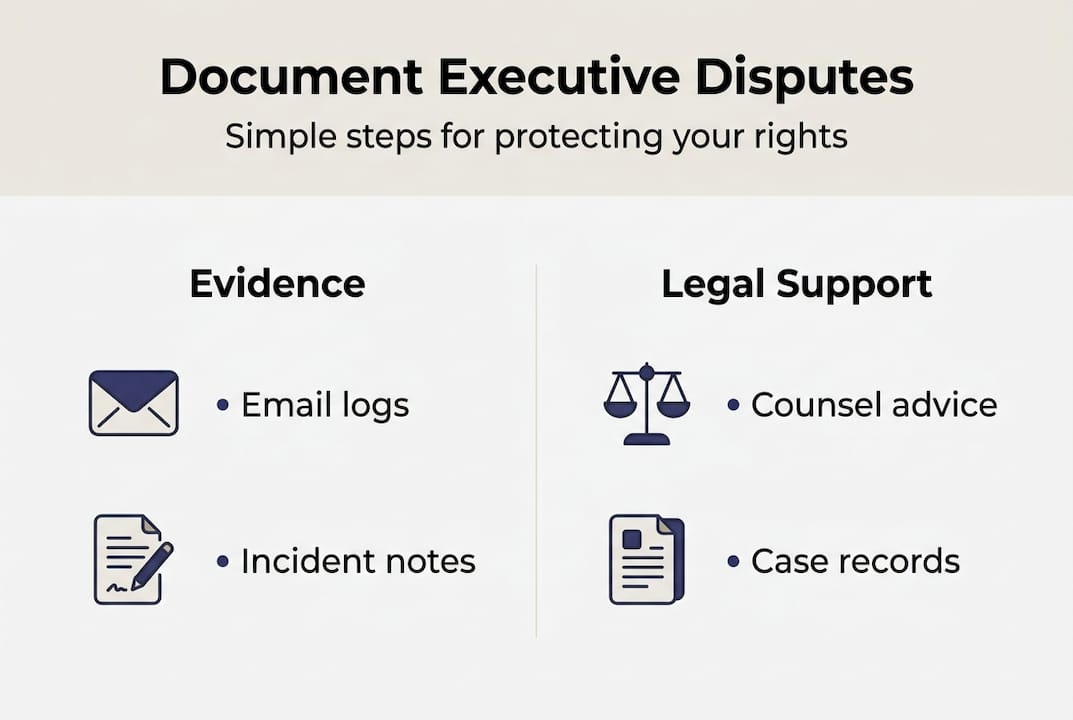
Pro Tip: Start a private, dated log the moment you suspect retaliation. Note every incident, who was present, what was said, and how it affected your work. This documentation becomes your most valuable asset if litigation follows.
Negotiation strategies and best practices for dispute resolution
Not every executive dispute ends in a courtroom. In fact, most resolve through negotiation, mediation, or arbitration. Knowing how to approach resolution strategically is just as important as knowing your legal rights.
Effective dispute resolution for executives typically follows a clear sequence:
- Preparation. Gather all documentation, understand the full value of your claim (lost compensation, equity, future earnings), and clarify your goals before any conversation begins.
- Internal escalation. In some situations, raising concerns through proper internal channels is a required first step and can also create a record of good-faith effort.
- Mediation. A neutral third party helps both sides reach a voluntary agreement. This can be faster and less expensive than arbitration or litigation.
- Arbitration. Many executive employment agreements include mandatory arbitration clauses. Know whether yours does and understand the process before any dispute arises.
Non-compete and confidentiality clauses add another layer of complexity. California generally does not enforce non-compete agreements against employees, but firms sometimes use them as leverage during negotiations anyway. Understanding your rights around executive non-compete strategies can prevent you from being pressured into accepting unfavorable settlement terms.
Common mistakes executives make during dispute resolution:
- Negotiating directly with the employer’s legal team without their own counsel
- Accepting the first severance offer without evaluating its full value
- Signing a broad release of claims before understanding what rights are being waived
- Allowing the dispute to drag on without a clear legal strategy
- Underestimating the reputational risk of a public dispute
Legal negotiation strategies for executives are pivotal in achieving favorable settlement outcomes, and the difference between prepared and unprepared counsel is often measured in significant financial terms.
The overlooked realities of executive disputes in Century City
Here is something most articles won’t tell you directly: executives are often their own worst adversary in a dispute. The instinct to handle things quietly, to protect the firm’s reputation, or to believe that a polite conversation will resolve everything tends to cost more than it saves.
Los Angeles adds specific complexity. The legal environment here is heavily protective of employees, and Century City firms know it. Their legal teams are trained to move quickly to limit liability. If you wait while they act, the gap closes against you.
There is also the digital reality that many executives underestimate. Emails, Slack messages, and even LinkedIn activity can become evidence. A single poorly worded response sent in frustration can shift the narrative in a dispute. This is not a reason for paralysis. It is a reason to engage a Century City dispute guide and trusted legal counsel before the situation escalates.
Conventional wisdom says handle it internally first. The better wisdom: know your rights before the first conversation, so you never accidentally waive them.
Connect with expert employment counsel for executive disputes
Understanding your rights is the first step. Acting on them with the right support is what actually protects your career and your financial future. Shirazi Law Office focuses exclusively on employment law for executives and senior managers across Los Angeles, including those navigating disputes at firms throughout Century City.
Whether you are facing wrongful termination, experiencing retaliation, or working through a severance negotiation, the right time to engage counsel is before you sign anything or make formal statements. Explore what executive legal representation looks like for someone at your level, review guidance on Century City executive terminations, and learn how current discrimination laws in 2026 may impact your case. Contact Shirazi Law Office to schedule a confidential consultation.
Frequently asked questions
What are the most common executive disputes at Century City firms like Deloitte?
Wrongful termination, retaliation, breach of contract, and discrimination are among the most frequent executive disputes. Century City executives regularly face disputes involving complex employment agreements and protected activity claims.
How should an executive respond to wrongful termination?
Executives should preserve all documentation, consult legal counsel, and follow formal complaint procedures promptly. Executive termination claims are increasingly resulting in significant settlements, making early legal involvement essential.
What constitutes retaliation against executives in the workplace?
Retaliation includes demotion, reassignment, exclusion from meetings, or other adverse actions following whistleblowing or protected activity. Retaliation claims require prompt documentation and skilled legal handling to be effective.
Are non-compete and confidentiality clauses enforceable for Century City executives?
These clauses are often scrutinized and may not always be enforceable under California law; an attorney can clarify your specific situation. Severance dispute outcomes often hinge on how these clauses are interpreted and negotiated.
What are some effective negotiation strategies for resolving executive disputes?
Preparation, clear documentation, mediation, and involvement of expert legal counsel are key best practices. Legal negotiation strategy is pivotal in achieving outcomes that protect both your financial interests and your professional reputation.





[…] Executive disputes at Century City firms: A practical guide – Law Office of Brian Y. Shirazi, … […]