
TL;DR:
- Executives in Beverly Hills should understand their unique value, legal rights, and market norms to negotiate fair severance packages. Effective preparation and strategic negotiation with legal counsel can significantly improve outcomes and protect legal claims, especially before formal offers are made. Recognizing timing, board influence, and reputation as leverage points often results in more favorable terms and a smoother transition.
When a company decides to part ways with a senior leader, the terms of that separation can shape the next chapter of your career and financial life. Beverly Hills executives face a uniquely high-stakes environment where first offers rarely reflect true market value, legal protections are substantial, and negotiation missteps can cost you hundreds of thousands of dollars. This guide walks you through exactly how to recognize your leverage, prepare methodically, negotiate with confidence, and avoid the traps that catch even experienced executives off guard.
Table of Contents
- Understand your value and rights as an executive
- Prepare your severance negotiation strategy
- Negotiate effectively: Tactics for senior leaders
- Avoid common severance pitfalls in Beverly Hills
- What most executives miss about severance negotiations
- Get strategic support for your next negotiation
- Frequently asked questions
Key Takeaways
| Point | Details |
|---|---|
| Know your value | Executives command higher severance packages—averaging 6-24 months or 2x salary multipliers. |
| Prepare strategically | Gather documents, set clear goals, and time your negotiations for best leverage. |
| Negotiate beyond cash | Request references, medical coverage, and tailored clauses—not just a payout. |
| Avoid common pitfalls | Watch for early releases, tax traps, and restrictive clauses during negotiations. |
| Seek expert legal support | Work with specialized attorneys to maximize severance outcomes and protections. |
Understand your value and rights as an executive
Now that you’re clear on the importance of negotiation, let’s examine the foundation: your unique value and the severance rights executives command.
Executives in Beverly Hills operate in one of the most competitive and high-value employment markets in the country. Your leverage isn’t just your title. It’s your institutional knowledge, your client relationships, your trade secrets exposure, and the reputational risk your departure poses to the company. These factors together create negotiating power that most general employees simply don’t have.
California law does not mandate severance pay, but your employment agreement, stock plan, and past company practice all create enforceable obligations. Understanding the difference between what’s legally required and what’s customary in your market is step one. For Beverly Hills executive severance situations, market norms often far exceed what employers initially offer.
What counts as a strong severance package?
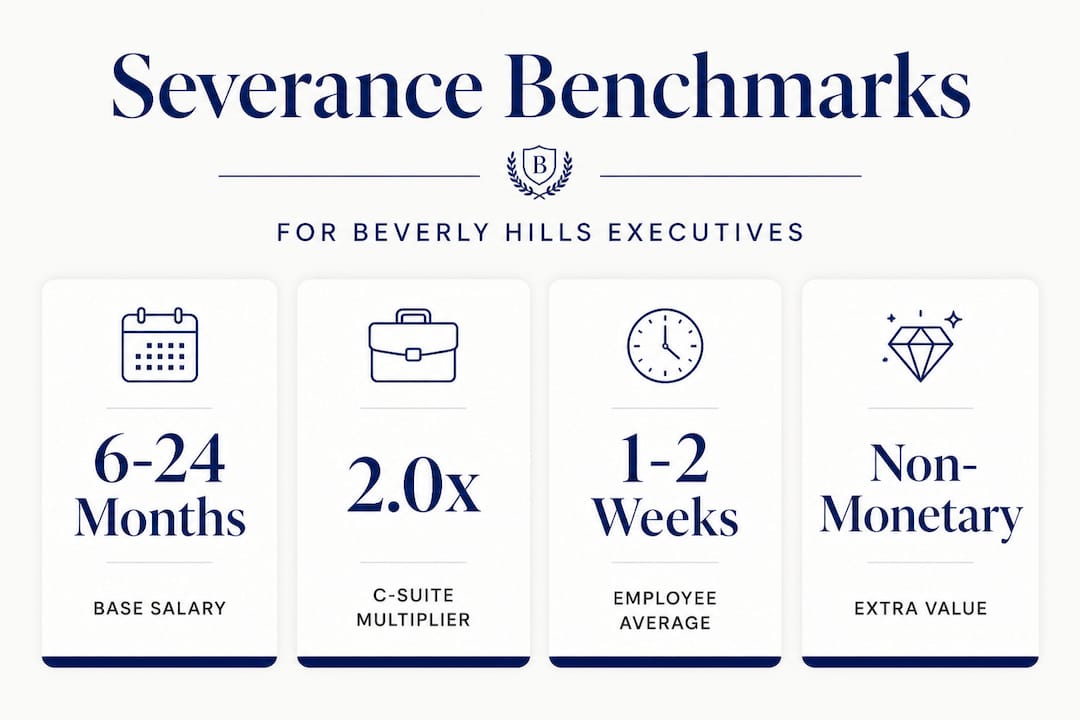
Typical benchmarks show 1 to 2 weeks of pay per year of service for general employees, while executives routinely receive 6 to 24 months of base salary or multipliers ranging from 1.5x to 2x their total compensation. Here’s how those benchmarks break down by role:
| Role level | Typical cash component | Common multiplier |
|---|---|---|
| C-Suite (CEO, CFO, COO) | 12 to 24 months base | 2.0x base or total comp |
| Senior VP | 9 to 18 months base | 1.5x to 2.0x |
| VP and Director | 6 to 12 months base | 1.0x to 1.5x |
| Senior Manager | 3 to 9 months base | 1.0x |
Beyond cash, a strong package typically includes:
- Accelerated vesting of equity awards and options
- Extended health benefits (often COBRA bridge for 12 to 18 months)
- Outplacement services tailored to executive roles
- A carefully worded reference letter and agreed-upon separation statement
- Bonus proration for the year of departure
- Garden leave provisions that keep you on payroll during a transition period
Pro Tip: Never reveal your financial urgency during early conversations. Employers will use that information to low-ball their offer and drag out negotiations.
Working with an employment lawyer in Beverly Hills before you respond to any initial offer gives you the clearest picture of where your package stands relative to market expectations.

Prepare your severance negotiation strategy
Having recognized your value, the next step is laying groundwork for a negotiation that plays to your strengths.
Preparation separates executives who walk away with transformative packages from those who accept whatever lands in their inbox. The work you do before the first formal conversation determines nearly everything about the outcome.
Documents and data to gather before you negotiate
Before sitting down at the table, you need a complete picture of your compensation history and contractual rights. Here’s a prioritized order of what to collect:
- Your employment agreement and any amendments: This is your legal baseline. Look for severance provisions, change-of-control clauses, and any “good reason” resignation triggers.
- Equity award agreements: Stock options, restricted stock units, and performance shares may have accelerated vesting provisions triggered by termination events.
- Bonus plan documents: Annual incentive plans often specify payout rules upon involuntary termination. Don’t assume you’ve forfeited your bonus.
- Compensation history: Three to five years of W-2s and total compensation statements help you establish the value of what you’re walking away from.
- Performance reviews: Strong reviews directly contradict any narrative that termination was performance-based, which matters enormously if there are legal claims to consider.
- Prior severance agreements at the company: If you know other executives received better terms, that’s evidence supporting a higher offer.
- Correspondence about your role: Emails praising your work, announcing your achievements, or expanding your responsibilities are powerful negotiating tools.
Setting monetary and non-monetary goals
C-Suite executives typically see 2.0x multipliers, with VPs receiving 6 to 24 months of base salary. But the most effective executives define their goals in layers, not just dollar amounts. Your monetary floor is the minimum you’ll accept. Your monetary target is where you’d feel genuinely satisfied. And your non-monetary priorities often matter just as much as cash.
Non-monetary terms worth pursuing include the framing of your departure (resignation versus involuntary termination for unemployment purposes), the scope of a non-disparagement clause, continued vesting on unvested equity, and the exact language of your reference. Century City executive severance disputes frequently hinge on these non-cash terms rather than the headline number.
Timing matters significantly. The best moment to negotiate is before you sign anything and before legal counsel on the company’s side gets too entrenched. Consulting Hollywood executive contract strategies resources early can help you calibrate when and how to engage.
Pro Tip: Calculate what you’re leaving on the table if unvested equity lapses. In many cases, accelerating even one tranche of RSUs adds more value than months of base salary.
Negotiate effectively: Tactics for senior leaders
Now that you’re prepared, let’s move into the heart of the process: negotiation itself.
Effective executive severance negotiation isn’t a confrontation. It’s a structured conversation where you advocate clearly for your interests while keeping the relationship professional. How you handle this process will be remembered by board members, investors, and industry contacts long after the deal closes.
Step-by-step tactics for negotiation meetings
- Request time to review. Never respond to a severance offer in the same meeting where it’s presented. Ask for at least two weeks, which is standard and legally appropriate in California.
- Acknowledge without conceding. Open your response by acknowledging the offer, not by attacking it. Something like “I appreciate the company putting together an initial proposal” keeps the tone collaborative.
- Lead with your documented value. Present your tenure, specific business outcomes you drove, and the complexity of your role. Ground your counteroffer in data, not emotion.
- Name your number with confidence. Executives who offer vague ranges signal uncertainty. State a specific target and explain the reasoning behind it using market benchmarks.
- Bundle your requests. Present all your asks together rather than negotiating each item separately. Bundling makes it easier to trade items strategically.
- Treat “final offers” skeptically. Employers routinely call an offer final when it isn’t. The correct response is to thank them for clarity and ask if there’s any flexibility on specific items.
“The most expensive mistake an executive can make is treating a severance negotiation as a formality. Every provision in that agreement has a dollar value or a career value. Get representation before you sign.”
Beyond salary multipliers, ask for garden leave (where you remain on payroll but aren’t required to work, preserving your income while you search), explicit limits on what the company can say about your departure, and clarity on whether non-compete provisions are enforceable under California law. California is one of the most employee-friendly states on wrongful termination risks for executives, and broad non-competes are largely unenforceable here, which is leverage you should use.
Understanding executive disputes in Century City firms also reveals a consistent pattern: the executives who achieve the best outcomes consistently arrive with legal counsel already engaged, not as an afterthought.
Avoid common severance pitfalls in Beverly Hills
Negotiation isn’t just about getting to yes. It’s also about sidestepping hazards that can compromise your outcome.
Even well-prepared executives make costly mistakes when navigating separation agreements. Beverly Hills has its own market culture, employer norms, and legal landscape that create specific traps.
The most common and costly mistakes
-
Releasing legal claims too early. Many severance agreements require you to release all employment-related claims in exchange for payment. If your termination involved discrimination, retaliation, or wage violations, that release could be worth far more than the severance offered. Never release claims without understanding what you’re giving up.
-
Overlooking tax consequences. A large lump-sum severance payment can push you into a higher tax bracket and trigger unexpected liabilities. Spreading payments over multiple tax years, or negotiating different payment structures, can preserve tens of thousands of dollars.
-
Accepting broad non-disparagement clauses without reciprocity. Standard agreements muzzle you but often leave the company free to say whatever it wants. Always negotiate for a mutual clause that binds both parties equally.
-
Ignoring non-compete carveouts. Even though California largely invalidates non-competes, separation agreements sometimes include provisions that attempt to limit your activity under different legal theories. Have counsel review every restrictive covenant clause carefully.
-
Failing to document all negotiations in writing. Verbal assurances from HR or even executives carry no legal weight once you’ve signed. Get every agreed modification in writing before you execute the agreement.
-
Missing the ADEA 21-day review requirement. If you’re 40 or older, federal law (the Age Discrimination in Employment Act) requires that you be given at least 21 days to consider any agreement that waives age discrimination claims, plus a 7-day revocation period. Employers sometimes downplay this. Know your rights.
Wrongful termination in Beverly Hills luxury jobs sectors shows a recurring pattern: executives at high-profile companies sign quickly because they feel embarrassed or pressured, and they discover later that the claims they released had significant value. Don’t let urgency or emotion override your judgment.
California law also provides executives often 6 to 24 months in market-standard protections, but only if you know to ask. The employer isn’t obligated to tell you what’s possible.
Pro Tip: Read every clause in your separation agreement out loud. The act of reading aloud forces you to slow down and notice language you might skim past silently. Flag anything that feels ambiguous for legal review.
What most executives miss about severance negotiations
Most articles on this topic focus on salary multipliers and healthcare continuation. Those are important. But in our experience working with Beverly Hills senior leaders, the most transformative outcomes often come from leverage points that never make it onto a standard checklist.
Timing is a hidden weapon. The moment the company announces your departure internally is a moment of vulnerability for them. If the narrative isn’t set, board members are nervous, or a transaction is pending, you hold timing leverage that evaporates the moment the announcement goes out. Executives who engage legal counsel immediately and negotiate before the announcement often achieve dramatically better terms than those who wait.
Board dynamics matter more than HR. In many separations, the HR team presents a policy-driven offer while the board or CEO has authorized room to do far better. Going directly to the right decision-maker, or having counsel reach out through the right channel, can bypass the policy floor entirely. This is especially true in Beverly Hills firms where the founder or a major investor has direct authority over senior leadership separations.
Your reputation is a negotiating asset. In the tight-knit business community of Beverly Hills, both parties know that how a separation is handled becomes a story that circulates. A well-handled exit that reflects well on both you and the company is genuinely valuable to the employer. Use that. Propose language, propose a joint communication plan, and offer to manage the transition professionally in exchange for better terms.
Treating a severance negotiation as purely financial leaves non-monetary value on the table. The executives who engage their employment lawyer in Beverly Hills early, think beyond the cash, and treat the process as a holistic negotiation consistently reach outcomes that change the financial trajectory of their next chapter.
Get strategic support for your next negotiation
If you’re approaching a separation and haven’t yet engaged legal counsel, the time to act is now, before you respond to any offer, sign any document, or make any statements about your departure. Shirazi Law Office provides direct, personal representation for Beverly Hills executives navigating complex severance situations. Whether your case involves a straightforward negotiation or potential wrongful termination resources for executives, you deserve counsel who understands the stakes and knows this market. Explore senior management legal representation options tailored to your situation, and reach out to Shirazi Law Office for a confidential consultation before your negotiation window closes.
Frequently asked questions
How much severance pay do executives typically get in Beverly Hills?
Most executives in Beverly Hills receive 6 to 24 months of base salary or a 1.5x to 2x multiplier depending on their role, tenure, and the strength of their employment agreement.
What documents should I gather before starting severance negotiations?
You should collect your employment contract, compensation history covering at least three years, performance reviews, equity award agreements, and any prior severance agreements within the company.
Can I negotiate severance terms other than money?
Yes, non-monetary items such as the language of your reference letter, extended health benefits, garden leave provisions, equity acceleration, and the scope of non-disparagement clauses are all negotiable and often highly valuable.
Should I accept my employer’s first severance offer?
Rarely. First offers typically reflect the company’s minimum policy position, not market value, and engaging experienced legal counsel before responding almost always produces meaningfully better terms.
Why is specialized legal help important in Beverly Hills executive severance cases?
An attorney who understands both California employment law and the specific norms of the Beverly Hills market can identify leverage points, protect your legal claims, and negotiate terms that a general advisor would miss entirely.
Recommended
- Beverly Hills Executive Severance: 30% Higher with Legal Help – Law Office of Brian Y. Shirazi, PC
- Wrongful Termination of Executives in Beverly Hills – Law Office of Brian Y. Shirazi, PC
- Executive Severance Disputes Impact Century City Leaders
- Wrongful Termination Claims in Beverly Hills Luxury Jobs
- Severance and Separation Agreements in Montclair You Need To Know





[…] Read the full article here. […]