TL;DR:
- Many Los Angeles tech workers are misclassified as independent contractors despite working under employee-like conditions, risking missed wages and benefits. California’s ABC test presumes workers are employees unless companies prove all three criteria, making classification complex for core roles like developers and designers. Recognizing red flags and gathering evidence can help contractors pursue legal claims and recover unpaid wages or penalties.
If you’re a tech professional in Los Angeles working under a contractor label, you may already have full employee rights under California law and not know it. Many app developers, UX designers, and software engineers in this city are incorrectly classified as independent contractors, despite working conditions that clearly point to an employment relationship. The legal and financial consequences are serious: missed wages, denied benefits, and tax burdens that should never have been yours to carry. This guide breaks down exactly how California decides your status, what warning signs to watch for, and what steps you can take to protect yourself.
Table of Contents
Key Takeaways
| Point |
Details |
| Employee presumption |
California law usually treats tech contractors as employees unless strict criteria are met. |
| Severe misclassification risks |
LA tech firms face big penalties, and workers can win back pay and legal fees if misclassified. |
| Contracts aren’t decisive |
1099s or contracts don’t override actual work conditions under state law. |
| Narrow exemptions |
Few tech roles qualify for AB5 exemptions, making most vulnerable to misclassification. |
| Documentation is key |
Keep records of your work situation to prove misclassification and protect your rights. |
Why misclassification matters for LA tech professionals
The difference between being classified as an employee versus an independent contractor is not a technicality. It determines whether you receive overtime pay, minimum wage protections, workers’ compensation coverage, unemployment insurance, and employer-paid payroll taxes. For tech professionals in Los Angeles, this difference can translate to tens of thousands of dollars per year.
Here is what’s genuinely at stake:
- Back pay and overtime: Misclassified employees can recover unpaid overtime and minimum wage violations going back several years.
- Benefits denial: Health insurance, paid sick leave, and retirement contributions can all be recoverable if you were treated as an employee.
- Tax liability shifts: Contractors pay the full self-employment tax (15.3%), while employees split it with their employer. Misclassification puts that entire burden on you.
- Unemployment and workers’ comp: If you’re hurt on the job or lose work, you may have no safety net as a contractor, even if you legally qualified for one.
Los Angeles has emerged as one of the most active cities in the country for misclassification enforcement. The
DLSE enforces via audits, citations, and wage claims, and its enforcement record includes millions in penalties across industries, including a notable $1.3 million citation against LA car washes in 2024.
“The post-Dynamex era changed everything in Los Angeles. Workers who once had no recourse now have powerful legal tools to reclaim what was taken from them.”
Following the Dynamex decision and the passage of AB5,
LA saw a surge in class action filings with easier certification standards and higher settlements. Penalties in these cases often stack to three to four times the original unpaid wages. Tech and creative industries are particularly exposed because the nature of the work closely mirrors traditional employment. You can find deeper context on
misclassification guidance in Downtown LA that covers how these claims play out locally.
AB5, the ABC test, and how tech roles are judged
California uses the
ABC test under AB5 as the primary mechanism for classifying workers. It codified the standard from the 2018 Dynamex decision and applies statewide, including Los Angeles. Under this test, every worker is presumed to be an employee. The burden is on the company to prove all three prongs of the ABC test are satisfied.
The three prongs explained:
| Prong |
What it asks |
Why it’s hard for tech companies |
| A: Control |
Is the worker free from company control over how work is done? |
Set hours, required meetings, and tool mandates fail this test |
| B: Outside normal course of business |
Does the worker perform work outside the company’s core business? |
For a software firm, a developer or UX designer is core business |
| C: Independent business |
Is the worker customarily engaged in an independently established trade? |
Contractors working exclusively for one client rarely qualify |
Prong B is the most problematic for tech companies. If a startup hires a developer to build its core product, that developer is performing the company’s central function. That is exactly what AB5 was designed to capture.
Tech and creative workers in LA including app developers, UX designers, and graphic designers are frequently misclassified when treated like employees through set hours, company hardware, direct supervision, and deep integration into the product team, regardless of what the contract says.

Pro Tip: Even if a company calls you a vendor and issues you a 1099, what matters is the reality of how you work. If you sit in their Slack channels all day, attend mandatory standups, and work exclusively on their product, you likely fail the ABC test as a contractor.
Exemptions do exist. Licensed engineers working in certain professional services contexts may revert to the older Borello multifactor test. But there is no broad exemption for software developers under AB5. Learn more about how this affects
misclassification in creative roles or revisit the employee vs contractor test explained to understand the full picture.
Spotting misclassification: Red flags for tech contractors
Knowing the legal standard is one thing. Recognizing it in your daily working life is another. These are the most common red flags that tech contractors should watch for carefully.
Signs you may actually be an employee:
- You work set hours defined by the company, not by your own schedule.
- You use company-issued equipment, software licenses, or proprietary internal tools.
- Your work is supervised by a manager who reviews your output or methodology, not just the final result.
- You work almost exclusively for one client over an extended period.
- You were onboarded like an employee, including training, background checks, or company handbook review.
- Your project is the company’s core product or service, not a peripheral or specialized task.
- You cannot subcontract or delegate the work to someone else.
One of the biggest mistakes tech contractors make is relying on their signed contract or 1099 status as legal protection. Under California law, workers should gather evidence of control and integration over the labels placed on the relationship. The actual facts of how you work decide your legal status.
Documentation you should start collecting now:
- Emails that show scheduling requirements, supervision, or performance expectations
- Slack messages or meeting invites that reflect mandatory participation
- Onboarding materials, company policies, or handbooks you were asked to follow
- Payment records showing a consistent salary-like structure rather than project-based invoicing
- Records showing you could not work for competitors or had exclusivity requirements
Pro Tip: Screenshot and save digital communications before raising a complaint. Workers who wait until after a dispute often find that access to internal tools and communications has been revoked.
Once you have your evidence, you have two main legal routes. You can file a claim with the DLSE directly, or you can file a PAGA (Private Attorneys General Act) notice, which allows you to recover civil penalties on behalf of yourself and other workers. Both paths carry time limits, so acting promptly matters. If retaliation occurs after you raise concerns, that creates a separate and serious legal issue. Understanding
workplace retaliation risks is important before you take action, and learning more about filing a claim can help you move forward with confidence.
Penalties and legal remedies for misclassification in tech
The financial consequences of misclassification fall heavily on employers, but only when workers take action. Here is a clear breakdown of what both sides face.
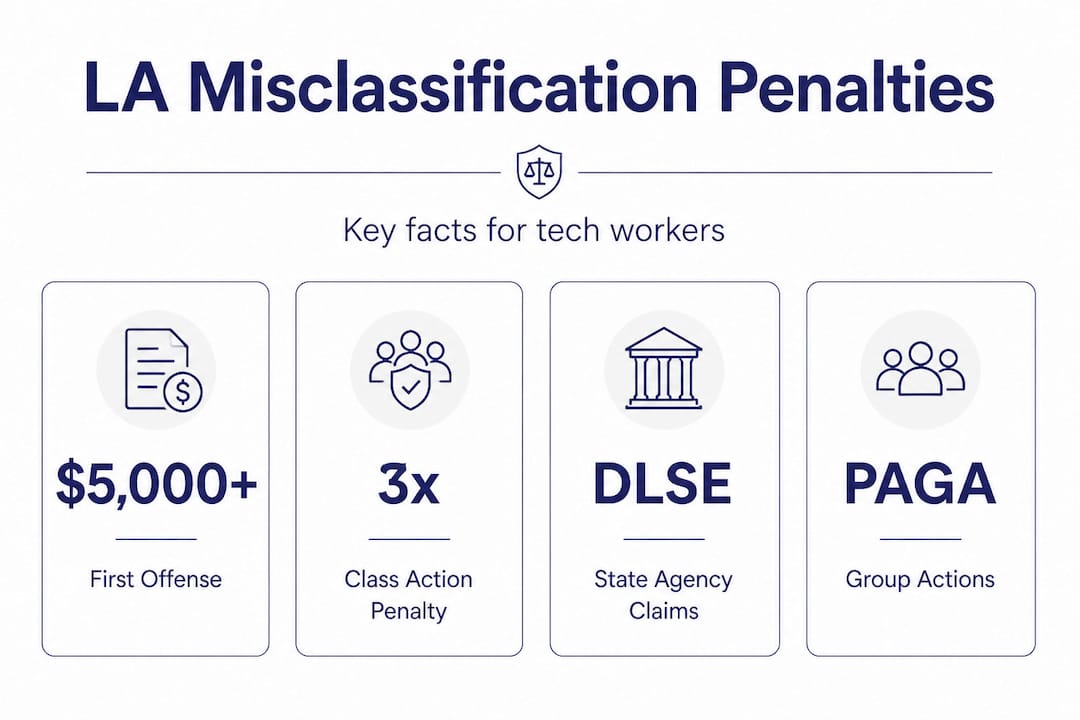 What employers risk:
| Violation type |
Penalty range |
| Willful misclassification (first offense) |
$5,000 to $15,000 per violation |
| Repeat willful misclassification |
Up to $25,000 per violation |
| Unpaid wages and overtime |
Full back pay plus interest |
| PAGA penalties |
$100 per pay period per employee |
| Class action exposure |
Potentially millions across all affected workers |
For willful misclassification, employers face civil penalties of $5,000 to $15,000 per violation under Labor Code Section 226.8, enforced by the DLSE and LWDA. Repeat offenders face up to $25,000 per violation. In class action settings, penalties stack to three to four times the original unpaid wages, which explains why settlements in tech and delivery sector cases have reached significant dollar amounts.
Steps to pursue your claim:
- Gather all documentation of the working relationship, especially evidence of control and integration.
- Consult an employment attorney to assess whether the ABC test is met and what claims apply.
- File a wage claim with the DLSE, or file a PAGA notice if you want to pursue civil penalties.
- Observe deadlines: three years for unpaid wages under most state claims, one year for PAGA notices.
- Consider a class action if other contractors at the same company share your situation.
“Your case is not just about a label on a contract. It’s about wages you earned, protections you deserved, and accountability for companies that cut corners.”
Pro Tip: PAGA claims are especially powerful because they allow one worker to act on behalf of the entire workforce. If a company misclassified fifty contractors the same way, a single PAGA notice puts all of them in play.
Start by documenting a misclassification case thoroughly, and if a broader claim is appropriate, explore
class action wage claims to understand your options.
Navigating AB5 exemptions and edge cases in LA tech
Not every tech role falls cleanly under AB5’s default presumption. Several exemptions and edge cases can shift the analysis significantly, and knowing them helps you understand where you truly stand.
Key exemptions relevant to tech professionals:
- Licensed engineers: Certain licensed professionals may revert to the older Borello multifactor test if they meet specific professional services criteria.
- Graphic designers and fine artists: Some may qualify under AB5’s professional services exemption, but only if they set their own rates, maintain a client base, and work under specific contractual conditions.
- Computer professional overtime exemption: Under Labor Code Section 515.5, certain highly paid computer professionals are exempt from overtime requirements, but this is an overtime carveout, not a misclassification exemption. Being exempt from overtime does not make you a contractor.
- No broad software developer exemption: AB5 has no blanket carveout for software developers, despite lobbying efforts. Most app and backend developers remain subject to the full ABC test.
Several edge cases also complicate the landscape:
- Prop 22: This ballot measure exempts app-based rideshare and delivery drivers from AB5, but it does not extend to tech professionals or software workers. If you build the app, you are not covered by Prop 22.
- B2B contracts: If you operate a legitimate independent business entity (an LLC or corporation), have multiple clients, and truly function as an independent enterprise, a B2B exemption may apply. However, signed contracts and 1099s do not override facts on their own. The actual working relationship still controls.
- Joint employer liability: Tech companies that use staffing agencies to hire contractors can still face joint employer liability if they control the work conditions.
- Federal tests differ: The IRS and Department of Labor use their own classification standards, which are less protective than California’s. California’s ABC test is stricter, meaning you can be an employee under state law even if federal agencies would classify you differently.
Understanding how non-compete agreements intersect with misclassification is also worth exploring, especially if your “contractor” contract includes restrictions on future work. Review the
impact of non-compete on tech workers if your agreement includes such clauses.
What most LA tech professionals overlook about misclassification
Here is something most articles about misclassification won’t tell you plainly: the biggest risk is not that companies are deliberately breaking the law. It is that many companies, and many workers, genuinely believe that a signed contract makes everything legal. That belief is wrong, and it costs people real money.
The companies are not always the villains. Some tech firms in Los Angeles have no idea they are misclassifying their workforce. Startup culture encourages “move fast” hiring, and early teams often blur the line between founders, contractors, and employees. By the time a company reaches twenty or fifty people, those early contractors are deeply embedded in the business, attending sprints, managing products, and training new hires, while still receiving 1099s.
The second thing most tech professionals overlook is that enforcement agencies often lag behind the market. The DLSE does not knock on your employer’s door the moment misclassification happens. That means the protection of the law only reaches you when you act. Proactive documentation, knowing your rights, and getting legal guidance at the right time can turn an ambiguous situation into a clear and recoverable claim.
The uncomfortable truth is this: gray areas in your classification are usually gray only because no one has examined the evidence closely. When an experienced employment attorney reviews your emails, your schedule, your onboarding materials, and your contract, the picture clarifies quickly. Most tech contractors who think they might be misclassified actually are. Learn more about current
tech employment dispute trends that reflect what is happening across Los Angeles right now.
Get help with misclassification in Los Angeles tech
If anything in this article sounds familiar, you owe it to yourself to get a professional assessment of your situation. Misclassification is not a gray area you have to navigate alone. At Shirazi Law Office, we work directly with tech professionals, contractors, and executives throughout Los Angeles to evaluate their employment status and pursue the claims they deserve. Explore your
employee rights guidance to understand the full scope of protections available to you. If your contractor relationship ended abruptly or suspiciously,
wrongful termination support may also be relevant. Reach out to an
employment lawyer in Los Angeles today to take the first step toward protecting what you have earned.
Frequently asked questions
What is the ABC test and how does it affect tech contractors in LA?
The ABC test under AB5 presumes all workers are employees unless a company can satisfy all three prongs, making it very difficult for tech companies to legitimately classify core roles like developers or designers as independent contractors.
Are software engineers exempt under AB5 in Los Angeles?
No. AB5 includes no broad exemption for software engineers, though some highly compensated computer professionals may qualify for a narrower overtime exemption under Labor Code Section 515.5.
What can I recover if I am misclassified as an independent contractor?
You may recover unpaid wages, overtime, interest, civil penalties, and in class actions, penalties up to three to four times the original unpaid wages, plus potential attorney’s fees.
Does having a 1099 or contract prevent you from being an employee in California?
No. Signed contracts and 1099s do not determine your legal status under California law. The actual facts of how you work, including control, supervision, and integration, decide whether you are an employee.
Recommended







[…] Read the full article here. […]