TL;DR:
- Historically, major Los Angeles museums systematically excluded women artists, shaping art canon and collections.
- Data-driven activism like Gallery Tally and Guerrilla Girls exposed ongoing gender disparities publicly.
- Legal protections in California enable employees to report and pursue remedies for gender discrimination in cultural institutions.
In 1970, the Los Angeles County Museum of Art hosted a landmark group exhibition that
featured zero women artists. Not a few. Not a token one. Zero. For a museum anchored in the heart of Los Angeles, a city that prides itself on progressive values and creative diversity, that fact is staggering. Decades later, LACMA and institutions like it still wrestle with questions of representation, equity, and accountability. This article unpacks the roots of gender bias at Miracle Mile museums, traces the activism it ignited, examines what has changed, and clarifies what legal tools exist for those who experience discrimination in these spaces.
Table of Contents
Key Takeaways
| Point |
Details |
| Historical exclusion |
LACMA’s 1970 exhibition excluded women entirely, sparking activism and awareness campaigns. |
| Activist interventions |
Projects like Gallery Tally and Guerrilla Girls use art and data to expose ongoing museum biases. |
| Current progress |
LACMA has made some recent gains in women’s representation, though overall numbers remain low. |
| Legal action |
California law provides actionable remedies for gender discrimination within cultural organizations. |
| Deep change needed |
Incremental improvements do not fully address systemic bias—lasting solutions require structural change. |
Historical exclusion and its ripple effects
The year 1970 is a useful starting point for understanding why gender equity in Los Angeles museums remains a live issue in 2026. LACMA’s now-infamous exhibition was not an accident. It reflected a widespread institutional assumption: that serious, collectible art was made by men. Women artists were not simply underrepresented. They were, in many cases, systematically invisible.
That zero women artists figure became a flashpoint. Artists, critics, and activists responded with fury. One of the most significant responses was the founding of the Woman’s Building in Los Angeles in 1973, a cultural center dedicated entirely to women’s art and feminist education. It gave women artists a space to exhibit, teach, and organize when major institutions refused them entry. The Woman’s Building operated for over two decades and trained generations of artists and advocates.
This history matters for anyone walking through LACMA today. The exclusions of the past did not just wound individual careers. They shaped entire canons. They decided which names appeared in textbooks, which works entered permanent collections, and which artists future generations would study and revere. Exclusion compounds over time. A woman whose work never entered a major museum collection in 1970 never became a name students learned in 1990. That cycle is extraordinarily difficult to break.
Here are some of the key patterns that characterized early gender exclusion in major museums:
- Group exhibitions at major institutions routinely featured all-male rosters well into the 1980s.
- Acquisitions budgets were directed almost exclusively toward male artists, creating lopsided permanent collections.
- Critical narratives framed women’s work as decorative or domestic, rather than as serious artistic contribution.
- Women in museum leadership roles were rare, limiting internal advocacy for broader representation.
- Informal networks among collectors, curators, and dealers reinforced existing hierarchies.
Issues around
West Hollywood gender bias in creative industries mirror what happened inside museums: informal exclusion that feels impossible to name but is unmistakable in its effects. The result, in both settings, is a workplace and cultural landscape where women advance more slowly, earn less recognition, and face structural barriers that their male peers simply do not encounter.
“The art world’s gender problem is not a relic of the past. It is a living structure that shapes every acquisition decision, every curatorial hire, and every exhibition checklist.”
Grassroots organizations understood this early. Groups like the Guerrilla Girls, founded in 1985 in New York, used data, wit, and public confrontation to make invisible biases impossible to ignore. Questions around
pay equity discrimination in arts institutions follow the same logic: systemic undervaluation of women’s contributions eventually shows up in salary data, promotion rates, and institutional prestige.
Visualizing inequity: Activism and data-driven projects
From historical exclusion, a generation of activists turned to data visualization as both protest and methodology. If museums would not voluntarily count and report gender ratios, activists would do it for them, publicly and relentlessly.
The
Gallery Tally project, which started in 2013 in Los Angeles, crowd-sources data on gender ratios in top galleries. Volunteers visit exhibitions, tally the number of works by women versus men, and contribute the findings to a growing database. The results are then published in striking poster format. Over 400 posters have been produced, turning raw numbers into visual arguments that are impossible to dismiss.
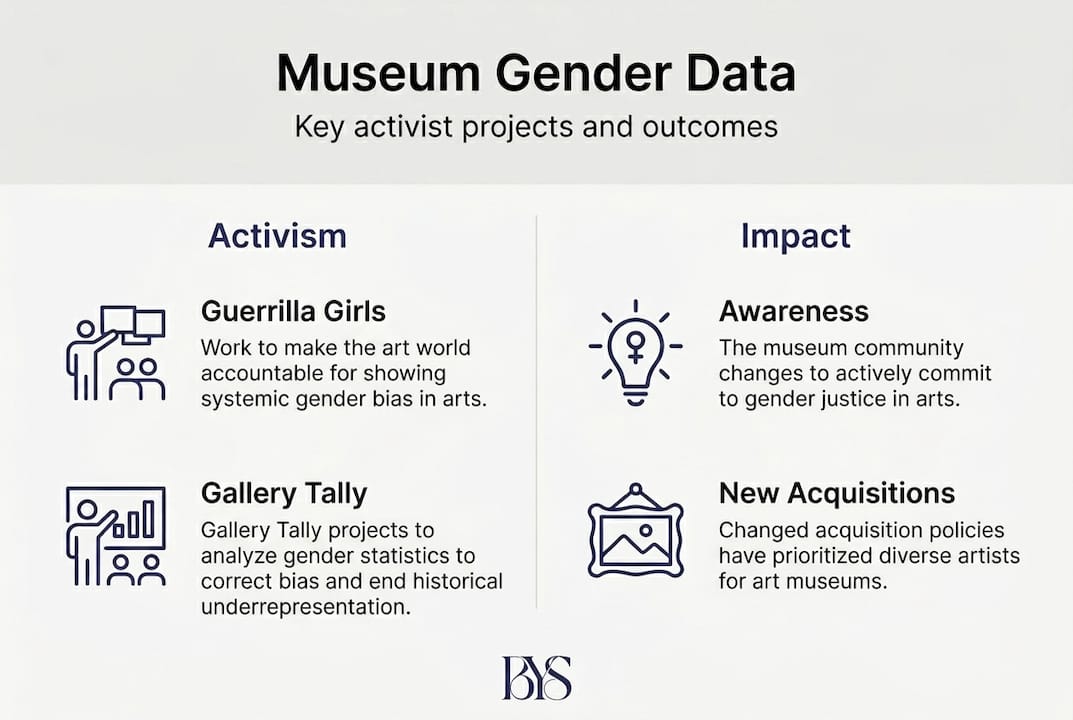
The project’s approach is elegant in its simplicity. Rather than relying on institutions to self-report, it mobilizes community observers. It turns every museum visit into an act of research. And it produces artifacts, the posters, that function as both evidence and art. If you visit an exhibition and notice a Gallery Tally poster on a nearby wall, that poster is telling you something precise: how many women artists are represented in that specific gallery at that specific moment.
Here is how a visitor or advocate can engage with data-driven activism like Gallery Tally:
- Research the gender breakdown of any upcoming exhibition before you attend. Many institutions now publish artist lists online.
- Document your own observations during gallery visits, noting the ratio of works by women to works by men.
- Share your findings on social media using project-specific hashtags to contribute to broader crowd-sourced datasets.
- Compare permanent collection data against traveling exhibitions to see whether the institution treats representation differently depending on context.
- Contact museum education departments to ask whether gender equity data informs their public programming choices.
The Guerrilla Girls operate on a similar philosophy. Their
2025 to 2026 exhibition at the Getty emphasizes that persistence matters as much as rage. For over four decades, the group has used gorilla masks, biting humor, and statistical rigor to document bias at the world’s most prestigious institutions. Seeing their work at a major Los Angeles museum is itself a statement about how far advocacy has moved the needle. It would have been unimaginable thirty years ago.
The role of advocacy in entertainment and arts industries has shifted significantly because groups like these made the numbers impossible to ignore. Data is not neutral, but it is harder to dismiss than anecdote.
Pro Tip: When visiting any major museum, treat the Guerrilla Girls’ historical posters and Gallery Tally materials as primary sources, not just art objects. They document institutional behavior over time and reveal patterns that press releases from the same institutions often obscure.
The table below illustrates how data-driven activism methods compare in approach and reach:
| Method |
Data source |
Output |
Public reach |
| Gallery Tally |
Crowd-sourced visitor counts |
Printed posters, online database |
Local and national |
| Guerrilla Girls |
Published museum statistics |
Art installations, public campaigns |
International |
| Academic research |
Institutional records |
Peer-reviewed studies |
Academic and policy circles |
Current gender representation: Progress and pitfalls
Activism’s visibility eventually pressures institutions to respond. The question is whether that response constitutes genuine structural change or strategic image management.
Recent acquisitions at LACMA signal incremental progress.
Works by women, including Virginia Vezzi’s self-portrait and commissions like Sarah Rosalena’s tapestry, reflect a deliberate effort to diversify the permanent collection. These are meaningful additions. They represent real money directed toward real women artists. And they become part of a collection that will shape how future generations understand the history of art made in and around Los Angeles.
But context matters. New acquisitions can be significant without being sufficient. The persistent gender bias documented in major museums, including LACMA, is evidenced not just by historical exclusions but by current statistics showing women represent only eleven to fourteen percent of major museum collections. One self-portrait and one tapestry commission, no matter how excellent, do not shift that number meaningfully.
Here is where recent progress has been most visible:
- New commissions from women artists in LACMA’s expansion programming.
- Acquisitions committees that now include voices explicitly advocating for underrepresented artists.
- Traveling exhibitions curated specifically to foreground women’s work.
- Increased transparency in some institutions around collection gender breakdowns.
And here is where the gaps remain most stark:
- Permanent collections where women’s work constitutes a small fraction of total holdings.
- Wall space in flagship galleries still skewed heavily toward male artists.
- Auction valuations that systematically undervalue women’s work relative to comparable male-created pieces.
- Curatorial pipelines where women advance into leadership but rarely into the most powerful acquisition roles.
The contrast between leadership and collection data is particularly telling. When
nearly half of museum directors are women, but collections still hover at eleven to fourteen percent female representation, it suggests that leadership gains do not automatically translate into collection equity. Structural inertia is real. Changing who leads an institution does not automatically change a century of acquisition decisions already embedded in stone and canvas on those walls.
Progress is real. It is also insufficient. Both things are true simultaneously, and holding that tension is important for anyone who cares about where the art world goes next.
Legal frameworks and actionable remedies
With clarity on representation trends, the next step is understanding what legal frameworks exist to challenge gender bias in cultural institutions. This matters both for employees inside museums and for artists and contractors who interact with these institutions.
California is among the most protective states in the country for workers facing discrimination. The Fair Employment and Housing Act (FEHA) prohibits discrimination on the basis of sex, gender identity, and gender expression in workplaces with five or more employees. Museums, galleries, and cultural nonprofits are fully covered. FEHA applies to hiring, promotion, compensation, working conditions, and termination.
California equality laws are notably broad in scope compared to federal protections, offering longer filing windows and the ability to recover emotional distress damages alongside economic losses. For employees facing gender discrimination inside a museum context, whether as a curator, educator, conservator, or administrative professional, these protections are directly applicable.
Recent data shows that leadership gains of nearly 48% women directors across major institutions coexist with persistent activism from groups like Guerrilla Girls and Gallery Tally, demonstrating that visibility does not automatically produce equity. This gap between representation at the top and representation on the walls and in the payroll is precisely the kind of structural inconsistency that legal frameworks are designed to address.
If you believe you have experienced gender discrimination in a museum or cultural institution, here are concrete steps to consider:
- Document everything. Keep records of communications, performance reviews, assignment patterns, and any incidents that felt discriminatory. Dates, names, and specifics matter enormously in legal proceedings.
- Report internally through your institution’s human resources or compliance channels. This step is often required before pursuing external legal remedies and creates a paper trail.
- File a complaint with the California Civil Rights Department (formerly DFEH) within three years of the discriminatory act under state law.
- Consult an employment attorney with experience in gender discrimination cases before accepting any settlement or signing any separation agreement.
- Preserve digital communications, including emails and messaging app records, which frequently become critical evidence in discrimination cases.
Pro Tip: California law prohibits retaliation against employees who report discrimination in good faith. If you face adverse employment action after raising concerns, that retaliation may itself constitute a separate legal violation, strengthening your overall claim. Connecting with counsel familiar with
disability discrimination remedies and similar employment law issues can help you understand how intersecting claims are handled.
Understanding your rights is not a sign of aggression toward an institution you may genuinely love. It is a way of holding that institution accountable to the values it publicly espouses.
Why museums’ revisionist efforts aren’t enough
Here is an uncomfortable truth that the art world tends to avoid: acquiring more works by women is not the same as dismantling a biased system. It is the system’s equivalent of a press release. It says something without changing the underlying architecture.
The contrast between activists’ ongoing critique and LACMA’s revisionist acquisition efforts captures this tension precisely. A museum can add Virginia Vezzi to its collection while still running curatorial hiring processes that favor graduates of male-dominated elite networks. It can commission Sarah Rosalena’s tapestry while still paying female conservators less than their male counterparts in comparable roles.
True equity in cultural institutions requires structural overhaul: transparent reporting on collection composition, pay equity audits, publicly accountable acquisition criteria, and sustained investment in underrepresented artists across decades rather than during a single budget cycle. It also requires examining how
disability bias parallels and other intersecting forms of discrimination compound gender inequity inside the same institutions. One group’s exclusion rarely exists in isolation.
Data-backed activism is essential. But it must accompany, not substitute for, genuine institutional transformation.
For those seeking legal support on gender discrimination
If what you have read here resonates with your own experience, you are not alone, and you have options. Gender discrimination in museums, galleries, and other cultural institutions is both a public policy failure and a personal injury. Understanding your
employee discrimination rights is the first step toward protecting your career and your livelihood. Shirazi Law Office works with employees, executives, and professionals across Los Angeles who are navigating exactly these kinds of complex, high-stakes situations. Whether you are facing unequal pay, a hostile work environment, or retaliatory treatment after raising concerns, pursuing
gender discrimination claims with experienced legal counsel can make a decisive difference in your outcome.
Frequently asked questions
What was the main catalyst for gender bias activism around LACMA?
The 1970 LACMA exhibition featuring zero women artists prompted the founding of the Woman’s Building and ignited decades of feminist activism challenging museum bias in Los Angeles.
How did Gallery Tally help raise awareness of gender bias?
Gallery Tally crowd-sourced data on gender ratios in top galleries and published the results in over 400 visually striking posters, turning abstract statistics into undeniable public evidence of women’s underrepresentation.
Has LACMA made any progress in representing women artists recently?
LACMA has acquired works by women, including Virginia Vezzi’s self-portrait and Sarah Rosalena’s commissioned tapestry, but overall collection-wide representation for women artists still lags significantly behind men.
Are legal remedies available for gender discrimination in museums?
Yes, California’s Fair Employment and Housing Act provides strong protections against gender discrimination in cultural institutions, and employees can file complaints with the California Civil Rights Department or pursue claims through an employment attorney.
Recommended