
TL;DR:
- Women make up the majority of the luxury retail workforce but face significant pay gaps and limited leadership opportunities. Industry patterns include subtle bias, exclusion from networks, and retaliation that perpetuate the glass ceiling. Taking proactive steps like documenting incidents, reporting concerns, and seeking legal advice can help protect careers and promote workplace equality.
Women make up the majority of the workforce at iconic luxury brands like Chanel, yet they earn just 81-85% of what their male counterparts take home in Beverly Grove luxury retail jobs. The gap between the polished image of empowerment these brands project and the reality inside their organizations is striking. Beverly Hills may feel like a world apart, but the same patterns of pay disparity, glass ceiling barriers, and blocked advancement that affect luxury fashion globally show up right here. This article examines what the data actually says, how bias operates in practice, and what you can do to protect your career and your rights.
Table of Contents
- The reality of gender bias in Beverly Hills luxury fashion
- How the glass ceiling persists: Bias mechanisms and barriers
- Case studies: Patterns of gender discrimination at major luxury brands
- Practical steps and strategies for confronting gender bias
- Why industry change is slow—and what actually works
- Get support for your workplace rights in Beverly Hills luxury
- Frequently asked questions
Key Takeaways
| Point | Details |
|---|---|
| Leadership gap persists | Women make up the majority workforce but are still vastly underrepresented at leadership levels in Beverly Hills luxury brands. |
| Bias is often subtle | Unconscious bias, exclusion from networks, and hidden pay gaps create ongoing barriers beyond visible discrimination. |
| Legal action is possible | Even without public lawsuits, professionals can report, document, and seek legal advice about gender discrimination issues. |
| Industry change is slow | Superficial diversity programs are not enough; true equity requires deep, ongoing advocacy and reform. |
The reality of gender bias in Beverly Hills luxury fashion
The luxury fashion industry has long traded on images of strong, stylish women. Yet when you look past the marketing, the numbers tell a different story. Industry-wide gender statistics show that women dominate the workforce at brands like Chanel, making up roughly 76% of employees, but their representation drops sharply at the management level, reaching only up to 60% in leadership roles. And across the broader luxury sector, female executives account for just 14% of the total.
Those numbers matter because Beverly Hills is not an exception. The Beverly Grove pay equity data confirms that women in local luxury retail consistently earn less than men performing comparable work. The pay gap is not accidental. It reflects structural patterns that repeat across the industry.
Key disparities at a glance:
- Women make up the majority of the luxury retail workforce but hold a minority of senior roles
- Pay gaps of 15-19% persist even when controlling for role and experience
- Creative director and C-suite positions remain disproportionately male
- Peer brands including Gucci, Armani, and LVMH have all faced discrimination-related litigation
| Brand | Reported issue | Status |
|---|---|---|
| Gucci | Race and sex bias, retaliation | Lawsuit filed |
| Armani | National origin discrimination | Legal action |
| LVMH | Retaliation claims | Litigation |
| Chanel Beverly Hills | Pay gaps, glass ceiling | No major public lawsuit |
The absence of a major public lawsuit at Chanel Beverly Hills does not mean the workplace is free of bias. It often means that wage disputes in luxury retail go unreported, employees fear retaliation, or cases are quietly settled. The pattern across peer brands makes clear this is an industry-wide challenge, not an isolated one.
How the glass ceiling persists: Bias mechanisms and barriers
Understanding why women stall in their careers at luxury brands requires looking at the specific mechanisms that keep barriers in place. It is rarely one dramatic act of discrimination. More often, it is a series of smaller, compounding forces.
The glass ceiling in Beverly Grove is reinforced through several overlapping dynamics:
- Unclear promotion criteria: When advancement standards are vague, decision-makers default to familiarity, which often means promoting people who look and act like them
- Network exclusion: Informal professional networks, client dinners, and after-hours socializing often exclude women, cutting them off from visibility and sponsorship
- Stereotype penalties: Women who are assertive or direct are frequently labeled difficult, while men with the same traits are seen as strong leaders
- Retaliation risks: Employees who raise concerns about pay or promotion inequity often face subtle pushback, reduced responsibilities, or sudden performance critiques
“The industry averages just 14% female executives, and pay rates sit at 81-85% of male peers. These are not outliers. They are the baseline.”
Research on where female creative directors are shows that unconscious bias, exclusion from inner circles, and promotion favoritism are the primary drivers of the leadership gap. The creative director pipeline is especially male-dominated, which shapes the culture of entire organizations from the top down.
Pro Tip: If you notice that promotion decisions at your workplace consistently favor men with similar or lesser qualifications, document specific instances with dates, names, and outcomes. That record becomes critical if you later need to pursue a legal claim.
For professionals who face sudden termination after raising these concerns, understanding wrongful termination in luxury brands is an essential next step. California law provides strong protections, but you need to act quickly and strategically.
Case studies: Patterns of gender discrimination at major luxury brands
Real-world legal cases reveal how gender bias actually plays out inside luxury organizations. While Chanel Beverly Hills has no major public discrimination lawsuits on record, the cases filed against peer brands show clear and repeating patterns.
Gucci faced allegations of race and sex bias combined with retaliation against an employee who spoke up. Armani faced claims tied to national origin discrimination. LVMH dealt with retaliation lawsuits from employees who challenged internal practices. These are not fringe cases. They reflect women’s leadership challenges that run across the entire luxury sector.
What these cases have in common:
- The initial complaint was about pay or promotion inequality
- After the complaint, the employee experienced a shift in treatment
- Retaliation took subtle forms such as reduced hours, reassignment, or negative reviews
- Legal action followed only after internal remedies failed
- Settlements or verdicts often included non-disclosure agreements
| Pattern | Frequency in luxury sector |
|---|---|
| Pay disparity claims | Very common |
| Retaliation after complaint | Common |
| Advancement blockage | Common |
| Public trial outcome | Rare |
The absence of public lawsuits at a specific location does not mean discrimination is absent. It often means employees don’t know their rights or fear the consequences of speaking up.
The wrongful termination risks in Beverly Hills are real, and the local pay equity challenges documented across the area confirm that these dynamics are not theoretical. If you recognize any of these patterns in your own workplace, that recognition is the first step toward protecting yourself.
Practical steps and strategies for confronting gender bias
Knowing the risks is one thing. Knowing what to do about them is another. Here is a clear, actionable framework for professionals in Beverly Hills luxury workplaces.
Step 1: Recognize the signs
Bias is not always loud. Subtle forms of bias and retaliation can be as damaging as overt discrimination. Watch for:
- Being passed over for promotions despite strong performance
- Receiving lower pay than male peers in equivalent roles
- Being excluded from key meetings, client events, or decision-making conversations
- Receiving vague or shifting feedback after raising a concern
Step 2: Document everything
Start a private log immediately. Record dates, times, names, and what was said or done. Save emails and written communications. Note who was present. This documentation is your foundation if you need to escalate.
Step 3: Use internal channels strategically
Report concerns to HR in writing when possible. Keep copies of everything you submit. Internal reporting creates a formal record and is often required before pursuing external legal remedies.
Step 4: Build and use your professional network
Connect with other women in your industry and in Beverly Hills professional circles. Peer support provides both emotional grounding and practical intelligence about how others have navigated similar situations.
Step 5: Seek legal advice early
You don’t need to wait for a crisis. Know your rights in Beverly Grove before you need them. An employment attorney can help you assess your situation, understand your options, and decide the best path forward.
Pro Tip: California has some of the strongest employee protections in the country. Even if your employer is a global luxury brand, California law applies to your workplace. Don’t assume your employer’s size or prestige puts them above the law.
Why industry change is slow—and what actually works
Luxury brands are skilled at marketing empowerment. They feature women prominently in campaigns, celebrate female icons, and issue statements about equality. But the C-suite and creative director ranks remain stubbornly male-dominated. That gap between messaging and reality is not accidental.
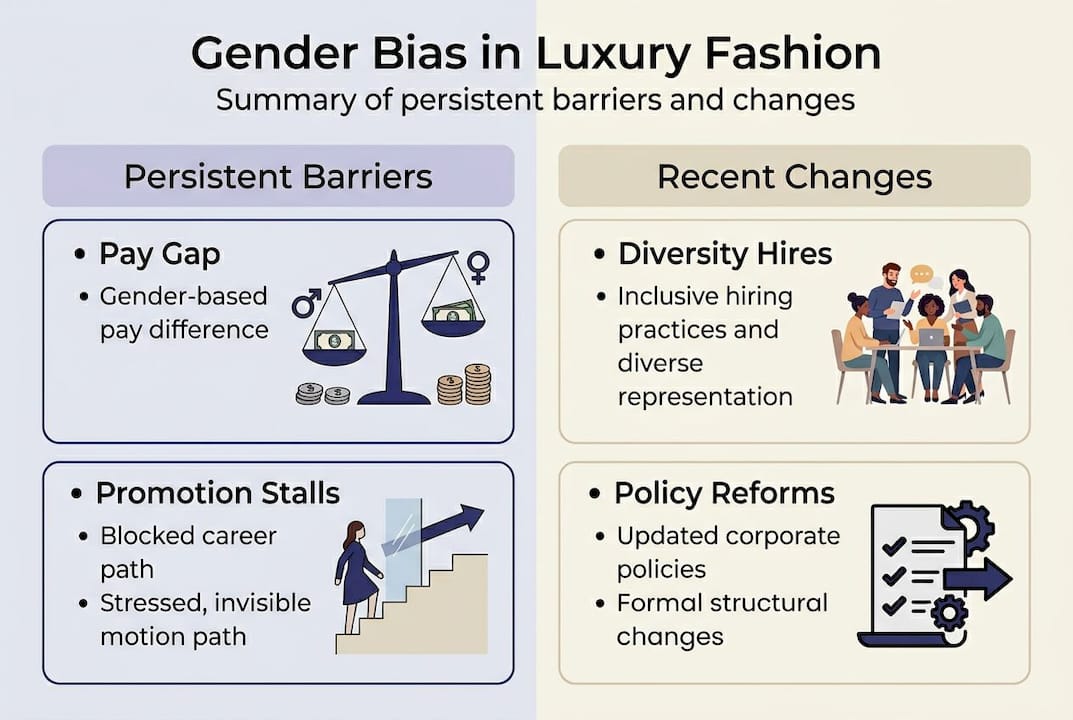
From our experience working with professionals in Beverly Hills and across Los Angeles, real change does not come from diversity statements. It comes from transparent promotion criteria that remove subjective judgment, structured mentorship programs that give women access to the same sponsorship men receive informally, and genuine consequences when bias is documented and confirmed. Without accountability, policies are just paperwork.
The unspoken norms in exclusive luxury circles are particularly resistant to change. When relationships, taste, and personal chemistry drive advancement decisions, bias hides in plain sight. It gets labeled as “fit” or “culture” rather than what it actually is.
Progress is happening, but slowly. The professionals who move it forward are the ones who document, report, advocate, and when necessary, seek outside legal support. Individual action, backed by strong California employment law, is still the most reliable engine of change.
Get support for your workplace rights in Beverly Hills luxury
If you are a professional or executive in Beverly Hills facing gender bias, pay inequity, or blocked advancement at a luxury brand, you do not have to navigate this alone. Shirazi Law Office focuses exclusively on employment law for individuals like you, combining deep knowledge of California law with a personal, determined approach to every case. Whether you are dealing with a pay gap, a denied promotion, retaliation, or wrongful termination, speaking with an experienced gender discrimination lawyer in LA can clarify your options quickly. Explore your employee rights resources or get wrongful termination advice tailored to executives and senior professionals. Your career and your story deserve real advocacy.
Frequently asked questions
How common is gender bias at luxury brands in Beverly Hills?
Gender bias is well documented across the luxury sector, with women earning 81-85% of men’s pay and holding far fewer leadership roles. At brands like Chanel, 76% of employees are women, but management representation lags significantly, and public lawsuits at the Beverly Hills location specifically are rare.
What are the key signs of gender discrimination in luxury workplaces?
The most common indicators include pay gaps, stalled promotions despite strong performance, exclusion from professional networks or key meetings, and retaliation after raising concerns. These patterns of bias and exclusion are often subtle but systemic and legally actionable under California law.
Can I report gender bias even if there is no obvious lawsuit or public case?
Absolutely. The absence of public lawsuits at a specific location does not mean discrimination is absent or that your experience is not actionable. You can document and report bias at any stage, and California law protects you from retaliation for doing so.
What can professionals do if they encounter glass ceiling barriers?
Start by documenting every incident with specifics, then use internal HR channels in writing, and consult an employment attorney early. Practical steps including documentation and legal guidance are your strongest tools for challenging glass ceiling barriers in any luxury workplace.
Recommended
- Beverly Hills Wage Disputes in Luxury Retail Stores – Law Office of Brian Y. Shirazi, PC
- Disability Discrimination In Beverly Hills Luxury Hotels – Law Office of Brian Y. Shirazi, PC
- Gender Discrimination In West Hollywood’s Entertainment Industry – Law Office of Brian Y. Shirazi, PC
- Beverly Grove Gender Discrimination: 81% Pay Equity Challenge – Law Office of Brian Y. Shirazi, PC
- Aspirational shopping: how to access luxury fashion smartly