
TL;DR:
- Workplace defamation requires proving false statements shared with third parties causing harm.
- Privileged internal statements during HR processes are generally protected and not actionable.
- Most defamation claims in LA real estate fail due to privilege defenses and difficulty proving damages.
Imagine building a decade-long career in Downtown Los Angeles real estate, only to watch it unravel because of false statements circulating through your brokerage. That scenario is not hypothetical. A Los Angeles County Superior Court lawsuit filed in early 2026 alleges that Douglas Elliman withheld over $300,000 in commissions while a “toxic corporate culture” threatened a top agent’s professional standing. This guide unpacks what legally qualifies as workplace defamation, the significant hurdles you face proving it, and the practical steps you can take to protect your reputation in one of the most competitive real estate markets in the country.
Table of Contents
- Understanding workplace defamation in Downtown LA real estate
- How defamation claims intersect with employment actions
- Proving workplace defamation: legal standards and hurdles
- Strategies for protecting your professional reputation
- Why most Downtown LA real estate defamation claims fail (what attorneys see up close)
- Get expert support for your Downtown LA workplace defamation case
- Frequently asked questions
Key Takeaways
| Point | Details |
|---|---|
| Defamation risks are high | Downtown LA real estate professionals must be vigilant because reputational harm can quickly impact careers and commissions. |
| Legal requirements are strict | California courts require proof of falsity, unprivileged publication, and distinct reputational damage for workplace defamation claims. |
| Timing and context matter | Statements during HR or termination actions are often privileged, making many claims hard to win. |
| Prevention is key | Documenting issues, seeking legal advice early, and maintaining professionalism can help protect your reputation. |
Understanding workplace defamation in Downtown LA real estate
With that real case in mind, let’s break down what workplace defamation actually means for Downtown LA real estate professionals.
Workplace defamation is not simply someone saying something unkind about you at the office. It is a specific legal claim with precise requirements. Under California law, you must establish that someone made a false statement of fact about you, that it was shared with at least one other person, that the communication was not legally privileged, and that it caused real harm to your reputation, business, or career. These are not easy boxes to check, and understanding the workplace defamation basics is the first step toward knowing whether you have a viable claim.
Downtown LA real estate amplifies every one of these risks. Agents, brokers, and executives operate in a high-visibility environment where reputation is currency. A single false statement about your ethics, your sales record, or your client relationships can ripple through a tight-knit professional network with devastating speed. Deals collapse. Referrals dry up. Clients quietly move to competitors. The financial consequences can be enormous, especially when your income depends on commissions rather than a fixed salary.
The industry’s social dynamics make things worse. Real estate in Downtown LA runs on relationships, and those relationships are constantly tested by competition for listings, commissions, and market share. When disputes arise, false statements often travel through informal channels: whisper networks, group chats, shared offices, and industry events. Tracking exactly who said what, when, and to whom becomes genuinely difficult, which matters enormously when you try to build a legal case.
California Civil Jury Instruction (CACI) 1700 requires a plaintiff to prove: (1) the defendant made a statement of fact about the plaintiff; (2) the statement was false; (3) the defendant communicated it to a third party; (4) the communication was unprivileged; and (5) the statement harmed the plaintiff’s reputation, business, or occupation. Each element must be established by a preponderance of the evidence.
Statements that can be defamatory in a real estate workplace context include:
- False claims that you misappropriated client funds or commissions
- Fabricated accusations of professional misconduct or license violations
- Untrue statements that you breached fiduciary duties to clients
- False characterizations of your sales performance or deal history
- Invented claims that you created a hostile environment for colleagues
- Misleading statements to clients designed to redirect listings away from you
Reviewing recent employment verdicts in Downtown LA makes clear that courts take these claims seriously when the evidence is there. The problem is that the evidence standard is demanding, and many claims stumble before they ever reach a jury.

How defamation claims intersect with employment actions
Now that we understand the basics, it’s crucial to know how defamation claims can get derailed or dismissed by how and when reputational statements surface during employment disputes.
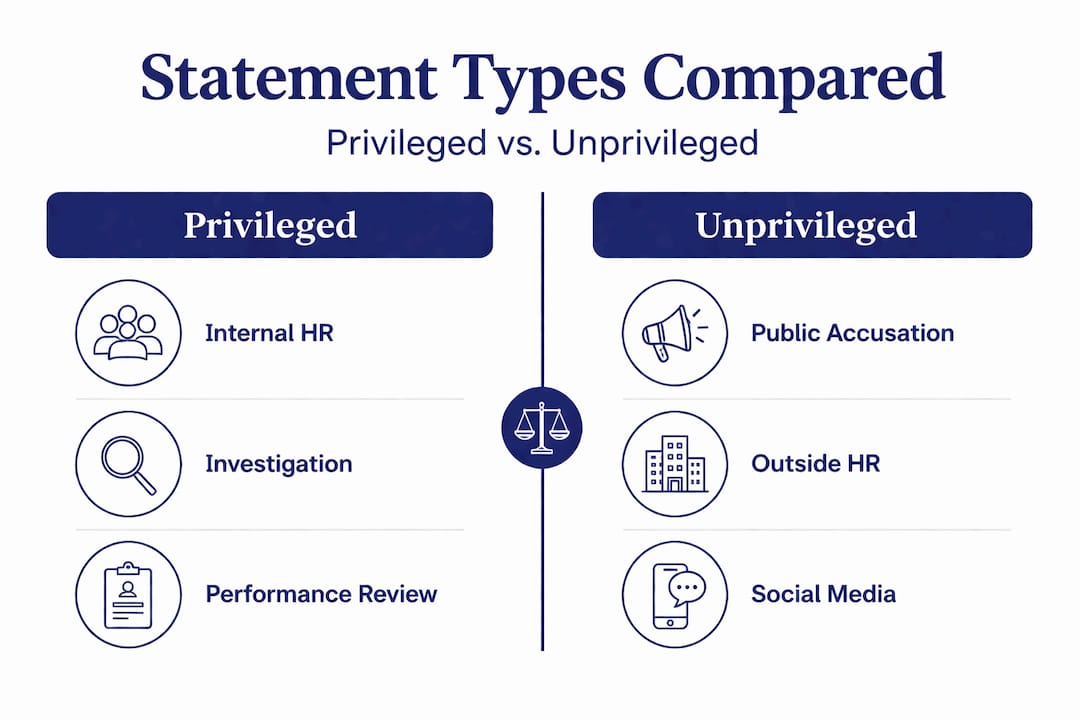
One of the most common traps for real estate professionals is conflating defamation with wrongful termination. These are separate legal theories, and courts treat them very differently. When a manager makes a false statement during a termination meeting, during an HR investigation, or in an internal performance review, that statement may be shielded by what California law calls a “qualified privilege.” The privilege exists because employers need some breathing room to conduct internal investigations and make employment decisions without every critical comment becoming a lawsuit.
The critical distinction is between statements made within an internal HR or termination process and statements made outside that process to third parties who have no legitimate business need for the information. A supervisor telling HR that you “stole commissions” during a disciplinary meeting is very different from that same supervisor repeating the claim to your clients, a competing brokerage, or an industry association.
Courts have also drawn a sharp line around damages. The Hearn v. PG&E analysis illustrates a key California appellate limitation: when the alleged defamatory statements are part of the same termination process and the damages sought are essentially tied to the job loss itself, a separate defamation damages theory may fail entirely. You cannot simply repackage your wrongful termination damages as defamation damages and expect a different result.
Privileged vs. unprivileged statements: a comparison
| Statement type | Example | Privileged? | Actionable? |
|---|---|---|---|
| Internal HR investigation note | Manager writes “agent falsified sales data” in a disciplinary file | Likely yes | Probably not |
| Termination letter to employee | “We are letting you go for misconduct” | Likely yes | Probably not |
| Statement to a client | “We fired her for stealing commissions” | No | Yes |
| Statement to a competing brokerage | “He was fired for ethics violations” | No | Yes |
| Reference call to a future employer | False statements about performance | Qualified privilege applies | Depends on malice |
| Social media post by a manager | False professional misconduct claim | No | Yes |
Understanding where your situation falls on this spectrum is essential before you invest in litigation.
Here is the typical sequence of events in an HR or termination process that affects how defamation claims are evaluated:
- A workplace dispute or complaint arises, often tied to commissions, client relationships, or performance.
- HR opens an internal investigation and interviews witnesses.
- Management makes statements during the investigation process.
- A termination decision is made and communicated to the employee.
- Post-termination, statements may be made to clients, colleagues, or outside parties.
- The employee discovers the statements and consults an attorney.
Steps 1 through 4 are heavily privileged territory. Steps 5 and 6 are where genuine defamation claims often live, and understanding the distinction between defamation versus HR complaints is where your legal strategy begins to take shape.
Pro Tip: Document every statement you hear about yourself, including who made it, who was present, the date, and the setting. A statement made to a client over lunch carries very different legal weight than the same statement made in a closed HR meeting.
Proving workplace defamation: legal standards and hurdles
These nuances make the process tricky. So what does it actually take, evidence-wise, to win a workplace defamation case in Downtown LA?
The elements needed to prove defamation under California law are demanding, and courts do not give plaintiffs the benefit of the doubt. You must prove each element with sufficient evidence, and in cases involving public figures or matters of public concern, the standard rises to “clear and convincing” evidence of actual malice.
Evidentiary requirements for each element
| Element | What you must prove | Real-world example |
|---|---|---|
| Publication | The statement was shared with at least one third party | A broker emails a client group falsely accusing you of fraud |
| Reference to plaintiff | The statement was clearly about you | Your name, photo, or identifying details were included |
| Defamatory meaning | The statement would harm your reputation in the community | Accusing you of license violations or financial misconduct |
| Falsity | The statement was factually false, not just unflattering | You have records proving the commission was legitimately earned |
| Lack of privilege | The communication was not protected by qualified privilege | The statement was made to an outside party, not in an HR process |
| Harm | You suffered actual reputational or financial damage | Lost clients, lost listings, lost referrals you can document |
California’s proof requirements under CACI 1700 are applied strictly. Courts do not assume harm. You must show it with real evidence, which in a commission-based industry means documenting the specific business you lost and connecting that loss to the false statement.
Common hurdles that cause workplace defamation claims to fail include:
- Privilege protection: Most internal HR and management communications are shielded, even if they contain false information.
- Insufficient publication: If the statement was only heard by one person who was directly involved in the employment decision, courts may find it was not truly “published.”
- Inability to prove falsity: Opinions, even harsh ones, are not defamatory. “She was a poor performer” is an opinion. “She stole $50,000 from a client” is a factual claim that can be proven true or false.
- Overlap with termination damages: If your financial losses all flow from being fired, courts may refuse to award separate defamation damages.
- Statute of limitations: California’s one-year statute of limitations for defamation is strict. Missing it ends your claim entirely.
Strategies for protecting your professional reputation
Knowing what you’re up against, here’s how you can proactively protect your reputation and respond if you’re facing harmful statements.
The Ernie Carswell lawsuit describes a “descent into toxicity” and an “unstable and hostile” environment that affected a top agent’s professional standing. That kind of environment rarely appears overnight. It builds gradually, which means you often have time to take protective steps before the damage becomes irreversible.
If you believe you are being targeted by defamatory statements, take these steps immediately:
- Write everything down. Record every statement you hear, with dates, witnesses, and the context in which it was made. Your memory will fade; written records will not.
- Preserve all communications. Save emails, texts, voicemails, and any written materials that reference the statements. Do not delete anything, even if it seems unimportant.
- Avoid retaliation. Do not respond to false statements with your own aggressive claims. Retaliation can undermine your legal position and give the other side ammunition.
- Identify witnesses. Who else heard the statements? Colleagues, clients, or vendors who witnessed the false claims may be critical to your case.
- Consult an employment attorney early. California’s one-year statute of limitations means delay is dangerous. An attorney can assess whether the statements are actionable and what evidence you need to preserve.
- Request your personnel file. California law gives you the right to review your own file. It may contain written statements that form the basis of your claim.
Proactive prevention is equally important. Before any dispute arises, you can reduce your vulnerability by taking these steps:
- Maintain a professional tone in all written communications, especially during commission disputes or client disagreements.
- When you disagree with a factual claim made about you in writing, respond in writing with a calm, factual correction and keep a copy.
- Use neutral, precise language in any dispute-related correspondence. Emotional language can be taken out of context.
- Build and document your professional relationships so that your reputation has a strong foundation that can withstand attack.
- Know your reporting misconduct protections under California law, because retaliation for reporting workplace misconduct is itself a separate legal claim.
Pro Tip: Seek legal advice before you make any formal complaint or take any action that could be characterized as escalating a dispute. Many defamation claims derail because the plaintiff inadvertently created a paper trail that weakened their own position.
Why most Downtown LA real estate defamation claims fail (what attorneys see up close)
Here is the uncomfortable truth that most generic legal articles skip over: the majority of workplace defamation claims filed by real estate professionals in Downtown LA do not result in meaningful recovery. That is not a reason to give up. It is a reason to go in with clear eyes.
From the litigation trenches, the pattern is consistent. A professional suffers real reputational harm, consults an attorney, and believes they have an airtight case. Then the legal analysis begins. The most damaging statements turn out to have been made during an HR investigation, which means they are likely privileged. The financial losses are real, but they are almost entirely traceable to the termination itself, not to a distinct reputational injury. The one statement that was made outside the HR process was made to a single person who is now unavailable to testify.
Empirically grounded benchmarks specifically for Downtown LA real estate defamation claims are scarce in published case law. What we do have is a clear framework from CACI and appellate decisions that shows just how narrow the path to recovery actually is. Courts apply these standards rigorously. Juries are skeptical of claims that look like employment disputes repackaged as defamation.
The most important thing a skilled attorney does in these cases is separate the genuine career damage from the HR process fallout. If your reputation was harmed by statements made outside any privileged context, to clients, to industry peers, or to the public, that is where your claim lives. Everything else is noise that can actually hurt your case by making it look like you are trying to recover twice for the same wrong.
Reviewing employee rights lessons from other LA cases shows that the professionals who recover meaningful damages are those who can draw a clean line between what was said, where it was said, who heard it, and what specific harm followed directly from it. That kind of surgical precision requires experienced counsel and early intervention.
Get expert support for your Downtown LA workplace defamation case
If you are a real estate professional in Downtown Los Angeles facing false statements that are damaging your career, your reputation, and your livelihood, you do not have to navigate this alone. Shirazi Law Office provides focused, strategic representation for employees and executives facing workplace defamation counsel in Los Angeles and complex employment disputes. Brian Y. Shirazi works directly with each client to assess whether statements are actionable, what evidence needs to be preserved, and how to build the strongest possible case. Whether you need guidance on how to navigate employee rights and discrimination laws or you are ready to pursue a claim, the firm offers confidential consultations tailored to your specific situation. Reach out today and protect what you have worked to build.
Frequently asked questions
What counts as workplace defamation in a Downtown LA real estate firm?
It is a false statement of fact made by someone at your workplace that damages your professional reputation, is shared with at least one other person, and is not protected by legal privilege, as defined by California’s CACI 1700 requirements.
Can I sue for defamation if the statements happened during my firing or investigation?
You can file a claim, but courts frequently treat those statements as privileged or fold the damages into the termination claim, which is a key limitation illustrated by the Hearn v. PG&E ruling.
What evidence do I need to prove workplace defamation?
You need documented proof of a specific false statement, who made it, who received it, how it caused distinct harm to your reputation or business, and that the communication was not legally privileged under California’s defamation standards.
If I win a workplace defamation lawsuit, what damages can I recover?
Recovery is limited to losses that flow directly from the reputational harm itself, not losses that duplicate what you would recover for wrongful termination, a boundary the Hearn v. PG&E decision enforces strictly.
Are there special rules for Downtown LA real estate defamation cases?
The core legal rules are statewide, but the commission-driven, relationship-dependent nature of Downtown LA real estate means that false statements spread faster and cause more measurable financial harm, as illustrated by the Ernie Carswell lawsuit alleging a toxic environment that damaged a top agent’s professional standing.
Recommended
- Workplace Defamation in LA | LA Employment Lawyer
- Workplace Defamation Claims Impacting Beverly Hills Careers – Law Office of Brian Y. Shirazi, PC
- Workplace defamation after HR complaints Beverly Grove 2026 – Law Office of Brian Y. Shirazi, PC
- Workplace Defamation In Miracle Mile Museums: Employee Rights – Law Office of Brian Y. Shirazi, PC
- Justice Shield Law | California Employment Lawyers — Free Consultation