

TL;DR:
- Wage and hour violations are common in Los Angeles creative industries, often hidden and damaging.
- California law requires written contracts for freelancers over $250 and prohibits misclassification of workers.
- Proactive legal compliance helps protect creatives from costly disputes and potential legal penalties.
Wage and hour violations are quietly widespread across Los Angeles creative industries, and Carthay’s studios are no exception. No major lawsuits have surfaced in this neighborhood specifically, but that silence does not mean creatives are safe. The risks are real, subtle, and financially damaging. Whether you work as a freelance illustrator, an in-house video editor, or a production coordinator, California labor law applies to you fully. This guide breaks down the most common violations, the laws that protect you, and the steps you can take right now to protect your livelihood before a dispute ever begins.
Table of Contents
- Why Carthay’s creative studios face hidden wage and hour risks
- The California Freelancer Protection Act: How it impacts creative studios
- Employee vs contractor: The ABC Test and common misclassification pitfalls
- Unique scenarios: On-call time, unpaid duties, and expense pitfalls
- Why proactive compliance beats waiting for a lawsuit
- Find legal support for Carthay wage and hour disputes
- Frequently asked questions
Key Takeaways
| Point | Details |
|---|---|
| Carthay lawsuits rare | No big lawsuits exist, but the same California laws protect Carthay creatives as elsewhere in LA. |
| Freelancers need contracts | Written contracts are required for most freelance projects over $250 and protect against payment disputes. |
| Employee status matters | Misclassification can lead to missed wages and legal problems—always check your category and keep records. |
| Proactive compliance pays | Studios and workers who track time, payments, and compliance avoid costly legal issues. |
| Legal help is available | Specialized employment lawyers support creative professionals with wage and hour challenges. |
Why Carthay’s creative studios face hidden wage and hour risks
The absence of publicized lawsuits in a neighborhood does not mean labor law violations are not happening. California’s wage and hour statutes apply to every employer, from a Fortune 500 production company to a boutique design firm on a quiet Carthay side street. As confirmed by local legal analysis, no specific wage and hour cases have been filed against Carthay creative studios, yet California’s laws apply uniformly regardless of lawsuit history.
So what kinds of violations should you watch for? The most common ones in LA’s creative sector include unpaid overtime, off-the-clock work demands, late or missing freelance payments, and worker misclassification. Misclassification, in particular, is a growing problem. LA wage and hour violations show a consistent pattern: studios label workers as independent contractors to avoid paying benefits, overtime, and payroll taxes.
The numbers paint a clear picture. More than one in three Hollywood freelancers have experienced wage theft at some point in their career. That is not a minor statistic. It reflects an industry-wide culture where cutting corners on pay is normalized and rarely challenged.
Five categories of workers face the greatest exposure:
- Freelance designers, animators, and editors working project-to-project without written contracts
- Non-union crew members who lack collective bargaining protections
- Day laborers on short-term studio shoots
- Part-time or seasonal creatives who are classified as contractors despite working fixed schedules
- Junior staff who accept unpaid or underpaid trial periods
“California labor laws do not distinguish between a major Hollywood studio and a small Carthay creative agency. If you perform work, you are entitled to be paid correctly, on time, every time.”
You can see how these patterns repeat across the industry in documented wage disputes at Amazon Studios, where even large employers faced scrutiny for similar practices. The takeaway is straightforward: your employer’s size and your neighborhood’s lawsuit history have nothing to do with whether you are protected under California law.
The California Freelancer Protection Act: How it impacts creative studios
California took a significant step to protect gig and project-based workers with specific freelancer legislation. The California Freelance Worker Protection Act requires written contracts for any freelance engagement valued at $250 or more, mandates payment within 30 days of project completion, and makes retaliation for asserting those rights illegal.
This law matters enormously for Carthay’s creative professionals. Many studios and agencies still operate informally, relying on verbal agreements or vague email threads. Under the Act, that is not good enough. If your project exceeds $250 and there is no written contract, your studio could face penalties even before a payment dispute arises.
Here is a quick summary of what the law requires:
| Requirement | Details |
|---|---|
| Written contract | Mandatory for work valued at $250 or more |
| Payment deadline | Within 30 days of completing the contracted work |
| Retaliation protection | Employers cannot punish you for invoking your rights |
| Penalties for violation | Double damages plus attorney’s fees for retaliation |
If you are a studio manager or creative director, compliance is not optional. Here are the steps you need to follow for every freelance engagement:
- Draft a written contract before work begins, naming deliverables, timeline, and payment amount.
- Set a calendar reminder to process payment within 30 days of project delivery.
- Never threaten, demote, or drop a freelancer because they asked about payment or filed a complaint.
- Keep all project correspondence and invoices organized for at least four years.
- Train your team on what constitutes retaliation so no one unknowingly crosses a legal line.
Pro Tip: Save every email, text, and invoice related to a project in a dedicated folder. If a payment dispute arises, your documentation is your strongest asset. Courts and agencies resolve disputes faster when the paper trail is clear.
Employee vs contractor: The ABC Test and common misclassification pitfalls
One of the most consequential legal questions for any creative professional in Carthay is whether you are actually an employee or a contractor. California uses a strict standard called the ABC Test under AB5 and the Dynamex decision to answer that question. Employers must satisfy all three elements to lawfully classify someone as an independent contractor.
Here is how the ABC Test works in practice:
| ABC Test element | What it means |
|---|---|
| A: Free from control | The worker operates without direction from the hiring company |
| B: Outside usual business | The work performed is outside the company’s core business activity |
| C: Independent trade | The worker is customarily engaged in an independent business or trade |
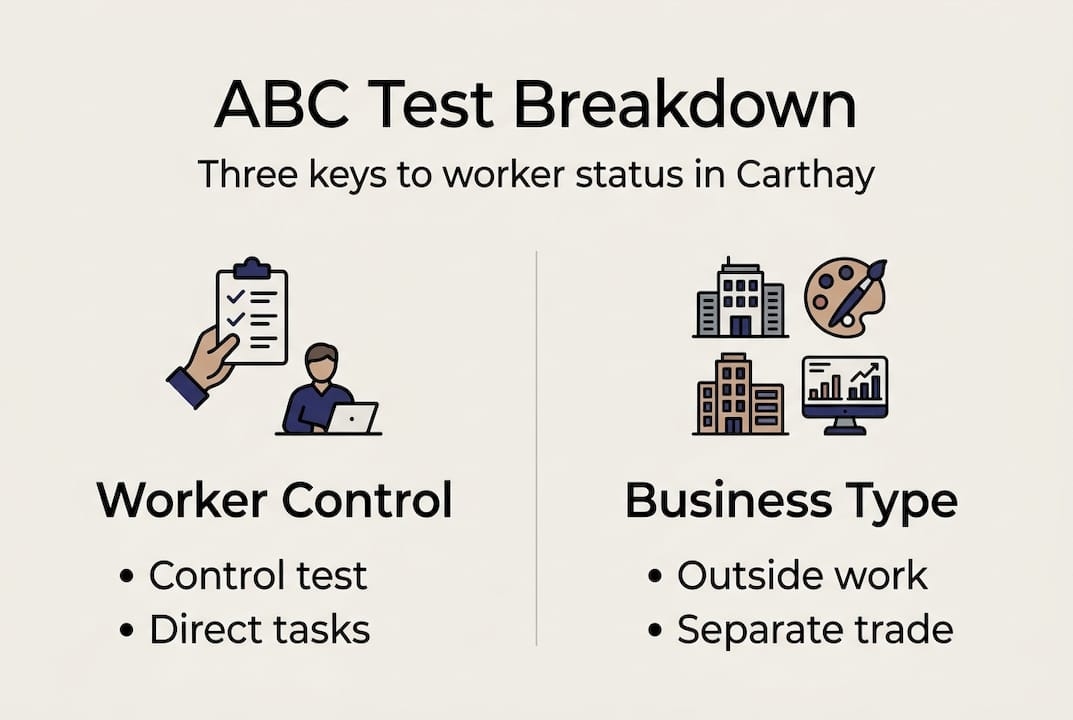
Failing even one element means the worker is legally an employee, regardless of what a contract says. Many creative studios in LA routinely fail element B. A studio that hires a video editor to produce content for its clients cannot argue that editing is outside its usual business.
The consequences of misclassification are serious:
- Back pay for overtime hours that were never compensated
- Unpaid benefits including health coverage and paid leave
- Tax penalties for both the worker and the employer
- Class action exposure when multiple workers share the same misclassification pattern
- PAGA penalties, which allow workers to sue on behalf of the state for each violation
Misclassification in creative work is one of the most litigated wage issues in California. You can review detailed analysis of how it plays out in entertainment in discussions about LA wage and hour disputes.
Pro Tip: Before you sign any contractor agreement, ask your employer directly whether you will have control over your schedule, tools, and methods. If the honest answer is no, you may already qualify as an employee under California law.
Unique scenarios: On-call time, unpaid duties, and expense pitfalls
Beyond contracts and classification, there are less obvious situations where your compensation could quietly disappear. These are the gray areas that studios often exploit, knowingly or not, and where creative professionals leave money on the table without realizing it.

On-call and standby time is one of the most misunderstood issues. If a studio requires you to remain available during specific hours and restricts your freedom to do other things, that time may be compensable under California law. Warner Bros. studio operations faced accusations of widespread labor violations that included exactly this scenario: workers on standby who were never paid for hours they were effectively controlled by the employer.
Other hidden violations that affect creative professionals include:
- Off-the-clock work: Answering emails, attending pre-production calls, or reviewing scripts before your official shift begins
- Pre and post-shift duties: Setting up equipment, running safety checks, or organizing files after your scheduled time ends
- Unreimbursed expenses: Purchasing software, equipment, or supplies out of pocket without reimbursement when the work required it
- Missed meal and rest breaks: California mandates a 30-minute meal break for shifts over five hours and a 10-minute rest break for every four hours worked
- Uniform or costume costs: Requiring workers to buy branded or specialized clothing without compensation
“Studios often assume that creative professionals, especially senior ones, will absorb small financial inconveniences without complaint. But the law does not have a minimum threshold for these violations. Every dollar matters.”
If you have dealt with any of these situations, understanding your rights around unpaid overtime issues is an important first step. Looking at LA wage and hour case examples from other industries also illustrates how broadly these patterns appear and how successfully workers have recovered damages.
Why proactive compliance beats waiting for a lawsuit
Here is the uncomfortable truth most creative professionals in Carthay do not want to hear: the best time to act on a wage and hour issue is before it becomes a formal dispute. Waiting for a lawsuit to motivate change is far more costly than building habits of compliance from the start.
We have seen studios face class actions and PAGA penalties that dwarfed what proactive workplace compliance would have cost them. Audits, accurate timekeeping systems, and honest ABC Test adherence are not bureaucratic burdens. They are financial self-defense. For creative professionals, this means keeping records even when no dispute is visible on the horizon. Your timesheet from three years ago may be the critical piece of evidence in a future claim.
LA’s entertainment sector is under increasing scrutiny from California’s Labor Commissioner and private plaintiff attorneys. Violations that trigger PAGA penalties do not require a single large incident. A pattern of small, repeated payroll errors can expose a studio to massive liability. Silence in your neighborhood today does not guarantee silence tomorrow. The creatives who protect themselves now are the ones who stay in control of their careers.
Find legal support for Carthay wage and hour disputes
If any of these scenarios feel familiar, you do not have to figure this out alone. Shirazi Law Office works with creative professionals throughout Los Angeles, including the Carthay area, to resolve wage and hour disputes before they spiral. Whether you are dealing with misclassification, missed payments, or off-the-clock demands, getting advice from a skilled employment law expert early makes a real difference. Brian Y. Shirazi offers personalized, focused attention to every case, because your situation is not just a legal matter. It is your career and your income. Reach out today to learn more about your employee rights and how California law can work in your favor.
Frequently asked questions
Are there special wage and hour laws for creative studios in Carthay?
No, Carthay studios follow the same California wage and hour laws as every other workplace. As local legal sources confirm, the absence of publicized local cases does not create any exceptions.
What counts as wage theft in a creative studio?
Wage theft includes unpaid overtime, late payments, off-the-clock work demands, and denied rest breaks. More than one in three Hollywood freelancers have experienced at least one of these violations.
What proof should I keep if I suspect a wage dispute?
Save written contracts, invoices, emails, and timesheets as soon as you sense a problem. Meticulous documentation of communications and payment records is the foundation of a strong wage claim.
Am I an employee or a contractor in a creative studio job?
California’s ABC Test under AB5 uses three strict criteria, and most freelancers who work under studio direction and within its core business actually qualify as employees under the law.
Who can help me with a wage and hour dispute in Carthay?
A seasoned employment lawyer with experience in California’s creative industry is your best resource for evaluating your specific situation and pursuing the right legal strategy.
Recommended
- Seasoned Employment Lawyer in Carthay
- Wage and Hour Violations in Downtown LA Workplaces
- Culver City Wage Disputes: Amazon Studios, HBO Rights – Law Office of Brian Y. Shirazi, PC
- Wage and Hour Disputes in LA | LA Employment Lawyer
- Chevron wage dispute rights: Bakersfield workers’ guide | Justice Shield Law