TL;DR:
- Many Downtown LA workers are unlawfully denied legally required meal and rest breaks, leading to wage violations. California law mandates specific paid and unpaid break periods for non-exempt employees, with penalties for violations that include premium pay and wage statement penalties. Enforcing these rights protects workers’ health, dignity, and financial compensation, and immediate action is essential for recovery.
Thousands of employees across Downtown Los Angeles work through their lunch hour, skip their afternoon break, or get pulled back to the register before their mandated rest is over. This is not just an inconvenience. It is, in many cases, a violation of California law. Whether you work in a high-rise office, a restaurant, a retail shop, or a warehouse in the heart of LA, the law protects your right to take meal and rest breaks. Understanding exactly what those rights are and what to do when an employer ignores them could mean real money and better working conditions for you.
Table of Contents
Key Takeaways
| Point |
Details |
| Break rights are protected |
Downtown LA workers are entitled to specific meal and rest breaks under California law. |
| Violations have real consequences |
Employees may receive premium pay and employers face penalties for each day required breaks are missed. |
| Waivers are limited |
Meal break waivers are only valid under strict conditions and must not be coerced. |
| Record-keeping helps claims |
Documenting missed breaks and communications can strengthen any legal action you pursue. |
| Legal support is available |
Expert guidance is available to help protect your rights and secure owed compensation. |
Understanding California’s meal and rest break laws
California has some of the strongest worker protections in the country. When it comes to breaks, the rules are clear and specific. Every employee who qualifies as “non-exempt” under the law is entitled to both meal periods and rest periods during their shift.
What is a non-exempt employee? Simply put, a non-exempt employee is someone who is covered by California’s wage and hour laws. This generally includes hourly workers and salaried employees who earn less than twice the state minimum wage and do not meet the legal tests for an exemption based on their job duties. Most workers in retail, food service, hospitality, healthcare support, office administration, and similar Downtown LA industries are non-exempt.
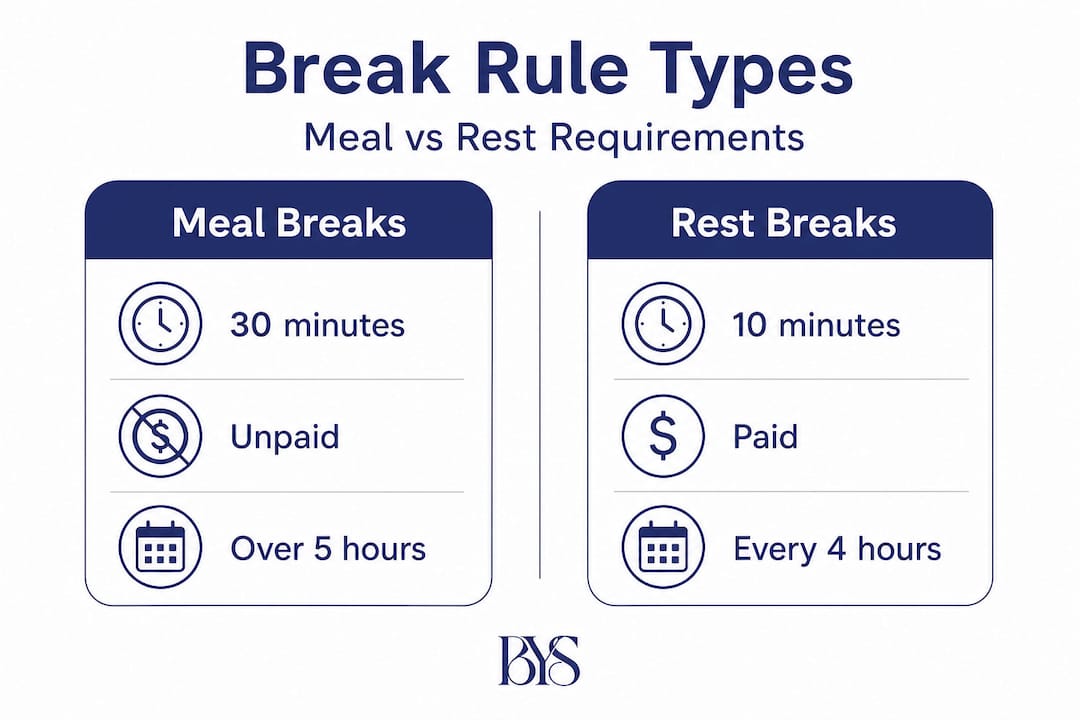
California non-exempt employees generally get an
unpaid 30-minute meal break for shifts over five hours, a second meal break for shifts over ten hours, plus paid 10-minute rest breaks for every four hours worked. This framework is set out under California’s labor code and is not optional for employers.

Here is a simple breakdown of how those rules work in practice:
| Shift length |
Meal breaks required |
Rest breaks required |
| Under 3.5 hours |
None |
None |
| 3.5 to 5 hours |
None |
1 paid 10-minute break |
| Over 5 hours |
1 unpaid 30-minute break |
2 paid 10-minute breaks |
| Over 10 hours |
2 unpaid 30-minute breaks |
3 paid 10-minute breaks |
A few additional points every Downtown LA worker should know:
- Meal breaks must be uninterrupted and off-duty, meaning you must be completely relieved of all work duties.
- Rest breaks should fall in the middle of each four-hour work period as much as possible.
- Employers cannot pressure, discourage, or penalize you for taking a break you are legally entitled to.
- An employer cannot simply claim the workplace is too busy to allow breaks. Being short-staffed does not override the law.
These kinds of denials often show up as
wage and hour violations that employees don’t report because they simply don’t know their rights.
Pro Tip: Keep a personal log of your breaks. Note the date, shift start and end time, and whether each break was taken on time, cut short, or skipped. This documentation can be critical if you ever need to file a claim.
What counts as a meal or rest break violation?
With the basics understood, let’s look at how violations really happen day to day. Violations are often subtle. Many employers don’t outright say “you cannot take a break.” Instead, the violation happens in more indirect ways that can be harder to identify but are just as illegal.
Common types of violations include:
- A manager calls you back to the floor or to the register before your break time is up.
- You are told to clock out but then asked to continue light duties during your “off” period.
- Meal breaks are scheduled so late in the shift that they don’t count as timely breaks under the law.
- You feel pressured not to take breaks because coworkers or supervisors make comments about the workload.
- You are required to remain “on call” or stay on the premises in a way that prevents you from truly resting.
- You sign a waiver without understanding what it means or without genuinely choosing to do so.
Here is how compliant and non-compliant breaks compare:
| Break element |
Compliant break |
Non-compliant break |
| Duration |
Full 30 minutes (meal) or 10 minutes (rest) |
Cut short by even a few minutes |
| Duty status |
Completely relieved of duties |
Asked to monitor, answer calls, or stay ready |
| Timing |
Within the first five hours of a shift (meal) |
Provided too late or too early |
| Consent to waive |
Truly voluntary and informed |
Pressured or coerced |
“If the employer fails to provide compliant meal/rest periods, California Labor Code § 226.7 provides ‘premium pay’ of one additional hour at the employee’s regular rate for each workday the required break is not provided.”
This premium pay is commonly called a “break premium.” One important enforcement note is that the California Division of Labor Standards Enforcement (DLSE) limits this premium to one per workday for each type of violation. So if you miss two meal breaks in one day, you still receive only one premium for that category. The same cap applies to rest breaks separately.
If you are uncertain whether your situation qualifies as a violation, speaking with an
employment lawyer in Downtown LA can help you assess your specific circumstances quickly and clearly.
Legal consequences for employers and employee remedies
Once a violation occurs, it’s important to know what legal consequences exist and what actions you can take. The good news is that California law gives you real financial remedies when your breaks are denied.
Here is how the premium pay calculation works:
- Identify the workdays on which a compliant break was not provided.
- Determine your regular hourly rate of pay for each of those days.
- Multiply that rate by one hour for each type of violation per day.
- Add those amounts together across all affected days to get your total unpaid premiums.
For example, if you earn $22 per hour and your employer failed to provide your meal break on 40 workdays over six months, you are owed $880 in meal period premiums alone. That figure grows even more if rest breaks were also missed. These amounts can add up significantly over time.
Beyond premium pay, the legal stakes for employers are even higher than many people realize. Meal and rest break premiums are classified as wages under California law.
Break premiums count as wages under California Labor Code sections 203 and 226, which means employers who fail to pay them also expose themselves to wage-statement penalties and waiting-time penalties when an employee is discharged or quits.
This is a major development. It means an employer who does not list break premiums correctly on your pay stub could face additional liability for each incorrect wage statement issued. And if your employment ends and owed premiums were never paid, waiting-time penalties can add up to 30 days’ wages.
Pro Tip: When reviewing your pay stub, check whether any break premiums appear. If you were denied breaks and no premium appears on your wage statement, that discrepancy itself becomes evidence of a potential violation.
Steps to take if your break rights are being violated:
- Document everything. Dates, times, names of managers or supervisors involved.
- Review your pay stubs for missing or incorrect break premium entries.
- Request your time records from your employer. You have the right to do this under California law.
- File a wage claim with the DLSE or pursue a civil lawsuit, typically within three years for wage claims.
- Consult an attorney before signing any settlement or release.
Reviewing
recent employment verdicts in similar cases can give you a realistic picture of what employees have recovered when their rights were violated.
Waivers, exceptions, and special Downtown LA considerations
Not every situation is cut and dried. Here’s how specific exceptions or local factors change the rules.
One area that confuses many workers is the concept of a meal break waiver. California law does allow employees to waive their first meal break under certain conditions. Specifically, if the shift is six hours or less, the employee and employer can mutually agree to skip the meal break. For shifts over ten hours, a second meal break can be waived only if the first one was taken and both parties agree.
However, California
meal break waivers face tighter scrutiny from courts evaluating their enforceability. Courts have looked closely at whether waivers were truly voluntary, properly disclosed, and appropriately revocable. A waiver you signed on your first day of employment without anyone explaining it, or one buried in an onboarding packet, may not hold up legally.
Red flags to watch for in waiver documents:
- A blanket waiver that applies to all shifts regardless of length.
- No mention of your right to revoke the waiver.
- A form signed at hiring, before you understood your schedule.
- Language suggesting that breaks are not available or that you “agree” not to need them.
- Any clause that penalizes you for revoking a previously signed waiver.
Downtown LA presents its own unique workplace pressures. The city’s dense mix of industries including finance, legal services, tech startups, hospitality, and retail creates environments where employees often feel expected to go above and beyond to keep up with demanding schedules. Workers in high-pressure settings may feel that taking a break reflects poorly on their commitment. Others may work for employers who exploit
misclassification of workers to avoid providing breaks altogether by labeling them as independent contractors when they are legally employees.
If you have been told you are not entitled to breaks because of your “contractor” status but you work fixed hours, follow company rules, and use company equipment, that classification may be wrong. Misclassification is a serious issue in Downtown LA and often accompanies break violations.
Pro Tip: You cannot be fired or retaliated against for asserting your right to take a legally required break. If a supervisor threatens your job or schedule for asking about breaks, that could itself be a separate legal violation worth documenting.
Why meal and rest break enforcement really matters for Downtown LA workers
Here is an uncomfortable truth: the law already provides you with protections. But protections that go unasserted might as well not exist.
Many Downtown LA workers skip breaks not because they want to, but because they’ve absorbed a workplace culture that treats breaks as optional extras. Over time, that habit becomes invisible. You stop noticing that you’re working through lunch. You stop recognizing that your employer is benefiting from your unpaid labor. And it affects you more than just financially.
Skipping breaks raises stress levels and reduces focus. Research on workplace fatigue consistently shows that workers who do not take adequate rest periods make more errors, experience higher rates of burnout, and are more likely to leave their jobs. Denying breaks is not just an employer cutting corners. It is an employer extracting more from you than the law permits, at a direct cost to your health and well-being.
There’s also a collective dimension here. When one worker stands up and says “I am owed my breaks and my premium pay,” it often starts a conversation that benefits the entire team. Employers who know their workers understand their wage and hour rights tend to comply more carefully. Enforcement isn’t about being difficult. It is about maintaining basic workplace dignity.
At Shirazi Law Office, we believe firmly that enforcing your break rights is not a minor administrative matter. It is about asserting that your time, health, and wellbeing have value. Every worker deserves a workplace where the law is followed without needing to fight for it. But when that fight is necessary, knowing you have rights and having someone in your corner makes all the difference.
Take action: How to protect your rights in Downtown LA
After all you’ve learned, here’s how to get concrete help protecting your rights. Timing matters more than most people realize. California’s statute of limitations for wage claims is generally three years, but evidence fades, records get lost, and the sooner you act, the stronger your position.
Shirazi Law Office represents employees throughout Downtown Los Angeles who are dealing with
wage and hour disputes in LA including missed break premiums, inaccurate wage statements, and related retaliation. Brian Y. Shirazi brings focused, personal attention to every case and takes the time to understand exactly what happened to you and what remedies are available.
Whether you’ve missed a handful of breaks or have years of unclaimed premiums, a consultation can clarify your options and put you on a clear path forward. You deserve a
Los Angeles employment lawyer who treats your situation with the seriousness it deserves. Your case is not just a file number. It is your livelihood, your time, and your right.
Frequently asked questions
Who is legally entitled to meal and rest breaks in California?
Most non-exempt employees in California are entitled to meal and rest breaks as outlined in the labor code, and non-exempt employees earn breaks based on the total length of their shift.
If I miss more than one break in a day, how much premium pay can I receive?
You may receive one premium for each type of violation per workday, meaning one for a missed meal break and one for a missed rest break. The DLSE caps daily premiums at one per category per day, not one per individual missed break.
Are employers allowed to force me to sign away my meal break rights?
Meal break waivers are only valid in specific, limited circumstances and must be truly voluntary and revocable. Courts have found that waiver enforceability has strict requirements and waivers obtained through pressure or confusion may not hold up.
What counts as a compliant meal break under California law?
A compliant meal break must be at least 30 consecutive, uninterrupted, off-duty minutes, and under California law, a 30-minute meal break is required for shifts exceeding five hours.
What happens if my break premium is not listed as wages on my pay stub?
Your employer may face additional penalties beyond the premium itself, since break premiums treated as wages under California Labor Code sections 203 and 226 create wage-statement and waiting-time liability for employers who fail to account for them properly.
Recommended






[…] Read the full article here. […]