
TL;DR:
- California law provides robust protections for employees facing layoffs, including mandatory advance notice and remedies for violations. Workers should verify employer compliance with the WARN Act, file promptly for unemployment benefits, and document all communications to secure their rights. Consulting legal experts early helps employees maximize their entitlements and navigate complex layoff procedures effectively.
Losing your job feels like the ground dropping out from under you. Many employees assume a layoff is something that simply happens to them, with no recourse and no real options. That assumption is wrong. California offers some of the strongest worker protections in the country, and Larchmont Village employees facing layoffs have specific rights around advance notice, unemployment benefits, and legal remedies that most people never fully claim. This guide walks you through those rights, step by step, so you know exactly what you’re entitled to and what to do next.
Table of Contents
- Essential rights for Larchmont Village employees facing layoffs
- How and when you qualify for unemployment benefits
- Severance pay, WARN notice, and potential remedies
- Your first steps after receiving a layoff notice
- Our take: Layoff rights in practice—what most guides leave out
- How we can help safeguard your employee rights
- Frequently asked questions
Key Takeaways
| Point | Details |
|---|---|
| Advance notice rights | California employees may be entitled to written WARN notice before qualifying layoffs or plant closures. |
| Unemployment eligibility | You can apply for UI benefits if laid off or if your hours are reduced through no fault of your own. |
| Remedies for illegal layoffs | Missing or late WARN notice may entitle you to back pay, benefits, and legal claims. |
| Act quickly for benefits | Filing unemployment and consulting legal help promptly increases your protections and options. |
| Document everything | Keep all layoff and employment documents—the details can make or break your case if you need to challenge your layoff. |
Essential rights for Larchmont Village employees facing layoffs
Now that you know the landscape, let’s detail exactly what rights you have and how local rules apply.
California operates under one of the most protective layoff frameworks in the nation. At the center of that framework is the California WARN Act, commonly called Cal-WARN. Under this law, Cal-WARN requires advance written notice for certain mass layoffs, plant closures, or relocations, with both employees and relevant state agencies receiving that notice. The standard requirement is 60 days of advance written notice. That 60-day window exists specifically to give you time to plan, seek new work, and access resources before your income stops.
Who qualifies under Cal-WARN? The law applies to employers with 75 or more employees. A covered “mass layoff” generally involves 50 or more workers losing their jobs within a 30-day period. Plant closures and relocations follow their own triggers, and the rules can vary based on how your employer counts part-time workers, the specific worksite definition, and the timeline of the action.
Your status matters a great deal. Part-time employees, for instance, count toward the 75-employee threshold but may be treated differently in some calculations. Tenure also plays a role, since some short-term or temporary workers may be excluded from certain protections. This is why understanding the specifics of your employment situation matters far more than just knowing the general rule.
Cal-WARN is a powerful protection, but it is deeply fact-specific. Whether your employer’s action triggers it depends on employee counts, the nature of the action, timing, and your specific worksite.
If your employer violates Cal-WARN obligations, you are not left without options. You can pursue remedies including back pay for each day of violation, the value of lost benefits, and civil penalties. You can also explore wrongful termination protections if your layoff was connected to protected activity such as filing a complaint, taking medical leave, or reporting misconduct.
Key rights to remember:
- The right to 60 days of written advance notice if Cal-WARN thresholds are met
- The right to know what triggered the layoff and which employees are affected
- The right to pursue back pay and benefits if proper notice was not given
- The right to challenge a layoff that violates anti-retaliation or anti-discrimination laws
- The right to access Larchmont Village legal resources to evaluate your specific situation
Pro Tip: Ask your employer for written confirmation of your layoff notice and carefully check the date it was issued. If the notice was given fewer than 60 days before your last day and the layoff meets Cal-WARN criteria, you may have a legal claim worth pursuing.

How and when you qualify for unemployment benefits
Beyond knowing your basic rights, financial stability is often your next concern. Here’s how unemployment benefits work.
The California Employment Development Department, known as the EDD, administers unemployment insurance (UI) benefits for workers across the state. The good news is that UI benefits are available if you lose your job or have reduced hours through no fault of your own, provided you meet the state’s eligibility requirements. Being laid off because of a company downsizing, budget cuts, or a closure generally qualifies you. Being fired for misconduct generally does not.
Eligibility hinges on several factors. You need to have earned enough wages during a 12-month “base period” before your claim. You must be available for work, actively seeking employment, and physically able to work. California does not require a waiting period before benefits begin in most layoff situations, which makes applying promptly all the more important.
California’s unemployment insurance exists to support workers who lose income through no fault of their own. If your employer reduced your hours significantly, you may be eligible even before a full layoff occurs.
Here’s a step-by-step breakdown of the process:
- File your claim immediately. You can apply online through the EDD portal or by phone. Don’t wait until your last day of work.
- Gather your employment information. You’ll need your employer’s name, address, and your dates of employment.
- Document your wages. Have your most recent pay stubs or W-2 forms available to report your earnings accurately.
- Complete your continued certification. Every two weeks, you must certify that you are still eligible, reporting any income or job offers.
- Respond to any EDD notices promptly. Delays in responding can result in benefit interruptions or denials.
One area many employees overlook is a partial layoff. If your employer cuts your hours by 20% or more, you may qualify for partial UI benefits even while still employed. This matters for Larchmont Village workers in industries such as entertainment, hospitality, and retail, where hours fluctuations are common. The EDD treats a significant reduction in hours as a qualifying event, giving you the flexibility to claim some support while you look for additional work.
Common reasons the EDD denies UI claims include voluntarily quitting, being unavailable for work, or not meeting the wage requirements. All three can be challenged. If your claim is denied, you have the right to appeal within 30 days of the decision. Consulting local employment lawyers before that appeal deadline can significantly improve your outcome.
Pro Tip: Apply as soon as you receive your layoff notice, not after your last day. Benefits are calculated from the date you file, so every day of delay is a potential day of lost income.
Severance pay, WARN notice, and potential remedies
Once you know your benefits, the next crucial area is fair compensation and what recourse you have when layoff procedures are not followed.
California law does not require employers to offer severance pay. Severance is typically a matter of contract, company policy, or negotiation. However, your employer’s failure to follow Cal-WARN notice requirements can create an obligation that functions similarly to severance. When WARN notice is not provided when required, employees may seek remedies such as back pay and benefits for the period of violation, up to 60 days.
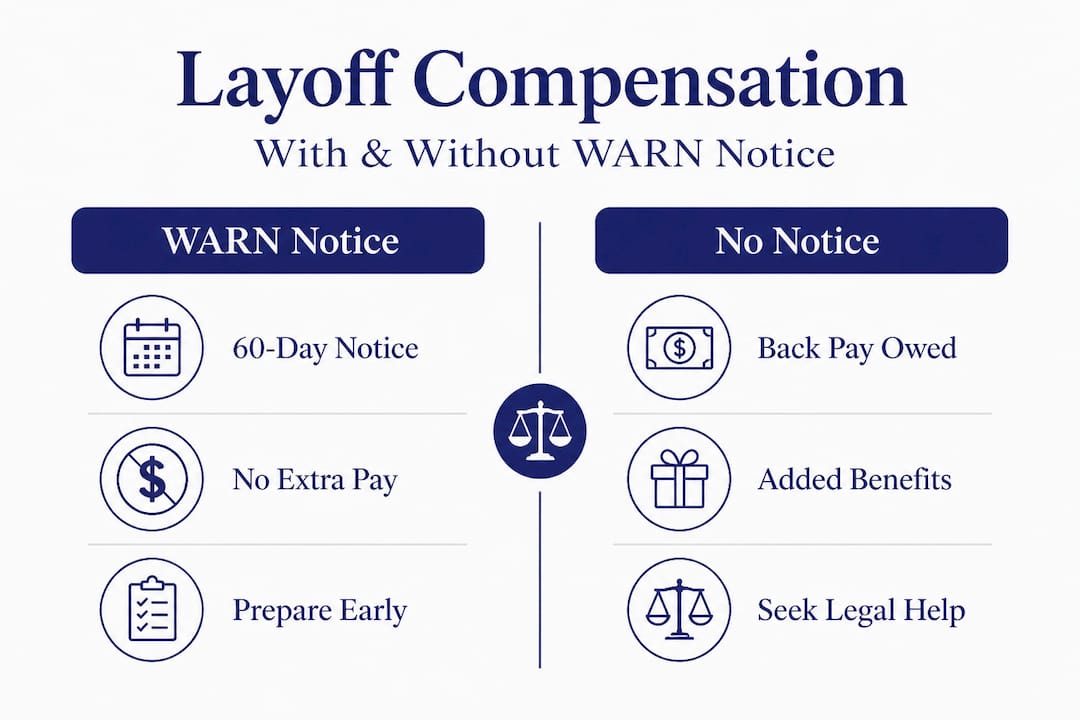
That potential recovery is significant. If you were earning $5,000 per month and your employer failed to give 60 days of notice, you could be looking at up to $10,000 in back pay, plus the value of any health insurance or other benefits you lost during that period.
| Situation | What you may receive |
|---|---|
| Employer gave proper 60-day Cal-WARN notice | No additional pay owed under WARN; standard severance if offered |
| Employer gave partial notice (e.g., 30 days instead of 60) | Back pay for the missed notice period (up to 30 days) plus benefits |
| Employer gave no WARN notice when required | Back pay for up to 60 days plus value of lost benefits and possible civil penalties |
| Employer gave notice but violated anti-retaliation law | Additional damages, reinstatement, attorney’s fees, and more |
Beyond WARN remedies, you may also have claims related to retaliation after layoffs if your termination was connected to a protected activity. California prohibits employers from laying off workers in retaliation for reporting safety violations, filing wage claims, taking protected medical leave, or engaging in other legally protected conduct.
Steps to take if you believe your layoff notice was not legal:
- Write down the exact date you received any written or verbal layoff notice
- Confirm the total number of employees affected at your worksite
- Check your employment contract and any company policy on severance or layoff procedures
- Request a copy of any WARN notice that was filed with the state
- Contact the California Labor Commissioner’s Office if you believe your rights were violated
- Consult with a lawyer about wrongful termination remedies if your layoff seems connected to unlawful conduct
Statistic callout: Employers who fail to provide required WARN notice face liability for up to 60 days of back pay and the value of employee benefits for each affected worker. For a team of 50 employees, that exposure can exceed hundreds of thousands of dollars in aggregate.
Your first steps after receiving a layoff notice
After addressing remedies, it’s time to act. Here’s what to do in your first days post-layoff.
The hours and days after receiving a layoff notice are critical. Acting quickly and methodically gives you the best chance of protecting your financial stability and your legal rights. The EDD maintains a Layoff Services page that connects workers to WARN-related information, Rapid Response teams, and unemployment resources, making it a strong first stop for practical guidance.
Here is a prioritized action plan:
- Document everything. Save copies of your layoff notice, any emails about the decision, and your most recent performance reviews. These records matter if you ever need to challenge the layoff.
- Verify the WARN notice. Check the date it was issued, the number of employees listed, and whether your employer filed the required notice with the state. Cal-WARN notices must also be sent to the local workforce development board.
- File your UI claim immediately. Do not wait. Every day counts when it comes to benefit calculations.
- Review your severance offer carefully. If your employer offers severance in exchange for signing a release of claims, get employment law help before you sign. Releasing your claims may waive your right to sue for discrimination, retaliation, or WARN violations.
- Contact a Rapid Response team. California’s Rapid Response program sends teams to affected worksites to help workers apply for UI, access retraining, and connect with career services.
- Consult a lawyer if something feels wrong. If the timeline, the people selected for layoff, or the paperwork does not add up, speak with a California employment attorney promptly.
| Action item | Timeline | Resource |
|---|---|---|
| Document layoff notice and details | Same day | Keep physical and digital copies |
| File unemployment insurance claim | Within 24 to 48 hours | EDD online portal or phone |
| Verify Cal-WARN compliance | Within first week | EDD WARN FAQ, employer HR department |
| Review severance agreement | Before signing | Employment attorney |
| Contact Rapid Response | Within first week | California EDD Layoff Services page |
| Consult employment lawyer | Within 2 weeks | Local employment law firm |
Our take: Layoff rights in practice—what most guides leave out
After laying out step-by-step action, let’s dig into what really matters and why so many employees miss their strongest protections.
The honest reality is that most layoff guides oversimplify the law. They tell you Cal-WARN exists, remind you to file for unemployment, and leave out the part where most employees never actually verify whether the law applies to their specific situation. That gap costs workers real money and real legal leverage.
Cal-WARN coverage is highly fact-specific, touching thresholds, type of action, site definitions, part-time counting, and notice recipients. Whether your layoff triggers Cal-WARN protections is not always obvious. We have seen situations where an employer quietly separated employees across two or three departments over six weeks, deliberately staying just under thresholds. In those cases, the total impact clearly hit workers hard, but without careful review of the counts and timelines, the legal obligation appeared absent.
This is why documentation is so much more important than most people realize. The employee who kept every email, every written notice, and a personal log of who was laid off and when is the client who can actually enforce their rights. The employee who relied on memory alone faces a much steeper climb.
We also see many workers accept a severance offer too quickly, often within the first 48 hours of receiving it, without understanding what claims they are signing away. Under California law, employees over 40 who are asked to sign a release of age discrimination claims must be given at least 21 days to consider the offer and 7 days to revoke it after signing. Younger workers do not have that statutory protection, but they still benefit enormously from getting legal eyes on any agreement before they sign.
Our perspective is simple. A layoff is not the end of your options. It is the moment when your options are most time-sensitive. Get personalized guidance before you sign anything, before the appeal deadlines pass, and before the evidence of what actually happened begins to fade.
Pro Tip: Keep a personal log starting the day you receive your layoff notice. Write down dates, names, conversations, and anything unusual about how the layoff was handled. That record can be the difference between a strong claim and a weak one.
How we can help safeguard your employee rights
Navigating a layoff is far less overwhelming when you have someone in your corner who knows California employment law inside and out. At Shirazi Law Office, we work with employees and executives throughout Los Angeles, including Larchmont Village, who are facing exactly the situations described in this guide. Whether you need help evaluating a severance offer, enforcing your WARN rights, or pursuing a wrongful termination claim, we provide direct, personal attention to your case from start to finish. If your layoff does not feel right, do not wait. Reach out to our Larchmont Village layoff lawyers for a case evaluation and get the clarity you need to move forward with confidence.
Frequently asked questions
Does my company have to give advance notice before layoffs in California?
Yes, if the layoff qualifies under Cal-WARN, your employer must give 60 days of written notice or face penalties including back pay and benefits liability.
What can I do if I wasn’t given WARN notice but should have been?
You may be eligible for back pay and benefits and can seek legal remedies, since employees may pursue back pay and related damages when required notice is not provided.
Can I collect unemployment if my hours are only reduced, not eliminated?
Yes, reduced hours through no fault of your own can qualify you for partial unemployment benefits in California, even if you are still employed.
Where can I find help right after a layoff?
The EDD Layoff Services page connects you with WARN information, Rapid Response teams, and unemployment resources immediately following a layoff.
Are all employees covered by the WARN Act?
No, WARN coverage is fact-specific and depends on employer size, layoff scale, worksite definitions, and other factors, so always verify whether your situation qualifies.
Recommended
- Seasoned Employment Lawyer in Larchmont Village
- Seasoned Employment Lawyer in Westwood
- Employment Law Articles on Workplace Rights & Disputes – Law Office of Brian Y. Shirazi, PC
- Beverly Grove Retail Wrongful Termination: Your Rights Explained – Law Office of Brian Y. Shirazi, PC
- How Labor Laws Shape Fair Hiring: What Job Seekers Must Know