
TL;DR:
- Healthcare workers in Westwood often experience unpaid overtime despite strong California wage laws.
- Common causes include improper work schedule exemptions, time rounding, off-the-clock work, and misclassification.
- Workers should document hours, review pay records, and consult attorneys to effectively recover owed wages.
Healthcare workers in Westwood put in long, demanding hours, often going well beyond their scheduled shifts, only to discover that their paychecks do not reflect all the time they actually worked. California has some of the strongest wage protection laws in the country, yet overtime violations remain surprisingly common in hospitals, clinics, and research facilities throughout the area. If you work in healthcare near Westwood or surrounding Los Angeles neighborhoods, understanding your overtime rights is not just helpful. It is essential for protecting your livelihood and holding your employer accountable.
Table of Contents
- What counts as unpaid overtime for Westwood healthcare workers?
- Common reasons overtime goes unpaid in Westwood hospitals
- How to file an unpaid overtime claim: Step-by-step guide
- Retaliation protections: What healthcare workers need to know
- Why unpaid overtime problems persist despite legal wins
- Get expert help for your unpaid overtime claim
- Frequently asked questions
Key Takeaways
| Point | Details |
|---|---|
| Most overtime is owed | Healthcare workers in Westwood often miss overtime pay due to employer tactics and exemptions. |
| Know employer defenses | Employers frequently use Alternate Work Schedule (AWS) or compliance claims to deny overtime. |
| Document everything | Gather pay stubs, timesheets, and logs before contacting a lawyer for the best case outcome. |
| Retaliation risks persist | Legal protections exist but gaps mean retaliation is still a concern for workers reporting unpaid overtime. |
| Legal help is vital | Consulting an experienced employment lawyer increases the chances of successful claims and protects your rights. |
What counts as unpaid overtime for Westwood healthcare workers?
California law sets clear standards for overtime pay, but those standards come with layers that can confuse even the most diligent worker. Under the California Labor Code, most non-exempt employees must receive 1.5 times their regular rate for any hours worked beyond eight in a single workday or forty in a workweek. They must also receive double time for hours beyond twelve in a single day. These rules apply regardless of whether you work in a hospital, a research lab, or an outpatient clinic.
For healthcare workers specifically, the daily overtime rule is critically important because of how shifts are structured. A nurse working a ten-hour shift, for example, is entitled to overtime for the two hours beyond the eight-hour daily threshold, even if she has not exceeded forty hours that week. Many workers do not realize this. They assume weekly totals are all that matter, but California runs on both daily and weekly calculations.
Common unpaid overtime scenarios include:
- Mandatory pre-shift preparation such as reviewing patient files or setting up equipment before clocking in
- Post-shift documentation when nurses and medical assistants complete charts after their official end time
- Missed or shortened meal and rest breaks that legally extend the compensable workday
- On-call time where workers remain accessible and restricted in their activities but receive no overtime credit
- Training or mandatory meetings held outside scheduled hours
Employers often argue they are compliant, pointing to alternative work schedule (AWS) exemptions. Under a properly adopted AWS, healthcare workers can agree to work shifts of up to twelve hours without triggering daily overtime, provided specific procedural steps were followed. However, many AWS agreements are adopted incorrectly, making them legally unenforceable. If the proper secret ballot vote and documentation requirements were not met, those exemptions may not apply to you.
Workers at institutions like UCLA have pushed back against wage practices they believe are unfair. As reported, employers may claim compliance or AWS exemptions while workers protest systemic underpayment despite union wins, with no explicit retaliation protection emphasized in those disputes.
Pro Tip: Review your timesheets from the past three years and flag every instance where your recorded hours do not match your actual start and end times. California’s statute of limitations for wage claims typically runs three years, so you have more history available than you might think. You can also visit our LA overtime violation guide for a broader overview of how these claims work across Los Angeles.
Common reasons overtime goes unpaid in Westwood hospitals
Understanding the definition of unpaid overtime sets us up to examine the key reasons these claims are so frequently overlooked in Westwood hospitals. The problem is not always intentional on the employer’s part, but systemic patterns are hard to ignore when workers in the same department consistently come up short.
Here are the top five reasons overtime pay gets missed or denied in healthcare settings:
- Incorrect AWS adoption. The employer set up an alternative work schedule without following California’s required election procedures, then used that schedule as a shield against overtime claims.
- Time clock rounding. Hospitals use software that rounds punch times to the nearest quarter hour, systematically shortening compensable time over hundreds of employees.
- Off-the-clock work pressure. Supervisors encourage workers to finish tasks “quickly” after clocking out, creating unpaid labor that never appears in payroll records.
- Misclassification. Workers are labeled as exempt managers or supervisors when their actual duties are primarily non-managerial, eliminating their overtime eligibility incorrectly.
- Union contract complexity. Collective bargaining agreements can sometimes create confusion about which overtime rules apply, leaving workers uncertain about when to push back.
The table below shows how overtime eligibility can vary depending on shift structure, union status, and department:
| Shift type | Union status | Department | Overtime eligibility |
|---|---|---|---|
| 8-hour standard | Non-union | General nursing | Full California OT rules apply |
| 12-hour AWS | Properly voted | ICU or ER | AWS may suspend daily OT |
| 12-hour AWS | Improperly adopted | Lab or research | Standard CA rules still apply |
| Rotating shifts | Non-union | Radiology | Daily AND weekly OT both apply |
| On-call hourly | Any | Any clinical | Compensable if activity restricted |
Systemic underpayment at major medical and research institutions is not a myth. Reports of alleged wage theft highlight that even institutions with active union representation can still underpay workers when internal compliance systems fail to keep pace with actual scheduling practices.
Knowing your rights around Westwood non-compete agreements is also worth exploring, especially if your employer uses those agreements as leverage during wage disputes. Separately, workers dealing with overlapping disability issues should understand their Westwood disability rights, since disability-related schedule modifications can affect how overtime is calculated. And if you are navigating a medical leave alongside a wage dispute, reviewing your Westwood medical leave rights can clarify how leave interacts with unpaid overtime claims.
Pro Tip: Keep a private written log, separate from your employer’s time-tracking system, documenting every hour you work, every break you miss, and every instance where you were asked to continue working after clocking out. This contemporaneous record can be powerful evidence in a wage claim.
How to file an unpaid overtime claim: Step-by-step guide
Armed with knowledge about overtime violations, here is how you can take action if you believe you have gone unpaid.
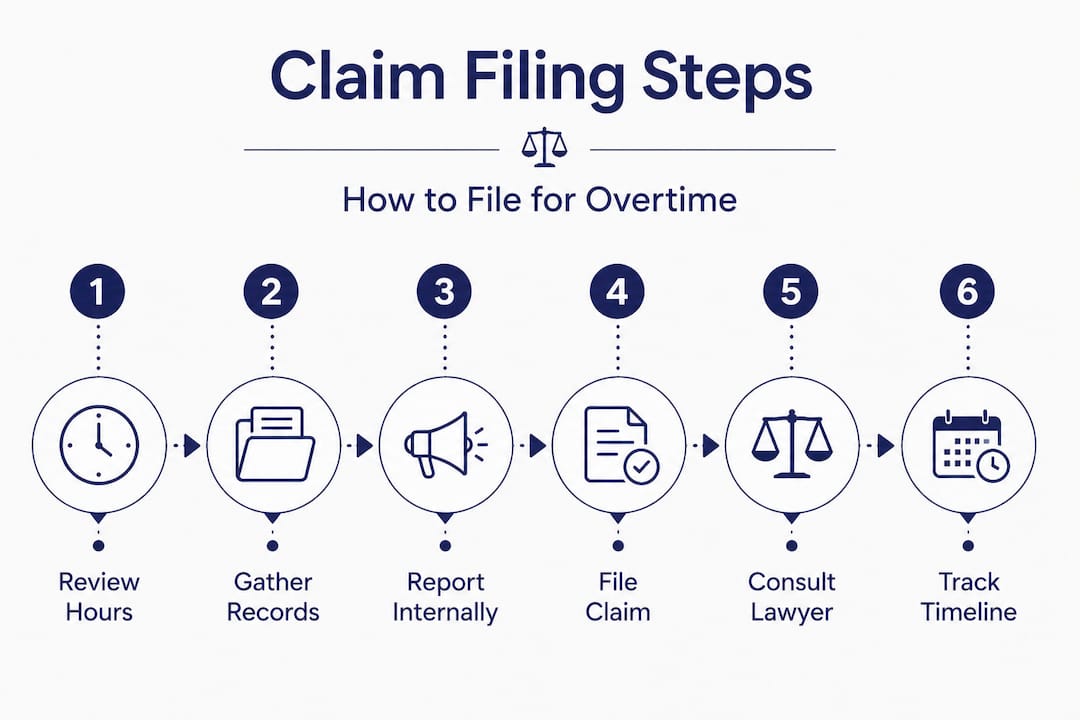
Step 1: Identify the violation. Start by determining exactly which pay periods are in question. Pull your pay stubs and compare them against your actual work hours. Look for patterns: recurring short paychecks, missing double-time payments, or pay periods where your shifts stretched beyond eight hours without any overtime reflected.
Step 2: Gather your documentation. Before you contact anyone, build your evidence file. The documents you want to collect include:
- Pay stubs from at least the past three years
- Time records, shift logs, or punch histories
- Any written AWS agreements or voting records
- Emails, texts, or written communications about scheduling or off-the-clock work
- Your employment contract or offer letter
- Department scheduling records showing actual hours worked
- Notes documenting missed breaks and the circumstances
Step 3: Report internally (with caution). Some workers choose to raise the issue with HR or a direct supervisor first. This can work, but it also risks alerting your employer before you have fully protected yourself. If you report internally, do so in writing and keep copies of everything. Verbal conversations are hard to prove later.
Step 4: File a wage claim or consult an attorney. You can file a wage claim with the California Labor Commissioner’s Office, or you can retain an employment attorney who can file a civil lawsuit directly. The civil route often allows for broader recovery, including waiting time penalties (an additional day of wages for each day the employer delays paying you after termination, up to thirty days), interest, and attorney’s fees.
Step 5: Understand the timeline. The California statute of limitations for wage claims is generally three years under state law and two years under federal law. Systemic underpayment claims sometimes involve large groups of affected workers, which can lead to class action or representative action filings that expand recovery opportunities significantly.
Working with a Westwood employment lawyer gives you a significant strategic advantage. An experienced attorney can identify violations you might have missed, calculate the full scope of your damages, and navigate complex AWS exemption defenses that employers frequently raise. If your claim involves overlapping issues, such as a disability-related scheduling modification that also affected your overtime eligibility, understanding your Westwood disability accommodation rights strengthens your overall position.
It is also critical to recognize that filing a claim carries retaliation risks. Our workplace retaliation guide outlines the specific protections available to healthcare workers in the Los Angeles area and what you should do if your employer responds to your claim with adverse action.
Retaliation protections: What healthcare workers need to know
Before pursuing a claim, it is essential to understand the protections and risks regarding workplace retaliation. Many Westwood healthcare workers hesitate to come forward precisely because they fear losing their jobs, being demoted, or facing a hostile work environment.
California law prohibits retaliation against employees who report wage violations or file claims with the Labor Commissioner. Under Labor Code Section 98.6, employers cannot discharge, threaten, or discriminate against a worker for filing a wage claim or participating in a wage investigation. Violating this provision can expose the employer to additional civil penalties.
Common forms of retaliation that workers experience include:
- Sudden schedule changes that reduce hours or shift desirability
- Negative performance reviews that appear shortly after a complaint is filed
- Demotion or reassignment to less favorable roles or departments
- Termination disguised as a layoff or performance issue
- Increased scrutiny or micromanagement designed to manufacture grounds for discipline
- Hostile comments from supervisors or coworkers encouraged by management
Reports involving institutions like UCLA emphasize that retaliation protections are not always explicit or well enforced in healthcare and research settings, leaving workers in a vulnerable position even after they take legally protected steps.
To protect yourself, document everything before and after you file your claim. Keep records of your performance reviews, your communication with supervisors, and any changes to your duties or schedule. If you experience retaliation, you have the right to file a separate complaint under California law.
Our firm regularly handles LA workplace retaliation law claims for employees across Los Angeles who face adverse action after standing up for their rights. We also handle West Hollywood retaliation claims for workers in nearby neighborhoods who face similar pressures in competitive medical and entertainment-adjacent industries.
Why unpaid overtime problems persist despite legal wins
Even with more awareness and successful claims, the overtime issue endures, and most guides overlook a critical reason why. Legal victories, whether from union negotiations, class action settlements, or individual wage claims, do not automatically reprogram how hospitals manage their scheduling software, how supervisors communicate expectations, or how HR departments handle compliance reviews. The structural gap between winning a legal right and actually receiving fair pay remains wide.
Union wins deserve recognition. When organized labor secures overtime language in a collective bargaining agreement, those gains are real. But they are only as strong as enforcement. Systemic underpayment persists not because employers always act in bad faith, but because healthcare scheduling is genuinely complex, and compliance often falls to administrators who are focused on staffing costs rather than wage law precision.
There is also a hidden cost that workers rarely discuss openly. Contesting a wage claim takes time, emotional energy, and often courage. Even when you win, the process itself can feel defeating.
“Employers frequently treat the cost of settling individual overtime claims as a routine budget line rather than a signal to fix broken practices. Until the structural incentives change, the pattern continues.”
The most effective counter to this reality is collective action. When multiple workers document the same violation and come forward together, the legal and reputational pressure on an employer multiplies. Class and representative action lawsuits under California’s Private Attorneys General Act (PAGA) allow workers to recover civil penalties on behalf of the state, creating consequences that individual settlements often cannot.
Pro Tip: Talk confidentially with coworkers you trust about your shared experiences. If multiple people in your department notice the same pattern of missed overtime credits, you may have the basis for a collective action that recovers far more than any single claim could.
Get expert help for your unpaid overtime claim
If you are ready to pursue your claim or need advice on other workplace rights, the next step is consulting with an employment attorney who understands the specific legal landscape for Westwood healthcare workers. Shirazi Law Office has represented workers throughout Los Angeles in wage and hour disputes, retaliation matters, and complex employment cases involving overlapping legal issues.
Our team can review your situation, assess the strength of your overtime claim, and advise you on strategy, whether that means filing with the Labor Commissioner, pursuing civil litigation, or joining a collective action. Visit our page on Westwood wage violation rights to learn more about the specific protections available to medical staff and researchers in the area. You can also reach out to a Los Angeles employment lawyer for a broader consultation covering wage issues, wrongful termination, and workplace discrimination. If your situation involves disability-related complications alongside wage violations, our Westwood disability discrimination resources explain how those claims interact and how to protect all of your rights at once.
Frequently asked questions
Who qualifies for overtime pay in Westwood healthcare jobs?
Most non-exempt healthcare workers qualify for overtime unless their employer properly applies recognized exemptions like AWS agreements or specific union carve-outs negotiated in a valid collective bargaining agreement. Even when employers claim compliance, the procedural requirements for those exemptions are strict and frequently challenged.
Can my employer retaliate if I report unpaid overtime?
California law prohibits retaliation for filing a wage claim, but retaliation protections are not always explicitly enforced in healthcare settings, so documenting your workplace conditions before and after you file is a critical protective step.
What documents do I need before filing a claim?
Gather pay stubs, timesheets, shift logs, and copies of any AWS schedules or overtime denial notices, since employers claiming AWS exemptions must show proper adoption procedures that you have a right to review.
Does union membership guarantee overtime pay?
Union membership improves enforcement opportunities, but systemic underpayment persists even in unionized healthcare environments when contract language is vague or internal compliance systems fail to track daily overtime accurately.
How long does the claims process take?
The timeline varies based on complexity and whether the claim goes through the Labor Commissioner or civil litigation, but most claims require at least several weeks to months for initial review, investigation, and potential mediation before any resolution is reached.