

TL;DR:
- California’s FEHA law offers extensive protections for nightlife workers, including part-time and contractor status.
- Recognized harassment includes quid pro quo and hostile work environment conduct from colleagues, managers, and customers.
- Proper documentation and legal advice are crucial to effectively report harassment and prevent retaliation.
If you work in a bar, nightclub, or hospitality venue in West Hollywood, you have real legal protections, even if your employer has never mentioned them. California’s FEHA is the primary law shielding nightlife workers from sexual harassment, and it applies whether you work Friday nights only or hold a full-time management role. Many workers assume that fast-paced, tip-dependent environments operate outside the reach of employment law. They don’t. Recent lawsuits and settlements across West Hollywood have made it clear that workers can and do recover damages, and that employers face real accountability when they look the other way.
Table of Contents
- Who is protected under West Hollywood sexual harassment law?
- Types of sexual harassment in nightlife venues
- How to document and report sexual harassment
- Navigating retaliation and legal remedies
- Our insight: What nightlife workers must know and why most guides miss it
- Get help: Experienced legal support for West Hollywood nightlife workers
- Frequently asked questions
Key Takeaways
| Point | Details |
|---|---|
| Legal protections are strong | California laws cover even small venues and recognize multiple harassment sources. |
| Documentation is critical | Accurate records of incidents are required for successful internal and legal claims. |
| Reporting takes courage | Nightlife workers face unique risks but legal advice and direct CRD filings offer real protection. |
| Retaliation is unlawful | Employers cannot fire, demote, or punish workers for reporting harassment. |
| Recent lawsuits drive change | High-profile cases show legal action can result in settlements and improved policies. |
Who is protected under West Hollywood sexual harassment law?
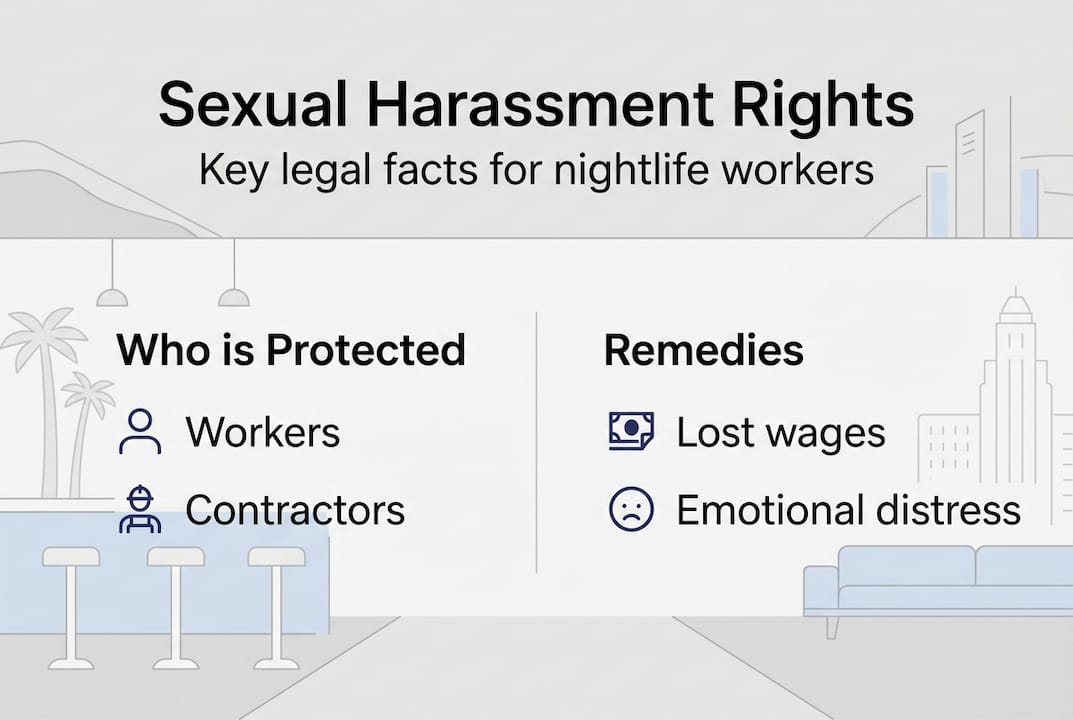
The protections are broader than most people realize. California’s Fair Employment and Housing Act, commonly called FEHA, covers workers across nightclubs, bars, lounges, concert venues, and hospitality businesses. The law covers employers with 5+ employees, and harassment claims can apply even at smaller venues under certain conditions.
Importantly, protection extends beyond full-time employees. Contractors, part-time servers, freelance entertainers, and gig workers may all qualify depending on the nature of their working relationship with the venue. If you work regular shifts, follow the venue’s dress code, or depend on management for your schedule, you likely have standing to file WeHo harassment claims.
Here is a quick comparison of how California law stacks up against federal protections:
| Protection area | California FEHA | Federal Title VII |
|---|---|---|
| Employer size threshold | 5+ employees | 15+ employees |
| Damage caps | No cap | $300,000 max |
| Filing deadline | 3 years | 180 to 300 days |
| Contractor coverage | Broader scope | Limited |
| Enforcement agency | CA Civil Rights Dept | EEOC |
California law is consistently stronger than federal law on nearly every dimension. Workers here have more time to file, face no arbitrary damage caps, and benefit from a broader definition of who qualifies as a protected worker.
The two main types of harassment recognized under hospitality harassment law are:
- Quid pro quo harassment: A manager or supervisor offers job benefits, such as better shifts or tips, in exchange for sexual favors, or threatens negative consequences for refusal.
- Hostile work environment: A pattern of unwelcome conduct, whether from a supervisor, coworker, or customer, that makes the work environment intimidating, offensive, or abusive.
Both types are fully actionable under California law. You do not need to suffer severe physical contact to have a claim. Persistent comments, unwanted touching, and demeaning jokes can all form the basis of a strong case.
Types of sexual harassment in nightlife venues
Nightlife settings create conditions where harassment thrives. Dim lighting, alcohol, late hours, and power imbalances between management and staff all contribute. Nightlife workers face unique power imbalances, with repeated minor acts accumulating into legally recognized hostile environments.
The two actionable harassment types play out in very specific ways in venue settings:
- Quid pro quo examples: A bar manager tells a female bartender she will lose her weekend shifts unless she tolerates a VIP guest’s advances. A club owner implies that promotions depend on going on dates with him.
- Hostile environment examples: A head server makes daily sexual comments about a coworker’s appearance. Regular customers grope staff while management ignores complaints. A bouncer sends repeated unsolicited messages to a new hire.
- Customer-sourced harassment: Employers have a legal duty to protect workers from known harassing customers. If management is told about a problem guest and does nothing, the venue can be held liable.
- Coworker conduct: Harassment by peers is just as actionable as harassment by supervisors. The standard is whether the employer knew or should have known and failed to act.
- Retaliation disguised as scheduling: Cutting someone’s shifts after they complain is not just bad management. It can be treated as illegal retaliation.
High-profile cases and settlements involving West Hollywood venues illustrate how these patterns appear in practice. In documented incidents at venues like Soho House West Hollywood, staff reported being drugged and assaulted, with claims that management failed to create safe working conditions. These cases highlight what’s at stake.
Research on customer conduct in service settings shows that the power dynamic between tipping customers and tipped workers creates a specific kind of vulnerability that legal frameworks are only beginning to fully address.
Pro Tip: Start a private digital log from your very first incident, even if it seems minor. Courts and investigators look for patterns. A single incident may be hard to prove, but ten documented incidents with dates and witnesses become a compelling record.
Also consider hostile environment claims carefully. Courts assess severity and frequency together. What matters is the cumulative effect on your ability to do your job, not whether any single act crossed an obvious line.

How to document and report sexual harassment
Documentation is often the difference between a successful claim and a dismissed one. The process matters as much as the facts themselves.
Follow these steps as soon as harassment occurs:
- Write it down immediately. Record the date, time, location, what was said or done, who was present, and how it affected you. Use a personal phone or private email, not work systems.
- Preserve evidence. Save text messages, emails, screenshots of social media messages, or any written communications from the harasser.
- Identify witnesses. Note the names of anyone who saw or heard the incident. Even if they seem reluctant, their observations could matter later.
- Report in writing internally. Submit a written complaint to HR or management. Keep a copy for yourself. Verbal complaints are harder to verify.
- File with the California Civil Rights Department. If internal reporting fails or seems unsafe, you can file directly. Under the CRD reporting process, you have three years from the last incident to file, and there are no caps on the damages you can recover.
Studies suggest that between 42% and 75% of harassment incidents go unreported, largely due to fear of retaliation, disbelief, or job loss. In nightlife settings where tips and schedules are controlled by the same managers receiving complaints, those fears are especially well-founded.
Pro Tip: Before making any formal internal report, consult with an attorney. An employment lawyer can assess retaliation after reporting and help you sequence your actions to protect both your job and your claim.
The workplace claims process in California is worker-friendly compared to most states, but only if you follow the right steps and timelines. An attorney can help you avoid common procedural mistakes that can weaken or bar a legitimate claim. Workers who document carefully and act promptly consistently have stronger outcomes.
Navigating retaliation and legal remedies
Retaliation is what most nightlife workers fear most, and that fear is legitimate. But retaliation itself is illegal, and it significantly increases your potential recovery.
Retaliation includes any adverse action taken because you reported harassment or participated in an investigation. Common forms in nightlife settings include:
- Reduced shifts or hours after filing a complaint
- Sudden poor performance reviews with no prior warnings
- Being assigned undesirable tasks or locations
- Termination shortly after a report is made
- Social exclusion or hostility encouraged by management
If you experience any of these, document them the same way you would document harassment. The retaliation claims process under FEHA runs parallel to harassment claims and can result in additional damages.
Under California law, no cap on damages exists under FEHA, which means compensation can include lost wages, emotional distress, attorney fees, and punitive damages in serious cases. Compare that to federal law, which limits damages to $300,000 for most employers. The difference is enormous.
Recent litigation outcomes in West Hollywood cases show that workers who come forward with documented claims and legal representation have achieved meaningful settlements and policy changes at their venues. These outcomes matter not just for individual workers but for the broader nightlife community.
Studies consistently show that underreporting in the West Hollywood nightlife industry runs between 42% and 75%. That means the majority of workers who experience harassment never formally pursue their rights. If you’re reading this, you are already ahead of most.
Learn from harassment lawsuit lessons in similar cases to understand what outcomes are realistic and what evidence courts find most persuasive. The civil rights remedies available to California workers are among the strongest in the country.
Our insight: What nightlife workers must know and why most guides miss it
Most legal guides focus on what harassment is and how to report it. What they skip is the harder truth: in hospitality settings, the systems designed to protect you often fail by design.
HR departments in high-turnover nightlife venues are frequently aligned with ownership, not workers. A formal complaint can travel directly back to the manager you just reported. That is not a hypothetical. It happens regularly. Nightlife power dynamics and tip dependency create an environment where workers rationally fear that speaking up will cost them their income faster than any legal process can protect them.
Economic dependence is the real enforcement gap. When your rent depends on your Saturday night shift, and your Saturday night shift depends on staying quiet, the legal right to file a complaint feels abstract. This is why so many claims are never made.
The practical answer is to build your case before you report. Consult an employment lawyer with insights specific to Los Angeles venues. Then, consider whether filing directly with the California Civil Rights Department, rather than going through internal HR, gives you stronger protection. In many cases, it does.
Pro Tip: Going to HR first is not always required and is sometimes the wrong first move. An attorney can help you decide which path gives you the most protection before you take any formal step.
Get help: Experienced legal support for West Hollywood nightlife workers
If you’re experiencing sexual harassment in a West Hollywood nightlife venue, you don’t have to figure this out alone. The legal options available to you are real, and the right guidance can make all the difference in how your case unfolds. Shirazi Law Office represents workers across Los Angeles in exactly these situations, from bartenders and servers to promoters and venue staff. Working with a skilled Los Angeles employment lawyer means you get a clear picture of your rights before you make any moves. Review the employee rights guide for 2026 to understand what protections apply to your situation, and reach out to explore your sexual harassment claims with an attorney who knows West Hollywood.
Frequently asked questions
What types of sexual harassment are recognized in West Hollywood nightlife venues?
California recognizes both quid pro quo and hostile work environment harassment, covering conduct from customers, coworkers, and supervisors. Under FEHA’s broad scope, even repeated low-level incidents can form the basis of a valid claim.
How long do I have to file a sexual harassment claim in California?
You have three years from the last incident to file with the California Civil Rights Department, which is significantly longer than federal deadlines. The CRD three-year window gives workers more time to gather evidence and consult with legal counsel.
What should I do if I fear retaliation for reporting harassment?
Document all incidents carefully and speak with an attorney before making any formal report, since retaliation is illegal and can substantially increase your damages. Workers who seek legal advice first are better positioned to protect both their income and their claim.
Can I sue my employer if a customer harasses me?
Yes. Employers are legally responsible for harassment by customers when they are notified and fail to take corrective action. Research on customer caste dynamics confirms that tipped workers face particular vulnerability, and California courts hold employers accountable for inaction.
Recommended
- West Hollywood Sexual Harassment Claims – Hospitality Law Impact – Law Office of Brian Y. Shirazi, PC
- West Hollywood Retaliation Claims After Reporting Sexual Harassment: Your 2026 Employee Guide – Law Office of Brian Y. Shirazi, PC
- Sexual Harassment Claims in West Hollywood Workplaces
- Sexual Harassment Risks for West Hollywood Workers
- Justice Shield Law | California Employment Lawyers — Free Consultation