
TL;DR:
- California law protects private employees reporting misconduct internally or to authorities, even with imperfect belief.
- Employees involved in misconduct or mistaken in their beliefs are still protected if actions are made in good faith and reasonableness.
- Document everything, act quickly, and consult legal experts to build strong retaliation claims and safeguard rights.
Many corporate employees in Hancock Park assume whistleblower protections only shield government workers or those who catch misconduct red-handed with solid proof. That belief is wrong, and it costs people their careers. California law is far broader than most realize, protecting private-sector employees who report concerns internally, refuse illegal orders, or cooperate with investigations, even when their understanding of the law turns out to be imperfect. This guide explains exactly which activities are covered, how the reasonable belief standard works, what retaliation looks like in practice, and how you can protect yourself before your employer has a chance to push back.
Table of Contents
- Core whistleblower protections in Hancock Park for corporate employees
- Who is protected? Employees involved, mistaken, or at risk
- How retaliation and wrongful termination are handled legally
- Practical steps for Hancock Park corporate whistleblowers
- What most experts miss about whistleblower protection
- Connect with local employment experts to protect your rights
- Frequently asked questions
Key Takeaways
| Point | Details |
|---|---|
| Broad protection for whistleblowers | Corporate employees in Hancock Park are protected for internal and external reporting—even if acting on reasonable but mistaken beliefs. |
| Unique coverage for involved employees | Even employees who participated in wrongdoing are eligible for protection when reporting, if their belief was reasonable. |
| Robust defenses against retaliation | California law shields whistleblowers from demotion, termination, and other acts of retaliation. |
| Action steps for safeguarding rights | Document evidence and consult an employment lawyer quickly to strengthen and protect whistleblower claims. |
Core whistleblower protections in Hancock Park for corporate employees
California’s whistleblower laws apply to far more situations than most employees expect. If you work in Hancock Park’s corporate sector, you are covered regardless of whether you report to a government agency or simply raise a concern with your own HR department.
What counts as whistleblowing? The law recognizes both internal and external reporting. You do not need to contact a regulator or file a formal complaint with a government body to be protected. Telling your supervisor about a payroll irregularity, flagging a safety concern in a company-wide email, or refusing to sign off on a fraudulent report are all activities that trigger legal protection.
Protected activities include internal reporting to supervisors or HR, reporting to government agencies, refusing to participate in violations, and testifying in investigations. Protection applies even when an employee’s belief in the violation is mistaken, so long as the belief is reasonable.
Here is a quick breakdown of the categories that matter most:
- Internal reporting: Complaints made to managers, HR, compliance officers, or ethics hotlines
- External reporting: Reports filed with the Labor Commissioner, Cal/OSHA, the SEC, or the IRS
- Refusal to participate: Declining to carry out an instruction that you reasonably believe is unlawful
- Testimony and cooperation: Participating in an employer investigation or speaking with government investigators
“You don’t need to be right about the law. You need to have a genuine, reasonable belief that something unlawful is happening.”
This distinction matters enormously. Many employees stay silent because they are not 100 percent certain that what they witnessed is actually illegal. California law does not demand certainty. It demands reasonableness. If a thoughtful person in your position could look at the same facts and suspect a violation, your belief qualifies.
Hancock Park is home to a dense cluster of private corporations, financial service firms, and media-adjacent businesses. Private employees, not just those in public agencies, are fully covered by California’s whistleblower statutes. Understanding your workplace retaliation protections before a situation escalates is one of the smartest moves any corporate employee can make.

Who is protected? Employees involved, mistaken, or at risk
The scope of protection under California law extends well beyond the obvious cases. Two groups of employees are frequently surprised to learn they qualify for protection.
Employees who were part of the wrongdoing. It sounds counterintuitive, but an employee who participated in misconduct can still report it and receive legal protection. Courts have confirmed this principle, reasoning that requiring “clean hands” before granting protection would discourage exactly the kind of internal reporting that laws are designed to encourage. Whistleblower protection extends to employees involved in the wrongdoing they report, especially when their belief in the violation is reasonable and they act in good faith.
Employees who were mistaken. If you reported a concern and your employer later showed that no legal violation actually occurred, that does not automatically strip you of protection. What matters is whether your belief was reasonable at the time you made the report. Courts look at what you knew, what documents you saw, what instructions you received, and whether a reasonable person with that same information would have reached the same conclusion.
Here is a comparison to make the distinction concrete:
| Situation | Protected? | Why |
|---|---|---|
| Employee reports payroll fraud she witnessed directly | Yes | Reasonable, direct knowledge |
| Employee reports fraud based on rumor with no supporting evidence | Likely no | Not a reasonable belief |
| Employee reports a policy he thought was illegal, but was not | Yes | Reasonable belief at the time |
| Employee reports a competitor’s wrongdoing unrelated to employer | No | Outside scope |
| Employee who helped falsify records later reports the scheme | Yes | Good faith report, reasonable belief |
The following scenarios are especially relevant for Hancock Park corporate workers:
- A finance analyst suspects the company is misreporting earnings and tells their department head
- An HR manager refuses to follow an instruction to destroy personnel files during an investigation
- A senior associate participates in a product launch that later appears to involve false advertising, then reports it to compliance
All three could qualify for protection, even if the employee later finds out their legal interpretation was imperfect.
Pro Tip: If you are a senior professional considering reporting a concern, review your employment agreement first. Retaliation against executives handling complex reporting obligations is a pattern we see regularly in executive retaliation claims. Your position does not reduce your protections. In many cases, it strengthens your legal standing.
Understanding the wrongful termination legal impact of making a report is essential before you take action. The more informed you are going in, the better your position if things go wrong.
How retaliation and wrongful termination are handled legally
Retaliation is not always dramatic. Your employer does not need to fire you on the spot the morning after you file a complaint for it to qualify as illegal retaliation. The law recognizes a wide spectrum of adverse actions, and some of the most damaging forms of retaliation are subtle and cumulative.
What counts as retaliation under California law? Any action that would discourage a reasonable employee from reporting misconduct in the first place can qualify. This includes:
- Termination or constructive termination (forcing an employee to quit through intolerable conditions)
- Demotion or removal of job responsibilities
- Pay cuts, denial of bonuses, or exclusion from incentive programs
- Negative performance reviews that appear suddenly after a complaint
- Social isolation, ostracism, or exclusion from meetings and communications
- Transfer to a less desirable role or location
The timing of these actions is often the clearest evidence of retaliation. If you received a glowing review in January and were placed on a performance improvement plan two weeks after raising a compliance concern in March, that sequence tells a story.
Steps to build a strong claim. This is where many employees make costly errors. They rely on memory, informal conversations, and verbal complaints. Courts want documentation.
- Put every complaint in writing. Send an email to HR or your supervisor summarizing what you reported and when. Keep a copy outside company systems.
- Date-stamp everything. Note every instance of changed treatment, missed promotions, or altered responsibilities with specific dates and details.
- Collect relevant records. Save performance reviews, compensation statements, emails referencing your complaint, and any communications that show a shift in how you are treated.
- Identify witnesses. Colleagues who observed the retaliation or the original misconduct can provide critical support.
- File a complaint with the California Labor Commissioner if internal routes fail or if you believe retaliation is ongoing.
Here is a quick comparison of actions that are more likely to be protected versus those that may not qualify:
| Employee action | More likely protected | Less likely protected |
|---|---|---|
| Emailing HR about a compliance concern | Yes | |
| Verbally complaining without follow-up | Without documentation | |
| Refusing to sign a fraudulent document | Yes | |
| Complaining about a rude manager with no legal violation | Generally no | |
| Reporting safety violations to Cal/OSHA | Yes |
Pro Tip: Do not wait for your employer to make the first move. If you sense that your workplace environment changed after you raised a concern, start building your record immediately. Consult a local employment lawyer before you respond to any performance management process that feels retaliatory.
Pursuing a whistleblowing wrongful termination claim requires that you act quickly and strategically. California has strict deadlines for filing certain claims, and missing them can eliminate your legal options entirely.
Practical steps for Hancock Park corporate whistleblowers
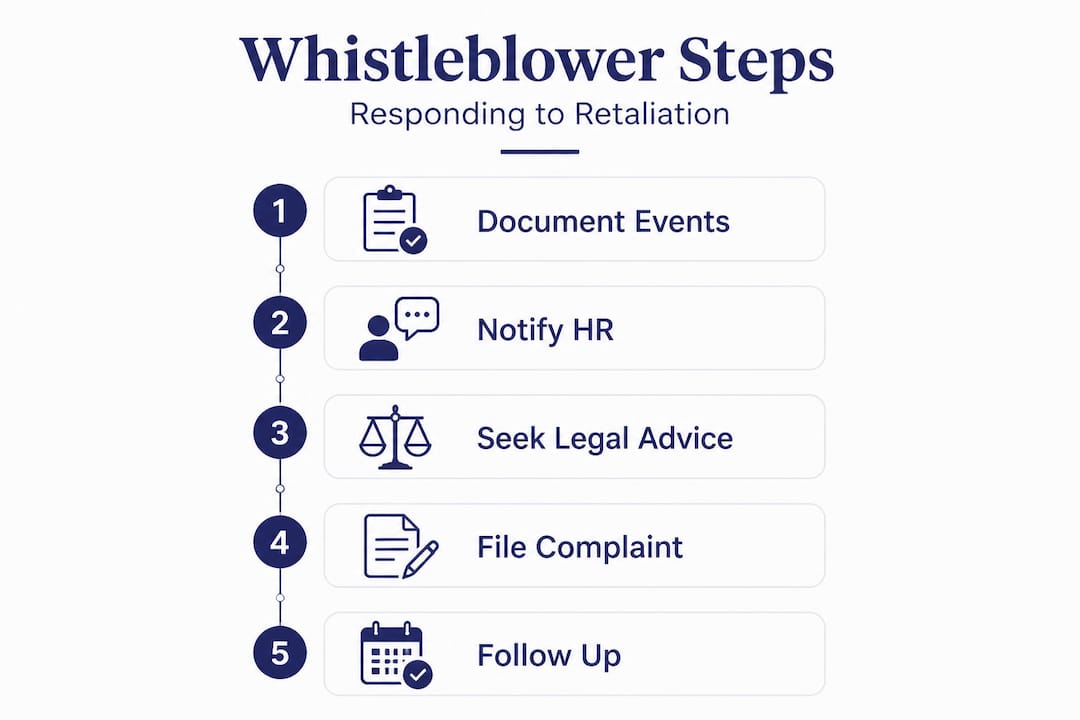
Knowing the law is one thing. Acting correctly in the middle of a stressful workplace situation is another. Here is a concrete action plan for corporate employees in Hancock Park who are considering reporting misconduct or who are already facing fallout from a report they made.
Step-by-step action guide:
- Document the underlying concern first. Before you report anything, write down what you observed, including dates, locations, people involved, and what was said or done. Specifics matter more than volume.
- Report internally in writing. Use email rather than a phone call or a casual conversation. Address it to HR or your direct supervisor and use a subject line that clearly identifies it as a compliance concern.
- Report externally if internal channels fail. California employees have the right to contact the Labor Commissioner, Cal/OSHA, or other relevant agencies. Protected activities explicitly include reporting to government bodies, and doing so adds a layer of legal protection your employer cannot easily dispute.
- Save copies of everything off company systems. Use a personal email address or a personal storage device. Employers have been known to revoke system access quickly once they realize an employee is building a record.
- Consult an employment attorney as early as possible. Early legal guidance shapes the entire outcome of a potential claim.
Evidence that strengthens your position:
- Emails and messages showing when you raised the concern
- Performance reviews from before and after the report
- Written communications referencing your complaint
- Compensation records showing any changes after the report
- Witness statements from colleagues
Mistakes to avoid:
- Relying solely on verbal complaints with no written follow-up
- Waiting months before taking any formal action
- Discussing your concerns publicly on social media before consulting counsel
- Signing a separation agreement without having an attorney review it first
Pro Tip: If you hold a leadership position in a Hancock Park firm, your situation may carry additional complexity. The stakes are higher, the employer’s response may be more aggressive, and your severance negotiation can be tied directly to how your whistleblower claim is handled. Executive retaliation protection is a specialized area, and it requires legal support that understands both employment law and the realities of senior professional roles.
California’s entertainment and media corridors also create unique reporting situations. If your work touches any aspect of production, content, or media operations, whistleblower protection in adjacent industries follows similar legal frameworks, and the same documentation principles apply.
What most experts miss about whistleblower protection
Most guides about whistleblower protection focus on the obvious scenarios: a courageous employee sees fraud, reports it to the government, and becomes a protected whistleblower. That is the cleanest version of the story. Real corporate life in Hancock Park is rarely that clean.
The truth is that the gray areas are where most employees actually live. They witnessed something that might be a violation. They were told to do something they felt uncomfortable about. They were present in a meeting where something questionable happened. Standard legal advice does not always address these scenarios with the nuance they deserve, and employees end up either staying silent out of uncertainty or acting without understanding their exposure.
Here is what we believe most commentary misses: documentation is more valuable than the report itself. We have seen situations where employees made textbook complaints to HR, followed every formal step, and still struggled to build a strong retaliation case because they had no contemporaneous records. Meanwhile, employees who quietly kept detailed journals, saved emails, and noted behavioral changes in writing consistently put themselves in stronger legal positions.
Another overlooked reality: retaliation in corporate settings often comes in waves, not a single act. An employee raises a concern, and nothing happens immediately. Then, three months later, a project gets reassigned. Four months after that, a performance review shifts in tone. Five months later, a bonus disappears. Each incident, standing alone, seems minor. Together, they form a pattern of illegal retaliation. Recognizing this pattern early is critical, and it requires that you stay alert long after the initial report.
Hancock Park’s concentration of private firms, particularly those connected to the entertainment economy and financial sector, creates a specific risk profile. Executives and senior managers in these companies are often pressured to stay loyal precisely because their departure could create regulatory scrutiny. That pressure is exactly when your legal protections matter most. For context on how LA media firms handle job cuts and the retaliation patterns that follow, the picture is rarely simple.
Do not wait for the situation to become obvious. If something feels wrong, start building your record now.
Connect with local employment experts to protect your rights
Understanding whistleblower law is the first step. Enforcing your rights is a different challenge, and one that benefits from experienced legal support. Shirazi Law Office works exclusively in employment law, representing corporate employees, executives, and senior professionals throughout Los Angeles. If you are facing retaliation or believe your employer has crossed a legal line, you deserve guidance from someone who understands the full weight of what you are dealing with. Explore your options through employee rights guidance tailored to California law. Whether you are navigating Hollywood retaliation claims or need immediate counsel on a Hancock Park situation, Brian Y. Shirazi is ready to review your case personally. Reach out today through LA workplace retaliation help and take the first step toward protecting your career, your income, and your future.
Frequently asked questions
Are Hancock Park corporate employees protected when reporting internally?
Yes, internal reports to supervisors or HR are protected activities under California law, even when the employee’s belief in the wrongdoing turns out to be mistaken but was reasonable at the time.
Does protection extend to employees involved in workplace wrongdoing?
Yes, employees who report misconduct they participated in can still receive legal protection, provided their belief in the violation was reasonable and they acted in good faith when reporting.
What qualifies as retaliation under California law?
Retaliation includes firing, demotion, pay cuts, denial of bonuses, exclusion from projects, and creating conditions that pressure an employee to resign, all following an act of protected reporting.
What steps should corporate employees in Hancock Park take after facing retaliation?
Document every incident with dates and specific details, follow up all complaints in writing, preserve records outside company systems, and consult with a qualified employment attorney promptly to protect your legal options before any filing deadlines pass.
Recommended
- Executive Retaliation Claims After Whistleblowing in Century City – Law Office of Brian Y. Shirazi, PC
- Wrongful Termination After Whistleblowing in Downtown LA
- Retaliation on Hollywood Sets – Legal Protections for Whistleblowers
- Wrongful Termination After Reporting Misconduct: Legal Impact on Downtown Los Angeles Executives – Law Office of Brian Y. Shirazi, PC
- Los Angeles Employee Rights After Reporting Misconduct – California United Law Group


[…] Read the article here. […]
Your content always feels genuine and heartfelt to me
This post came at exactly the right moment when I needed encouragement most 💎