
You just got fired. Or maybe your manager has been making comments that cross a clear line. Either way, you’re searching “best employment attorneys near me” at midnight, clicking through websites that all say roughly the same thing, and wondering how you’re supposed to tell a qualified advocate from a well-marketed one. Knowing how to choose an employment lawyer is one of the most consequential decisions you’ll face in a workplace dispute, and getting it wrong doesn’t just cost you money. It can cost you your case. This guide walks you through every step with specificity, not platitudes.
Table of Contents
- What you need before choosing an employment lawyer
- Step-by-step process for finding and evaluating employment lawyers in Los Angeles
- Questions to ask during your initial consultation with an employment lawyer
- Common pitfalls and red flags when selecting an employment lawyer in California
- What to expect after choosing your employment lawyer and beginning your case
- Why the usual advice on picking an employment lawyer often misses the mark for Los Angeles employees
- Connect with experienced employment lawyers in Los Angeles neighborhoods
- Frequently asked questions
What you need before choosing an employment lawyer
Before you start comparing attorneys, take stock of what you’re bringing to the table. Your preparation directly shapes how productive your first consultation will be and signals to any serious lawyer that you’re a client worth taking on.
Start by gathering your core documentation. Employment disputes run on paper trails, and the more organized yours is, the faster a lawyer can assess the strength of your claim.
Essential documents and why they matter
| Document | Why it matters |
|---|---|
| Employment contract or offer letter | Establishes agreed terms, role, compensation, and at-will status |
| Performance reviews | Contradicts pretextual firing claims or shows retaliatory timing |
| Emails and text messages | Proves discriminatory remarks, hostile behavior, or policy violations |
| Personnel action notices | Shows official HR decisions, dates, and stated reasons |
| Payroll records | Critical in wage and hour disputes |
| Witness names and contact info | Supports credibility and corroboration |
| Company handbook or policies | Reveals if proper procedures were followed or violated |
Next, know your legal category. Wrongful termination, sexual harassment, wage theft, and pregnancy discrimination each have different legal standards, administrative agencies, and timelines. You don’t need to know California law inside and out. But you do need to know which category your situation falls into, because that shapes which attorneys have relevant experience.
Timing is not optional. For federal discrimination claims, you have just 45 days to contact an EEO Counselor after the discriminatory act or personnel action before your ability to pursue federal remedies is at serious risk. Many employees miss this window entirely because they spent weeks in denial or informal HR conversations.
Also, be aware of California’s Senate Bill 37 (SB 37), which governs attorney advertising in the state. Any lawyer advertising their services must include their name and official office location. If a website or ad lacks these disclosures, treat it as a warning sign before you even pick up the phone.
Finally, know what you want. A six-figure settlement? Reinstatement to your job? A public acknowledgment of wrongdoing? Your goals affect strategy, and a good lawyer will ask about them early. Being clear on this before the consultation saves time and shows that you’re serious.
Pro Tip: Practice communicating with legal counsel by writing out a one-page summary of your situation before your first call. Lawyers assess cases quickly. A clear, chronological summary gives them what they need to give you an honest assessment.
Step-by-step process for finding and evaluating employment lawyers in Los Angeles
With your documents and timelines ready, here’s how to find and thoroughly evaluate candidates for your case.
-
Search verified directories first. Use the California State Bar’s attorney search, the Los Angeles County Bar Association’s referral service, or platforms like Super Lawyers to build an initial list. These sources include licensing status and practice area filters.
-
Verify the license and disciplinary record. Every California attorney has a publicly searchable record with the State Bar. Look up anyone you’re seriously considering. A discipline record isn’t automatically disqualifying, but undisclosed issues are.
-
Confirm SB 37 advertising disclosures. Any lawyer advertising their services in California must display their name and official office location. No disclosure means no compliance, and that’s a character data point.
-
Check for relevant case experience. Selecting employment attorneys with experience in cases similar to yours and a clear communication style is essential. A lawyer who handles mostly wage claims may not be the right fit for a complex executive termination involving a non-compete clause.
-
Interview at least two or three lawyers. Most employment attorneys in Los Angeles offer free initial consultations. Use them. You’re not just evaluating credentials; you’re evaluating how they listen, how they explain your options, and whether they treat your situation seriously.
-
Compare your options by firm type. This is where many employees get confused.
Employment lawyer type comparison
| Lawyer type | Pros | Cons |
|---|---|---|
| Solo practitioner | Direct attorney access, personal attention, often lower overhead | Limited capacity during complex litigation |
| Boutique employment firm | Focused expertise, collaborative resources, experienced support staff | Less personal than solo; varies widely in quality |
| Large general practice firm | Broad resources, multiple practice areas under one roof | Your case may not be a priority; less specialization |
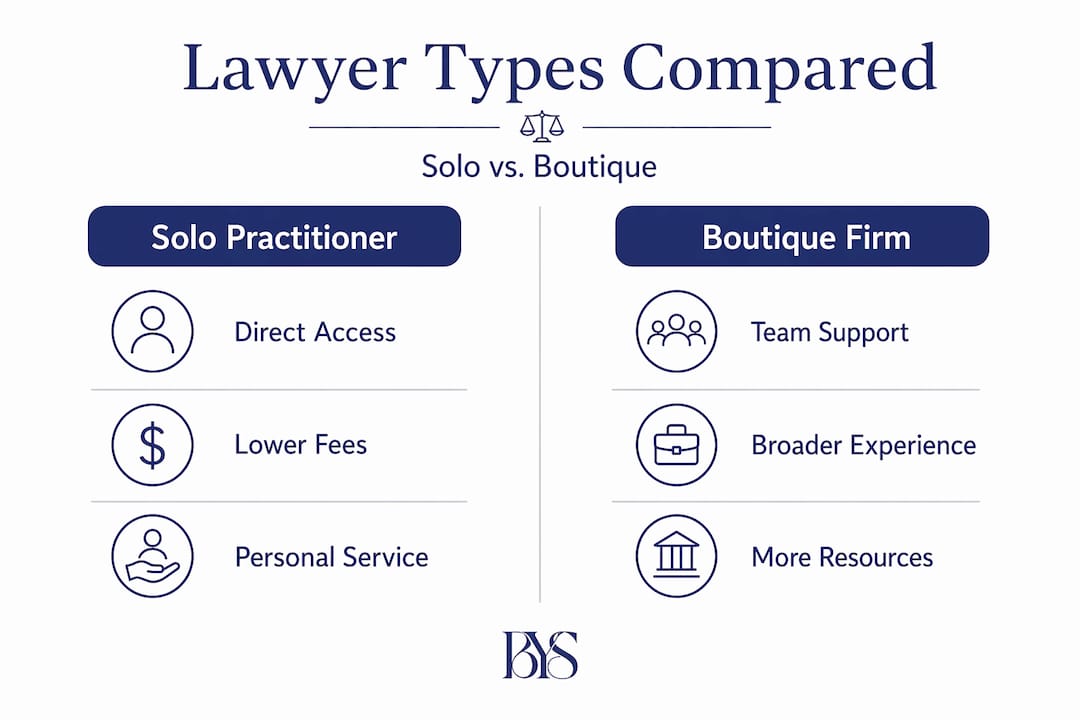
For Los Angeles employees dealing with harassment, wrongful termination, or discrimination, a solo practitioner or boutique firm often provides the most focused attention. A large firm may have the name recognition, but your case might be handled by a junior associate you’ve never met.

Pro Tip: When researching employment lawyers in Los Angeles or looking into employment lawyers in Hollywood, pay attention to how quickly their office responds to your initial inquiry. Responsiveness during intake often predicts responsiveness throughout your case.
Questions to ask during your initial consultation with an employment lawyer
Once you identify potential lawyers, these questions help you assess if they are the right fit for your needs.
Ask specifically and expect specific answers. Vague responses to direct questions are a pattern, not a one-time slip.
- How many cases similar to mine have you handled in California? Experience with wrongful termination in Westwood or sexual harassment disputes in Century City is not the same as general civil litigation experience.
- Have any of these cases gone to trial? Settlement experience matters. Trial readiness matters more. A lawyer who has never faced a jury may fold under pressure when your employer refuses to negotiate fairly.
- What is your assessment of my case right now? An honest lawyer gives you a frank read, including weaknesses. One who immediately tells you your case is a winner before reviewing your documents is selling, not advising.
- Who will I actually be working with? Clarify who will be your main contact — the attorney, an associate, or a paralegal — because this directly affects case progress and how informed you stay throughout.
- What is your fee structure? Many employment lawyers in California work on contingency for discrimination or wrongful termination cases, meaning they only get paid if you win. Others charge hourly or require a retainer. Know this upfront. Ask about costs you may owe regardless of outcome.
- How often will you update me, and through what channel? Weekly emails? Phone calls on request? This question tells you how organized their practice is and whether your communication style will mesh with theirs.
Consider understanding client communication with lawyers before your consultation so you can have a more productive conversation.
Pro Tip: Do not choose an employment lawyer based on the lowest fee. A contingency lawyer who takes weak cases just to collect something offers you poor representation. Quality and fit matter far more than cost when your livelihood and professional reputation are on the line.
Common pitfalls and red flags when selecting an employment lawyer in California
Knowing what questions to ask is vital, but awareness of common pitfalls will protect you from unsuitable representation.
Here’s what to watch for:
- Missing SB 37 disclosures in advertising. If a lawyer’s ad or website doesn’t display their name and official office location, they are not compliant with California’s rules on attorney advertising.
- Guarantees of results. No ethical lawyer can promise you a win. SB 37 prohibits advertisements that claim guaranteed results or settlements within specific timeframes because these claims are inherently misleading.
- Slow or vague communication during intake. If it takes five days to get a callback about a consultation, imagine how long it takes when your deadline is approaching.
- No California employment law focus. A general practice lawyer who occasionally handles employment cases is not the same as someone whose entire practice centers on employee rights under California law.
- Pressure to sign immediately. Any lawyer who pushes you to retain them at the first meeting, before you’ve had time to compare options, is prioritizing their intake over your interests.
California’s SB 37 was designed specifically to reduce misleading attorney advertising. Treat ads as a starting point only. A polished billboard in Beverly Hills tells you nothing about whether that attorney has won a harassment case in the past three years.
If you’re reviewing experienced employment lawyers online, cross-reference what their websites claim against verified State Bar records and real case experience.
What to expect after choosing your employment lawyer and beginning your case
After selecting your lawyer carefully, here’s how your legal journey typically unfolds in California workplace cases.
The first steps your lawyer will take:
- Case fact analysis. Your attorney reviews every document you provide and identifies legal theories, timeline issues, and potential vulnerabilities in your claim.
- Administrative or court filing triage. Depending on whether your claim is federal or state, your lawyer decides whether to file with the EEOC, the California Civil Rights Department (formerly DFEH), or proceed directly to court.
- Decision on ADR or litigation. Many California employment disputes begin with mediation or alternative dispute resolution. Your lawyer advises on whether that benefits you or whether going straight to litigation is stronger given your facts.
- Discovery and document exchange. Both sides exchange evidence. Expect to participate in gathering additional records, responding to written questions (interrogatories), and possibly sitting for a deposition.
- Settlement negotiations or trial preparation. Most cases settle before trial, but only after formal EEOC counseling or alternative dispute resolution within roughly 30 days. Your lawyer should always be prepared for both paths.
What you should expect from your lawyer throughout:
- Regular case status updates, not just responses when you ask
- Clear explanations before you sign anything
- Honest assessments when new information changes the picture
- Advance notice of hearings, deadlines, and any required action on your part
Staying engaged with communicating with your lawyer throughout the process helps you remain an active participant rather than a passive bystander in your own case.
Why the usual advice on picking an employment lawyer often misses the mark for Los Angeles employees
Most articles about choosing an employment lawyer give you a checklist. Check the State Bar. Read reviews. Compare fees. That advice isn’t wrong. It’s just incomplete in ways that matter most when you’re in a time-sensitive, emotionally charged situation.
Here’s what gets left out.
Marketing budgets are not legal credentials. The attorneys with the most prominent online presence in the Los Angeles area have often invested heavily in ads, not cases. A lawyer running aggressive ad campaigns from a Century City office address does not automatically have trial experience or a deep roster of discrimination wins. Yet that’s often who employees find first.
The 45-day window changes everything. Most advice treats timing as a footnote. But quick action in discrimination cases is not just helpful; it is legally decisive. We’ve seen employees spend four weeks interviewing lawyers casually while their federal clock ran out. By the time they hired someone, their strongest legal avenue was closed.
Local knowledge is underrated. An attorney who regularly practices in Downtown Los Angeles or Mid-Wilshire understands the procedural culture of those courts, knows which mediators are effective, and can realistically predict how local agencies respond to specific claim types. That’s not something a well-reviewed attorney from another region can replicate quickly.
California’s SB 37 directs employees to treat lawyer advertisements as starting points and verify credentials directly through the State Bar. The law exists precisely because advertising can be sophisticated and misleading at the same time.
Trial readiness is your real leverage. Employers and their legal teams know which plaintiff’s attorneys will push to trial and which won’t. A lawyer with a reputation for settling everything is easier for an employer to lowball. When you hire an attorney who is genuinely prepared to litigate all the way through, your negotiating position is stronger from day one.
When searching for local employment lawyers in Los Angeles, ask directly: when did you last take a case to trial, and what was the outcome? The answer tells you more than any online review.
Pro Tip: Prioritize lawyers who can shift fluidly between mediation and litigation. The best outcomes often come from attorneys who enter settlement talks with a fully prepared case file and a trial date on the calendar.
Connect with experienced employment lawyers in Los Angeles neighborhoods
For trustworthy legal support in Los Angeles, consider these specialized employment law services to protect your rights effectively.
The Law Office of Brian Y. Shirazi, PC represents employees, executives, and senior managers across Los Angeles, including Mid-Wilshire, Beverly Grove, Westwood, and surrounding neighborhoods. The firm focuses entirely on workplace rights, handling wrongful termination cases in LA, discrimination, harassment, retaliation, and executive employment disputes. As an experienced employment lawyer in Los Angeles, Brian Y. Shirazi brings personal attention and determined advocacy to every case. If you’re unsure whether your situation qualifies, a free consultation is the right first step. You can also review your rights under California’s 2025 and 2026 discrimination laws to better understand where you stand before you call.
Frequently asked questions
How do I verify if an employment lawyer is licensed in California?
You can verify a lawyer’s license and disciplinary status through the California State Bar’s official online attorney search before signing any representation agreement.
What should I do if I think I faced workplace discrimination in California?
Contact an EEO Counselor within 45 days of the discriminatory act to preserve your right to pursue a federal claim through the EEOC counseling and complaint process.
Why is it important to avoid lawyers who guarantee results?
SB 37 prohibits guarantees of outcomes in attorney advertising because they are misleading; a lawyer making such promises is violating professional ethics rules and should not be trusted with your case.
How can I prepare for my initial consultation with an employment lawyer?
Bring organized case documents, know your goals, and prepare a list of questions covering the lawyer’s experience, communication style, and fee structure so the meeting is productive and not just introductory.
Are local Los Angeles lawyers better for my employment dispute?
Yes, in most cases. Local counsel understand regional court procedures, local agency practices, and neighborhood-specific workplace dynamics that out-of-area attorneys simply don’t have firsthand familiarity with.