TL;DR:
- Employees often misunderstand their rights and employer obligations during workplace investigations. Knowing the employer’s legal entity, following California law standards, and documenting every step are crucial for protecting oneself effectively. Seeking professional legal guidance ensures proper handling of complaints, fairness, and potential retaliation claims under California employment law.
When a workplace investigation begins, most employees feel immediate confusion about what rules apply, who governs the process, and what rights they actually have. If you work in or near the
Carthay Circle neighborhood of Los Angeles, that confusion is even greater because no reliable, source-backed information exists about a California employer specifically named “Carthay” with its own investigation policies. What does exist, powerfully and clearly, is California law. California’s Fair Employment and Housing Act (FEHA) sets binding standards that apply to every employer in the state, regardless of neighborhood, industry, or company size.
Table of Contents
Key Takeaways
| Point |
Details |
| Legal entity matters |
Always identify your exact employer name to apply workplace rights and policies correctly. |
| FEHA governs investigations |
California FEHA sets clear requirements for prompt, fair, and documented workplace investigations. |
| Fairness demands notice |
You are entitled to notice of allegations and a chance to respond during an investigation. |
| Complaint deadlines |
Claims of harassment or discrimination with the CRD must be filed within three years. |
| Retaliation prevention |
Document everything and seek legal help if you suspect retaliation after reporting misconduct. |
Why identifying your employer’s legal entity matters
With the confusion around Carthay clarified, let’s discuss why knowing your employer’s legal entity is step one in protecting yourself.
Many employees refer to their workplace by its neighborhood or a shorthand name they hear every day. You might say “I work at Carthay” when you actually work for a corporation, LLC, or partnership with a completely different formal name. That distinction is not trivial. It can determine whether you file a complaint correctly, whether your lawsuit names the right defendant, and whether your attorney can obtain your employment records efficiently.
No reliable employer-specific information exists for a California entity named “Carthay” conducting workplace investigations. Carthay Circle is a recognized Los Angeles neighborhood, not a registered employer with its own HR policies or investigation framework. If someone told you that “Carthay policy” governs your situation, that is a red flag worth examining closely.
Here is why the legal entity name is so critical:
- Paystubs tell the truth. Your paystub lists the legal name of the entity that employs you. That is the name that matters for any complaint, demand letter, or lawsuit.
- Employee handbooks must match. If your handbook references one company name and your paystub lists another, you may be working for a parent company, subsidiary, or staffing agency rather than who you think.
- California labor agencies need the correct name. Filing a complaint with the California Civil Rights Department (CRD) under an incorrect employer name can delay or complicate your case.
- Court filings are unforgiving. A lawsuit naming the wrong entity wastes time and money and may trigger procedural dismissals.
“Your employer’s legal name is not just paperwork. It is the foundation of every legal right you plan to exercise.”
Pro Tip: Before any investigation begins or complaint is filed, pull your most recent paystub and your employment handbook. Write down the exact legal entity name listed. Cross-reference it with your offer letter. If all three match, you have the right name. If they differ, consult an employment attorney immediately.
Once you have confirmed your employer’s correct legal identity, applying California law becomes much cleaner and more effective.

California FEHA requirements for workplace investigations
Now that you know why employer identity matters, let’s unpack what California law actually demands from workplace investigations.
California’s Fair Employment and Housing Act is one of the most protective employment statutes in the country. It covers employers with five or more employees and requires them to take active steps to prevent and address harassment, discrimination, and retaliation. A
FEHA “reasonable steps” obligation means employers cannot simply wait for problems to arise. They must have a written anti-harassment policy that outlines specific investigation steps.
According to CRD guidance, a legally compliant workplace investigation must be:
- Prompt. An employer should begin an investigation as soon as a complaint is received or misconduct is observed. Delays of weeks or months without explanation can themselves constitute a FEHA violation.
- Thorough. Investigators must interview the complainant, the accused, and any relevant witnesses. Reviewing documents, emails, surveillance footage, and other evidence is part of the job.
- Fair and impartial. The investigator must not have a personal stake in the outcome. Using a supervisor who is friends with the accused, for example, compromises impartiality.
- Documented. Written records of interviews, findings, and remedial steps must be maintained. Poor documentation is one of the most common employer failures in litigation.
- Followed by action. Finding misconduct and doing nothing about it is not a defense. Employers must implement corrective measures or face liability.
Understanding these
sexual harassment workplace standards gives you a benchmark. If your employer’s investigation falls short on any of these points, that shortfall matters legally.
| Investigation element |
Good investigation |
Problematic investigation |
| Timing |
Begins within days of complaint |
Delayed weeks without explanation |
| Investigator |
Neutral third party or HR professional |
Accused’s supervisor or close colleague |
| Witness interviews |
All relevant witnesses interviewed |
Only the accused and complainant interviewed |
| Documentation |
Detailed written records kept |
Little to no documentation |
| Follow-up |
Concrete corrective action taken |
No action or vague promises |
This comparison is not abstract. Courts and CRD investigators examine exactly these factors when determining whether an employer took its legal obligations seriously. If you suspect your investigation was flawed, this table is a useful starting point for evaluating what went wrong.
Navigating investigations: Notice, response, and fairness
Understanding the general requirements, let’s zoom in on how fairness operates during an actual investigation.
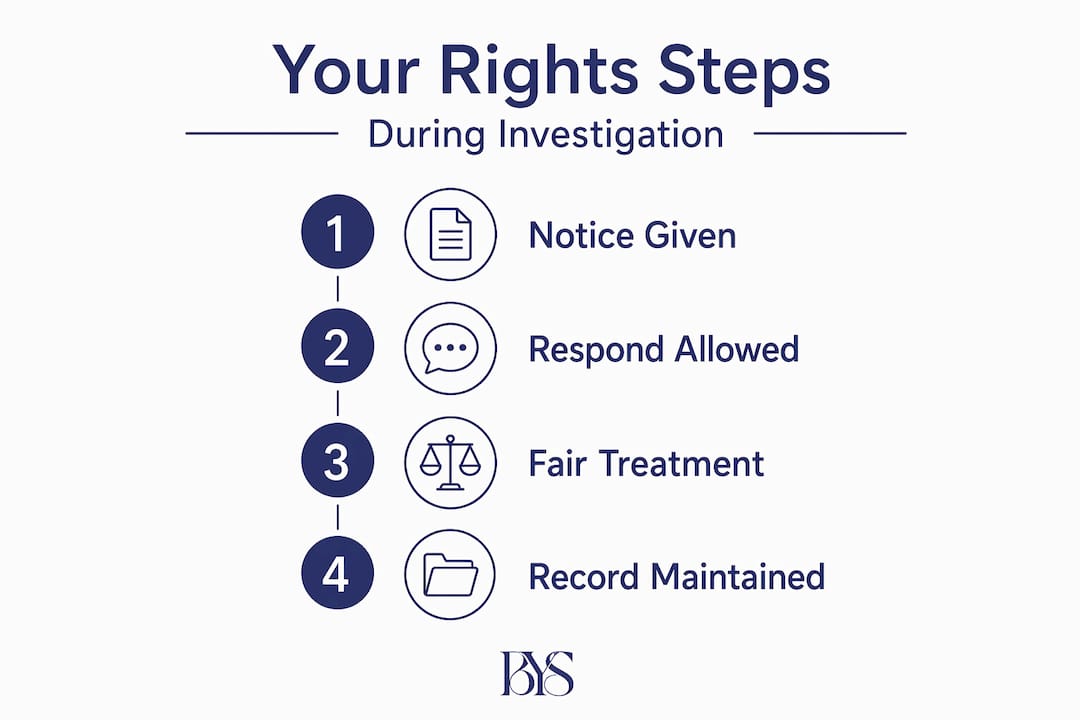
When you are named as a respondent in a workplace investigation, you may feel blindsided and powerless. But procedural fairness gives you specific rights that the process must honor. Specifically,
procedural fairness centers on giving respondents notice of allegations and a meaningful opportunity to respond during the evidentiary phase. This principle is widely recognized across employment law jurisdictions and applies as a foundational standard in California investigations as well.
Here is what procedural fairness typically looks like in practice:
- You receive written or verbal notice of the allegations against you before any interview.
- You are given adequate time to gather your thoughts, consult a personal advisor, or seek legal counsel before responding.
- The investigator presents the core allegations and asks for your account, not just confirmation of what others have said.
- You have an opportunity to identify witnesses or evidence that supports your perspective.
- A decision is not made about you before your side of the story is heard and considered.
What fairness does
not require is for the investigator to accept your version of events, share every piece of evidence gathered, or delay the process indefinitely. Investigators retain the authority to make credibility determinations and weigh competing accounts. That judgment phase is separate from the procedural fairness phase.
| Your right during investigation |
What it means in practice |
| Notice of allegations |
You know what you’re being accused of before your interview |
| Opportunity to respond |
Your account is solicited and documented |
| Witness identification |
You can name people who can support your position |
| Legal consultation |
You may seek personal legal advice before or during the process |
If the investigation that led to your
wrongful termination legal impact denied you any of these rights, that procedural failure can strengthen your legal claim considerably. Courts take shortcuts seriously, especially when a job is on the line.
Pro Tip: If you are called into an investigation interview, ask in writing beforehand whether you will be informed of the allegations prior to the meeting. Keep a copy of any response you receive. This simple step creates a paper trail that documents how your employer handled its procedural obligations.
Filing complaints and avoiding retaliation
After fairness in investigations, it is critical to know your complaint options and how to protect yourself from retaliation.
If your employer’s investigation was flawed, biased, or resulted in an unjust outcome, California law gives you formal channels to push back. The primary avenue is filing a complaint with the California Civil Rights Department, formerly known as the Department of Fair Employment and Housing (DFEH). A CRD complaint deadline of three years from the date of the alleged unlawful act applies to harassment and discrimination claims under FEHA. Missing this deadline typically forecloses your right to sue.
Here is how the CRD filing process works:
- Document the incident and its date. You need a clear record of what happened, when it happened, and who was involved.
- File online or by phone. The CRD accepts complaints through its online portal or by calling their intake line. You do not need an attorney to file, though legal guidance is strongly recommended.
- Receive a right-to-sue notice. After filing, the CRD may investigate or issue a right-to-sue notice allowing you to pursue litigation in civil court.
- File a civil lawsuit if warranted. With a right-to-sue notice, you can bring claims in California Superior Court for damages including back pay, emotional distress, and attorney’s fees.
Beyond filing correctly, you must protect yourself from retaliation. California law prohibits employers from taking adverse action against employees who report harassment, discrimination, or participate in an investigation. Adverse actions include termination, demotion, pay cuts, schedule changes intended to penalize you, or creating a hostile environment after you speak up.
Steps to guard against
workplace retaliation protections include:
- Keeping a personal log with dates, times, and details of any negative treatment after you report.
- Saving emails, texts, or voicemails that suggest retaliation.
- Reporting the retaliatory behavior separately from your original complaint.
- Consulting with an attorney who handles executive retaliation guidance if you are in a senior role and facing complex repercussions.
“Retaliation claims are often more powerful than the underlying discrimination claims because they show a pattern of wrongful conduct. Do not underestimate their value.”
Documenting everything from day one is the single most effective thing you can do to protect your legal position.
Employer risks and employee strategies: Investigations as legal defense
Finally, understanding how investigations are used legally can help you protect your interests and assert your rights.
Many employees do not realize that their employer’s investigation is not always a neutral fact-finding mission. Employers frequently commission or conduct investigations partly to build a legal defense. If a lawsuit follows, they point to the investigation as evidence they took “reasonable steps” to address misconduct. This is a legitimate defense strategy under California law. But it carries significant risk for employers too.
Specifically,
employer investigations create legal risk for employers if used defensively in ways that compromise attorney-client privilege or work-product protections. California courts have found that when employers rely on an investigation as a defense in litigation, they may waive those protections and be required to disclose the full investigation record, including notes, communications, and witness statements. This is known as the “sword and shield” problem: you cannot use the investigation as a sword to defend yourself while shielding its contents from the opposing party.
For you as an employee, this means several important things:
- The investigation record, including witness statements and investigator notes, may eventually be discoverable in litigation.
- You should request copies of all documents related to the investigation that concern you, including any reports or findings.
- If you are denied access, an attorney can file discovery requests to compel disclosure during litigation.
- The investigation timeline itself can be used to show unreasonable delays or biased procedures.
“Investigations that look thorough on the surface sometimes reveal their flaws under legal scrutiny. Don’t accept conclusions at face value.”
Your best strategy is to build your own parallel record. Write down what happened during every investigation meeting. Note who was present, what questions were asked, and what you said. Track every piece of communication related to the investigation. If you reported
harassment retaliation and the investigation concluded without meaningful corrective action, your documented timeline becomes your most important asset.
Pro Tip: Treat every interaction with investigators or HR like a deposition. Be honest, be concise, and immediately afterward write down what was said. Your memory will fade faster than you expect, and these notes can be invaluable months later in legal proceedings.
The reality: What most employees miss when workplace investigations begin
After unpacking the complexities, it is time to share some hard-won perspective for employees facing these situations.
The single most common mistake we see is employees who focus entirely on the substance of what happened and completely overlook the procedural landscape. They assume the investigation will be fair, that HR is neutral, and that the right outcome will emerge naturally. That assumption is often wrong.
Employers set the rules of the investigation. They choose the investigator, control the timeline, and draft the findings. You are operating in their arena. That does not mean you are powerless. It means you need to be more organized and more legally aware than they expect you to be.
Most employees also wait too long to establish their own evidentiary timeline. They react to each development rather than proactively documenting from the start. By the time they consult an attorney, key details are fuzzy, emails have been deleted, and witnesses have been coached or have moved on.
The other gap we see repeatedly involves employer identity confusion, exactly the kind that surrounds the Carthay situation. Employees who are unsure who their legal employer is delay filing, name the wrong party in complaints, or accept investigation outcomes from entities that may not even have proper jurisdiction over their employment. Confirming your employer’s legal name sounds like a minor administrative step. In reality, it is the gateway to every right you hold under California law.
If you are facing a
whistleblowing retaliation claim or any investigation-related retaliation, the time to act is immediately. California law protects you, but only if you engage those protections before deadlines pass and evidence disappears.
Get expert help: Legal support for Carthay and greater Los Angeles
These practical steps set up your rights, and here is where professional help makes the real difference. If you work in Carthay, Mid-Wilshire, Century City, Beverly Hills, West Hollywood, or anywhere across Los Angeles, Shirazi Law Office stands ready to protect you. Whether you are facing wrongful termination, harassment, discrimination, or retaliation, Brian Y. Shirazi brings focused, personal attention to every case. Understanding your
employee rights under discrimination laws is the first step. Taking action with an experienced
Los Angeles employment lawyer by your side is what turns knowledge into results. Contact Shirazi Law Office today for a confidential consultation and let us help you assert the rights California law guarantees you.
Frequently asked questions
What should I do if my employer is listed as Carthay on paperwork but I can’t find Carthay-specific investigation policies?
Confirm the exact legal entity name from your paystub or handbook, because no Carthay-specific employer with its own investigation policy has been identified. Apply California FEHA standards and CRD guidance directly to your situation.
What deadlines apply for filing a workplace discrimination or harassment complaint in California?
A CRD complaint must be filed within three years of the date of the alleged unlawful act under FEHA. Missing this deadline typically ends your right to pursue a civil lawsuit.
Do California employers have to give me a chance to respond during an investigation?
Yes. Procedural fairness requires notice of the allegations and a meaningful opportunity to respond before any findings are made against you.
How can an employee protect themselves from retaliation after reporting misconduct?
Document every negative interaction after filing your complaint, and seek legal counsel promptly if you experience adverse treatment. CRD guidance emphasizes retaliation prevention as a core employer obligation throughout the investigation process.
Are workplace investigation findings always confidential in California?
Not necessarily. When employers use investigations as a legal defense, California courts may require disclosure of investigation records, potentially waiving attorney-client privilege in the process.
Recommended