
TL;DR:
- California bans non-compete agreements but employers may still pursue related trade secret claims and jurisdiction tactics.
- Fairfax fashion executives face risks from company restructuring, acquisitions, and cross-state employment laws.
- Early legal review and careful documentation are crucial for protecting against costly disputes during career transitions.
Many executives at Fairfax District fashion brands operate under a confident assumption: California bans non-compete agreements, so they have nothing to worry about. That assumption is understandable, but it can be dangerously incomplete. Even in California, former employers have found creative legal angles to pursue departing executives, using trade secret claims, jurisdiction tactics, and contract language that blurs the line between what’s prohibited and what might still stick. If you’re a senior professional in this industry, understanding where the real risks lie isn’t optional. It’s essential protection for your career, your reputation, and your future.
Table of Contents
- How non-compete disputes arise in Fairfax District fashion brands
- Understanding California law and Fairfax District realities
- Case study spotlight: Saks v. Shin and lessons for fashion leaders
- Strategic action steps for executives facing non-compete threats
- The uncomfortable truth: Non-compete risk isn’t zero for Fairfax executives
- Work with experienced counsel for your Fairfax employment law needs
- Frequently asked questions
Key Takeaways
| Point | Details |
|---|---|
| California bans non-competes | Most non-compete clauses are unenforceable for Fairfax District fashion executives under California law, but risks still exist. |
| Industry lawsuits happen elsewhere | Major fashion non-compete cases, like Saks v. Shin, show that litigation can arise even without public Fairfax disputes. |
| Proactive legal review is critical | Early contract review and strategic legal guidance are essential for executive job changes or responding to threats. |
| Trade secrets drive many disputes | Alleged theft of confidential data often leads to multi-claim lawsuits alongside non-compete charges. |
How non-compete disputes arise in Fairfax District fashion brands
The Fairfax District has long been a cornerstone of Los Angeles streetwear culture. Brands like Supreme, The Hundreds, and a rotating roster of independent labels have made this stretch of Fairfax Avenue a global destination for fashion insiders. But the landscape is shifting. The Fairfax District flagship closure of The Hundreds in 2025 signals that even iconic streetwear institutions are not immune to retail pressures. When companies downsize, restructure, or close, executive departures often follow and that’s precisely when non-compete disputes tend to surface.
It’s worth being direct about the current state of litigation in the area. No specific non-compete disputes involving executives or senior professionals from fashion brands located in the Fairfax District have been publicly identified in recent sources. That absence of litigation is not the same as an absence of risk. Many disputes are settled quietly, resolved through demand letters, or never publicized because executives capitulate to pressure from former employers.
What we do know is that the broader fashion industry is not immune to aggressive non-compete enforcement. High-profile disputes at luxury retail giants have raised awareness of how quickly a career transition can turn into a courtroom battle. For Fairfax executives, understanding these patterns is valuable preparation.
Here’s a look at the kinds of employment disputes that can arise in fashion brand settings:
| Dispute type | Common trigger | Typical legal claim |
|---|---|---|
| Non-compete violation | Executive joins competitor | Breach of contract |
| Trade secret theft | Data downloaded before exit | Misappropriation claim |
| Solicitation of clients | Bringing clients to new employer | Tortious interference |
| Breach of confidentiality | Sharing proprietary methods | Injunctive relief sought |
Understanding these categories helps you recognize risk before it materializes. The following factors in the Fairfax District’s fashion environment can create conditions where disputes become more likely:
- Brand closures and restructuring: When a company winds down operations, executives who move quickly to competitors may face scrutiny over client relationships and internal knowledge.
- Acquisition activity: Fashion brands that are acquired by larger holding groups often bring new employment contracts with more aggressive restrictive covenants.
- Cross-border employment: Many Fairfax-based brands have operations, investors, or parent companies in states where non-competes are more readily enforced.
- Executive access to sensitive data: Senior professionals routinely handle pricing strategies, vendor relationships, and creative direction materials that companies later claim as protectable trade secrets.
Understanding these dynamics helps you stay alert to risks that don’t announce themselves in advance. Executives who recognize the patterns early are far better positioned to protect themselves. If you’re already dealing with a difficult work environment, resources on Fairfax hostile work environments and Fairfax workplace retaliation can help you understand the fuller picture of your rights.
Understanding California law and Fairfax District realities
California’s position on non-compete agreements is genuinely distinctive. Under Business and Professions Code Section 16600, nearly every contractual clause that restricts an employee’s right to work for a competitor is void. This is not a gray area in California. The state has repeatedly reaffirmed and strengthened this prohibition, including updates that took effect in 2024 requiring employers to notify former employees that existing non-compete provisions in their contracts are unenforceable.

That said, knowing the rule doesn’t mean you’re automatically protected. The FTC’s 2024 nationwide non-compete ban was blocked by federal courts, meaning the national regulatory solution that many executives were counting on never materialized. State law still governs, and California’s law remains the strongest protection available. But here’s where fashion executives need to pay close attention.
| Jurisdiction | Non-compete stance | Key test applied |
|---|---|---|
| California | Virtually prohibited | No reasonableness test; near-total ban |
| Texas | Enforceable with limits | Reasonableness in scope, geography, time |
| New York | Enforceable with limits | Legitimate business interest test |
| Florida | Pro-enforcement | Presumed valid; employee must rebut |
| Federal (FTC) | Ban blocked by courts | No federal rule currently in effect |
This table illustrates why jurisdiction matters enormously. If your employer is headquartered in Texas or Florida, or if your contract contains a choice-of-law clause selecting another state’s law, you could face legal proceedings outside of California. Courts in those states may apply their own standards rather than California’s protective approach.
Additionally, non-compete claims rarely arrive alone. Employers frequently pair them with trade secret misappropriation claims, breach of fiduciary duty allegations, and requests for emergency injunctive relief. Even if the non-compete clause itself fails, these accompanying claims can be costly to defend and damaging to your reputation during the litigation process.
Pro Tip: Before signing any new employment agreement, have a California-licensed employment attorney review every restrictive covenant, including non-solicitation and confidentiality clauses. Some of these provisions can operate similarly to non-competes in practice, even if they’re not labeled that way.
Understanding LA non-compete law in detail gives you an enormous advantage. Executives in neighboring business districts like Century City have faced similar questions, and guidance on Century City agreement restrictions offers useful parallel context for understanding how courts evaluate these clauses across Los Angeles.
Case study spotlight: Saks v. Shin and lessons for fashion leaders
Few cases illustrate the stakes of a non-compete dispute better than the ongoing matter involving Saks Global and former Bergdorf Goodman Chief Merchant Yumi Shin. This case has become a closely watched example of how non-compete enforcement plays out in the modern fashion industry.
The dispute centers on a one-year non-compete agreement that Shin signed as part of her executive compensation package. When she accepted a senior role at Nordstrom, Saks and Neiman Marcus moved quickly to block her from starting. The lawsuit alleged not only breach of the non-compete clause, but also trade secret theft. According to filings, Shin was accused of downloading substantial amounts of internal data before her departure, a move that transformed what might have been a straightforward contract dispute into a multi-claim litigation battle.
The mechanics of the case reveal several critical patterns that every fashion executive should understand. First, the case is being litigated in Texas and Delaware courts, not New York or California. This jurisdiction selection is deliberate. Employers often choose venues where non-competes carry more legal weight and where emergency injunctions are easier to obtain. Second, the simultaneous bankruptcy proceedings at Saks have added procedural complexity, demonstrating that corporate restructuring and executive departures frequently collide in messy and unpredictable ways.
“What executives often fail to anticipate is that the litigation itself becomes the punishment. Even if you ultimately win, months or years of legal proceedings can delay your career, drain your resources, and damage relationships with your new employer before the case resolves.”
Here’s a step-by-step breakdown of how the Saks v. Shin dispute escalated, and what you can learn from each stage:
- Employment agreement review failure: Shin’s non-compete clause was embedded in an executive compensation document. Many executives in similar situations sign these documents during onboarding without fully analyzing the restrictive covenant language.
- Career opportunity emerged: A competitor offered a senior role. This is the moment where legal review of existing obligations is critical, not after the offer is accepted.
- Pre-exit data activity: Data was allegedly downloaded from company systems before departure. This single action transformed the case from a contract dispute into a federal trade secret claim.
- Emergency injunction sought: The former employer immediately sought a temporary restraining order to block Shin from starting at Nordstrom. Even a temporary injunction can derail a career transition for months.
- Multi-venue litigation: Proceedings were initiated in multiple courts, dramatically increasing the legal complexity and cost for all parties.
- Ongoing resolution: The case remains active, illustrating that these disputes rarely resolve quickly. Executives facing similar allegations should expect a prolonged process.
For executives navigating complex career moves, understanding how executive mobility cases proceed gives you a realistic view of what’s at stake if a dispute is not managed carefully from the start.
Strategic action steps for executives facing non-compete threats
Knowing the risks is only half the equation. Taking deliberate steps before, during, and after a job transition is what separates executives who navigate career moves cleanly from those who end up in costly disputes. Here is a practical framework drawn from the legal patterns we’ve examined.
California’s strong protections mean that CA employment counsel should be your first call, not your last resort, when you’re considering a move. Other states take a “reasonableness” approach to non-competes, meaning courts weigh the employer’s interest against your right to work. California rejects that balancing test entirely, but only California courts applying California law will give you that protection automatically.
Use the following checklist to protect yourself before and during a transition:
- Review every document you signed. Non-compete language can appear in offer letters, equity agreements, bonus documentation, and promotion paperwork, not just your original employment contract.
- Flag choice-of-law clauses. If your contract says disputes will be governed by another state’s law, that clause could be challenged in California but will still create immediate legal risk.
- Do not take company data. This point cannot be stated strongly enough. Even materials you created personally may be considered company property under your employment agreement. Downloading, forwarding, or saving any company files before your departure is the single most common trigger for trade secret claims.
- Be transparent with your new employer. Inform them of any restrictive covenants in your current contract before you accept a new role. Surprises after you start can damage trust and may expose your new employer to third-party litigation.
- Document your exit process carefully. Return all company devices and materials, confirm in writing that you’ve complied with departure obligations, and keep copies of all correspondence related to your resignation.
- Consult qualified counsel before accepting the new role. Not after you resign. Not after you receive a demand letter. Before you sign anything with a new employer.
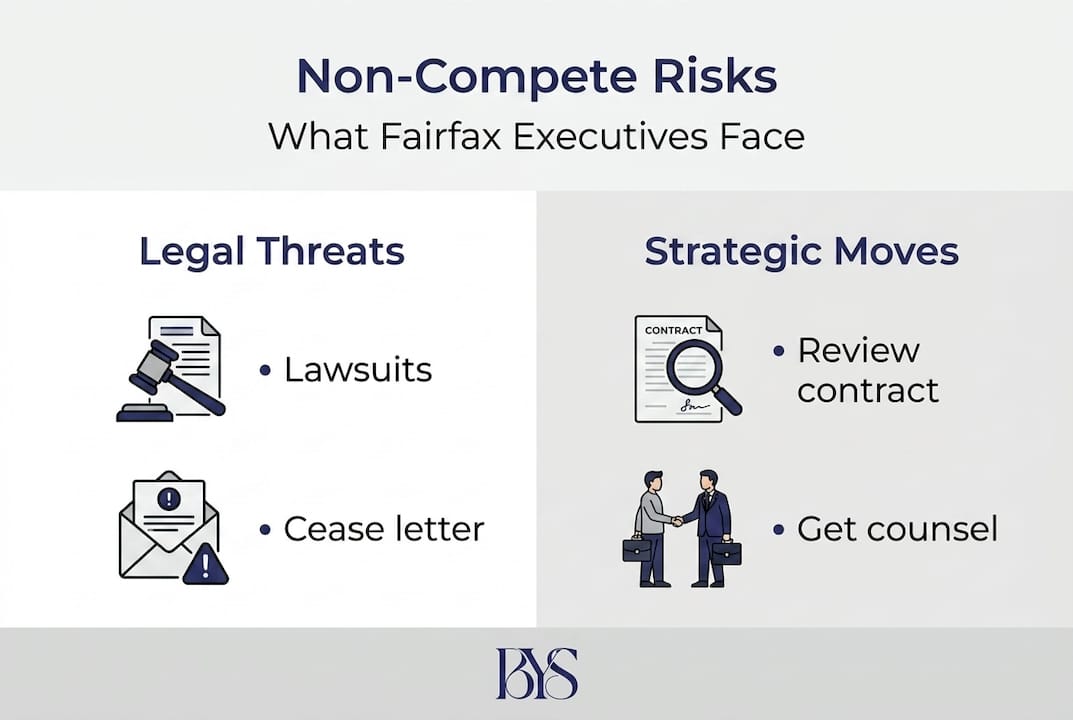
Pro Tip: If your former employer sends a cease-and-desist letter or demand letter after you leave, do not respond on your own. Every word in your response can be used in subsequent litigation. Refer the matter to an attorney immediately.
Working with Fairfax employment counsel who understands both California law and the fashion industry’s specific dynamics gives you a meaningful advantage. Executives in neighboring areas have encountered related issues, and resources on non-compete pitfalls in Westwood illustrate how consistently these concerns arise across Los Angeles neighborhoods.
The uncomfortable truth: Non-compete risk isn’t zero for Fairfax executives
Most legal guides stop at “California bans non-competes” and leave executives feeling fully protected. That’s a mistake. The real risk isn’t the non-compete clause standing alone. It’s the cluster of claims that arrive alongside it, including trade secret allegations, breach of fiduciary duty arguments, and emergency injunctions, that can halt your career even when the non-compete itself would never survive a California court.
Multi-state employers know exactly what they’re doing when they file in Texas or Delaware. The jurisdiction game is deliberate, and defending yourself in an out-of-state court is expensive, disruptive, and time-consuming even when you ultimately prevail. Add a trade secret claim triggered by something as simple as emailing yourself a presentation, and you’re suddenly defending on two fronts.
The executives who avoid these situations aren’t the ones who know California law. They’re the ones who plan carefully, consult counsel early, and understand that the goal isn’t just to win a lawsuit, it’s to avoid becoming a defendant in the first place. Complacency about California’s protections is the most common and most expensive mistake we see. Your rights are real, but they require strategic action to be meaningful.
Work with experienced counsel for your Fairfax employment law needs
If you’re a senior professional or executive in the Fairfax District navigating a career transition, contract dispute, or threatened non-compete claim, you deserve legal counsel who understands the fashion industry and California employment law in equal measure. Shirazi Law Office provides focused, personal representation for executives who face complex employment and separation challenges. Whether you need a contract reviewed before signing, guidance during a high-stakes departure, or aggressive representation against a former employer’s claims, the firm is ready to stand by your side. Explore your options with Los Angeles employment lawyers who specialize in these issues, get tailored executive dispute guidance, and learn how 2026 employee rights apply to your situation today.
Frequently asked questions
Can a Fairfax District fashion executive be sued for non-compete violation?
Yes, absolutely. While California bans most non-competes, executives can still face lawsuits over contract clauses, trade secrets, or if other state laws are involved, especially since the FTC’s nationwide ban was blocked by federal courts.
Are there any current Fairfax District non-compete lawsuits in fashion?
No public cases have been identified involving Fairfax District fashion brands specifically, but the risk remains real and active in the broader fashion industry, as seen in major disputes elsewhere.
What is the best first step if a former employer threatens a non-compete claim?
Consult a local California employment attorney immediately, because California’s pro-mobility standards differ sharply from other states, and early counsel can shape how the entire dispute unfolds.
Can non-compete clauses affect out-of-state career moves for fashion leaders?
Yes, significantly. The Saks v. Shin case illustrates how disputes can be filed in Texas or Delaware courts even when an executive worked primarily in another state, making it essential to review all agreements before accepting any new role.