

TL;DR:
- Disability discrimination in Los Angeles offices often occurs subtly, such as overlooked promotions or exclusion.
- California law (FEHA) provides broad protections, requiring reasonable accommodations unless undue hardship exists.
- Employees should document incidents promptly, follow official procedures, and seek legal advice early to protect their rights.
Disability discrimination is more common in Los Angeles corporate offices than most employees realize, and Mid-Wilshire’s dense concentration of media companies, financial firms, and professional service organizations makes it a particularly active environment for these violations. California’s employment laws offer some of the strongest worker protections in the country, yet many employees don’t know how to use them. This guide breaks down what disability discrimination actually looks like in a corporate office setting, which legal protections apply to you, and what concrete steps you can take to protect your career and your rights.
Table of Contents
- Understanding disability discrimination in Mid-Wilshire corporate offices
- Legal protections and employee rights
- How disability discrimination typically unfolds in corporate settings
- What to do if you experience disability discrimination
- Why most corporate employees underestimate disability discrimination risk
- Connect with experienced legal advocates
- Frequently asked questions
Key Takeaways
| Point | Details |
|---|---|
| Know your rights | California law gives you strong protections against disability discrimination in corporate offices. |
| Take prompt action | Document discrimination quickly and follow internal complaint procedures to strengthen your case. |
| Seek professional help | Consult experienced employment lawyers to ensure your rights are enforced and remedies are pursued. |
| Understand subtle biases | Discrimination can be subtle; stay vigilant and proactive in identifying microaggressions and exclusion. |
Understanding disability discrimination in Mid-Wilshire corporate offices
Disability discrimination, at its core, is any adverse employment action taken against an employee because of a physical or mental disability. Under California law, that definition is broader than most people expect. The California Fair Employment and Housing Act (FEHA) defines “disability” expansively to include conditions that limit a major life activity, even temporarily. This means chronic migraines, anxiety disorders, back injuries, and many other conditions qualify for legal protection, not just visible or severe impairments.
In Mid-Wilshire’s corporate sector, LA workplace disability rights are frequently tested in settings that appear modern and inclusive on the surface. The reality is that discrimination often surfaces in ways that aren’t obvious at first glance.
Common examples in Mid-Wilshire corporate offices include:
- Passing over a qualified employee with a disability for a promotion in favor of a less experienced colleague
- Denying remote work or flexible scheduling as a reasonable accommodation without engaging in any interactive process
- Excluding employees with disabilities from client-facing roles based on stereotypes about their capabilities
- Making offensive comments about an employee’s medical condition, even framed as “concern”
- Structuring layoffs in ways that disproportionately impact employees who recently disclosed disabilities or requested accommodations
One of the most persistent misconceptions is that discrimination requires malicious intent. It doesn’t. A manager who genuinely believes they’re “protecting” a disabled employee by removing responsibilities is still engaging in discriminatory behavior if that action is unwanted and based on disability status. Bias in corporate settings often operates through soft-touch decisions, reassigning accounts, excluding someone from travel opportunities, or quietly reducing an employee’s responsibilities.
Subtle biases show up in performance reviews too. An employee who requests accommodation may suddenly receive lower ratings that were never an issue before. That pattern, while hard to pinpoint in isolation, becomes significant when documented over time.
Consider creative agency disability bias cases, which illustrate how professional environments that prize high performance can unintentionally or deliberately push out employees who need accommodations.
Pro Tip: Keep a running log of every incident, email, meeting, or verbal comment related to your disability or accommodation request. Include dates, times, witnesses, and the exact words used. This documentation is often the most powerful tool in any future legal claim.
Legal protections and employee rights
With a clear understanding of what discrimination looks like, we can move into the specific legal protections that empower Mid-Wilshire employees to push back.
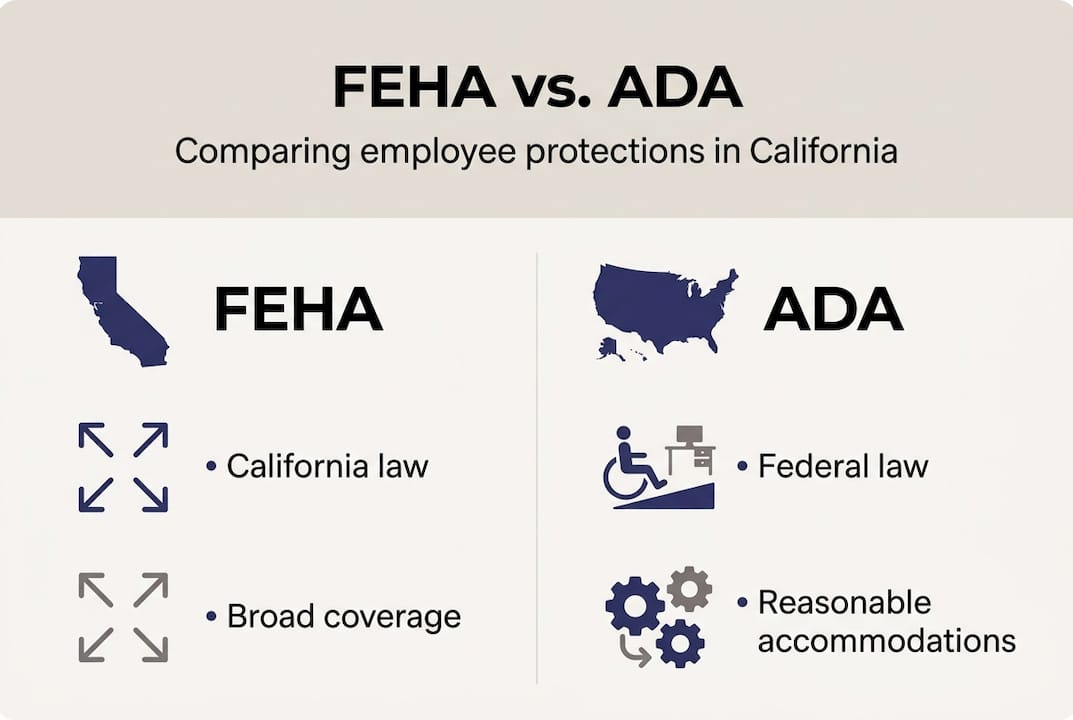
California’s FEHA is the primary shield for most employees facing disability discrimination in the state. It applies to employers with five or more employees and covers a wider range of disabilities than the federal Americans with Disabilities Act (ADA). The ADA, which applies to employers with 15 or more employees, provides a critical baseline of federal protection. However, California’s FEHA typically offers stronger remedies and a broader scope, which is why most California employees benefit more from pursuing claims under state law.
Key legal mandate: Under FEHA, employers are required to provide reasonable accommodations to qualified employees with disabilities unless doing so would cause undue hardship to the business. The employer must also engage in a timely, good-faith interactive process with the employee to identify possible accommodations.
Westwood accommodation rights cases consistently show that employers who skip or delay the interactive process expose themselves to significant legal liability, even if they eventually offer an accommodation.
Comparison: FEHA vs. ADA protections
| Feature | California FEHA | Federal ADA |
|---|---|---|
| Employer size threshold | 5+ employees | 15+ employees |
| Definition of disability | Broader, includes more conditions | Narrower definition |
| Scope of accommodation duty | Strong, includes interactive process | Required but less robust |
| Remedies available | Broader, including emotional distress | More limited |
| Agency enforcement | California Civil Rights Department | EEOC |
Steps employees can take to assert their rights:
- Request accommodations in writing. Submit your request formally to HR or your manager, and keep a copy for yourself.
- Participate in the interactive process. Engage genuinely, but document every meeting and every request for medical information.
- Track the employer’s response timeline. Unreasonable delays in responding to accommodation requests can themselves constitute a legal violation.
- File a complaint with the California Civil Rights Department (CRD) if your employer fails to accommodate or retaliates against you.
- Consult an employment attorney before resigning or accepting any severance, as both decisions can significantly affect your legal options.
Understanding LA medical leave & disability rights is also essential because disability and medical leave often intersect. Employees taking leave under the California Family Rights Act (CFRA) or the federal Family and Medical Leave Act (FMLA) may also be entitled to additional protections under FEHA if their leave relates to a qualifying disability.
How disability discrimination typically unfolds in corporate settings
Knowing your rights is fundamental, but understanding how discrimination actually unfolds at work is what enables practical action.
In Mid-Wilshire corporate offices, disability discrimination rarely begins with a dramatic event. It builds slowly. An employee discloses a diagnosis or requests an accommodation, and shortly after, the tone of management interactions shifts. Projects are reassigned. Emails become curt. The employee is left off meeting invites. Then comes a formal performance improvement plan, and eventually termination.
Mid-Wilshire employment lawyer case patterns reveal that employees are often surprised by how quickly a workplace can turn hostile after a disclosure, even in organizations with robust HR policies on paper.
Overt vs. subtle disability discrimination: what to watch for
| Type | Overt discrimination | Subtle discrimination |
|---|---|---|
| Hiring | Rejected after disclosing disability in interview | Passed over without explanation after disclosure |
| Promotions | Told directly disability is a concern | Repeatedly overlooked with vague performance reasons |
| Accommodations | Flat denial with no process | Accommodation promised but never implemented |
| Termination | Fired immediately after medical leave | Managed out over months through poor reviews |
| Day-to-day treatment | Open mockery or hostile remarks | Exclusion from meetings, events, or communications |
Steps to take when you suspect discrimination:
- Write down every incident as soon as it happens, even if it seems minor at the time
- Save copies of all emails, performance reviews, and HR communications outside of company systems if possible
- Note any changes in how colleagues or managers treat you after an accommodation request
- Identify any coworkers who may have witnessed discriminatory behavior
- Review your company’s internal complaint procedure and follow it precisely so you create a formal record
The role of HR deserves careful consideration. HR exists to protect the company, not the employee. That doesn’t mean you should avoid HR, but it means you should approach the process strategically. Filing an internal complaint can be an important step in building your legal record, but you should do it with a clear understanding of what documentation you already have.

Downtown LA disability cases and Mid-Wilshire harassment guide resources both confirm that employees who document consistently and thoroughly have significantly stronger legal positions. Timing matters. California has strict deadlines for filing complaints, so taking action early is always better than waiting.
What to do if you experience disability discrimination
Armed with real case insight, the next crucial step is learning exactly how to react when you find yourself facing discrimination at your corporate office.
The hours and days immediately following a discriminatory incident are critical. Many employees freeze, minimize what happened, or assume things will improve. That instinct is understandable, but it can work against you. Acting promptly and methodically protects your legal rights and strengthens any future claim.
Actionable steps to take after a disability discrimination incident:
- Write it down immediately. Record what happened in as much detail as possible. Include the date, time, location, exactly what was said or done, and who was present. Even small details matter later.
- Preserve all written communications. Forward relevant emails to a personal account if your company policy allows it, or print them. Losing access to company systems after termination is common.
- Request your accommodation in writing if you haven’t already, and follow up any verbal conversations with a written summary sent via email.
- File an internal complaint with HR. Even if you don’t expect a favorable result, this creates a formal record and satisfies the procedural steps that may be required before filing an agency complaint.
- Consult an employment attorney before taking major steps. This includes before signing anything, before resigning, and before responding to any formal disciplinary action.
- File a complaint with the California Civil Rights Department. You generally have three years from the date of a FEHA violation to file, but acting sooner preserves evidence and witness memory.
LA workplace disability discrimination attorneys consistently emphasize that the quality of your documentation can be the single most decisive factor in your case. Employers regularly argue that adverse actions were performance-related, not disability-related. Your documentation is what tells a different story.
Understanding the medical leave & disability process is also essential if your disability requires you to take leave. Your right to return to your position after qualifying medical leave is legally protected, and interference with that right is itself a violation.
Pro Tip: After any conversation with HR or management about your accommodation or disability, send a follow-up email summarizing what was discussed and what was agreed upon. If your employer denies your accommodation, request that denial in writing. A written denial is powerful evidence in a legal proceeding.
Why most corporate employees underestimate disability discrimination risk
Before closing, it’s worth addressing something that doesn’t get said often enough: most employees in Mid-Wilshire corporate offices significantly underestimate how real and how close this risk is to them.
There’s a widespread assumption that progressive company culture and strong HR departments mean discrimination doesn’t happen at your workplace. That assumption is wrong. In fact, the workplaces that are most confident about their inclusive culture are often the ones where subtle discrimination has gone unaddressed the longest. When no one expects it, no one looks for it.
Employees also frequently delay seeking legal advice out of fear. Fear of retaliation, fear of damaging professional relationships, or simply not recognizing that what’s happening to them meets the legal definition of discrimination. That delay costs them. Evidence disappears. Deadlines pass. What started as a manageable situation becomes much harder to remedy.
The Westwood disability guide makes this point clearly: getting legal advice early doesn’t mean you’re committing to litigation. It means you’re informed. It means you can make strategic decisions rather than reactive ones. Proactive advocacy is almost always more effective than waiting until a situation becomes severe.
Your career, your livelihood, and your dignity are worth protecting before they are threatened, not only after.
Connect with experienced legal advocates
If you’re navigating disability discrimination in a Mid-Wilshire corporate office, you don’t have to face it alone. Shirazi Law Office provides strategic, results-driven representation for employees who are standing up to powerful employers. Whether you’re dealing with a denied accommodation, a hostile work environment following a disclosure, or a wrongful termination tied to your disability, experienced legal guidance makes a decisive difference. Learn more about your protections through LA disability discrimination lawyer resources and review the latest employee rights laws that apply to your situation. If your employment has been terminated, explore your options through Mid-Wilshire wrongful termination guidance. Contact Shirazi Law Office today to protect what you’ve built.
Frequently asked questions
What counts as disability discrimination in Mid-Wilshire corporate offices?
Disability discrimination includes unfair treatment, denial of reasonable accommodations, and any employment action based on your disability status, covering everything from hiring and promotion decisions to termination.
What legal protections are available for disabled employees in Los Angeles?
Both California’s FEHA and the federal ADA protect employees from discrimination and ensure access to reasonable accommodations, with FEHA offering broader disability accommodation rights and stronger remedies under California law.
How should I respond after experiencing disability discrimination at work?
Document all incidents in writing immediately, report the situation to HR using formal procedures, and consult with a qualified employment lawyer experienced in workplace disability discrimination to assess your legal options.
Can I be fired for requesting disability accommodations?
No. It is illegal under both FEHA and the ADA for employers to retaliate against or terminate you for seeking reasonable accommodations, and such retaliation may entitle you to additional legal remedies.
Recommended
- Mid-Wilshire sexual harassment claims guide for 2026 – Law Office of Brian Y. Shirazi, PC
- Workplace Disability Discrimination in LA | LA Employment Lawyer
- Westwood workplace disability discrimination guide 2026 – Law Office of Brian Y. Shirazi, PC
- Gender Discrimination Claims in Mid-Wilshire Firms – Law Office of Brian Y. Shirazi, PC