

TL;DR:
- California law protects film workers from hostile environments tied to protected traits, including freelancers.
- Power imbalances and industry-specific risks make Hollywood sets vulnerable to unreported harassment and retaliation.
- Reporting incidents promptly and documenting everything is crucial to defending rights and avoiding retaliation.
Hollywood sells glamour. But behind the scenes, the reality for many film workers is far less polished. Over 12,000 hostility complaints were filed in California in 2023, with the entertainment industry seeing among the highest rates. If you work on a film set in California, whether as crew, talent, or production staff, you have real legal protections. This guide breaks down what qualifies as a hostile work environment, why film sets carry unique risks, and what steps you can take to protect your career and your rights.
Table of Contents
- What is a hostile work environment on a film set?
- Common signs and unique risk factors on Hollywood sets
- Legal protections: Employee rights and employer responsibilities
- Notable case studies: Hollywood lawsuits, lessons, and gray areas
- A new way forward: Rethinking safety and advocacy on film sets
- Get help with hostile work environment concerns
- Frequently asked questions
Key Takeaways
| Point | Details |
|---|---|
| California’s broad protections | Film set workers—including freelancers—are covered by strong hostile work environment laws under FEHA. |
| High risk for film crews | Hollywood film sets have above-average hostility complaints due to unique power dynamics and industry pressures. |
| Reporting and documentation | Meticulous record-keeping and following proper complaint channels are crucial for successful claims. |
| Employer responsibility | Production companies must train, investigate, and prevent harassment or face strict legal liability in California. |
What is a hostile work environment on a film set?
With industry interest high, it’s crucial to understand what actually qualifies as illegal hostility. Not every difficult director or tense production qualifies under the law. California has a specific legal standard, and meeting it matters.
Under California’s Fair Employment and Housing Act (FEHA), a hostile work environment means unwelcome conduct based on protected characteristics such as sex, race, age, or disability that is severe or pervasive enough to create an abusive workplace. FEHA is the state law that governs most workplace discrimination and harassment claims in California, and it sets a high but achievable bar for legal action.
Protected classes under FEHA include:
- Sex and gender identity
- Race and ethnicity
- Age (40 and older)
- Disability, physical or mental
- Religion and national origin
- Sexual orientation
- Pregnancy status
On a film set, conduct that may cross the legal line includes repeated sexual comments from a director toward crew members, racial slurs by a producer, deliberate exclusion of a disabled grip from work assignments, or intimidation tied to a protected trait. These are not hypotheticals. They show up in real complaints.
Here is a quick look at how conduct is measured:
| Type of conduct | Likely qualifies | Likely does not qualify |
|---|---|---|
| Repeated racial slurs | Yes | |
| One rude comment about work quality | No | |
| Unwanted touching of a sexual nature | Yes | |
| Yelling about a missed shot | No | |
| Systematic exclusion based on religion | Yes | |
| General on-set tension or stress | No |
The reasonable person standard matters here. Courts ask whether a reasonable person in your position would find the environment hostile. Creative industries sometimes try to use artistic expression as cover. But California’s film set hostile work rules do not make exceptions for creative context when the conduct targets a protected class.
A common misconception: rudeness, harsh criticism, or a difficult personality is not the same as a legally hostile environment. The law is looking for a connection to a protected trait. If the hostility is purely about your craft performance and not your identity, it likely does not qualify. That distinction is important to understand before you pursue a claim.
Common signs and unique risk factors on Hollywood sets
Now that you know the legal definition, let’s explore why Hollywood sets are especially vulnerable to hostility. The film industry is not just another workplace. Its structure creates conditions where harassment can thrive and go unreported.
Up to 70% of victims do not report hostile behavior due to fear of retaliation. This is even more pronounced in film, where your next job often depends on the goodwill of the same person causing harm.
Here is how film sets compare to more traditional workplaces:
| Factor | Traditional office | Film set |
|---|---|---|
| Employment type | Permanent, salaried | Freelance, project-based |
| Reporting chain | HR department | Production company, sometimes same offender |
| Location | Fixed | Remote, on location, offsite |
| Hours | Standard | Extended, irregular |
| Union protection | Common | Varies widely by role |
The most common sources of risk on a film set include:
- Power imbalances between A-list talent, directors, and below-the-line crew
- Fear of career retaliation in a small, reputation-driven industry
- Remote and offsite filming that removes workers from standard oversight
- Freelance contracts that limit perceived rights and make workers feel replaceable
- Union status gaps where some workers are protected and others are not
Freelancers are particularly exposed. Many believe that working on a per-project basis strips them of legal protections. That is simply not true under California law, and we will address that directly in the next section.

Compared to other industries, entertainment sector complaint rates are significantly elevated relative to hospitality and retail. The combination of concentrated power, irregular hours, and career dependency creates a perfect storm for abuse.
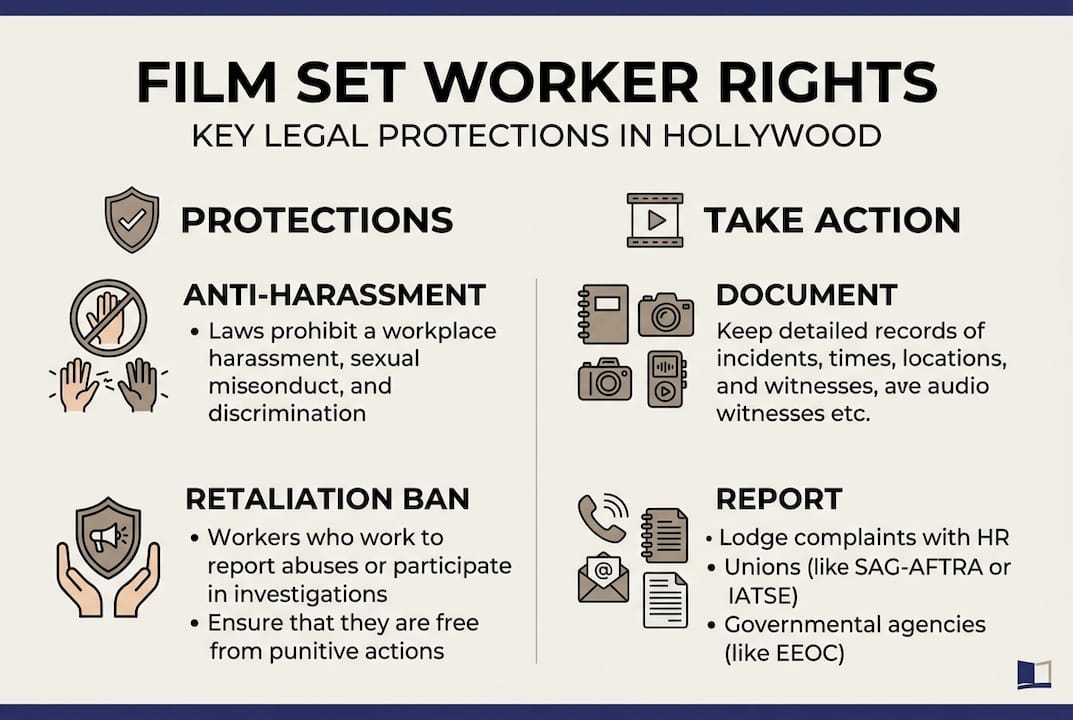
Pro Tip: Keep a private, time-stamped log of incidents, no matter how minor they seem. If you ever need to file a complaint, this record becomes one of your most powerful tools. Note who was present, what was said or done, and how it affected your ability to work.
For additional context on how these dynamics play out in real cases, Hollywood harassment lawsuit lessons offers a closer look at patterns seen across the industry.
Legal protections: Employee rights and employer responsibilities
Understanding the warning signs is important, but knowing your legal tools and protections is essential. California law goes further than federal law in several meaningful ways, and film workers should know exactly where they stand.
Federal law, specifically Title VII, generally covers employees at companies with 15 or more workers. California’s FEHA covers employers with 5 or more employees and extends protections to freelancers and independent contractors in many situations. That is a significant difference for an industry built on project-based work.
Employer obligations under California law include:
- Harassment prevention training for all employers with 5 or more employees
- Prompt investigation of any reported complaint
- Protection from retaliation for anyone who reports harassment
- Written anti-harassment policies made available to all workers
- Designated complaint channels that workers can actually access
On workplace harassment in California, the law draws a key distinction between supervisor conduct and coworker conduct. When a supervisor is the harasser, the employer is strictly liable, meaning the production company does not get to claim it didn’t know. For coworker harassment, liability attaches when the employer knew or should have known and failed to act.
Employers must provide harassment prevention training for companies with 5 or more employees, investigate all complaints promptly, and are strictly liable for any harassment carried out by a supervisor.
Documentation is your foundation. Report incidents in writing whenever possible, even if only by email to yourself or a trusted contact. Use the production company’s internal process first if it exists. Then, if no action is taken, you have the right to file a complaint with California’s Civil Rights Department (CRD) within 3 years of the incident.
Pro Tip: If you are unsure whether your situation qualifies, consult an attorney before filing. A missed procedural step can affect your claim. Understanding your options early protects your timeline.
Film workers in West Hollywood have specific resources available, and claims in West Hollywood are a good starting point for understanding your local options.
Notable case studies: Hollywood lawsuits, lessons, and gray areas
The law comes alive through the stories and outcomes of real film industry lawsuits. These cases are not just headlines. They reveal how courts interpret the rules and where the gray areas actually live.
Several recent cases illustrate how hostile work environment law applies on film sets:
- Kevin Costner stunt double lawsuit: A stunt double sued after an unscripted physically violent and intimate scene was performed without an intimacy coordinator or consent. The court found that a single severe act can be sufficient for a hostile environment claim. You do not need a pattern of repeated conduct if one incident is serious enough.
- Blake Lively vs. Justin Baldoni: Retaliation claims survived the pleading stage, showing that employers who respond to complaints with career-harming actions face real legal exposure. Harassment was examined within the filming context, but that context did not eliminate liability.
- Paramount executive assault claims: A studio-level case reinforcing that seniority does not grant immunity, and that entertainment industry case lessons often point back to failures in oversight at the top.
- Disney props department retaliation: An employee who reported discrimination was subsequently sidelined and denied opportunities. The retaliation claim succeeded independently of the original harassment claim.
A critical legal insight: retaliation claims often outlive the original harassment claims. Even if a harassment claim is disputed, punishing someone for reporting it is a separate and equally serious violation. For more on Hollywood retaliation law, understanding this distinction is essential.
Gray areas unique to film include:
- Scripted scenes involving physical contact or nudity
- Method acting contexts where performers claim creative license
- Informal set hierarchies where power is implied but not formal
The consistent lesson from these cases is that consent and coordination matter. When intimacy coordinators are bypassed, or when power is used to override a worker’s ability to refuse, the creative context does not protect the employer.
A new way forward: Rethinking safety and advocacy on film sets
Beyond specific cases, what is the bigger lesson for today’s film professionals? Compliance alone is not enough. Studios that check the training box but ignore set culture are still creating liability.
From our experience representing workers in Los Angeles, the most overlooked risk is subtle retaliation. It rarely looks like a termination letter. It looks like fewer call-backs, being left off the crew list, or being reassigned to less visible projects. Most workers never connect those consequences to the complaint they filed six months earlier.
The film workers who fare best are those who treat safety protocols as advocacy tools, not just paperwork. Demanding an intimacy coordinator is not being difficult. It is asserting a right that protects everyone on set. Studios that understand this shift reduce both legal exposure and reputation harm.
Transparency inside production companies also matters more than most executives realize. Workers who trust the reporting process actually use it. That early reporting lets studios correct problems before they become lawsuits. Legal protections for whistleblowers exist precisely because retaliation is the biggest barrier to honest reporting. Knowing those protections exist, and using them, changes the calculus for workers who would otherwise stay silent.
Get help with hostile work environment concerns
If you’re facing a hostile environment on a film set or want to understand your rights before a situation escalates, speaking with an experienced attorney is the most important step you can take. Shirazi Law Office represents film industry employees, executives, and crew members throughout Los Angeles. We know how this industry operates and how California law applies to it.
As an employment lawyer in Los Angeles, Brian Y. Shirazi provides direct, personal attention to every case. Whether you are documenting an ongoing situation or ready to take action, we can help you understand your options clearly. You can also explore employee rights in California to get a broader picture of the protections available to you in 2026.
Frequently asked questions
What kinds of behavior create a hostile work environment on a film set?
Unwelcome conduct based on protected traits, like repeated harassment or a single severe incident, can qualify if it would create an abusive atmosphere for a reasonable person. Under California law, hostile work environment requires conduct that is severe or pervasive and tied to a protected characteristic.
Are independent contractors or freelancers on film sets protected under California law?
Yes. California’s FEHA protects freelancers and contractors from hostile work environments, unlike federal law. FEHA covers freelancers where federal Title VII generally does not, making California one of the strongest states for worker protections.
How do I report hostile behavior if I fear industry retaliation?
Document everything, report internally in writing when possible, and file a CRD complaint within 3 years of the incident. Retaliation is prohibited under California law, and whistleblower protections apply the moment you make a good-faith report.
Does one single incident ever qualify as a hostile environment?
Yes. A single serious act such as assault or a dangerous unscripted physical encounter can be enough if it is sufficiently severe. Courts look at the nature and impact of the incident, not just how many times it occurred.
Are creative acting scenes ever exempt from these laws?
Not automatically. Scenes may not qualify as harassment if they are scripted and truly consensual, but lack of consent or proper coordination can create liability. Lack of intimacy coordination or pressured participation has been found actionable in recent Hollywood cases.
Recommended
- Hollywood Workplace Defamation – Protecting Studio Careers – Law Office of Brian Y. Shirazi, PC
- Hostile Work Environment Claims in West Hollywood – Law Office of Brian Y. Shirazi, PC
- California film hostile work environments: 18% rise 2026 – Law Office of Brian Y. Shirazi, PC
- Retaliation on Hollywood Sets – Legal Protections for Whistleblowers