

TL;DR:
- California law protects pregnant employees in businesses with five or more workers.
- Subtle retaliation often includes schedule changes and reduced hours after accommodation requests.
- Document interactions and file a complaint promptly to assert your pregnancy-related workplace rights.
Many pregnant employees in Pico-Robertson assume that because their employer runs a small boutique, café, or family-owned shop, the law simply doesn’t apply. That assumption can cost you your job, your income, and your peace of mind. California’s FEHA covers businesses with 5+ employees, which is a much lower bar than federal law’s 15-employee minimum. This guide explains which businesses are covered, how to recognize subtle retaliation, what leave and accommodations you’re entitled to, and the concrete steps you can take to protect yourself right now.
Table of Contents
- Who’s protected: What laws cover pregnancy discrimination in Pico-Robertson small businesses?
- Recognizing discrimination and subtle retaliation: What does it look like?
- Pregnancy leave, accommodations, and small employer loopholes
- How to assert your rights: Steps for documenting, filing, and seeking help
- What most guidance misses about pregnancy discrimination in small businesses
- Get expert help asserting your rights in Pico-Robertson
- Frequently asked questions
Key Takeaways
| Point | Details |
|---|---|
| Coverage thresholds | California law protects pregnant employees in businesses with 5 or more workers, but smaller shops may be exempt. |
| Subtle retaliation | Even minor changes in scheduling or job duties after asking for accommodations can count as retaliation. |
| Action steps | Document patterns of unfair treatment, request accommodations in writing, and file complaints within three years. |
| Legal options | Consulting an employment lawyer is crucial when facing uncertain coverage or retaliation from a small employer. |
Who’s protected: What laws cover pregnancy discrimination in Pico-Robertson small businesses?
Understanding the legal landscape is the first step toward protecting yourself. California and federal law both prohibit pregnancy discrimination, but they don’t cover the same businesses.
State vs. federal coverage at a glance
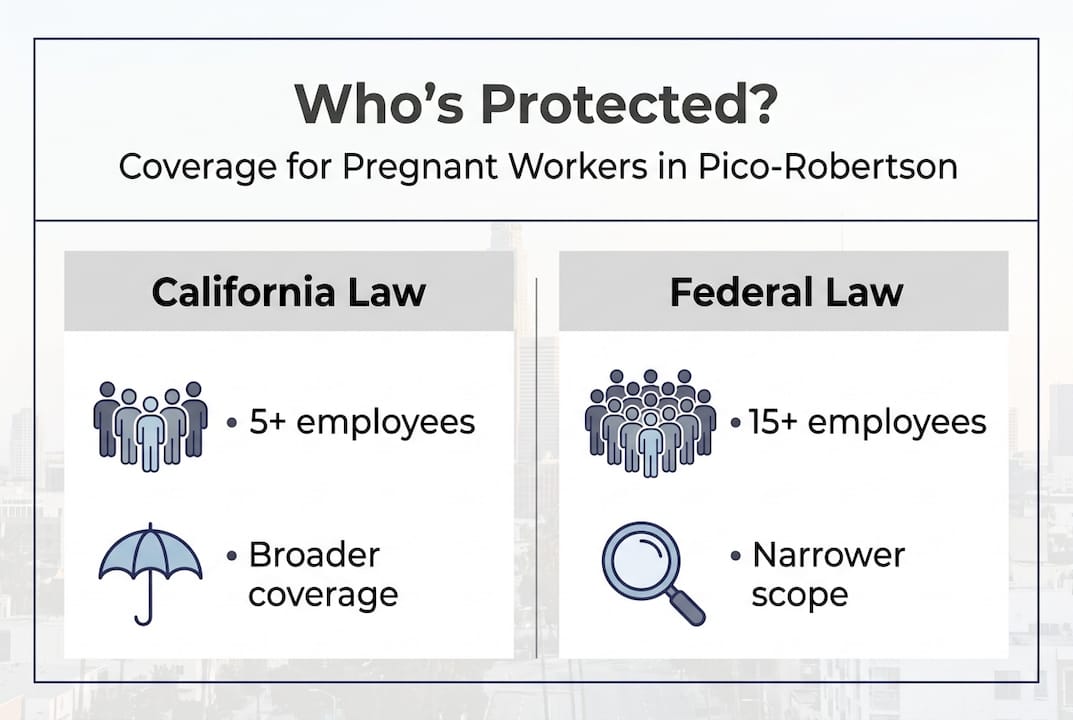
| Law | Employer size threshold | What it covers |
|---|---|---|
| California FEHA | 5+ employees | Pregnancy, childbirth, related conditions |
| Federal PDA | 15+ employees | Pregnancy discrimination in hiring/firing |
| Federal PWFA | 15+ employees | Reasonable accommodations for pregnancy |
| CFRA (leave) | 5+ employees | Baby bonding, pregnancy-related leave |
As the table shows, California’s FEHA protects far more workers than federal law does. A Pico-Robertson shop with just six employees is legally obligated to follow FEHA’s anti-discrimination rules. That’s significant, because many neighborhood businesses fall in exactly that range.
Where the loophole lives
The gap appears when a business employs fewer than five people total. Businesses under 5 employees are exempt from FEHA, which can leave workers in a genuinely difficult position. However, “fewer than five” is not always as simple as it sounds.
Here’s what can still bring a tiny employer under coverage:
- Multiple locations: If an owner runs two shops in the neighborhood with a combined staff of six or more, the total headcount may matter.
- Shared ownership structures: Related entities under common control can be treated as one employer.
- Independent contractors counted incorrectly: Some employers misclassify workers to stay under the threshold; courts look at economic reality, not job titles.
- Local ordinances: Certain Los Angeles municipal rules may provide additional protections.
Understanding pregnancy discrimination in Los Angeles requires looking beyond the obvious employee count. Employers cannot escape liability simply by arguing good faith or financial hardship once coverage applies.
Pro Tip: If you’re unsure whether your employer meets the five-employee threshold, count every worker who has been on the payroll during any week in the current or prior calendar year, including part-time staff. Courts often use this broader definition.
Knowing which law covers your situation determines everything that follows, including what accommodations you can demand, what leave you’re entitled to, and what remedies are available if things go wrong. For retail employees in particular, reviewing pregnancy leave rules in retail can clarify how these protections work in practice.
Recognizing discrimination and subtle retaliation: What does it look like?
Once you know which laws may protect you, the next step is learning to identify if what you’re experiencing actually qualifies—and what forms discrimination takes.
Discrimination is not always a blunt conversation or a sudden firing. In small workplaces, it often arrives quietly.
Overt examples:
- Being told your position will be “restructured” shortly after announcing your pregnancy
- Denied a promotion explicitly because of concerns about your upcoming leave
- Fired within weeks of disclosing your pregnancy
Subtle retaliation tactics:
- Unexplained reduction in weekly hours
- Sudden shift changes to less favorable times
- Critical performance reviews that appear after an accommodation request
- Being left out of team communications or decision-making
- Increased scrutiny of minor mistakes that were previously ignored
The data is striking. Over 20% of pregnant retail workers in Los Angeles report discrimination or lack of accommodations, and 27% of complaints in boutique retail allege retaliation after making a formal request. These numbers reflect what many employees in Pico-Robertson’s small shops experience but never report.
Why don’t people speak up? The fear is real. 86% of fast food workers fear retaliation for taking leave, and low-wage workers in particular face severe financial consequences if they lose their income while pregnant.
“Retaliation often doesn’t look like punishment. It looks like inconvenience. It looks like being left off the schedule or suddenly receiving ‘feedback’ you’ve never gotten before. Patterns matter more than any single incident.”
Learning to spot patterns is critical. One changed shift could be coincidence. Three in a row after your accommodation request is a pattern. Retaliation after accommodation requests follows a recognizable shape: timing is almost always tied to a protected action, whether that’s disclosing your pregnancy, requesting leave, or asking for lighter duties.
Pro Tip: Start a private log the moment something feels off. Record the date, what happened, who was present, and how it changed compared to your previous treatment. This log can become your strongest evidence.
For more detail on how this plays out in the neighborhood specifically, workplace retaliation in Pico-Robertson illustrates common patterns worth knowing.

Pregnancy leave, accommodations, and small employer loopholes
After spotting discrimination or retaliation, you need to know your rights to leave and the exact process for requesting accommodations—especially crucial if your employer is a small business.
California offers some of the strongest pregnancy leave protections in the country. Here’s how they stack up for small business employees:
- Pregnancy Disability Leave (PDL): Provides up to 4 months of job-protected leave for pregnancy-related disabilities. Applies to businesses with 5 or more employees.
- California Family Rights Act (CFRA): Adds up to 12 weeks of baby-bonding leave, also for businesses with 5 or more employees. PDL and CFRA can run back-to-back, giving eligible employees significant total leave.
- Reasonable accommodations: Employers covered by FEHA must engage in a good-faith interactive process to find reasonable changes, such as modified duties, more frequent breaks, or temporary reassignment.
- State Disability Insurance (SDI): Even if your employer isn’t required to hold your job, California’s SDI program provides partial wage replacement, regardless of employer size.
- Paid Family Leave (PFL): Available through the state for bonding, again independent of employer size.
If your employer falls below the five-employee threshold, PDL and CFRA may not apply. But you still have options. SDI and PFL are state insurance programs, not employer obligations, so they remain accessible. Additionally, if your employer misclassified workers or you can establish a combined-employer argument, coverage may extend to you.
Why settlements matter here: A Rancho Gordo jury awarded $252,000 against a smaller employer for ignored accommodation requests. In a large-firm case, AutoZone faced an $185 million punitive verdict. The message is clear: size does not protect employers who ignore the law.
Pro Tip: Always put accommodation requests in writing, even if your employer seems receptive verbally. An email creates a timestamp and protects you if the employer later claims ignorance.
For a fuller picture of how California handles Los Angeles pregnancy leave rules and how job security during pregnancy is protected, those resources can help you prepare before making any formal request.
How to assert your rights: Steps for documenting, filing, and seeking help
Understanding protections isn’t useful unless you know what to do when rights are violated. Here’s a practical roadmap.
Step-by-step action plan:
- Document everything immediately. Save emails, text messages, performance reviews, and scheduling records. Write down verbal conversations with dates, times, and witnesses present.
- Make your accommodation request in writing. A written request creates a formal record. Keep a copy.
- Notify HR or ownership in writing if retaliation follows. Reference your request and describe what changed.
- File a complaint with the California Civil Rights Department (CRD). You have up to 3 years from the last discriminatory act to file.
- Explore mediation. The CRD offers mediation before formal investigation. Many cases resolve this way, including settlements common in LA boutique cases.
- Request a right-to-sue letter if mediation fails or you prefer to pursue litigation directly.
“Even good-faith complaints protect against retaliation. The law prohibits punishment for complaining about discrimination, even if the underlying claim is ultimately not proven.”
Key documents to gather:
- Offer letters and job descriptions
- All performance reviews, especially recent ones
- Any written or digital communications about your pregnancy
- Scheduling records showing changes after your request
- Witness contact information
For employees concerned about career consequences, understanding how protecting your career after leave works legally can ease some of that fear. And LA pregnancy discrimination resources provide additional context for navigating the complaint process.
What most guidance misses about pregnancy discrimination in small businesses
Standard legal guides focus on the dramatic cases: the large corporation, the massive verdict, the headline. But from our experience working with clients throughout Los Angeles, the most common and most painful situations happen in small workplaces where there’s no HR department, no formal policy, and often a close personal relationship between employer and employee that makes asserting your rights feel almost impossible.
Small employers sometimes claim financial hardship as justification for not providing accommodations. California law does not accept that argument once coverage applies. And as official CRD cases show, the most common remedies are policy changes and compliance training, not just money. That means filing a complaint can change the environment for every employee, not just you.
Fear of subtle retaliation keeps more employees silent than outright hostility does. Documenting even small shifts in your treatment is not “rocking the boat.” It’s building the foundation of a legitimate legal claim. Consult a local employment law expert before concluding that your situation doesn’t rise to the level of a legal complaint.
Get expert help asserting your rights in Pico-Robertson
If you’re a pregnant employee in Pico-Robertson facing unfair treatment, reduced hours, or an ignored accommodation request, you don’t have to figure this out alone. Shirazi Law Office provides strategic, personal legal representation to employees throughout Los Angeles who are standing up to unlawful workplace treatment. Understanding your legal employee rights is the first step, and acting quickly matters because evidence fades and deadlines are real. Whether you need a case evaluation, guidance on documentation, or full representation, connecting with an experienced employment lawyer in Los Angeles gives you the clearest path forward. Don’t let fear or uncertainty delay you. Explore workplace retaliation resources and reach out today.
Frequently asked questions
Are all Pico-Robertson small businesses covered by pregnancy discrimination laws?
Not all. California’s FEHA exempts businesses with fewer than 5 employees, while federal law requires at least 15, so very small employers may fall outside both laws.
What should I do first if I face discrimination at work while pregnant?
Write down dates, witnesses, and specifics immediately, then formally request accommodations in writing and retain copies. This documented written request is your most important early step.
What counts as ‘retaliation’ after a pregnancy accommodation request?
Retaliation includes reduced hours, inconvenient shift changes, or negative performance reviews that appear after a good-faith request. Over 27% of complaints in boutique retail specifically allege this kind of post-request retaliation.
If my employer only has 4 workers, do I have any options?
You may still have rights if the employer operates multiple locations or if local ordinances apply. A local employment lawyer can evaluate whether combined headcounts or other legal theories extend coverage to your situation.
How long do I have to file a complaint about pregnancy discrimination in California?
You have up to three years from the last discriminatory act to file with the CRD, but acting sooner preserves evidence and keeps your options open.
Recommended
- Pregnancy Discrimination in LA | LA Employment Lawyer
- Pregnancy Discrimination in Beverly Grove Retail – Protecting Employee Rights – Law Office of Brian Y. Shirazi, PC
- Seasoned Employment Lawyer in Pico-Robertson
- West Hollywood Pregnancy Discrimination: 27% See Retaliation – Law Office of Brian Y. Shirazi, PC
- Justice Shield Law | California Employment Lawyers — Free Consultation