

TL;DR:
- Employers in Los Angeles tech companies can subtly retaliate through demotions, exclusion, or negative reviews.
- California law offers strong protections, requiring proof of retaliation based on patterns, timing, and causation.
- Quickly documenting incidents and consulting an employment attorney are crucial steps if retaliation is suspected.
If you work in tech in Los Angeles, you might assume retaliation only happens at small, poorly managed companies. Think again. Even industry giants face serious legal consequences for silencing employees who speak up. California law offers some of the strongest worker protections in the country, yet many tech employees in LA do not know where to start when their employer turns against them. This guide breaks down what workplace retaliation looks like in tech environments, what your legal rights are, how to build a case, and what steps to take right now if you believe you are being targeted.
Table of Contents
- What workplace retaliation looks like in Los Angeles tech firms
- Your legal rights: California and federal protections for tech employees
- How to prove retaliation: Building your case in tech workplaces
- What to do if you suspect workplace retaliation in LA tech
- What most tech employees get wrong about retaliation cases
- Connect with experienced LA workplace retaliation attorneys
- Frequently asked questions
Key Takeaways
| Point | Details |
|---|---|
| Retaliation is widespread | Even major tech firms like Google face workplace retaliation lawsuits and settlements in Los Angeles. |
| California offers strong protections | Laws like FEHA make it easier for employees to prove retaliation compared to federal law. |
| Documentation is critical | Your emails, timelines, and written records can make or break your retaliation claim. |
| Act fast if you suspect retaliation | You must file a complaint within three years, but earlier action improves your chances. |
| Legal help boosts success | Consulting an LA employment lawyer early increases your odds of a favorable outcome. |
What workplace retaliation looks like in Los Angeles tech firms
Now that you understand why this issue is urgent, let’s explore how retaliation typically unfolds in tech firms.
Under California law, workplace retaliation occurs when an employer takes an adverse action against an employee because that employee engaged in a legally protected activity. Protected activities include reporting discrimination, filing a harassment complaint, raising safety concerns, or refusing to participate in illegal conduct. The law does not require the retaliation to be obvious or dramatic. It just needs to be real and connected to your protected action.
In tech environments, retaliation often looks subtle at first. You might notice a shift in your manager’s tone after you flag a pay disparity. Then you get left off a critical project. Then your next performance review is suddenly below expectations, even though nothing about your work changed. These are the patterns that California courts pay close attention to.
Common retaliation tactics in LA tech firms include:
- Sudden termination or layoff shortly after a complaint
- Demotion or removal from a leadership role
- Exclusion from key meetings or high-visibility projects
- Negative performance reviews that appear out of nowhere
- Reassignment to less desirable tasks or teams
- Increased scrutiny or micromanagement
One of the most important legal concepts in retaliation cases is temporal proximity, which means the closeness in time between your protected action and the adverse action taken against you. If you reported a bias concern on Monday and were removed from a project on Wednesday, that timing alone can be powerful evidence.
The stakes in these cases are very real. Google settled a class action including FEHA retaliation claims for $28M related to pay disparities affecting Hispanic and Indigenous employees in California. That settlement signals that even the largest tech companies are not above accountability.
For a broader look at how workplace retaliation is defined and handled in Los Angeles, the patterns described above are consistent with what attorneys see across the industry. Smaller LA tech firms are not immune either. Retaliation claims in startups follow the same legal framework, and the consequences for employers can be just as severe.
| Company type | Common retaliation example | Legal issue raised |
|---|---|---|
| Google (large tech) | Termination after protesting company practices | FEHA, Title VII violations |
| ChowNow (LA startup) | Whistleblower suit after internal complaint | Whistleblower retaliation ($4M claim) |
| Mid-size LA tech firm | Demotion after reporting pay disparity | FEHA retaliation, wage claims |
Adverse actions include termination, demotion, exclusion from meetings and projects, and negative reviews, with causation shown by timing or patterns.
Your legal rights: California and federal protections for tech employees
Understanding what retaliation can look like sets the stage for grasping your powerful legal protections.
California gives employees significantly stronger protections than federal law. At the federal level, Title VII of the Civil Rights Act prohibits retaliation for reporting discrimination based on race, sex, religion, or national origin. California’s Fair Employment and Housing Act (FEHA) goes further, covering a broader range of protected characteristics and applying to smaller employers.
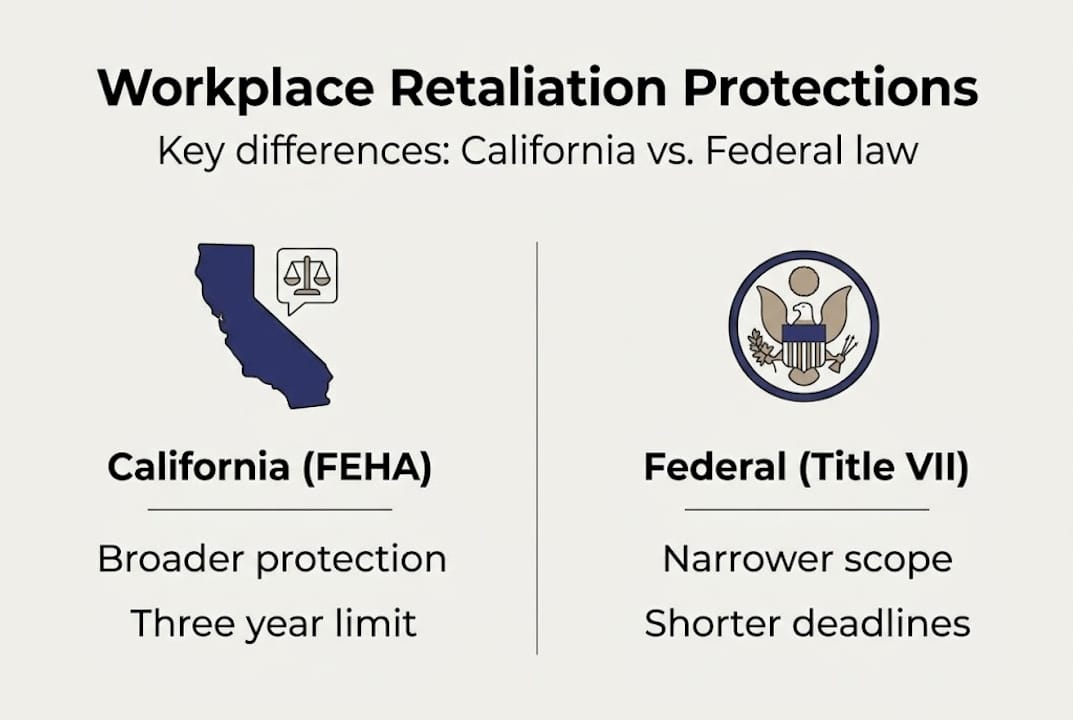
The key difference comes down to the legal standard used to prove retaliation. Federal law often requires employees to show that retaliation was the primary reason for the adverse action. California uses a more employee-friendly standard: the “substantial motivating factor” test. This means retaliation does not need to be the only reason your employer acted against you. It just needs to have played a meaningful role.
Protected activities under California and federal law include:
- Filing or threatening to file a discrimination or harassment complaint
- Reporting safety violations to a government agency
- Participating in a workplace investigation
- Protesting company practices you believe are unlawful
- Requesting a reasonable accommodation for a disability or pregnancy
- Taking protected medical or family leave
A recent case illustrates how far these protections extend. Former Google employees’ retaliation lawsuit for protesting Google’s AI work for Israel proceeded in federal court, alleging Title VII and California law violations. That case shows that even organized workplace protests can qualify as protected activity.

California’s “substantial motivating factor” standard under FEHA means employers cannot simply point to a business reason and walk away. Employees can counter with timing, patterns, and inconsistencies in the employer’s explanation.
Pro Tip: In LA tech, even being quietly excluded from a recurring meeting after raising a concern can qualify as retaliation. You do not need to be fired for your rights to be violated.
If you are a senior professional, executive retaliation claims carry additional complexity, especially when separation agreements or equity compensation are involved. And if you are still employed and wondering about reporting retaliation in tech, acting early protects your legal position.
| Protection | California (FEHA) | Federal (Title VII) |
|---|---|---|
| Standard to prove retaliation | Substantial motivating factor | But-for causation |
| Employer size covered | 5 or more employees | 15 or more employees |
| Protected characteristics | Broader list | More limited list |
| Remedies available | Broader, including emotional distress | More limited |
How to prove retaliation: Building your case in tech workplaces
Knowing your rights only helps if you can prove what happened. Here’s how to build a strong retaliation case.
“Retaliation claims often hinge on what you can prove, not just what you know happened.”
This is the reality most employees learn too late. Strong feelings and clear memories are not enough. Courts and agencies need documentation, timelines, and patterns.
Here is a step-by-step approach to building your case:
- Save everything in its original form. Emails, Slack messages, performance reviews, meeting invitations, and project assignments all matter. Do not edit or delete anything.
- Create a detailed written timeline. Record every significant event with dates, times, and who was involved. Note what happened before and after you made your complaint.
- Identify witnesses. Colleagues who observed changes in your treatment, heard comments from managers, or were present during key conversations can provide valuable support.
- File a complaint with the California Civil Rights Department (CRD), formerly known as the DFEH. You must file a CRD complaint within three years and obtain a right-to-sue notice before filing a civil lawsuit.
- Consult an employment attorney early. An attorney can help you identify what qualifies as protected activity, assess the strength of your evidence, and avoid procedural mistakes.
Pro Tip: Start documenting the moment something feels off, even if you are not yet sure it is retaliation. Courts look at the full picture, and early records are often the most credible.
Real-world tech examples show how these patterns play out. An engineer sidelined after flagging age bias, or a data scientist removed from an AI ethics team after reporting a concern, are exactly the kinds of tech retaliation patterns that California courts examine closely.
If your situation involves broader employment disputes in tech, your documentation strategy may also need to cover contract terms, equity agreements, and internal HR communications. And if your retaliation followed a health issue, understanding retaliation after medical leave is especially important.
For those who reported serious misconduct and faced termination, the legal framework around reporting misconduct adds another layer of protection worth understanding.
What to do if you suspect workplace retaliation in LA tech
Once you understand what evidence helps, here’s what to do if you think you’re facing retaliation.
Speed matters. California’s three-year window to file a CRD complaint sounds generous, but evidence disappears, witnesses move on, and memories fade. Acting quickly protects your rights and your options.
Here is your action plan:
- Gather your documentation immediately. Save emails, performance records, org charts, and any communications that show a change in your treatment after a protected action.
- Notify HR in writing. Put your concerns on record. A verbal complaint is harder to prove. An email creates a timestamp and a paper trail.
- File a formal complaint. You can file with your company’s HR department, and separately with the CRD. Filing within three years is required to preserve your right to sue.
- Consult an employment lawyer. Many retaliation cases are won or lost based on early decisions. A lawyer can tell you what your evidence is worth and what to do next.
Watch for these warning signs that your rights may be at risk:
- Sudden negative performance reviews after a complaint
- Removal from projects you were previously leading
- Being left out of team communications or meetings
- Increased scrutiny or impossible performance targets
- Comments from managers that reference your complaint
Two major pitfalls to avoid: do not delete any messages, even ones that seem unimportant, and do not resign too quickly. Quitting can sometimes weaken your legal position unless the situation rises to the level of constructive discharge, which is when conditions become so intolerable that a reasonable person would feel forced to leave.
If your situation involves a tech company in Culver City, understanding wrongful termination in Culver City tech is a strong starting point. For those in media-adjacent tech roles, wrongful termination in LA media covers related issues across entertainment and media firms.
What most tech employees get wrong about retaliation cases
Here is the honest truth most employees never hear: retaliation law is not about fairness. It is about what you can demonstrate with facts, documents, and patterns.
Many LA tech employees believe that only dramatic, obvious retaliation counts. Being fired the day after filing a complaint. A manager screaming at you in front of the team. But California law recognizes that sophisticated employers rarely act that bluntly. The subtle moves, exclusion from a key meeting, a quietly downgraded review, a reassignment that limits your visibility, often carry more legal weight precisely because they are harder for employers to explain away.
Waiting too long is another critical mistake. Employees often spend months hoping things will improve before they start documenting. By then, key evidence is gone and the timeline is murky. Vague claims without supporting records rarely hold up, no matter how genuine the experience.
The “substantial motivating factor” standard is genuinely powerful, but only if you have something to show the court. Retaliation does not need to be the only reason you were demoted or fired. It just needs to be a real one, backed by evidence. Workplaces run on records. Your employer is keeping theirs. You need to protect your own.
For those in leadership roles facing these pressures, whistleblowing retaliation claims at the executive level require a particularly strategic approach.
Connect with experienced LA workplace retaliation attorneys
Retaliation cases are complex, and the stakes are high. Going up against a well-resourced tech company without legal guidance puts you at a serious disadvantage. Shirazi Law Office focuses exclusively on employment law in Los Angeles, with direct experience in retaliation cases involving tech firms, executives, and professionals across the city.
If you recognize the patterns described here, the next step is a confidential conversation with someone who knows California employment law inside and out. You can speak with a local employment lawyer about your specific situation, or find an LA employment lawyer who handles tech workplace disputes. For those who have already been terminated, wrongful termination resources are available to help you understand your options.
Frequently asked questions
What counts as retaliation in Los Angeles tech companies?
Retaliation includes being fired, demoted, excluded from projects, or receiving negative reviews after reporting a concern or protected activity. Adverse actions are established through timing and patterns, not just the action itself.
How long do I have to file a retaliation claim?
You have three years to file a CRD complaint in California for workplace retaliation. Filing within three years and obtaining a right-to-sue notice is required before pursuing a civil lawsuit.
Can subtle actions like exclusion from meetings be retaliation?
Yes, exclusion from meetings or projects can qualify as retaliation, especially if it follows a complaint. California law recognizes exclusion from meetings as an adverse action when connected to protected activity.
What should I do first if I suspect retaliation?
Document everything, notify HR in writing, and consider consulting an employment lawyer early. Consulting an attorney early helps you avoid procedural mistakes that can weaken your case.
What evidence helps most in a retaliation claim?
Detailed records like emails, performance reviews, and timelines that show a pattern after protected activity are most helpful. Causation shown by timing and patterns is often the strongest form of evidence in California retaliation cases.
Recommended
- Workplace Retaliation in LA | Los Angeles Employment Lawyer
- Retaliation Claims in Culver City Startups – Protecting Executives
- Wrongful Termination After Reporting Misconduct: Legal Impact on Downtown Los Angeles Executives – Law Office of Brian Y. Shirazi, PC
- Wrongful Termination At LA Media Firms: 1,000 Jobs Cut – Law Office of Brian Y. Shirazi, PC