

TL;DR:
- Executives face unique legal risks like wrongful termination, pay discrimination, and retaliation despite their senior roles.
- Recent lawsuits at Google and Meta reveal that high-level employment disputes can be systemic and costly.
- Protecting your career requires understanding California’s employment laws and seeking strategic legal guidance early.
Many senior leaders assume their title, compensation package, and institutional value protect them from the kinds of workplace disputes that affect lower-level employees. That assumption is wrong, and recent litigation at two of the world’s most powerful tech companies proves it. Google and Meta have each faced high-profile lawsuits involving wrongful termination, pay discrimination, age bias, and whistleblower retaliation, filed by executives and senior directors, not entry-level workers. If you are a C-suite leader or senior manager in the Los Angeles area, understanding these cases is not just interesting. It is essential preparation for protecting your career, your compensation, and your reputation.
Table of Contents
- Why executive employment disputes matter at major tech firms
- Recent cases: What Google and Meta lawsuits reveal
- Understanding your employment rights and protections
- Strategic steps: What to do if you face a dispute
- A legal perspective: The hidden costs and overlooked realities of executive disputes
- Need help with an executive dispute? Get expert legal guidance
- Frequently asked questions
Key Takeaways
| Point | Details |
|---|---|
| Executive disputes rising | Recent cases show even top California tech leaders face wrongful termination, retaliation, and discrimination claims. |
| Legal rights are complex | Executives have unique California rights but must act fast and consult expert counsel. |
| Documentation is essential | Preserving records and contract details is critical when facing a potential dispute. |
| Not just financial risk | Lawsuits can impact reputation and future career opportunities as much as finances. |
Why executive employment disputes matter at major tech firms
There is a persistent myth that climbing the corporate ladder insulates you from employment disputes. In reality, executives face a distinct and often more complicated set of risks. Your visibility within the organization, your access to sensitive information, and your compensation structure all create friction points that can lead to serious legal conflicts.
In California, executive wrongful termination cases are rarely straightforward. They frequently involve layered claims: a termination that looks routine on paper but is actually rooted in retaliation, a severance agreement that waives critical rights, or a non-compete clause that limits future employment. As California executive termination laws make clear, these cases require detailed knowledge of employment law because the risks and protections for executives are genuinely unique.
For tech executive employee rights in the LA area, the stakes are especially high. Stock options, deferred compensation, and equity grants are often tied to termination terms. A wrongful exit can cost you far more than a paycheck. It can strip away years of vested equity and damage your standing in a relatively small professional community.
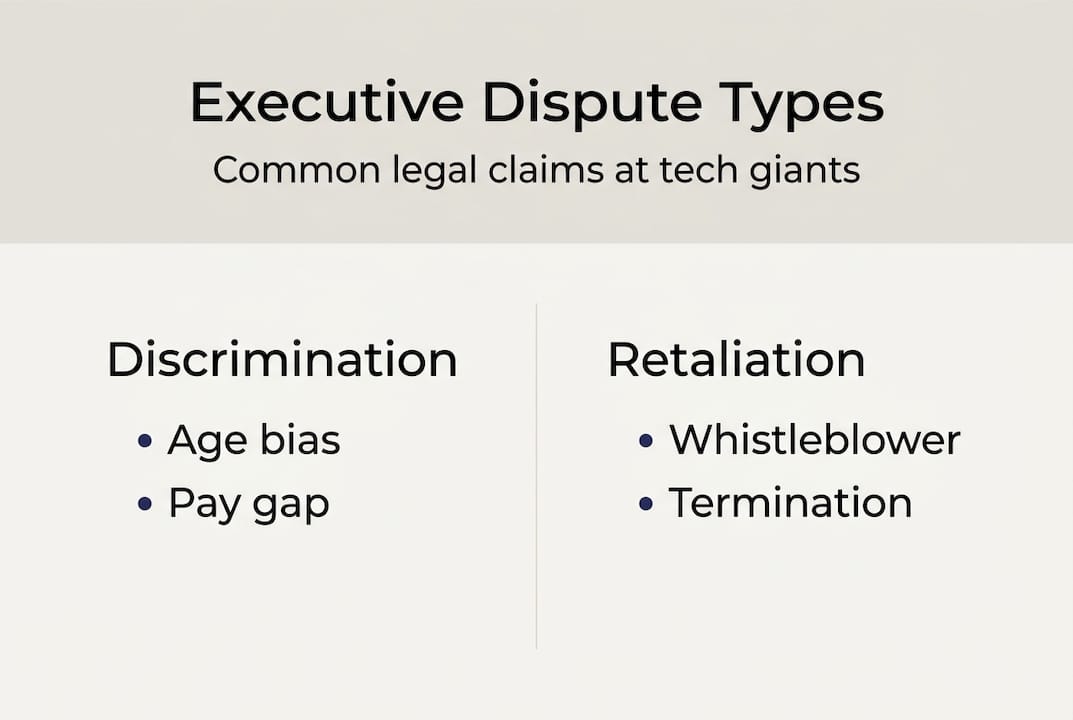
The most common risks executives face in tech disputes include:
- Retaliation for whistleblowing on financial misconduct, regulatory violations, or internal policy breaches
- Discrimination in pay, promotion, or layoffs based on age, race, gender, or national origin
- Breach of employment or severance contracts, including failure to honor agreed compensation or equity terms
“Your case is not just a legal matter. It is your livelihood, your professional reputation, and your future. Executives deserve the same fierce advocacy as anyone else facing an unjust workplace.”
Understanding these risks is the first step. The next is seeing how they play out in real litigation.
Recent cases: What Google and Meta lawsuits reveal
The past two years have produced a wave of high-profile executive employment lawsuits in California. Three cases stand out for what they reveal about emerging patterns in tech industry disputes.
The Meta age discrimination lawsuit. In early 2025, Nicolas Franchet, a former Meta senior director, filed suit alleging that older workers faced layoffs at dramatically higher rates. Specifically, employees over 40 were 1.5 times more likely to be laid off, and those over 50 were 2.5 times more likely. This is not a minor statistical quirk. It suggests a systemic pattern that California law, which offers some of the strongest age bias protections in the country, directly addresses.

The Google pay discrimination settlement. Ana Cantu filed suit against Google in Santa Clara alleging that the company systematically paid Hispanic and Indigenous employees less than their white and Asian counterparts. The case settled for $28 million, a figure that signals how seriously courts and companies are treating pay equity claims. For executives in LA, this case underscores that pay discrimination is not limited to hourly workers.
The Panzura whistleblower case. Larry McClure, CFO of Panzura LLC, a California tech firm, filed suit alleging retaliation after whistleblowing on misconduct by the company’s Chief Revenue Officer. The case is ongoing, but it illustrates the acute vulnerability of C-level officers who report internal wrongdoing. For more detail on how these disputes unfold, the Meta retaliation case details provide useful context on the legal dynamics involved.
| Case | Dispute type | Outcome | Key lesson |
|---|---|---|---|
| Franchet v. Meta | Age discrimination | Ongoing | Layoff patterns can constitute systemic bias |
| Cantu v. Google | Pay discrimination | $28M settlement | Pay equity claims apply to senior roles |
| McClure v. Panzura | Whistleblower retaliation | Ongoing | CFOs and C-suite are not immune to retaliation |
These cases share a common thread. Executives who believed their seniority offered protection found themselves in costly, reputation-affecting litigation. For Mid-Wilshire executive protections and across the LA area, the lesson is clear: title does not equal immunity.
“The executives in these cases were not outliers. They represent a growing class of senior professionals who are pushing back against unlawful treatment, and winning.”
If you are facing similar circumstances, understanding your legal protections is the critical next step. Executive whistleblower retaliation claims in particular require prompt and strategic legal action.
Understanding your employment rights and protections
California offers some of the strongest employment protections in the country, and many of them apply directly to executives. Knowing your rights before a dispute escalates is not just smart. It is often the difference between a strong claim and a missed opportunity.
Here is a structured overview of the core protections available to you:
- At-will employment and contractual carve-outs. California is an at-will state, meaning most employment can be ended by either party. However, if you have an employment contract, offer letter, or severance agreement with specific terms, those documents create enforceable obligations. Many executives have contractual protections they are not fully aware of.
- Anti-discrimination laws. California’s Fair Employment and Housing Act (FEHA) prohibits discrimination based on age, race, gender, national origin, disability, and other protected characteristics. These protections apply to executives at every level. The pattern of age discrimination seen in the Meta lawsuit is exactly what FEHA was designed to address.
- Anti-retaliation protections. If you report illegal conduct, safety violations, or financial fraud, California law prohibits your employer from retaliating against you. This covers termination, demotion, exclusion from meetings, and other adverse actions.
- Whistleblower statutes. California Labor Code Section 1102.5 is one of the broadest whistleblower protection laws in the country. It covers reports made internally or to government agencies, and it applies to senior executives as directly as it does to any other employee.
- Post-termination obligations. If you are asked to sign a separation agreement, be cautious. Some agreements contain overly broad non-disparagement clauses or releases that waive your right to pursue legitimate claims. As California employment law guidance notes, executives face unique risks precisely because their agreements are more complex.
For a broader view of your options, LA wrongful termination remedies can help you understand what outcomes are realistically available in California courts.
Also, pay attention to the Google pay bias case as a reference point. It demonstrates that even large, well-resourced companies are held accountable when pay structures are discriminatory.
Pro Tip: Consult an employment attorney before you respond to any termination notice, severance offer, or internal investigation. Early legal counsel can fundamentally shape how your case develops and what leverage you retain.
Strategic steps: What to do if you face a dispute
Knowing your rights is valuable. Acting on them strategically is what protects your career. If you are an LA executive facing potential wrongful termination, retaliation, or discrimination, here is a clear action plan.
- Preserve all records immediately. Save emails, performance reviews, meeting notes, and any communications that document the dispute or the conduct you are concerned about. Do this before you are locked out of company systems.
- Review your employment contract and equity agreements. Understand exactly what you are owed, including unvested stock, severance terms, and any clauses that affect your post-employment options.
- Avoid reactive communications. Do not send emotional emails or make verbal statements that could be used against you later. Every message you send during a dispute is potentially discoverable in litigation.
- Escalate through proper channels, carefully. If you report misconduct internally, document every step. If internal channels are compromised or retaliatory, consider reporting to the California Labor Commissioner or the EEOC.
- Engage legal counsel before signing anything. This is especially critical with separation agreements. The $28 million Google settlement was achieved with experienced LA-based counsel who understood both the legal claims and the strategic value of the case.
- Understand the timeline. Executive disputes typically move from internal complaint to legal demand to mediation or litigation over six to eighteen months. Knowing this helps you plan financially and professionally.
For executives who have already experienced adverse action, executive retaliation advice can help you understand the specific steps that apply to your situation. The Panzura whistleblower lawsuit is a useful reference for how CFO-level retaliation claims are structured and pursued.
Pro Tip: Choose legal counsel with specific experience in executive and tech-industry disputes. The complexity of equity compensation, non-competes, and high-stakes severance negotiations requires specialized knowledge, not general employment law practice.
A legal perspective: The hidden costs and overlooked realities of executive disputes
Most legal overviews focus on financial outcomes. Win the case, recover the damages, move on. But in our experience working with executives in the LA tech sector, the financial settlement is often the least complicated part of the story.
Reputation is the real currency at stake. When an executive dispute becomes public, even a favorable outcome can leave a lasting mark on how future employers, board members, and investors perceive you. This is why mediation and private settlement are increasingly the preferred path in LA’s tech community. They offer resolution without the exposure that litigation creates.
There is also a broader cultural shift happening in tech right now. The wave of layoffs since 2022 has created new legal gray zones around performance-based terminations that are actually disguised reductions in force, diversity initiatives that inadvertently create reverse discrimination claims, and DEI rollbacks that expose companies to new forms of bias liability. These are not settled areas of law.
For executives navigating key LA executive risks, the most important insight is this: your legal strategy must account for your career trajectory, not just your current claim. A settlement that pays well but bars you from your industry is not a victory.
Need help with an executive dispute? Get expert legal guidance
If you are a senior leader in Los Angeles facing wrongful termination, retaliation, or discrimination, the complexity of your situation demands specialized representation. Shirazi Law Office focuses exclusively on employment disputes for executives and senior management throughout LA, including Century City, Beverly Hills, Culver City, and Downtown Los Angeles. Whether you need a contract reviewed, a retaliation claim evaluated, or aggressive litigation support, the right counsel makes a measurable difference. Explore executive wrongful termination help to understand your options, connect with an employment lawyer Los Angeles who knows the tech sector, and review discrimination law guidance tailored to California executives.
Frequently asked questions
What are the most common legal claims in executive disputes at tech companies?
Wrongful termination, retaliation after whistleblowing, and discrimination based on age, gender, or race are the most frequent claims, as California executive law consistently confirms. Contract breach involving equity and severance terms is also increasingly common.
Are executive lawsuits in Los Angeles different from those in Silicon Valley?
Core protections apply statewide, but LA disputes often center on media, entertainment tech, diversity, and cultural industry issues. Silicon Valley sees higher case volumes, though California law applies equally across the state.
How should an executive respond after experiencing retaliation?
Preserve all documentation immediately, avoid direct confrontation with decision-makers, and consult an employment attorney without delay. The Panzura CFO case illustrates how quickly retaliation claims can escalate when early steps are mishandled.
Does winning an executive lawsuit mean career risks are over?
Not necessarily. Reputational impact and future hiring challenges often persist even after a favorable settlement, which is why strategic dispute resolution matters as much as the legal outcome itself.