
Luxury hotels in Beverly Hills project an image of flawless service and total accessibility. But a polished lobby and a published ADA policy are not the same thing. Even properties like the Waldorf Astoria Beverly Hills, which advertises ADA-compliant rooms with roll-in showers, visual alarms, and accessible terraces, can fall short in practice. Disability discrimination in these settings is often subtle, underreported, and legally actionable. If you have experienced unequal treatment during a stay at a Beverly Hills hotel, California law gives you real tools to fight back.
Table of Contents
- Understanding disability rights in Beverly Hills luxury hotels
- Spotting disability discrimination: What to look for
- Recent legal actions and trends in Beverly Hills luxury hotels
- Filing a disability discrimination claim against a Beverly Hills hotel
- Preventative steps and hotel responsibilities
- How legal support in Beverly Hills can help you
- Frequently asked questions
Key Takeaways
| Point | Details |
|---|---|
| ADA and CA law protections | Federal and state laws guarantee accessible hotel experiences and offer legal remedies for discrimination. |
| Recognize subtle discrimination | Even high-end hotels in Beverly Hills can fall short, so know the signs of less obvious discriminatory practices. |
| Legal action options | Guests can seek damages, injunctive relief, and attorney fees, sometimes even without direct harm. |
| Proactive guest advocacy | Asking detailed questions and preparing before your stay increases your chances of an accessible experience. |
| Expert legal help matters | Getting a specialized attorney maximizes your odds of a successful discrimination claim or negotiation. |
Understanding disability rights in Beverly Hills luxury hotels
Two layers of law protect you when you stay at a hotel in Beverly Hills. The first is federal. The Americans with Disabilities Act (ADA) requires hotels to provide equal access to facilities, services, and communications for guests with disabilities. The second is California state law, which goes further than the ADA in several important ways.
California Civil Code §54.3 allows you to recover actual damages plus a minimum of $4,000 per violation when a hotel denies you equal access. Civil Code §55 lets you seek injunctive relief, meaning a court order forcing the hotel to fix the problem. You can pursue CA Civil Code §55 enforcement and damages even if your financial losses are minimal, which makes California one of the strongest states in the country for disability rights claims.
Hotels must provide:
- Accessible guest rooms with features like roll-in showers, lowered beds, and visual fire alarms
- Auxiliary aids such as TTY devices, closed captioning, and written communication options
- Equal access to restaurants, pools, spas, fitness centers, and event spaces
- Staff trained to assist guests with disabilities without bias or delay
- Reasonable modifications to standard policies when requested
Key legal point: California law does not require you to prove intent. A hotel does not have to mean to discriminate for you to have a valid claim. The barrier or denial itself is what matters.
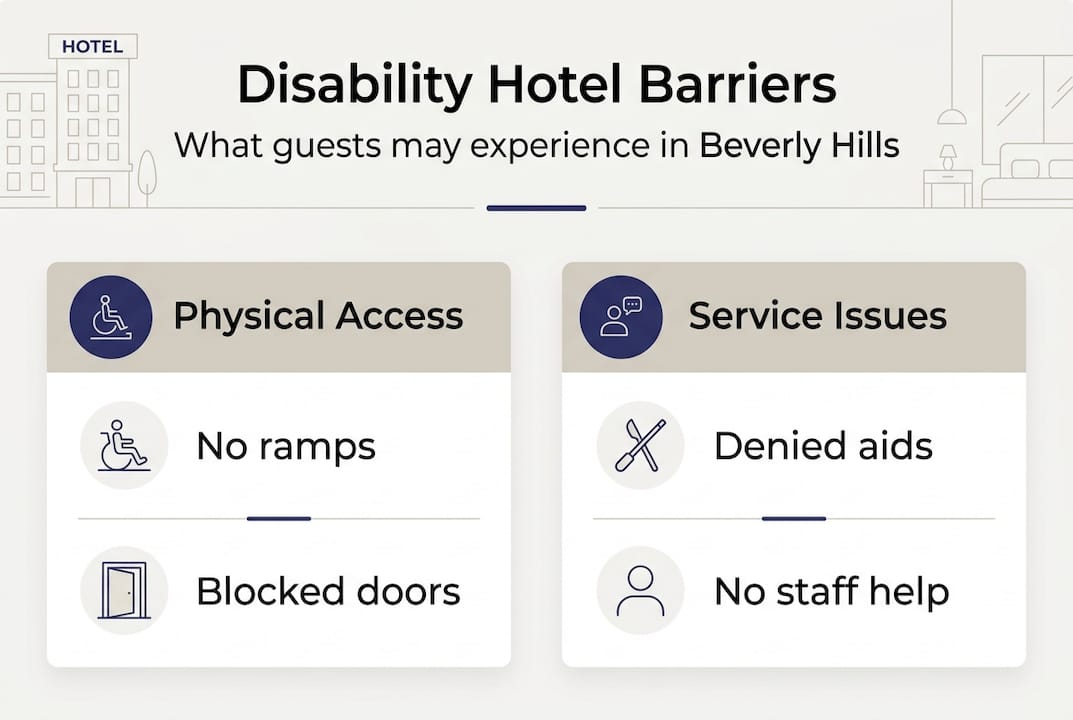
Common forms of discrimination include physical access barriers, communication failures, outright service denial, and retaliation when you complain. If you have dealt with disability accommodation issues or want to understand your accommodation rights in Westwood and surrounding areas, the legal framework is consistent across Los Angeles. For a broader view of disability discrimination in LA, the same statutes apply whether you are in Beverly Hills or Downtown. A solid disability accommodation guide can also help you understand what to request before you arrive.
Spotting disability discrimination: What to look for
Knowing your rights is step one. Recognizing when those rights are being violated is step two. Discrimination in luxury hotels rarely looks like a sign on the door. It tends to show up in small, dismissive moments that add up fast.
The Waldorf Astoria Beverly Hills advertises specific ADA features, but gaps in service or amenity access can still occur even at properties with strong written policies. Staff training, room availability, and auxiliary aid access are the three areas where the gap between policy and practice is widest.
Here are the most common red flags to watch for:
- Accessible room not honored. You reserved an accessible room and arrived to find it unavailable or swapped without notice.
- Restaurant or pool access denied. Staff direct you to a different entrance, a different table, or tell you a space is unavailable when it is not.
- Auxiliary aids missing or refused. You requested a visual alarm, a TTY device, or written communication and the hotel failed to provide it.
- Condescending or dismissive staff behavior. Staff speak over you, ignore your requests, or treat your disability as an inconvenience.
- Retaliation after a complaint. You raised a concern and suddenly received worse service, were asked to leave, or were treated with hostility.
If you have experienced any of these situations, you may have a valid claim under disability discrimination in hotels law in California.
Pro Tip: Start documenting the moment something feels wrong. Take photos of physical barriers, save all written communications, and write down the names of staff members involved along with the date and time. This record becomes your evidence.
Recent legal actions and trends in Beverly Hills luxury hotels
Disability discrimination lawsuits against hotels are not rare. They are increasing. Beverly Hills properties, given their high profile and premium pricing, are frequent targets for both individual claims and preemptive legal actions.
California’s “potentially aggrieved” standard under Civil Code §55 allows individuals to file suit before they are directly harmed, as long as they can show a real and immediate threat of discrimination. This provision has led to a wave of preemptive filings against hotels with documented accessibility gaps. Because attorney fees are recoverable in successful cases, attorneys are incentivized to take these cases, and guests are more likely to pursue them.
Here is how legal outcomes typically compare:
| Outcome type | What it means | Who benefits |
|---|---|---|
| Injunctive relief | Court orders hotel to fix barriers | Future guests and current plaintiff |
| Compensatory damages | Covers actual losses from discrimination | Plaintiff directly |
| Statutory damages | Minimum $4,000 per violation under §54.3 | Plaintiff directly |
| Attorney fees | Hotel pays your legal costs if you win | Makes claims financially viable |
| Consent decree | Negotiated compliance agreement | Broad, systemic change |
Notable trends in 2026 include increased scrutiny of spa and pool accessibility, stricter enforcement of auxiliary aid requirements, and growing attention to staff conduct as a form of discrimination. Hotels that rely on written ADA policies without regular compliance audits are the most exposed.
For employees working in these hotels who face related issues, wrongful termination claims in luxury hotels and Beverly Hills wage disputes follow a similar pattern of underreporting followed by significant legal exposure. The Disneyland Hotel disability lawsuits offer a useful comparison for how large hospitality brands handle these claims when they reach litigation.
Filing a disability discrimination claim against a Beverly Hills hotel
If you believe a Beverly Hills hotel violated your rights, acting quickly and methodically gives you the strongest possible case. Here is what to do.
- Document everything immediately. Write down what happened, who was involved, and when. Take photos of any physical barriers or inaccessible areas.
- Request written confirmation from the hotel. Ask for their accessibility policy in writing and document any refusals or delays.
- File a complaint with the appropriate agency. You can file with the California Department of Fair Employment and Housing (DFEH) or the U.S. Department of Justice, depending on your claim.
- Contact a disability discrimination attorney. An attorney familiar with CA Civil Code §55 claims can assess your case, identify all viable claims, and advise on strategy.
- Preserve all communications. Save emails, texts, booking confirmations, and any written responses from hotel staff.
Pro Tip: Do not accept any compensation or sign any waiver from the hotel before speaking with an attorney. Hotels sometimes offer small gestures like a room upgrade or a refund in exchange for a release of liability. Signing that document could eliminate your right to pursue a full legal claim.
If you have also experienced harassment or a hostile environment during your stay, resources on sexual harassment hospitality law and the hostile work environment guide provide relevant context for overlapping claims.
Preventative steps and hotel responsibilities
The best outcome is one where discrimination never happens. Knowing what to ask for and what hotels are legally required to provide puts you in a stronger position from the start.
Before you book, ask the hotel directly:
- Is the specific accessible room I need available for my dates?
- What auxiliary aids are available on request?
- Are the pool, spa, restaurant, and fitness center fully accessible?
- What is the process for requesting modifications to standard policies?
Hotels are expected to provide accessible rooms and auxiliary services under both ADA and California law. That obligation does not begin when you check in. It begins when you make your reservation.
Here is a quick reference for common accessibility features and what hotels are required to provide:
| Accessibility feature | ADA requirement | California requirement |
|---|---|---|
| Roll-in shower | Yes, in designated rooms | Yes, with advance notice |
| Visual fire alarm | Yes, in accessible rooms | Yes |
| TTY or equivalent | Yes, at front desk | Yes |
| Accessible pool entry | Yes, at least one means | Yes |
| Accessible restaurant seating | Yes | Yes, throughout venue |
| Staff assistance on request | Yes | Yes, without surcharge |
Regular staff training and internal compliance audits are not optional. They are part of a hotel’s legal obligation. If a hotel cannot demonstrate that its staff are trained to assist guests with disabilities, that gap itself can support a discrimination claim. For a detailed breakdown of your rights in 2026, the disability discrimination guide covers the current legal landscape in California.
How legal support in Beverly Hills can help you
Once you understand your rights, having the right attorney makes the difference between a frustrating complaint and a successful legal outcome. Shirazi Law Office represents individuals in Beverly Hills and across Los Angeles who face disability discrimination, hostile treatment, and denial of equal access. Our team knows California employment and civil rights law and applies that knowledge directly to your situation, whether you are a hotel guest asserting your rights or an employee facing retaliation. We help you understand your employee discrimination rights, build a strong case, and pursue every available remedy. If you are ready to speak with an employment lawyer in Los Angeles who handles discrimination claims, or if you need guidance on a wrongful termination Beverly Hills matter connected to your disability, contact Shirazi Law Office for a consultation.
Frequently asked questions
What laws protect guests with disabilities in Beverly Hills hotels?
The ADA and California Civil Code §§54.3 and 55 guarantee equal access, a minimum of $4,000 in statutory damages per violation, and the right to seek injunctive relief against non-compliant hotels.
What counts as disability discrimination in a luxury hotel?
Discrimination includes denial of accessible rooms and services, refusal to provide auxiliary aids, inaccessible amenities, and any harassment or dismissive treatment based on a guest’s disability.
Can I sue even if I was not directly harmed?
Yes. California’s “potentially aggrieved” standard under Civil Code §55 allows preemptive suits when there is a real and immediate threat of discrimination, even before a specific incident occurs.
What’s the first step if I face discrimination at a Beverly Hills hotel?
Document your experience in detail and consult a disability discrimination attorney before accepting any offer from the hotel. Early legal advice protects your right to pursue CA Civil Code §55 claims and maximizes your potential recovery.





wish you best and best