

Many employees believe union membership blocks their ability to file retaliation claims under California law, but recent court rulings prove otherwise. If you work at Sony Pictures or similar media companies in Culver City and face adverse treatment after reporting discrimination, you have stronger legal protections than you might realize. Understanding how California’s Fair Employment and Housing Act operates independently of union contract disputes can be the difference between accepting unlawful retaliation and successfully asserting your workplace rights. This guide breaks down the legal landscape, real cases, employee experiences, and practical steps to protect yourself in Culver City’s media industry.
Table of Contents
- Legal Landscape Of Workplace Retaliation Claims In Culver City Media Firms
- Notable Retaliation Cases Involving Sony Pictures Executives
- Workplace Culture And Employee Experiences At Sony Pictures In Culver City
- Practical Steps To Protect Yourself From Retaliation In Culver City Media Workplaces
- Protect Your Rights With Experienced Culver City Employment Lawyers
Key takeaways
| Point | Details |
|---|---|
| FEHA protects union workers | California retaliation claims can proceed despite Labor Management Relations Act challenges, as confirmed in recent Sony Pictures litigation. |
| Executive retaliation is real | Two former Sony executives filed discrimination and retaliation complaints in April 2024, highlighting ongoing risks at major Culver City studios. |
| Culture matters for safety | Employee reviews reveal toxic management and retaliation fears that should inform how you report workplace violations. |
| Documentation is critical | Keeping detailed records of complaints and subsequent adverse actions strengthens your legal position significantly. |
| Legal counsel helps early | Consulting employment attorneys familiar with Culver City media companies before retaliation escalates protects your career and rights. |
Legal landscape of workplace retaliation claims in Culver City media firms
California’s Fair Employment and Housing Act provides robust protections for employees who oppose discrimination, harassment, or other unlawful workplace practices. When you report these violations or participate in investigations, your employer cannot legally punish you through termination, demotion, exclusion from projects, or hostile treatment. These protections apply across industries, but media companies in Culver City present unique challenges due to high-profile projects, tight-knit teams, and frequent union representation.
Unionized workers at Sony Pictures and similar studios often worry that their collective bargaining agreements limit their ability to file individual retaliation claims. The Labor Management Relations Act can preempt state law claims when they require interpreting union contracts. However, FEHA retaliation claims proceed independently when they rest on statutory rights rather than contract interpretation. Vincent Steib’s lawsuit against Sony Pictures Television demonstrated this critical distinction, allowing his retaliation claim to advance despite the company’s LMRA preemption arguments.
This legal nuance matters enormously for Culver City media employees. You can pursue workplace retaliation in LA claims under FEHA even if you belong to a union, provided your complaint centers on discrimination, harassment, or other statutory violations rather than contract disputes. Courts examine whether your claim fundamentally depends on collective bargaining agreement terms or stands independently on California employment law.
Key elements strengthen FEHA retaliation claims in media workplaces:
- Clear temporal connection between your protected complaint and adverse employment action
- Evidence that decision makers knew about your complaint before taking action against you
- Proof that the adverse action was material enough to deter reasonable employees from reporting violations
- Documentation showing similarly situated employees without complaints received better treatment
Pro Tip: Start a detailed journal the moment you file any discrimination or harassment complaint. Record dates, times, participants, and exact statements from meetings or emails. This contemporaneous documentation becomes invaluable evidence if retaliation follows.
Understanding these protections empowers you to report workplace violations without fear that union membership strips away your California law rights. The distinction between contract interpretation and statutory rights creates a path forward for unionized media employees facing retaliation.
Notable retaliation cases involving Sony Pictures executives
High-profile retaliation cases at Sony Pictures reveal patterns that employees and executives should recognize. In April 2024, two former executives filed complaints alleging race, gender, and age discrimination alongside retaliation claims after their terminations. These cases illustrate how even senior management faces significant risks when opposing toxic workplace conditions at major Culver City studios.
The entertainment industry’s project-based structure creates unique retaliation vulnerabilities. Executives who raise concerns about discrimination often find themselves excluded from key meetings, removed from high-profile projects, or subjected to performance reviews that suddenly turn negative. Unlike traditional corporate environments where job duties remain relatively stable, media executives depend on continuous project assignments and internal relationships to maintain their positions.
These executive cases send ripples through the entire organization. When senior leaders face termination after filing discrimination complaints, lower-level employees notice and calculate their own risks before reporting violations. The chilling effect extends beyond individual cases to shape workplace culture across departments. Employees wonder whether HR investigations truly protect complainants or simply document reasons for future termination.
Several factors contribute to elevated retaliation risks in media executive roles:
- Subjective performance metrics tied to creative output and team dynamics
- High visibility of complaints within tight-knit entertainment industry networks
- Pressure to maintain positive relationships with powerful producers and directors
- Limited alternative employment options within specialized entertainment sectors
- Rapid project turnover that makes exclusion or reassignment easier to justify
The retaliation claims in Hollywood landscape shows consistent patterns across studios. Executives report initial positive performance reviews that deteriorate rapidly after filing complaints. They describe sudden communication breakdowns with colleagues who previously collaborated smoothly. Project assignments dry up or shift to less prestigious productions.
For executive retaliation claims in Century City and surrounding areas, the stakes involve not just immediate employment but long-term career trajectories. Entertainment industry reputations spread quickly through informal networks. Executives terminated under contentious circumstances face whisper campaigns that damage future opportunities even when legal claims ultimately succeed.
These real cases underscore why understanding your rights and documenting everything matters from the moment you consider filing a complaint. The executives who filed in April 2024 likely preserved evidence throughout their employment that now supports their legal claims. Their willingness to pursue litigation despite industry pressures helps establish precedents that protect other employees facing similar retaliation.
Workplace culture and employee experiences at Sony Pictures in Culver City
Employee reviews provide ground-level insight into workplace culture that shapes retaliation risks. Current Sony Pictures reviews highlight recurring themes around management toxicity, retaliation fears, and HR responsiveness concerns. These patterns help you assess risks before reporting violations and understand what protective measures you need.
Many reviewers describe environments where raising concerns leads to isolation or career damage. Employees report management that prioritizes protecting the company over addressing legitimate workplace issues. Some note that HR investigations seem designed to build termination cases against complainants rather than resolve underlying problems. These cultural realities create significant barriers to reporting discrimination or harassment.

The disconnect between public commitments and internal experiences appears in multiple reviews. While Sony Pictures publicly promotes diversity initiatives and workplace safety, employees describe persistent problems with discriminatory treatment and hostile work environments. This gap between external messaging and internal culture makes it harder for employees to predict how complaints will be received.
| Employee Reported Experience | Company Public Position |
|---|---|
| Retaliation fears after complaints | Active hiring for HR investigation roles |
| Toxic management protecting status quo | Diversity and inclusion commitments |
| HR building termination cases | Employee support and safety messaging |
| Isolation after raising concerns | Open door policies and feedback culture |
Recognizing warning signs helps you protect yourself in Culver City media workplaces:
- Sudden negative performance feedback after filing complaints
- Exclusion from meetings or projects you previously attended
- Changes in communication patterns from supervisors or colleagues
- Increased documentation or monitoring of your work activities
- Reassignment to less desirable roles or locations without clear business justification
- Hostile comments or cold treatment from team members
These cultural factors directly impact how you should approach sexual harassment claims in Culver City or other discrimination complaints. Understanding that retaliation risks are real helps you plan protective measures before filing formal complaints. You can time your complaint strategically, secure evidence first, and consult legal counsel to understand your options.
Pro Tip: Before filing internal complaints, assess your company’s actual track record with previous complainants. Talk discreetly with trusted colleagues about their experiences or observations. This intelligence helps you decide whether to pursue internal channels first or consult employment attorneys before alerting your employer.
The pattern of retaliation after reporting in Culver City media companies suggests that cultural change happens slowly. While legal protections exist, workplace realities often lag behind statutory requirements. Employees who understand both their legal rights and their company’s actual culture can navigate complaints more safely and effectively.
Employee experiences at Sony Pictures mirror broader entertainment industry patterns where power dynamics, creative hierarchies, and project-based work create environments where retaliation thrives. Recognizing these dynamics helps you protect yourself while still asserting your workplace rights when necessary.
Practical steps to protect yourself from retaliation in Culver City media workplaces
Taking strategic action when you face workplace discrimination or retaliation can mean the difference between successful legal claims and career damage without recourse. Follow these steps to protect your rights and strengthen your legal position:
-
Document everything immediately when you first notice discriminatory treatment or consider filing a complaint. Save emails, text messages, performance reviews, project assignments, and any communications related to the issues. Create a timeline with specific dates, times, participants, and exact statements.
-
Preserve evidence outside company systems before filing complaints. Forward relevant emails to your personal account, photograph documents, and back up electronic files. Companies sometimes restrict access to email and files immediately after employees file complaints.
-
Consult employment law attorneys who specialize in Culver City and entertainment industry cases before filing internal complaints. Legal counsel helps you understand your rights, evaluate your evidence, and develop strategy that protects you throughout the process.
-
File written complaints through official channels and keep copies of everything you submit. Verbal complaints are harder to prove later. Written documentation creates clear records of what you reported and when.
-
Continue documenting all workplace interactions after filing complaints. Note any changes in treatment, project assignments, performance feedback, or communication patterns. This evidence proves the temporal connection between your complaint and any adverse actions.
-
Report retaliation immediately through the same channels you used for your initial complaint. Create a paper trail showing you alerted the company to retaliatory treatment and gave them opportunities to correct it.
-
Maintain professional performance and conduct throughout the process. Employers often justify adverse actions by claiming performance problems. Continuing to excel at your job undermines these defenses.
-
Seek support from trusted colleagues, friends, or family to help you manage the stress of workplace retaliation. The emotional toll can be significant, and having support systems helps you maintain perspective.
Timing matters enormously in retaliation cases. California law requires you to file administrative complaints with the Civil Rights Department within three years of the last retaliatory act for FEHA claims. However, waiting too long can make evidence harder to gather and witnesses harder to locate. Early legal consultation helps you understand deadlines and preserve your claims.
Protecting executives in Culver City requires understanding both your employment contract terms and your statutory rights. Executive employment agreements often include arbitration clauses, non-disparagement provisions, or other terms that affect how you can pursue claims. Attorneys help you navigate these complexities while maximizing your legal protections.
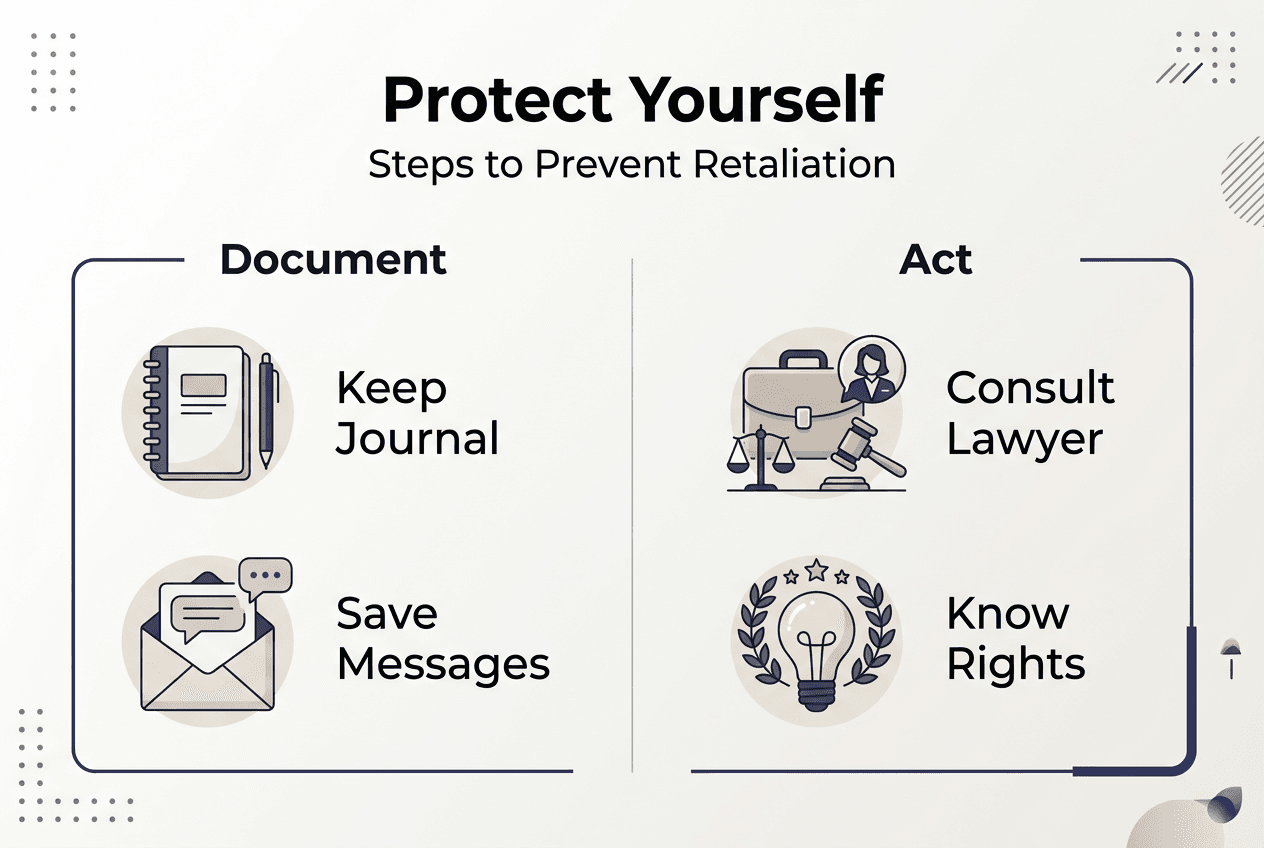
Pro Tip: Keep a detailed journal separate from work devices where you record your thoughts, observations, and experiences related to discrimination or retaliation. This contemporaneous record helps you remember details months or years later when building your case. Include emotional impacts and how the treatment affected your work and personal life.
Knowing how to communicate with legal counsel effectively helps you get maximum value from consultations. Bring your documentation, timeline, and specific questions about your situation. Be completely honest about all facts, even those that might seem unfavorable. Attorneys need full information to provide accurate advice.
Your rights under California law provide powerful tools to combat workplace retaliation, but only if you take strategic action to preserve evidence and assert those rights effectively. The steps above help you navigate the challenging period after filing discrimination complaints while protecting your legal claims and career interests.
Protect your rights with experienced Culver City employment lawyers
Navigating workplace retaliation at Sony Pictures or other Culver City media companies requires legal expertise that understands both California employment law and entertainment industry dynamics. The Law Office of Brian Y. Shirazi focuses exclusively on protecting employees, executives, and senior management facing discrimination, harassment, and retaliation in Los Angeles workplaces. Our firm brings deep knowledge of how major studios and media companies operate, the unique challenges union members face, and the strategic approach needed to hold employers accountable.
We represent professionals at all levels who experience unlawful treatment after opposing workplace violations. Whether you face termination, demotion, hostile work environments, or other retaliation, our practice provides strategic representation tailored to your specific situation. Understanding employee rights 2026 discrimination laws and how they apply to your case helps you make informed decisions about protecting your career and pursuing justice. As an experienced employment lawyer in Los Angeles, we combine practical knowledge with aggressive advocacy to recover damages and restore your professional reputation. For executive representation in LA, we handle complex separation issues, contract disputes, and high-stakes retaliation claims with discretion and skill.
Frequently asked questions
What is workplace retaliation and how does it show up at Sony Pictures?
Workplace retaliation occurs when employers take adverse action against employees who complain about discrimination, harassment, or other unlawful workplace practices. Common examples include termination, demotion, exclusion from projects, hostile treatment, negative performance reviews, or reassignment to less desirable roles. At Sony Pictures and similar Culver City media companies, retaliation may appear after you report race, gender, age discrimination, or toxic management, as demonstrated in recent executive termination cases. The adverse action must be material enough that it would deter reasonable employees from reporting violations.
Can unionized employees at Sony Pictures file retaliation claims under California law?
Yes, unionized workers can file FEHA retaliation claims even though they have collective bargaining agreements. While the Labor Management Relations Act can preempt state claims requiring contract interpretation, FEHA claims based on statutory discrimination protections proceed independently. Vincent Steib’s case against Sony Pictures Television confirmed this distinction, allowing his retaliation claim to advance despite LMRA preemption arguments. This means union membership at workplace retaliation in LA companies does not strip away your California employment law protections when you oppose discrimination or harassment.
What practical steps should I take if I experience retaliation at a Culver City media company?
Document all retaliation incidents and communications immediately, preserving evidence outside company systems before your access gets restricted. Save emails, texts, performance reviews, and project assignments to personal accounts. File written complaints through official HR channels and keep copies of everything you submit. Consult employment attorneys experienced in Culver City media cases before filing internal complaints to develop protective strategy. Continue documenting workplace interactions after complaining to prove temporal connections between your complaint and adverse actions. Report retaliation immediately through the same channels you used initially. Maintain professional performance throughout the process and seek legal counsel guidance on deadlines and next steps.
How long do I have to file a retaliation claim in California?
California law gives you three years from the last retaliatory act to file administrative complaints with the Civil Rights Department for FEHA retaliation claims. However, waiting too long makes evidence harder to gather and witnesses harder to locate. Early action protects your rights more effectively. Some claims may have shorter deadlines depending on your employment contract terms, arbitration agreements, or the specific nature of your complaint. Consulting employment attorneys soon after experiencing retaliation helps you understand all applicable deadlines and preserve your legal options while evidence remains fresh and accessible.





I was recommended this web site by my cousin. I am not sure whether this post is written by him as nobody else know such detailed about my trouble. You’re amazing! Thanks!
[…] Los Angeles plays out under California law more broadly, or explore a specific case study involving workplace retaliation at Sony Pictures to see how these legal principles apply in a high-profile Culver City […]