

Many employees believe disability protections only cover obvious physical conditions. In reality, California law extends far broader safeguards to workers in Westwood universities and research institutions than most people realize. This guide clarifies your legal rights under state law, explains how to recognize discrimination, and shows you how to assert protections when facing unfair treatment in academic workplaces.
Table of Contents
- Understanding Disability Discrimination Law In California Universities And Research Settings
- Common Forms And Examples Of Disability Discrimination In Academic Workplaces
- Reasonable Accommodations And The Legal Interactive Process
- Legal Procedures And Remedies For Disability Discrimination In California Academia
- Common Misconceptions And What Most Employees Get Wrong About Disability Discrimination
- Summary: Empowering Disabled Employees In Westwood’s Academic Workplaces
- Get Expert Legal Support For Workplace Disability Discrimination In Westwood
- Frequently Asked Questions About Disability Discrimination In California Universities
Key takeaways
| Point | Details |
|---|---|
| California’s FEHA provides expansive disability protections | State law covers employers with 5+ employees and defines disability more broadly than federal ADA standards |
| Common discrimination includes accommodation denials and hostile environments | Academic workplaces frequently fail to engage in required interactive processes for reasonable accommodations |
| Employees have strong legal rights to accommodations and remedies | California mandates good faith accommodation negotiations and protects against retaliation when asserting rights |
| Complaints must be filed within three years with the California Civil Rights Department | Timely action preserves your ability to pursue mediation, litigation, and damages |
| Legal representation significantly improves outcomes | Experienced employment lawyers help navigate complex procedures and maximize remedies |
Understanding disability discrimination law in California universities and research settings
California’s Fair Employment and Housing Act forms the foundation of disability protections in academic workplaces. FEHA prohibits disability discrimination against employees in organizations with five or more workers, covering nearly all Westwood universities and research institutions. This state law operates alongside federal protections but often provides stronger safeguards for disabled employees.
The scope of protected disabilities under California law exceeds federal standards. FEHA covers conditions limiting major life activities, while the ADA requires conditions to substantially limit activities. This broader definition means more employees qualify for protections in California academic settings, including those with mental health conditions, episodic illnesses, and conditions that only periodically affect work performance.
Key protections for university and research employees include:
- Protection from discrimination in hiring, promotion, job assignments, and termination decisions
- Rights to reasonable accommodations that enable job performance without undue employer hardship
- Mandatory interactive process where employers must negotiate accommodations in good faith
- Safeguards against retaliation when requesting accommodations or filing complaints
- Access to legal remedies including reinstatement, back pay, and compensatory damages
Both disability accommodation rights in Westwood and workplace disability discrimination protections apply equally to teaching faculty, research staff, administrative employees, and student workers in academic settings. Employers cannot claim exemptions based on job type or institutional mission.
Understanding these overlapping federal and state protections empowers you to recognize violations. California enforcement mechanisms through the Civil Rights Department often prove more accessible than federal processes, giving employees practical advantages when asserting their rights.
Common forms and examples of disability discrimination in academic workplaces
Disability discrimination in universities and research institutions takes many forms beyond obvious termination or hiring bias. Recognizing subtle violations helps you identify when your rights are being violated and take appropriate action.
Denial of reasonable accommodations represents the most frequent complaint. Failure to engage in interactive process violates California law even when employers claim they would have granted accommodations eventually. Universities may refuse flexible schedules for employees with chronic conditions, deny assistive technology for researchers with sensory disabilities, or reject workspace modifications for faculty with mobility limitations.
Hostile work environment complaints arise when colleagues or supervisors create intimidating, offensive, or abusive conditions based on disability status. Examples include persistent mocking of speech impediments, exclusion from collaborative research projects due to mobility aids, or unwanted intrusive questions about medical conditions during faculty meetings.
Common discriminatory practices in academic settings include:
- Rejecting qualified job applicants based on disclosed disabilities during hiring processes
- Assigning disabled employees to less desirable projects or courses as implicit punishment
- Denying promotion opportunities due to assumptions about disability limitations
- Creating documentation requirements for accommodations that exceed legal standards
- Using performance improvement plans to pressure disabled employees into resignation
- Retaliating against employees who request accommodations or file complaints
Automated hiring systems and recruitment tools increasingly screen out disabled applicants through biased algorithms. Universities using these technologies may inadvertently violate discrimination laws even without conscious bias from human decision makers.
Pro Tip: Document every accommodation request in writing through email or formal letters, and save all employer responses. These records become crucial evidence if you need to file a complaint or lawsuit. Include dates, names of people involved, and specific accommodation details in your documentation.
Recognizing these patterns helps you understand when workplace accommodation failures cross the line into illegal discrimination. Early identification enables timely legal action to protect your rights.
Reasonable accommodations and the legal interactive process
Reasonable accommodations modify job duties, work environments, or employment terms to enable disabled employees to perform essential functions. California law requires employers to provide these modifications unless they impose undue hardship, a high legal threshold rarely met in well funded university and research settings.
Typical accommodations in academic workplaces include:
- Modified work schedules allowing flexible hours for medical appointments or fatigue management
- Assistive technology such as screen readers, speech recognition software, or specialized lab equipment
- Physical workspace modifications including adjustable desks, accessible parking, or quiet office spaces
- Remote work options for employees whose disabilities make campus presence challenging
- Extended leave beyond standard policies for medical treatment or recovery periods
- Modified job duties that maintain essential functions while removing marginal tasks
FEHA mandates good faith interactive process between employers and employees to identify effective accommodations. This process requires open communication about disability limitations, essential job functions, and potential modifications. Universities cannot unilaterally decide accommodations are unnecessary or impose their preferred solutions without employee input.
The interactive process typically follows these steps. First, you request an accommodation and provide medical documentation supporting your need. Second, your employer must engage in timely discussion about your limitations and job requirements. Third, both parties explore potential accommodations collaboratively. Finally, the employer implements agreed accommodations or explains why proposed modifications cause undue hardship.
Reasonable accommodations in universities improve job performance by removing disability related barriers to productivity. Research shows accommodated employees demonstrate equal or higher performance levels compared to non disabled colleagues, benefiting both individuals and institutions.
Pro Tip: Request accommodations in writing through email to your supervisor and human resources department simultaneously. Specify your disability related limitations, proposed accommodations, and how modifications will enable you to perform essential job functions. Keep copies of all correspondence and follow up if you do not receive a response within two weeks.
Employers bear the burden of proving undue hardship when denying accommodations. Courts scrutinize these claims closely in university settings given institutional resources and academic mission flexibility. Understanding your disability accommodation rights in Westwood strengthens your position during interactive process negotiations.

Legal procedures and remedies for disability discrimination in California academia
California provides clear pathways for disabled employees to assert their rights and obtain remedies when facing discrimination. Understanding these procedures helps you take timely action and maximize available legal protections.
Employees must file complaints within three years of the last discriminatory act with the California Civil Rights Department. This generous timeline exceeds federal limits and preserves your rights even when discrimination continues over extended periods. Filing with CRD also satisfies prerequisites for later civil lawsuits if administrative resolution fails.
Key steps in the complaint process include:
- File a verified complaint with CRD describing the discrimination, identifying your employer, and specifying relief you seek. You can file online, by mail, or in person at CRD offices.
- CRD investigates your complaint by requesting information from your employer and reviewing supporting documentation you provide. This process typically takes several months.
- CRD offers mediation services where both parties negotiate resolution with assistance from trained mediators. Many cases settle during this phase through reinstatement, accommodation agreements, or monetary compensation.
- If mediation fails, CRD may issue a right to sue letter allowing you to file a civil lawsuit in California courts. You can also request this letter immediately to expedite litigation.
- Civil lawsuits enable you to pursue comprehensive remedies including reinstatement, back pay, front pay, compensatory damages for emotional distress, punitive damages for egregious conduct, and attorney fees.
California discrimination law protects employees from retaliation when filing complaints or participating in investigations. Universities cannot terminate, demote, or otherwise punish you for asserting your rights. Retaliation itself constitutes an independent violation carrying additional remedies.
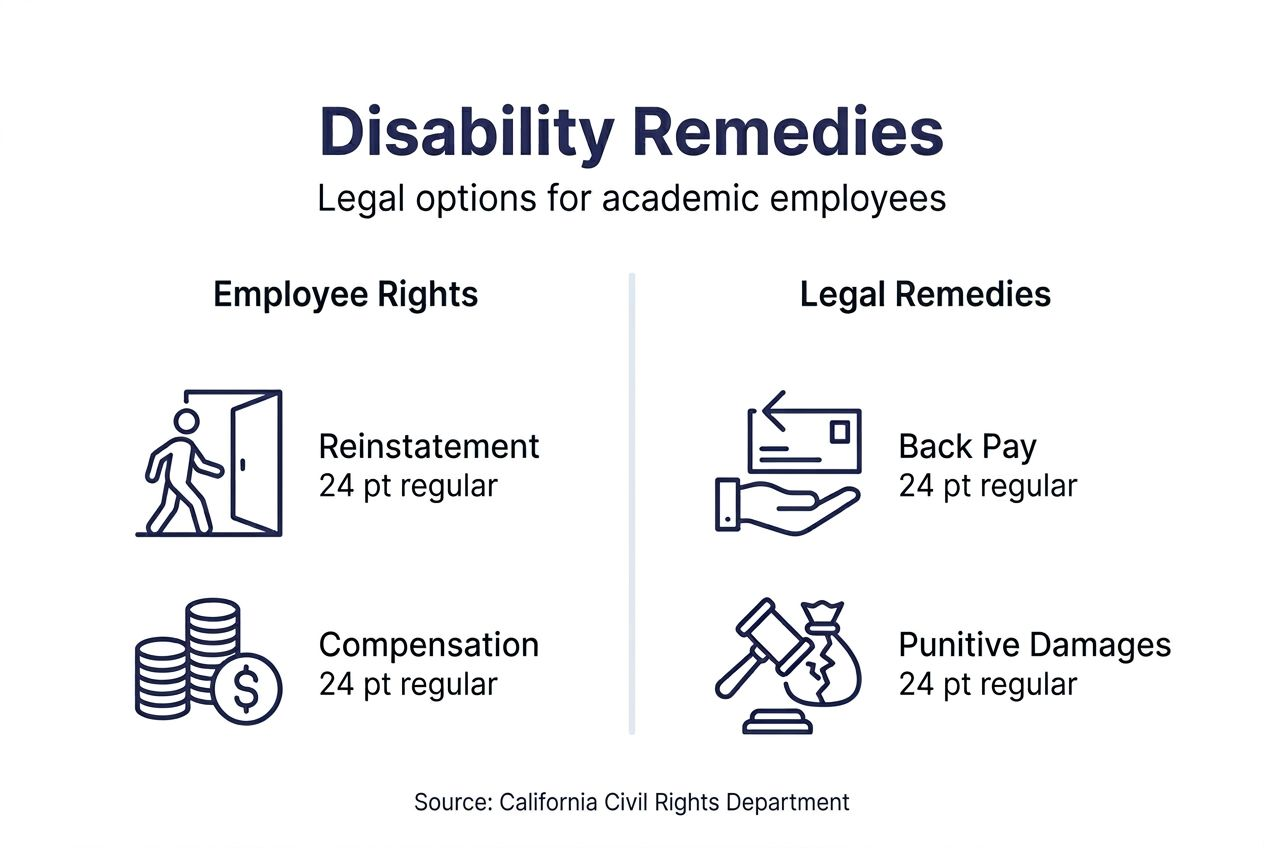
Available remedies in successful disability discrimination cases include reinstatement to your former position, compensation for lost wages and benefits, damages for emotional distress and suffering, modification of employer policies, mandatory training for supervisors, and coverage of legal costs. Courts can also order injunctive relief requiring universities to implement specific accommodation procedures.
Understanding complaint procedures empowers you to take decisive action when facing discrimination. Early legal consultation improves your strategic positioning and evidence gathering throughout the administrative and litigation process.
Common misconceptions and what most employees get wrong about disability discrimination
Misunderstandings about California disability law often prevent employees from asserting their rights. Clarifying these misconceptions helps you recognize protections available under state law.
Many employees wrongly believe disability protections only cover permanent physical conditions. FEHA extends to mental health conditions including depression, anxiety, and PTSD, as well as episodic conditions like epilepsy or diabetes that may not constantly affect daily activities. You qualify for protections even if your disability is well managed with medication or treatment.
Common misconceptions include:
- Believing employers can deny accommodations simply by claiming cost concerns without proving actual undue hardship
- Assuming you must disclose specific diagnoses rather than just functional limitations requiring accommodation
- Thinking you cannot file complaints until after termination rather than when discrimination begins
- Believing university prestige or academic freedom exempts employers from disability discrimination laws
- Assuming you need to prove intentional discrimination rather than showing disparate treatment occurred
- Fearing retaliation makes complaint filing too risky when law explicitly prohibits such punishment
Employers cannot require you to accept their preferred accommodation if it does not effectively address your disability related limitations. You retain the right to negotiate alternatives during the interactive process and reject modifications that fail to enable essential job function performance.
You do not waive disability discrimination claims by initially accepting inadequate accommodations. California law recognizes that power imbalances and fear of retaliation often lead employees to accept insufficient modifications. You can later request additional accommodations or file complaints about ongoing discrimination.
Understanding these clarifications empowers you to recognize violations and assert rights confidently. California law strongly favors employees in disability discrimination disputes, providing robust protections that exceed minimum federal standards.
Summary: empowering disabled employees in Westwood’s academic workplaces
California provides comprehensive legal protections for disabled employees working in Westwood universities and research institutions. FEHA extends beyond federal ADA standards, covering more conditions and requiring proactive employer engagement in accommodation processes. You have clear rights to reasonable modifications that enable job performance, participation in good faith interactive processes, and protection from retaliation when asserting these protections.
Recognizing common forms of discrimination helps you identify violations early. Accommodation denials, hostile work environments, and failure to engage in required interactive processes all constitute illegal discrimination under California law. Documentation of these violations strengthens your legal position when filing complaints or pursuing litigation.
Legal procedures through the California Civil Rights Department provide accessible pathways to justice. The three year complaint deadline, mandatory mediation options, and comprehensive remedy availability give employees significant advantages when challenging discrimination. Courts consistently enforce these protections in academic settings despite employer claims of institutional uniqueness or resource constraints.
Seeking experienced legal support from a seasoned employment lawyer in Westwood significantly improves outcomes. Attorneys specializing in disability discrimination understand academic workplace dynamics, navigate complex procedures efficiently, and maximize available remedies. Early legal consultation preserves evidence and strengthens your strategic positioning throughout the complaint and litigation process.
You can overcome workplace discrimination and secure the respectful, inclusive environment California law guarantees. Understanding your rights represents the first step toward asserting protections and obtaining fair treatment in Westwood’s academic workplaces.
Get expert legal support for workplace disability discrimination in Westwood
Shirazi Law Office specializes in representing employees facing disability discrimination in Westwood universities and research institutions. Our extensive experience with California employment law ensures your rights under FEHA and ADA receive full protection throughout complaint procedures and litigation.
Early legal support improves accommodation outcomes and discrimination claim success rates. We guide you through interactive process negotiations, document violations effectively, and pursue comprehensive remedies when employers violate your rights. Our strategic approach combines deep knowledge of 2026 discrimination laws with practical understanding of academic workplace dynamics.
Contact a seasoned employment lawyer in Westwood to schedule a consultation. We represent employees throughout Los Angeles in workplace disability discrimination cases, helping you assert your rights and secure the fair treatment California law guarantees. Protect your career and workplace dignity with experienced legal representation.
Frequently asked questions about disability discrimination in California universities
What disabilities qualify for protection under California law in academic workplaces?
California FEHA protects any physical or mental condition that limits a major life activity, including chronic illnesses, mental health conditions, learning disabilities, and episodic conditions. The definition is broader than federal ADA standards, covering more employees in university and research settings.
Can my university employer ask for medical documentation when I request accommodations?
Yes, employers can request reasonable medical documentation confirming your disability and need for accommodations. However, they cannot demand your complete medical records or require disclosure of specific diagnoses beyond functional limitations affecting work performance.
How long does my employer have to respond to my accommodation request?
California law does not specify exact timelines, but courts require prompt responses typically within two to four weeks. Unreasonable delays in engaging the interactive process can constitute disability discrimination even if accommodations are eventually granted.
Can I file a disability discrimination complaint if I still work for my employer?
Yes, you can file complaints with the California Civil Rights Department while still employed. California law prohibits retaliation for asserting your rights, and filing before termination often preserves more remedy options including reinstatement and ongoing accommodations.
What damages can I recover in a successful disability discrimination lawsuit?
California courts can award back pay, front pay, reinstatement, compensatory damages for emotional distress, punitive damages for egregious conduct, and attorney fees. Total compensation varies based on discrimination severity and economic losses, but successful cases often result in substantial recovery.
Do California disability protections apply to postdoctoral researchers and graduate student employees?
Yes, FEHA protects all employees including postdoctoral researchers, graduate teaching assistants, and student workers in universities with five or more employees. Your employment classification does not diminish disability discrimination protections under California law.