

Over 12,000 workplace hostility complaints were filed in California in 2023, with an 18% increase from the prior year and many more unreported. California film professionals face unique challenges on sets where power imbalances, long hours, and informal contracts create vulnerability. This guide covers legal standards under California’s Fair Employment and Housing Act, specific harassment behaviors, employer duties, and how you can document incidents and pursue remedies.
Table of Contents
- Understanding Hostile Work Environments In Hollywood
- Legal Framework: Defining Hostile Work Environments In California
- Harassment And Discrimination Behaviors On Film Sets
- Employer Responsibilities And Liability In California Film Production
- Industry-Specific Risk Factors On Film Sets
- Case Studies: Hostile Work Environment Lawsuits In Hollywood
- Proving A Hostile Work Environment: Documentation And Legal Steps
- Common Misconceptions And Legal Clarifications
- Legal Help For Hostile Work Environments On California Film Sets
- What Counts As A Hostile Work Environment On A Hollywood Film Set?
Key takeaways
| Point | Details |
|---|---|
| California’s FEHA defines hostile work environment standards for film professionals | Harassment must be severe or pervasive enough to create an abusive environment based on protected classes like gender, race, or age |
| Common harassment includes sexual misconduct, racial slurs, and intimidation | Offensive conduct such as unwelcome touching, discriminatory jokes, and verbal abuse creates hostile conditions on sets |
| Employers must train, investigate, and prevent hostile environments or face strict liability | Production companies can be held liable if they fail to act on harassment complaints or neglect prevention duties |
| Detailed documentation significantly improves legal claim success | Recording dates, witnesses, emails, and texts strengthens your case in California courts |
| Even a single severe incident can meet California’s legal standard | Severity and impact matter more than frequency under state law |
Understanding hostile work environments in Hollywood
A hostile work environment exists when harassment or discrimination becomes severe or pervasive enough to create an intimidating, offensive, or abusive workplace. California’s Fair Employment and Housing Act protects workers in film production from conduct targeting protected characteristics like gender, race, age, disability, religion, or sexual orientation.
The film industry presents unique challenges. Long shooting hours, remote locations, and tight deadlines amplify stress. Power dynamics between directors, producers, and crew create environments where speaking up feels risky. Up to 70% of victims do not report harassment due to fear of retaliation or career consequences.
Understanding your legal rights helps you recognize when conduct crosses the line. California law sets clear standards for what qualifies as hostility and what employers must do to prevent it. Key factors include:
- Whether conduct targets a protected class
- Frequency and severity of incidents
- Impact on your ability to perform your job
- Whether a reasonable person would find the environment hostile
- Whether employers knew or should have known about the conduct
Pro Tip: Keep a private log of incidents as they happen, even if you are unsure whether they qualify as harassment. Detailed contemporaneous notes strengthen your position if you later decide to pursue legal action.
Legal framework: defining hostile work environments in California
California’s FEHA provides stronger protections than federal law. The statute requires that prohibited conduct be severe or pervasive enough to create an abusive work environment, covering persons in protected classes. Courts apply a reasonable person standard, asking whether a reasonable person in your position would find the environment hostile.
Severity matters more than frequency. A single egregious incident, such as physical assault or explicit threats, can establish a claim. Pervasive conduct means repeated incidents that collectively create a hostile atmosphere, even if individual acts seem minor.
Employers face strict liability for harassment by supervisors or managers. If a supervisor creates or tolerates a hostile environment, the production company is automatically responsible. For coworker harassment, employers are liable if they knew or should have known about the conduct and failed to take corrective action.
California law also prohibits retaliation. If you report harassment or participate in an investigation, your employer cannot punish you through demotion, termination, or other adverse actions protected under retaliation laws. Understanding these protections helps you assert your rights without fear.
Key legal elements include:
- Protected class membership: harassment must relate to gender, race, age, disability, religion, sexual orientation, or other protected characteristics
- Unwelcome conduct: you did not invite, encourage, or consent to the behavior
- Severity or pervasiveness: conduct was serious enough or frequent enough to alter working conditions
- Employer knowledge: the company knew or should have known and failed to act
- Reasonable person standard: an objective observer would find the environment hostile
For detailed guidance on hostile work environment claims in California, consult experienced employment counsel who understands film industry dynamics.
Harassment and discrimination behaviors on film sets
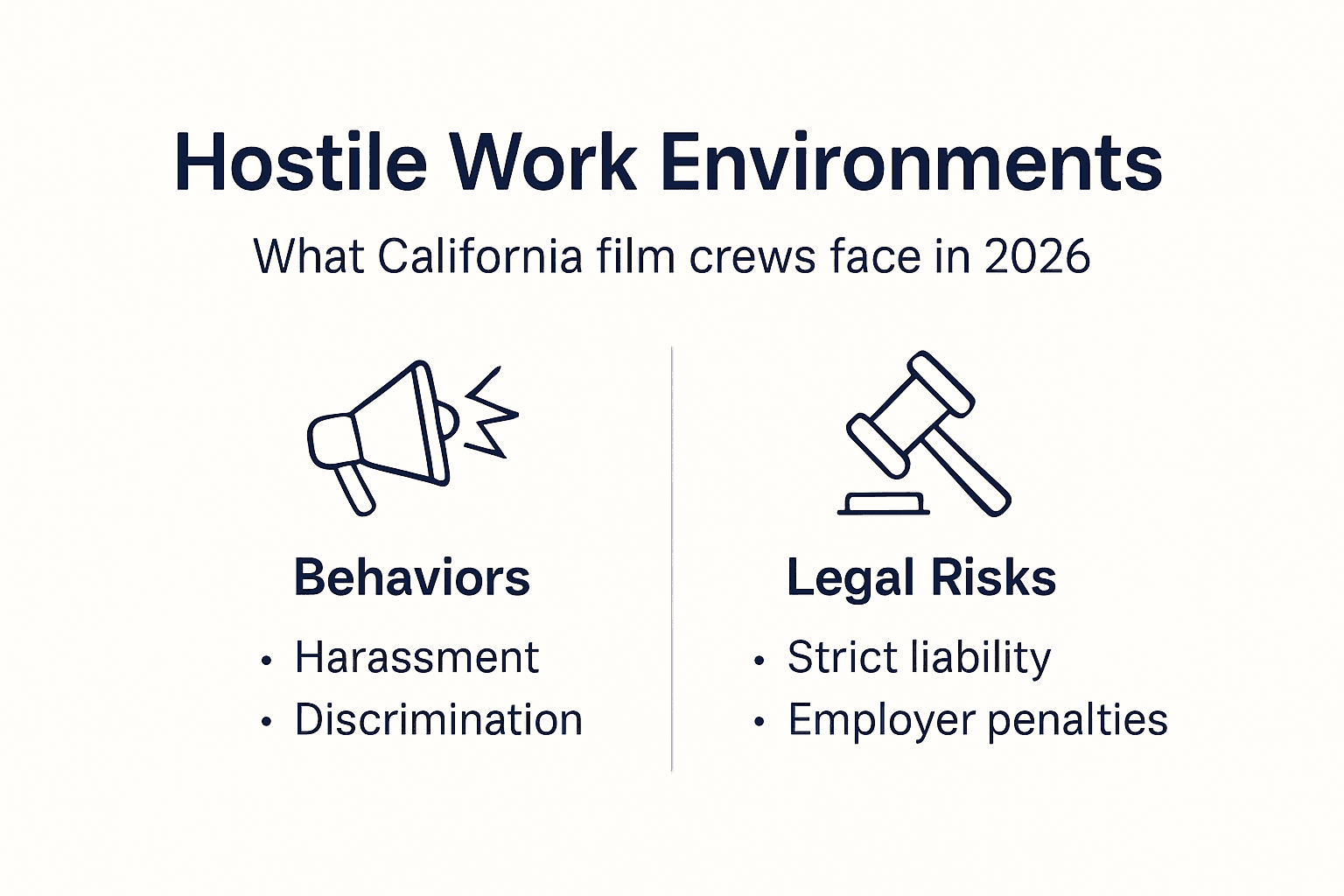
Offensive conduct such as sexual harassment, racial slurs, unwelcome physical contact, and discriminatory jokes are prevalent on film sets and contribute to hostile environments. Recognizing these behaviors helps you identify violations and take action.
Sexual harassment includes unwanted advances, requests for sexual favors, inappropriate comments about appearance or body, and sexually explicit jokes or images. Gender discrimination may involve treating women differently in job assignments, pay, or promotion opportunities. This conduct often targets below-the-line crew members who feel powerless to complain.
Racial harassment involves slurs, offensive jokes about ethnicity or national origin, and discriminatory treatment based on race. Some sets normalize casual racism or dismiss concerns as oversensitivity. Age-based harassment includes derogatory comments about older workers or assumptions about capabilities based on age.
Physical harassment ranges from unwelcome touching to intimidation tactics like blocking exits or invading personal space. Verbal abuse includes yelling, belittling, or threatening behavior that goes beyond normal workplace stress. Visual harassment involves displaying offensive imagery or materials that target protected groups.
Common harassment forms include:
- Unwanted sexual advances or propositions
- Touching, grabbing, or other physical contact without consent
- Sexually explicit jokes, comments, or imagery
- Racial or ethnic slurs and stereotypes
- Comments about age, disability, or religion
- Intimidation, threats, or hostile body language
- Offensive emails, texts, or social media posts
- Exclusion from opportunities based on protected characteristics
Pro Tip: Document the context surrounding harassment. Note who was present, what led to the incident, and how it affected your work. This context helps establish patterns and severity.
Understanding common harassment forms on film sets empowers you to recognize violations and seek appropriate remedies.
Employer responsibilities and liability in California film production
Employers must provide harassment prevention training, conduct prompt investigations, and can be strictly liable for supervisor harassment under California law. Production companies have affirmative duties to prevent and address hostile work environments.
California requires harassment prevention training for all supervisors and, in companies with five or more employees, for all staff. Training must cover protected classes, examples of harassment, complaint procedures, and anti-retaliation protections. Many film productions fail to provide adequate training to temporary or freelance crew.
When you report harassment, employer liability and training obligations require immediate investigation. Employers must interview witnesses, review evidence, and take corrective action if harassment occurred. Delays or superficial investigations expose companies to liability.
Strict liability applies when supervisors or managers create hostile environments. The production company cannot escape responsibility by claiming ignorance. For coworker harassment, liability attaches if the employer knew or should have known and failed to act reasonably.
Anti-retaliation protections shield employees who report harassment. If you face termination, demotion, schedule changes, or other punishment after complaining, you have grounds for a separate retaliation claim. Employer anti-retaliation duties extend to anyone who participates in investigations or opposes discriminatory practices.
Employer obligations include:
- Providing comprehensive harassment prevention training
- Establishing clear complaint procedures
- Investigating complaints promptly and thoroughly
- Taking corrective action proportionate to the violation
- Protecting complainants from retaliation
- Maintaining confidentiality to the extent possible
Production companies that fail these duties face significant consequences:
| Employer Failure | Legal Consequence |
|---|---|
| No harassment training | Presumption of inadequate prevention measures |
| Delayed investigation | Inference of deliberate indifference |
| Superficial inquiry | Failure to meet reasonable care standard |
| No corrective action | Direct liability for continuing harassment |
| Retaliation against complainant | Separate claim with additional damages |
Pro Tip: If your employer fails to investigate your complaint within a reasonable time (typically 30 days), document the delay. Prolonged inaction strengthens your claim that the company acted with deliberate indifference.
Understanding employer responsibilities under FEHA helps you hold production companies accountable for their legal duties.
Industry-specific risk factors on film sets
Lack of intimacy coordinators and unique power imbalances on film sets increase harassment risk and contribute to hostile environments. The film industry’s structure creates vulnerabilities that standard workplace protections may not fully address.

Intimacy coordinators ensure safety during scenes involving nudity or simulated sex. Their absence leaves actors and crew vulnerable to exploitation. Even when coordinators are present, power dynamics may discourage speaking up about boundary violations.
Power imbalances pervade film sets. Directors and producers control career opportunities, creating incentives to tolerate mistreatment. Informal hiring practices and short-term contracts mean workers fear blacklisting if they complain. Freelance crew lack the protections of permanent employment.
Physical conditions amplify stress. Long hours, remote locations, and demanding schedules create fatigue that makes harassment harder to endure. Tight deadlines pressure workers to prioritize production over safety concerns.
Hierarchical structures discourage reporting. Clear chains of command may not exist, leaving workers unsure whom to contact. When harassers occupy senior positions, reporting feels futile. Union protections vary, and non-union workers face even greater vulnerability.
Industry-specific risk factors include:
- Absence of intimacy coordinators for sensitive scenes
- Informal hiring and short-term contracts reducing job security
- Power imbalances between above-the-line and below-the-line workers
- Remote locations isolating workers from support systems
- Long hours and physical demands increasing vulnerability
- Hierarchical structures discouraging upward reporting
- Cultural normalization of aggressive or abusive behavior
Pro Tip: If your production lacks an intimacy coordinator for scenes involving nudity or simulated intimacy, formally request one in writing. Document the request and any denial to establish employer knowledge of potential risks.
Addressing industry-specific challenges on film sets requires tailored legal strategies that account for these unique factors.
Case studies: hostile work environment lawsuits in Hollywood
Recent lawsuits illustrate how California courts handle hostile work environment claims in the film industry. These cases provide lessons about legal standards, employer liability, and the importance of documentation.
The Blake Lively lawsuit against Justin Baldoni and Wayfarer Studios alleged sexual harassment, a hostile work environment, and retaliation. Lively claimed Baldoni engaged in inappropriate behavior during filming, including unwanted physical contact and explicit discussions. She also alleged that after raising concerns, she faced a coordinated campaign to damage her reputation and career.
This case highlights how hostile environments extend beyond on-set conduct to include retaliation and defamation. Employers who respond to complaints with intimidation or career sabotage face compounded liability. The lawsuit’s public nature increased industry awareness and prompted discussions about power dynamics and accountability.
Other cases have established that production companies cannot delegate responsibility through independent contractor arrangements. Even when crew members work as freelancers, FEHA protections apply if the production company exercises sufficient control over working conditions.
Legal ramifications from these cases include:
- Expanded interpretation of what constitutes retaliation
- Recognition that reputation damage can be actionable harm
- Emphasis on prompt, thorough investigations
- Increased scrutiny of power imbalances in entertainment
- Higher settlements and verdicts reflecting industry-wide problems
Publicity surrounding Hollywood hostile work environment lawsuits encourages more workers to report violations. Increased transparency creates pressure on production companies to improve policies and enforcement.
Proving a hostile work environment: documentation and legal steps
Detailed incident documentation with dates, witnesses, and communications significantly improves chances of legal success in California courts. Building a strong case requires systematic evidence gathering and strategic legal action.
Document each incident immediately. Record the date, time, location, and what happened. Identify witnesses who saw or heard the conduct. Describe your response and any impact on your work performance or mental health. Save emails, texts, voicemails, or other communications related to harassment.
File an internal complaint following your employer’s procedures. Put your complaint in writing, even if you also report verbally. Keep copies of all submissions and any responses. If your employer fails to investigate or take corrective action, document the failure.
You can report to the California Civil Rights Department (formerly DFEH) within three years of the last incident. The CRD investigates and may file charges on your behalf. You can also request a right-to-sue notice to pursue a private lawsuit. Federal claims go to the Equal Employment Opportunity Commission, but California law typically provides stronger protections.
Steps for pursuing a claim:
- Document incidents with dates, times, witnesses, and communications
- Report internally to HR, your supervisor, or designated contact
- Request a written response and timeline for investigation
- Follow up if the employer fails to act within 30 days
- File a complaint with the California Civil Rights Department
- Consult an employment attorney to evaluate your legal options
- Consider settlement negotiations or litigation based on evidence strength
Legal remedies may include:
| Remedy Type | Description |
|---|---|
| Back pay | Lost wages from termination or constructive discharge |
| Front pay | Future earnings if reinstatement is not feasible |
| Emotional distress damages | Compensation for psychological harm |
| Punitive damages | Additional penalties for egregious employer conduct |
| Injunctive relief | Court orders requiring policy changes |
| Attorney fees | Recovery of legal costs if you prevail |
Pro Tip: Photograph any offensive materials or images displayed on set. Visual evidence provides powerful proof that may be more persuasive than written descriptions.
Consulting experienced counsel helps you navigate legal claim steps and documentation requirements effectively. An attorney can assess evidence strength, identify additional remedies, and represent you in negotiations or litigation.
Common misconceptions and legal clarifications
California law recognizes even a single severe incident can qualify for hostile work environment claims, and employers are liable if they fail to act on coworker harassment. Misunderstandings about legal standards can prevent workers from asserting their rights.
Many believe only repeated incidents create liability. In reality, a single severe event like physical assault, explicit threats, or egregious sexual harassment can meet the legal standard. Courts focus on severity and impact, not just frequency.
Some think only overt harassment counts. Subtle conduct, such as exclusion from meetings, denial of opportunities, or patronizing comments, can contribute to a hostile environment when part of a pattern. Context matters: conduct that seems minor in isolation may be actionable when viewed cumulatively.
Another misconception involves employer liability for coworker harassment. Employers cannot escape responsibility by claiming ignorance. If harassment was obvious or reported, the employer must investigate and take corrective action. Failure to do so creates liability even if management did not directly participate.
Workers often fear retaliation will go unpunished. California’s anti-retaliation protections create a separate cause of action. Even if the underlying harassment claim fails, you can still prevail on retaliation if you suffered adverse action for complaining.
Common myths include:
- Only repeated incidents qualify (single severe events can suffice)
- Harassment must be overt or physical (subtle patterns count)
- Employers are not liable for coworker conduct (liability attaches if they fail to act)
- Complainants have no protection from retaliation (strong anti-retaliation laws exist)
- Only victims can file claims (witnesses and those who oppose discrimination are also protected)
Understanding misconceptions about employer liability ensures you do not dismiss valid claims based on incorrect assumptions. California’s legal standards are broader than many realize.
Legal help for hostile work environments on California film sets
Navigating hostile work environment claims requires expertise in California employment law and film industry dynamics. Shirazi Law Office focuses exclusively on employment disputes, providing strategic representation to film professionals facing harassment, discrimination, and retaliation.
Our firm understands the unique challenges of Hollywood production environments. We help you document incidents, file complaints, negotiate settlements, and litigate when necessary. Whether you face sexual harassment, racial discrimination, or retaliation for reporting violations, we provide confidential, dedicated support.
Explore our employment law articles for additional guidance on workplace rights and remedies. Contact us to discuss your situation and learn how we can protect your career and recover damages for the harm you have suffered.
What counts as a hostile work environment on a Hollywood film set?
A hostile environment includes harassment or discrimination severe or pervasive enough to create an intimidating or offensive workplace. Conduct must target a protected class like gender, race, age, disability, religion, or sexual orientation. Examples include sexual harassment such as unwanted advances or explicit comments, racial slurs or offensive jokes about ethnicity, unwelcome touching or physical intimidation, and discriminatory treatment in job assignments or opportunities. Courts apply a reasonable person standard, asking whether an objective observer would find the environment abusive.
How can I document incidents to support a hostile work environment claim?
Keep detailed notes with dates, times, locations, witnesses, and descriptions of what happened. Record your response and any impact on your work performance or mental health. Save emails, texts, voicemails, photos, or other communications related to incidents. Document internal complaints, including written submissions and employer responses. Contemporaneous records carry more weight than reconstructed accounts created later.
What legal protections do California film workers have against retaliation?
California law prohibits employers from punishing workers who report harassment or participate in investigations. Retaliation includes termination, demotion, schedule changes, reduced hours, or other adverse actions. You can file a separate retaliation claim even if the underlying harassment claim does not succeed. Anti-retaliation protections extend to anyone who opposes discriminatory practices or assists others in asserting their rights.
Can a single incident create a hostile work environment claim?
Yes, California law recognizes a single severe incident can meet hostile work environment criteria. Physical assault, explicit threats, or egregious sexual harassment may qualify even without repetition. Severity and impact are key legal factors, not just frequency. Courts consider whether the incident was serious enough to alter working conditions and whether a reasonable person would find the environment hostile.





[…] California film hostile work environments: 18% rise 2026 […]
[…] sells glamour. But behind the scenes, the reality for many film workers is far less polished. Over 12,000 hostility complaints were filed in California in 2023, with the entertainment industry seeing among the highest rates. […]