

Think your non-compete agreement is enforceable because you signed it in New York or drafted it with out-of-state counsel? Wrong. California’s Business and Professions Code §16600 voids nearly all non-compete agreements including for talent managers and entertainment lawyers. Recent 2026 legislative updates further outlawed non-competes even if signed out of state. This guide clarifies legal standards, exceptions, and practical protections for Century City professionals navigating these critical contract issues.
Table of Contents
- Overview And History Of California Non-Compete Law
- 2024 Amendments Impacting Non-Compete Enforceability
- Exceptions To The Non-Compete Prohibitions
- Specific Considerations For Talent Managers And Entertainment Lawyers
- Legal Risks And Consequences Of Enforcing Non-Compete Agreements
- Alternative Contractual Protections: Non-Solicitation And Confidentiality
- Practical Guidance For Navigating Non-Compete Agreements
- Protect Your Career And Clients With Expert Legal Support
- Frequently Asked Questions
Key Takeaways
| Point | Details |
|---|---|
| California prohibits most non-compete agreements | Talent managers and entertainment lawyers enjoy strong mobility protections under state law. |
| 2024 laws expanded these prohibitions | SB 699 and AB 1076 bar enforcement regardless of signing location or date. |
| Limited exceptions exist | Only business sales and trade secret protections qualify as valid exceptions. |
| Legal alternatives are available | Non-solicitation and confidentiality agreements protect legitimate business interests. |
| Violators face serious penalties | Employers risk civil penalties, lawsuits, and reputational damage. |
Overview and History of California Non-Compete Law
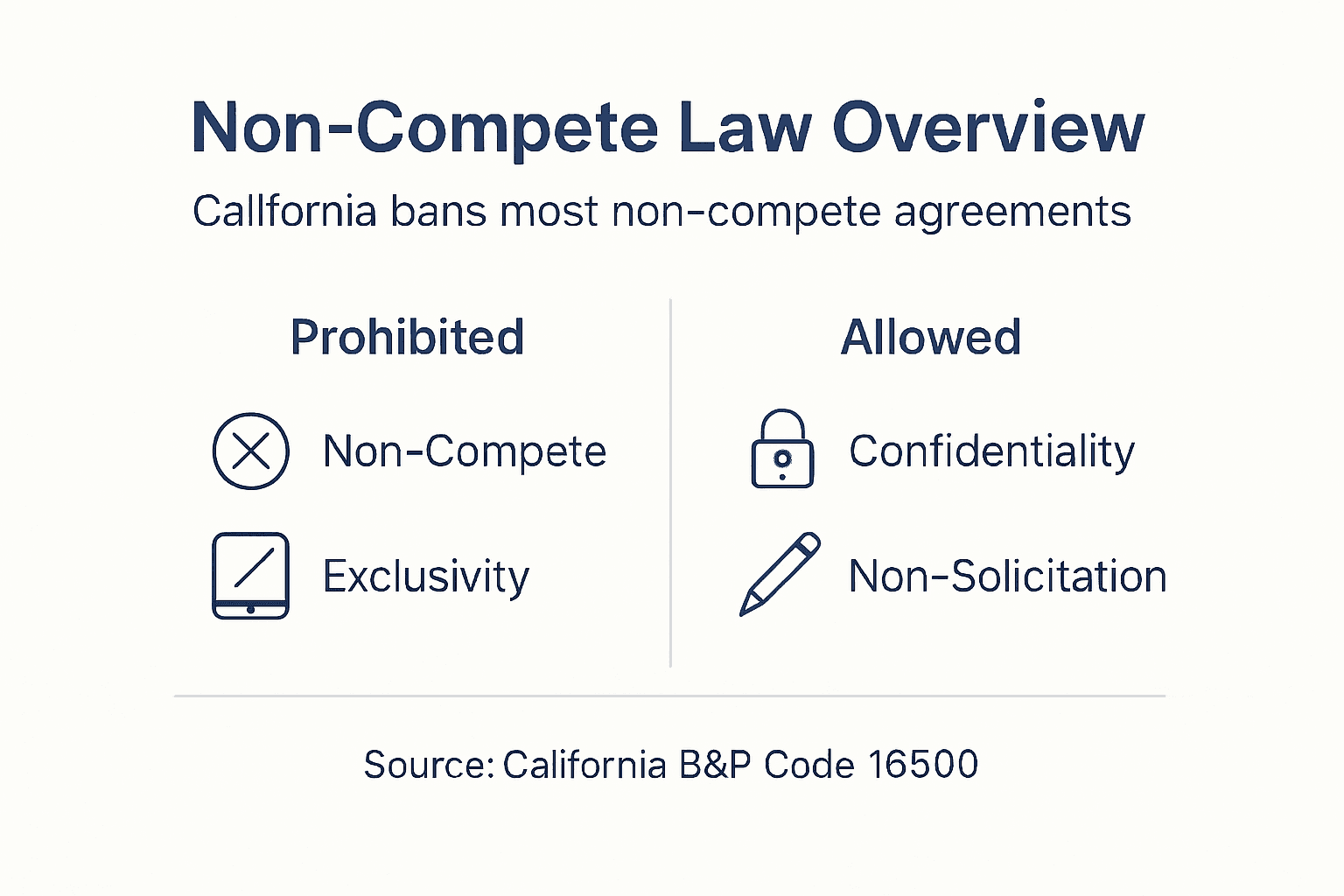
California Business and Professions Code §16600 prohibits non-compete agreements as a matter of public policy. The statute reflects California’s commitment to promoting employee mobility, economic competition, and innovation across all industries. This philosophy stands in sharp contrast to most other states, where non-competes remain common tools for restricting where and how professionals can work after leaving a job.
The entertainment industry historically relied on exclusivity provisions and non-compete clauses to lock talent and their representatives into restrictive arrangements. Studios, agencies, and management firms regularly inserted these terms into contracts. However, courts have increasingly invalidated these provisions to promote mobility and competition in California’s entertainment sector.
Understanding this historical foundation proves essential for talent managers and entertainment lawyers navigating modern contracts. California’s legal framework prioritizes professional freedom over employer imposed restrictions. This approach recognizes that allowing professionals to move freely between opportunities benefits the entire industry ecosystem.
Key aspects of California’s non-compete prohibition include:
- The law applies to all employment relationships, regardless of seniority or compensation level
- Contracts attempting to circumvent the prohibition through creative drafting remain unenforceable
- Professional mobility rights extend to all California workers, including highly compensated executives
- The statute reflects decades of consistent judicial interpretation favoring employee rights
For professionals working in non-compete battles in Century City, these protections prove particularly valuable. The concentration of entertainment businesses in this area creates unique pressures around client relationships and competitive opportunities. California law ensures that talent managers and lawyers can pursue their careers without artificial barriers imposed by former employers. This legal landscape supports executive mobility in Century City by preventing restrictive agreements from stifling professional growth.
2024 Amendments Impacting Non-Compete Enforceability
SB 699 and AB 1076, effective January 1, 2024, prohibit enforcing non-compete agreements regardless of agreement signing location or current work location. These landmark laws closed loopholes that some employers exploited by having employees sign agreements in other states or including choice-of-law provisions selecting non-California jurisdictions.
The amendments represent a major expansion of California’s existing non-compete prohibition. Previously, some uncertainty existed about whether California courts would honor non-competes signed elsewhere. The 2024 laws eliminated that ambiguity entirely. California now invalidates out-of-state non-competes when an employee works in California, regardless of contract language attempting to apply another state’s law.
For highly mobile professionals in entertainment, these protections prove critical. Talent managers and entertainment lawyers frequently work with national and international clients, sometimes signing contracts in New York, London, or other jurisdictions. The 2024 amendments ensure that California residents maintain their mobility rights even when contracts originate elsewhere.
Employers face significantly increased legal risks when attempting to enforce or impose non-competes after these changes. California courts now have explicit statutory authority to void these agreements, and employers who persist in enforcement face penalties. The legislation also requires employers to notify current and former employees that previously signed non-competes are now unenforceable.
Critical implications of the 2024 amendments include:
- Retroactive application to existing non-compete agreements signed before 2024
- Mandatory employer notification requirements for affected employees
- Enhanced penalties for employers who attempt enforcement despite the prohibition
- Elimination of choice-of-law provisions that previously created enforcement uncertainty
Pro Tip: Review any non-compete agreement you signed before 2024, even if signed out of state. You likely have stronger protections than you realize. Document any employer attempts to enforce these void provisions, as such actions may constitute unlawful retaliation.
Talent managers and lawyers must stay informed about these changes when negotiating contracts and challenging enforcement attempts. The 2024 laws fundamentally shifted the landscape, making previously gray areas black and white. If you work in California, non-compete provisions in your employment agreement are almost certainly unenforceable, regardless of where you signed them.
Exceptions to the Non-Compete Prohibitions
While California’s prohibition is broad, non-compete agreements remain valid in limited contexts such as goodwill sale agreements and partnership dissolutions. These narrow exceptions recognize legitimate business interests that differ from typical employment relationships. Understanding where these lines fall helps professionals identify when a restrictive provision might actually be enforceable.
The primary exceptions involve:
- Sale of a business or sale of substantially all operating assets, where the seller agrees not to compete with the buyer
- Dissolution or dissociation from a partnership, where departing partners agree not to compete
- Dissolution or dissociation from a limited liability company, following similar principles as partnerships
These exceptions make economic sense. When someone sells their business, the buyer pays for goodwill and expects not to face immediate competition from the seller using insider knowledge. Similarly, when partners split up a firm, reasonable restrictions prevent unfair competitive advantages. However, these exceptions apply only to true ownership transfers, not ordinary employment.
Trade secret protections remain legally enforceable separate from non-compete clauses. California law allows employers to protect genuinely confidential information through the Uniform Trade Secrets Act and common law protections. These safeguards prevent employees from stealing client lists, proprietary processes, or confidential business strategies without restricting where they can work.
| Agreement Type | Restricts Employment | Protects Information | California Enforceability |
|---|---|---|---|
| Non-Compete | Yes | Indirectly | Void except narrow exceptions |
| Non-Solicitation | Partially | No | Enforceable if narrowly tailored |
| Confidentiality | No | Yes | Fully enforceable |
| Trade Secret Protection | No | Yes | Fully enforceable |
Broad non-competes in employment contracts remain void regardless of how employers frame them. Simply calling a restriction something other than a non-compete does not make it enforceable. California courts look at the practical effect of the provision. If it prevents you from working in your profession or industry, it violates Section 16600.

Pro Tip: If your employment contract includes provisions restricting your future employment beyond confidentiality protections, flag them immediately. Even if labeled as non-solicitation or other terms, overly broad restrictions that effectively bar you from your profession are likely unenforceable under California law.
Navigating these exceptions carefully ensures compliance while protecting legitimate business interests. For talent managers and entertainment lawyers, the distinction between protecting confidential client information and restricting professional mobility is crucial. You can safeguard sensitive business data without surrendering your right to continue working in your field.
Specific Considerations for Talent Managers and Entertainment Lawyers
Entertainment contracts historically included non-compete and exclusivity provisions, but California’s legal framework has progressively invalidated these restrictions to promote professional freedom. The entertainment industry’s traditional reliance on restrictive agreements created unique challenges as California courts applied Section 16600 more aggressively over recent decades.
Talent managers and entertainment lawyers face distinct pressures around client relationships. When you build deep professional connections with actors, directors, producers, or other industry figures, your former employer may claim ownership of those relationships. However, California law generally rejects such claims. Your professional network and reputation belong to you, not your employer.
Modern California law invalidates exclusivity provisions that effectively function as non-competes. Even if a contract does not explicitly prohibit you from working elsewhere, provisions requiring exclusive dedication to one employer or barring you from representing competing interests may be unenforceable. Courts examine whether the practical effect restricts your ability to practice your profession.
Balancing client protection with professional freedom requires using alternative contract clauses that comply with California law. Entertainment firms can protect legitimate interests through confidentiality agreements, trade secret protections, and narrowly drafted non-solicitation provisions. These tools safeguard business information without imprisoning professionals in their current positions.
Key considerations for entertainment professionals include:
- Your right to continue working in the entertainment industry after leaving a position
- Protection of genuinely confidential client information versus ordinary business relationships
- Distinction between solicitation restrictions and outright employment prohibitions
- California’s policy favoring professional mobility in creative industries
California’s approach to non-compete agreements reflects a fundamental belief that professionals should control their own careers. This philosophy particularly benefits creative industries, where talent and relationships drive success. When the law allows free movement, the entire industry thrives through increased competition and innovation.
For entertainment professionals in Century City, these protections prove essential for career advancement. The concentration of major talent agencies, management firms, and entertainment law practices creates a highly competitive environment. Your ability to move between opportunities without legal restrictions enables you to maximize your professional potential. When employers attempt to enforce invalid restrictions, professionals should be prepared to assert their rights, potentially involving claims for unlawful retaliation if the employer takes adverse action.
Legal Risks and Consequences of Enforcing Non-Compete Agreements
Employers face civil penalties and lawsuits for attempting to enforce non-compete agreements in California. The legal consequences extend beyond simply having the agreement declared void. Employers who persist in enforcement despite knowing these provisions violate California law expose themselves to significant liability.
Employees possess strong legal rights to challenge and nullify unlawful non-compete agreements. You can seek declaratory relief confirming the agreement is void, injunctive relief preventing enforcement, and damages if the employer’s actions caused you harm. If an employer threatens litigation or takes adverse employment action based on an unenforceable non-compete, you may have claims for wrongful termination, retaliation, or unfair business practices.
The California Attorney General has issued multiple consumer alerts publicly reinforcing employee protections and signaling vigorous enforcement of non-compete prohibitions. These official statements demonstrate California’s commitment to protecting worker mobility. The Attorney General’s office has warned employers that attempting to enforce void non-competes may constitute unfair competition under California’s Unfair Competition Law.
Key statistic: Employers attempting to enforce non-compete agreements after the 2024 amendments face potential civil penalties of up to $2,500 per violation under California’s Unfair Competition Law, plus liability for attorney fees and damages.
Awareness of these risks helps talent managers and lawyers better protect themselves and their clients. When reviewing contracts or facing enforcement threats, understanding the potential consequences for employers provides leverage. Most sophisticated employers will back down when confronted with California law, recognizing the legal and financial risks of pursuing unenforceable restrictions.
Major risks for employers include:
- Civil penalties under California’s Unfair Competition Law and other statutes
- Liability for employee attorney fees and costs in declaratory relief actions
- Damages for wrongful termination if employment ends over non-compete disputes
- Reputational harm in industries where talent mobility is valued
- Regulatory scrutiny from the California Attorney General and Labor Commissioner
Ignoring these risks can lead to severe reputational damage and financial loss for employers. Entertainment industry employers particularly depend on maintaining positive reputations to attract top talent. Public disputes over unenforceable non-competes signal to prospective employees that the firm does not respect legal boundaries or employee rights.
For professionals facing enforcement threats in Century City, documenting all communications and seeking immediate legal counsel proves critical. Employers sometimes use intimidation tactics even when they know their legal position is weak. Having experienced representation sends a clear message that you understand your rights and will not be bullied into compliance with void restrictions.
Alternative Contractual Protections: Non-Solicitation and Confidentiality
Confidentiality agreements are enforceable and commonly used to protect trade secrets and client information in California. These agreements safeguard legitimate business interests without restricting where you can work or what profession you can practice. Employers can protect genuinely confidential information, proprietary business strategies, and trade secrets through well drafted confidentiality provisions.
Narrowly drafted non-solicitation clauses can limit direct solicitation of specific clients without constituting unlawful non-competes. California courts distinguish between provisions that restrict employment generally and those that narrowly target unfair solicitation of clients or employees. A carefully crafted non-solicitation clause might survive judicial scrutiny if it does not effectively bar you from working in your field.
However, broad or overly restrictive non-solicitation clauses risk invalidation under California law. Courts examine whether the provision’s practical effect amounts to a non-compete in disguise. If the clause prevents you from accepting business from clients who seek you out, or if it covers such a broad category of clients that you cannot effectively practice your profession, it likely violates Section 16600.
Key elements of lawful alternative protections include:
- Clear definition of what constitutes confidential information subject to protection
- Reasonable time limits on non-solicitation provisions, typically one to two years
- Geographic limitations that do not effectively bar practice in your primary market
- Distinctions between active solicitation and passive acceptance of client approaches
| Feature | Non-Compete | Non-Solicitation | Confidentiality |
|---|---|---|---|
| Restricts employment location | Yes | No | No |
| Restricts employment type | Yes | Potentially | No |
| Protects client relationships | Yes | Partially | No |
| Protects confidential information | Indirectly | No | Yes |
| California enforceability | Void | Narrow circumstances only | Enforceable |
| Requires legitimate business interest | No (void regardless) | Yes | Yes |
Using these alternatives safeguards business interests while complying with California law. Entertainment firms can protect client lists marked as confidential, proprietary deal structures, and sensitive business strategies. They can prevent employees from raiding client rosters immediately upon departure. What they cannot do is prevent you from continuing to work as a talent manager or entertainment lawyer.
Pro Tip: When negotiating employment contracts, propose strengthening confidentiality provisions in exchange for removing non-compete language. This approach addresses the employer’s legitimate concerns about protecting business information while preserving your professional mobility. Most sophisticated employers will accept this trade-off once they understand California law.
For professionals seeking legally compliant contract alternatives, working with experienced California employment counsel ensures your agreements protect business interests without exposing you to unenforceable restrictions. The goal is achieving balance: reasonable protections for confidential information combined with full freedom to continue your career.
Practical Guidance for Navigating Non-Compete Agreements
Protecting your career and your clients’ interests requires proactive strategies for addressing non-compete provisions before they become problems. Taking action early in the contracting process proves far easier than fighting enforcement battles later. Here are concrete steps to safeguard your professional mobility:
-
Review all employment contracts carefully with experienced California employment law professionals before signing. Do not rely on assurances that problematic provisions will not be enforced. Get the contract right from the start.
-
Negotiate removal or modification of any non-compete clauses during the hiring process. Employers often include these provisions as boilerplate without strong commitment to enforcement. Many will remove them when challenged by informed candidates.
-
Insist on using confidentiality and narrowly tailored non-solicitation clauses as lawful alternatives to broad non-competes. Frame this as protecting the employer’s legitimate interests while complying with California law.
-
Document all negotiations and communications about restrictive provisions. If disputes arise later, contemporaneous records of what was discussed and agreed upon prove invaluable.
-
Educate clients and colleagues about their non-compete rights and relevant 2024 law changes. Many professionals remain unaware of California’s strong protections. Sharing accurate information benefits the entire industry.
-
Stay updated on evolving legal standards through professional associations, legal publications, and consultation with employment law specialists. California employment law continues developing through new statutes and court decisions.
Pro Tip: If an employer presents a contract containing non-compete provisions and claims they are enforceable, this raises serious red flags about the employer’s legal sophistication and respect for employee rights. Consider whether you want to work for an organization that either does not understand California law or chooses to ignore it.
When facing non-compete disputes in Century City, immediate action proves critical. Do not wait for the employer to file a lawsuit. Proactively seek declaratory relief confirming your rights. This strategy puts you in the driver’s seat rather than playing defense.
If you are currently bound by a non-compete agreement signed before 2024, remember that the recent statutory changes apply retroactively. You likely have stronger protections than when you signed the agreement. Consulting with employment law experts helps you understand your current rights and options for challenging enforcement.
Protect Your Career and Clients with Expert Legal Support
Navigating non-compete agreements and protecting your professional mobility requires specialized legal knowledge. Shirazi Law Office provides experienced representation for talent managers and entertainment lawyers facing contract disputes, wrongful termination, and employment restrictions in Century City. We understand the unique pressures of the entertainment industry and California’s strong employee protections.
Our services include comprehensive contract review before you sign, strategic negotiation to remove unlawful provisions, and aggressive litigation when employers attempt to enforce void restrictions. We help professionals understand their rights under California’s 2026 legal landscape and take action to protect their careers. Whether you need guidance on Century City non-compete issues or representation in active disputes, we provide the strategic counsel you need.
Access comprehensive employment law resources and personalized representation tailored to your situation. Contact our office to discuss how we can help safeguard your professional freedom and business interests. An experienced Century City employment lawyer can make the difference between years of restricted opportunity and full career mobility.
Frequently Asked Questions
What makes non-compete agreements mostly unenforceable in California?
California Business and Professions Code Section 16600 declares void any contract restraining someone from engaging in a lawful profession, trade, or business. This statute reflects strong public policy favoring employee mobility and competition. Courts interpret it broadly to protect worker freedom.
Are non-compete clauses signed out-of-state enforceable in California?
No. The 2024 amendments to California law explicitly prohibit enforcing non-compete agreements regardless of where signed if the employee works in California. Choice-of-law provisions selecting another state’s law do not override California’s prohibition. Your physical work location in California triggers these protections.
What legal alternatives protect my client relationships without violating non-compete laws?
Confidentiality agreements protecting trade secrets and client information remain fully enforceable. Narrowly drafted non-solicitation clauses restricting active solicitation of specific clients for limited time periods may also be valid. These tools protect legitimate business interests without restricting your ability to practice your profession or accept clients who approach you.
Can I negotiate removal of a non-compete clause in my contract?
Yes, and you should. Many employers include non-compete provisions as boilerplate without fully understanding California law. When candidates demonstrate knowledge of the legal prohibition and propose alternative protections like enhanced confidentiality provisions, employers often agree to remove problematic language. Negotiating before signing proves far easier than fighting enforcement later.
What penalties do employers face if they try to enforce an illegal non-compete?
Employers risk civil penalties up to $2,500 per violation under California’s Unfair Competition Law, plus liability for your attorney fees and damages if their enforcement attempt causes you harm. If the employer terminates or retaliates against you for refusing to comply with a void non-compete, you may have additional claims for wrongful termination and retaliation. The California Attorney General actively monitors and prosecutes violations.





[…] professionals working in entertainment hubs like Century City, understanding non-compete agreements in Century City provides additional context for local industry practices. Similarly, broader protections apply […]