

Most American executives are surprised to learn that more than 60 percent of wrongful termination cases in California involve high-level professionals with carefully crafted contracts. For those in Los Angeles, career setbacks from sudden job loss cut deeper when personal reputations and lifelong work are at risk. Facing complex employment disputes goes beyond financial recovery; it is about securing your future standing and making each decision count with clarity and strategy.
Table of Contents
- Defining Wrongful Termination In California
- Types Of Wrongful Termination For Executives
- Legal Protections And Contractual Rights
- Risks, Damages, And Impact On Careers
- Avoiding Common Mistakes And Protecting Reputation
Key Takeaways
| Point | Details |
|---|---|
| Understanding Wrongful Termination | Employees in California have protections against dismissals that violate public policy, employment contracts, or statutory rights. |
| Common Claims for Executives | Discrimination, retaliation, and contract violations are leading causes of wrongful termination claims among executives. |
| Documentation is Essential | Maintaining comprehensive documentation can provide crucial evidence in wrongful termination disputes. |
| Consult Legal Professionals | Seeking legal advice immediately after termination is vital for protecting rights and navigating the situation effectively. |
Defining Wrongful Termination in California
Wrongful termination in California represents a complex legal landscape where employees have specific protections against unjust dismissal. Under state law, wrongful termination occurs when an employer fires an employee for illegal reasons that violate public policy, employment contracts, or statutory rights. The fundamental concept centers on protecting workers from arbitrary or discriminatory job loss.
Under California’s employment framework, wrongful termination can manifest in multiple scenarios. Specific legal definitions include firings that breach explicit employment contracts, violate anti-discrimination statutes, or punish employees for refusing to engage in illegal activities. Key protected categories include terminations based on race, gender, age, disability, sexual orientation, or as retaliation for reporting workplace violations.
Executives and senior management face unique challenges in wrongful termination cases. California law recognizes that high-level professionals often have more complex employment agreements with specific performance expectations and termination clauses. Executives must carefully document performance metrics, communication with employers, and any potential discriminatory patterns that might suggest an unlawful dismissal. Evidence such as performance reviews, email communications, and witness testimonies become critical in substantiating wrongful termination claims.
Pro tip: Preserve all employment documentation, including performance reviews, communication records, and contracts, as these can provide crucial evidence in potential wrongful termination disputes.
Types of Wrongful Termination for Executives
Executives in Los Angeles face unique challenges when confronting potential wrongful termination, with several distinct legal scenarios defining unlawful job separation. Specific legal protections encompass multiple scenarios that extend beyond standard employment relationships, providing critical safeguards for high-level professionals against unjust dismissal.
The primary types of wrongful termination for executives include discriminatory dismissals, retaliatory firings, and contract violations. Discriminatory terminations occur when an executive is fired based on protected characteristics such as age, race, gender, religion, disability, or sexual orientation. These dismissals directly contravene federal and California state anti-discrimination laws, which explicitly prohibit employment decisions rooted in bias or prejudice.
Retaliation represents another significant category of wrongful termination. Executives who report corporate misconduct, financial irregularities, safety violations, or unethical practices are legally protected from subsequent job loss. Executive retaliation claims often arise when employers attempt to silence whistleblowers or punish employees who refuse to participate in illegal activities. These protections ensure that senior management can challenge unethical corporate behaviors without fear of professional repercussions.
Pro tip: Maintain a comprehensive, dated record of all workplace communications, performance evaluations, and potential instances of discrimination or misconduct to strengthen your potential legal case.
The following table summarizes common causes of wrongful termination claims for executives in California and their typical business impact:
| Cause of Termination | Legal Risk | Business Impact |
|---|---|---|
| Discrimination | High | Loss of reputation, lawsuits |
| Retaliation | High | Damaged morale, regulatory scrutiny |
| Contract Violation | Moderate | Financial penalties, trust loss |
| Policy Violation | Moderate | Increased scrutiny, weakened ethics culture |
Legal Protections and Contractual Rights
Executives in Los Angeles possess a complex array of legal protections that extend far beyond standard employment agreements. Contractual rights for executives create multiple layers of defense against arbitrary job termination, with various legal mechanisms designed to protect senior professionals from unjust dismissal.
California law recognizes three primary categories of contractual protections for executives. First, explicit written contracts can stipulate specific termination conditions, requiring employers to demonstrate genuine cause for dismissal. Second, implied contracts emerge from employer communications, employee handbooks, and established workplace practices that suggest job security. Third, public policy exceptions protect executives who refuse to engage in illegal activities or who report corporate misconduct, ensuring they cannot be terminated for maintaining ethical standards.
The legal landscape for executive termination is further complicated by time-sensitive filing requirements and stringent evidence standards. Executive legal claims typically must be filed within 180 days of termination, with executives required to compile comprehensive documentation including performance reviews, communication records, and potential evidence of discriminatory practices. This process demands meticulous record-keeping and strategic legal preparation to successfully challenge potentially unlawful job separation.
Pro tip: Consult an employment attorney immediately after receiving notice of termination to preserve critical legal rights and begin documenting potential evidence of wrongful dismissal.
Risks, Damages, and Impact on Careers
Wrongful termination represents a profound threat to an executive’s professional trajectory, with potentially devastating long-term consequences that extend far beyond immediate financial loss. Economic implications of termination demonstrate that these legal disputes can create significant professional disruption, potentially derailing carefully constructed career paths and undermining future employment opportunities.

The financial and reputational damages of wrongful termination can be substantial for Los Angeles executives. Potential economic impacts include lost wages, diminished earning capacity, and significant legal expenses associated with pursuing litigation. Moreover, the professional stigma attached to a contested termination can create lasting challenges in securing comparable executive positions, with many professional networks becoming hesitant to engage with executives perceived as legally contentious.
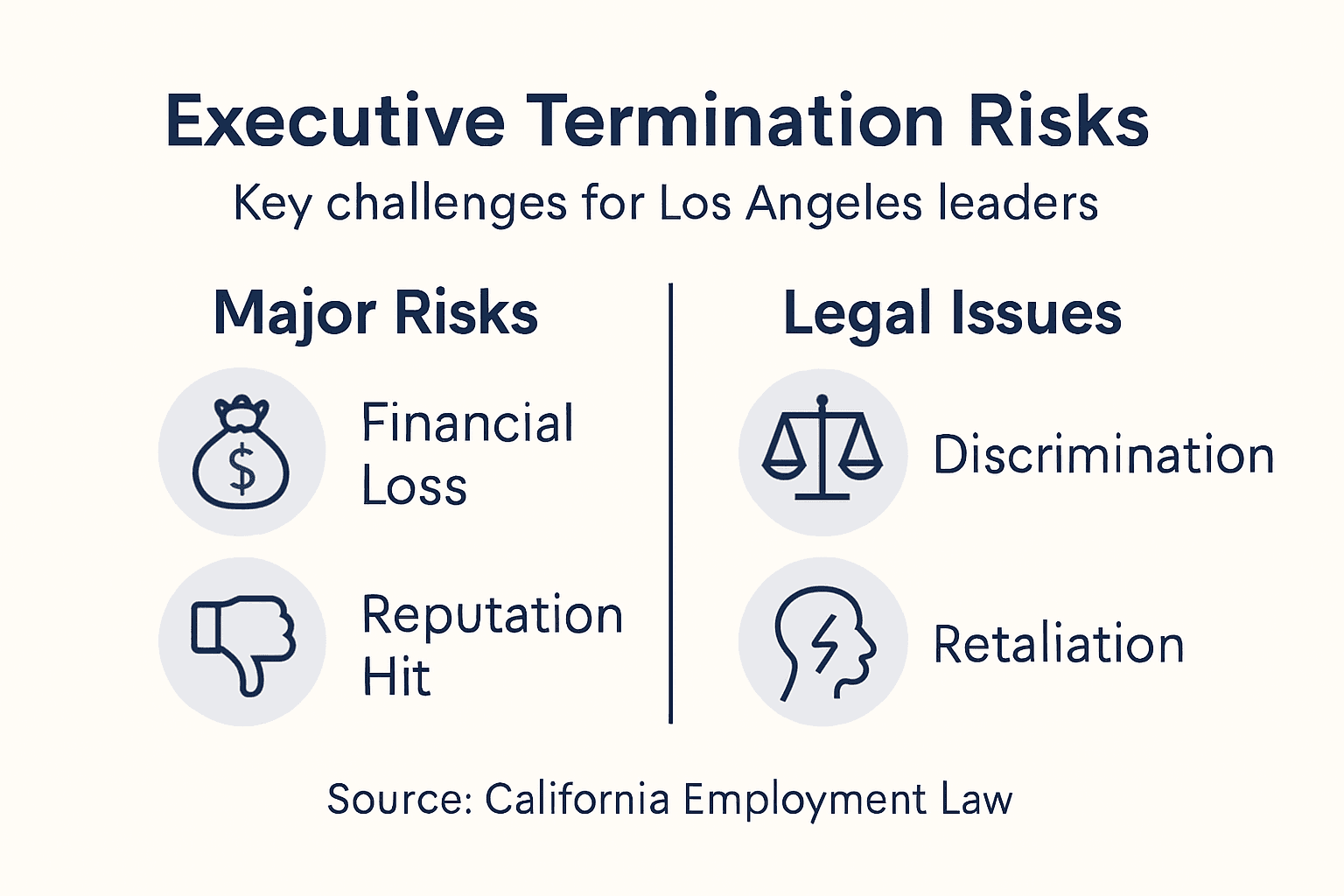
Career recovery after wrongful termination requires strategic navigation of complex professional landscapes. Executives must carefully manage their professional narrative, potentially leveraging legal resolutions to mitigate reputational damage. This often involves creating compelling explanations for potential employers, maintaining professional network relationships, and demonstrating resilience in the face of workplace challenges. Successful executives recognize that proactive reputation management becomes crucial in transforming a potentially career-threatening experience into an opportunity for professional reinvention.
Pro tip: Document every aspect of your termination meticulously, including performance records and communication history, to preserve your professional credibility and potential legal recourse.
Avoiding Common Mistakes and Protecting Reputation
Navigating the aftermath of a potential wrongful termination demands strategic and calculated actions from executives seeking to protect their professional standing. Immediate legal strategies become critical in preserving both legal rights and professional reputation, requiring careful, deliberate responses to unexpected job separation.
The most crucial initial steps involve maintaining professional composure while systematically documenting every aspect of the termination. Executives should resist impulsive reactions like publicly criticizing former employers or signing severance agreements without comprehensive legal review. Instead, they must meticulously collect all relevant documentation, including performance reviews, communication records, employment contracts, and detailed accounts of the termination circumstances. These materials serve as potential evidence and can significantly impact future legal proceedings or professional rehabilitation.
Here is a quick reference on steps executives should take immediately after termination to protect their rights:
| Step | Why It Matters | Common Mistake to Avoid |
|---|---|---|
| Document all communications | Preserves evidence for legal action | Deleting relevant emails |
| Consult a legal professional | Ensures correct legal strategy | Signing severance blindly |
| Maintain professionalism | Protects reputation and future options | Public outbursts or posts |
| Review employment contract | Identifies potential legal grounds | Overlooking small details |
Professional network management becomes paramount in reputation preservation. Executives must craft a strategic narrative that presents their termination professionally, focusing on future opportunities rather than past conflicts. This approach involves carefully managing references, leveraging professional connections, and potentially utilizing strategic communications to mitigate potential negative perceptions. Successful executives understand that reputation management is a nuanced process requiring emotional intelligence, strategic thinking, and a forward-looking perspective.
Pro tip: Engage a professional reputation management consultant who specializes in executive career transitions to help craft a strategic narrative and navigate potential professional challenges.
Protect Your Rights Against Wrongful Termination in Los Angeles
Facing wrongful termination as an executive in Los Angeles brings serious challenges including discrimination, retaliation, and complex contract disputes. You may be experiencing damages to your reputation, career uncertainty, and financial risks because your employer threatened your job security without legal grounds. It is vital to understand your legal protections and act quickly to preserve your rights by documenting performance reviews, communications, and potential discrimination evidence as described in the article.
At Shirazi Law Office we specialize in providing strategic legal support specifically for executives and senior management dealing with wrongful termination and other employment disputes. Our team helps you navigate contractual rights and fight unlawful dismissal to protect your career and professional reputation. Learn more about how we support senior professionals in high stakes job loss situations at Senior Management Representation and discover effective remedies on our Wrongful Termination page.
Do not wait until your case grows more complicated or your reputation is damaged. Contact Shirazi Law Office today for a timely consultation and safeguard your career with expert legal advocacy tailored to Los Angeles executives.
Frequently Asked Questions
What constitutes wrongful termination for executives?
Wrongful termination for executives occurs when an employer fires them for illegal reasons, such as discrimination based on protected characteristics, retaliation for reporting misconduct, or violations of employment contracts.
How can executives prove wrongful termination?
Executives can prove wrongful termination by documenting evidence such as performance reviews, communication records, and any discriminatory patterns or retaliation from employers, which may suggest the dismissal was unlawful.
What legal protections do executives have against wrongful termination?
Executives have several legal protections, including explicit employment contracts outlining termination conditions, implied contracts based on company practices, and public policy exceptions for refusing to engage in illegal activities or reporting corporate misconduct.
What are the common mistakes to avoid after being terminated?
Common mistakes to avoid include making public criticisms of former employers, signing severance agreements without legal review, and failing to document termination-related communications, all of which can negatively impact legal rights and professional reputation.





[…] Wrongful Termination for Los Angeles Executives: Key Risks […]
[…] Wrongful Termination for Los Angeles Executives: Key Risks […]
[…] is an important early step. Similarly, executives facing complex separation issues should look at wrongful termination risks for senior employees to understand what additional protections may […]
[…] California, executive wrongful termination cases are rarely straightforward. They frequently involve layered claims: a termination that looks […]