

High-level executives at major firms like Deloitte and PwC often believe their employment status shields them from wrongful termination protections available to other employees. This misconception can prove costly when facing retaliation or unlawful dismissal. California law provides robust protections for executives who engage in whistleblowing, report violations, or challenge discriminatory practices. Understanding these protections, recognizing retaliation patterns, and knowing how to document potential violations can make the difference between a successful claim and missed opportunities for legal recourse. This guide explains the legal framework, examines key cases, and outlines practical steps executives should take when facing employment disputes in Century City.
Table of Contents
- Key takeaways
- Understanding wrongful termination protections for executives in Century City
- Key wrongful termination cases involving Deloitte, PwC, and similar firms
- Practical steps and strategies for executives facing wrongful termination claims
- Navigating executive employment disputes in Century City: legal resources and support
- Protect your rights with expert legal counsel in Century City
- Frequently asked questions
Key Takeaways
| Point | Details |
|---|---|
| Executive protections | California law protects executives from retaliation including termination, demotion, exclusion, and harassment. |
| Protected activities scope | Protected activity includes formal whistleblowing as well as internal complaints about discrimination and reports of financial irregularities or illegal conduct. |
| Adverse actions timing | Adverse actions extend beyond termination to include exclusion from meetings, removal from high profile projects, denial of earned bonuses, reassignment to lesser roles, or negative performance reviews. |
| Procedural paths | FEHA and Labor Code 1102.5 offer overlapping protections with different filing requirements and pathways for pursuing claims. |
| Documentation matters | Documenting every interaction and preserving records helps establish causation between protected activity and adverse actions. |
Understanding wrongful termination protections for executives in Century City
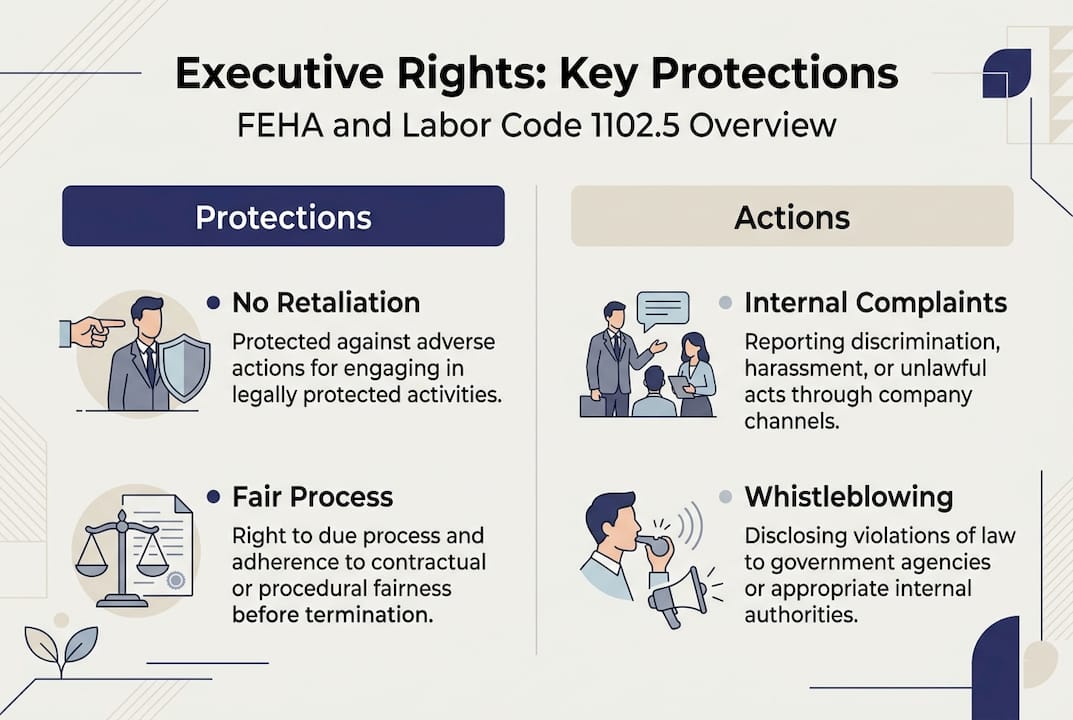
California law protects executives from retaliation including termination, demotion, exclusion, and harassment. Proving requires showing protected activity, adverse action, and causal link. Many senior professionals mistakenly assume their executive status or at-will employment contracts eliminate these protections. The reality is more nuanced and favorable to employees who understand their rights.
Protected activities extend beyond formal whistleblowing to include internal complaints about discriminatory practices, reports of financial irregularities, objections to illegal business practices, and refusals to participate in unlawful conduct. When you report suspected securities violations, tax fraud, environmental violations, or workplace discrimination, you engage in legally protected activity regardless of your position within the organization. Even informal complaints to human resources or management can qualify as protected activity under California law.
Adverse actions take many forms beyond outright termination. Executives may face exclusion from key meetings, removal from high-profile projects, denial of earned bonuses, reassignment to less prestigious roles, or sudden negative performance reviews. These subtle forms of retaliation can be just as damaging to your career as termination itself. Courts recognize that retaliation often manifests through professional isolation, reduced responsibilities, or creation of hostile work conditions designed to force resignation.
The causal link requirement focuses on timing and circumstances connecting your protected activity to the adverse action. If termination or demotion occurs shortly after you report violations or complain about discrimination, this temporal proximity creates an inference of retaliation. You don’t need direct evidence of retaliatory intent. Circumstantial evidence showing the adverse action followed your protected activity can satisfy this element, particularly when combined with shifting explanations from your employer or departures from standard procedures.
California’s Fair Employment and Housing Act (FEHA) and Labor Code Section 1102.5 provide overlapping protections with different procedural requirements. FEHA requires filing an administrative complaint with the Civil Rights Department before pursuing litigation, while Labor Code claims proceed directly to court. Understanding these procedural distinctions helps you preserve all available remedies and avoid technical pitfalls that could undermine otherwise valid claims.
Pro Tip: Document every interaction related to your complaint or protected activity immediately. Save emails to personal accounts, note dates and participants in meetings, and preserve performance reviews predating any complaints. This contemporaneous documentation becomes crucial evidence if you later need to establish the causal connection between your protected activity and adverse employment actions.
Key wrongful termination cases involving Deloitte, PwC, and similar firms
Examining precedent cases reveals how courts apply wrongful termination and retaliation principles to executive disputes at major professional services firms. Mauro Botta sued PwC for wrongful termination after whistleblower complaint; trial in 2021 addressing retaliation claims. The case highlighted challenges executives face when reporting concerns about firm practices, particularly when those concerns implicate senior leadership or core business operations.
The Botta litigation demonstrated how major firms may respond to internal complaints with investigation processes that themselves become vehicles for retaliation. Executives who raise concerns often find themselves subjected to heightened scrutiny, isolated from colleagues, or excluded from client relationships they developed. These patterns of behavior, when documented systematically, can support retaliation claims even when the firm articulates seemingly legitimate business reasons for adverse actions.
Klig v. Deloitte court found no breach in partner termination after criminal plea. This case illustrates the limits of wrongful termination claims when executives engage in conduct that provides independent grounds for termination. However, the decision also emphasized that firms must follow their own policies and partnership agreements when terminating senior professionals. Departures from standard procedures or selective enforcement of policies can support claims of pretext or discrimination.
Deloitte v. Lamela upheld non-compete enforcement against former tax partner under Florida law. While focused on restrictive covenants rather than wrongful termination, this case shows how firms use post-employment restrictions to limit executive mobility and bargaining power. California’s strong public policy against non-compete agreements provides significantly greater protection for executives than other jurisdictions, making the choice of law provisions in employment agreements critically important.
| Case | Firm | Key Issue | Outcome | Lesson for Executives |
|---|---|---|---|---|
| Botta v. PwC | PwC | Whistleblower retaliation | Trial on retaliation claims | Document timing of complaints and subsequent adverse actions |
| Klig v. Deloitte | Deloitte | Partner termination after plea | No breach found | Independent misconduct limits claims but procedure matters |
| Deloitte v. Lamela | Deloitte | Non-compete enforcement | Covenant upheld | California law offers stronger protection against restrictive covenants |
These cases reveal common patterns in how major firms approach executive termination cases in Century City and similar markets. Firms typically maintain detailed documentation of performance issues and policy violations to establish legitimate business reasons for termination. However, when this documentation appears suddenly after protected activity or departs from historical evaluation patterns, it may evidence pretext. Courts scrutinize whether the stated reasons for termination are consistent with how the firm treated similarly situated executives who did not engage in protected activity.
Practical steps and strategies for executives facing wrongful termination claims
When you suspect retaliation or wrongful termination, immediate action protects your legal rights and strengthens potential claims. Document timing and communications carefully; consult specialists early due to a three-year statute of limitations. The quality of your documentation often determines whether you can prove the causal connection between protected activity and adverse employment actions.

Start by creating a detailed timeline of events. Note when you first raised concerns, made complaints, or engaged in other protected activity. Record every subsequent interaction with management, human resources, or colleagues that relates to your complaint or work status. Include dates, times, locations, participants, and specific statements made during conversations. This timeline becomes the foundation for establishing temporal proximity and demonstrating how your treatment changed after engaging in protected activity.
Preserve all relevant communications immediately. Forward work emails to a personal account, save text messages, and document verbal conversations in contemporaneous notes. Many executives lose crucial evidence when firms revoke access to email systems upon termination. Taking proactive steps to preserve this evidence before losing access ensures you can prove your claims later. Be careful to comply with any confidentiality obligations while preserving evidence of your own employment situation.
- Create a comprehensive timeline documenting your protected activity and all subsequent employment actions
- Preserve emails, performance reviews, and communications by forwarding to personal accounts or saving to external devices
- Note any departures from standard procedures, such as unusual performance improvement plans or exclusion from normal business activities
- Consult with an employment attorney specializing in executive retaliation claims before making formal complaints when possible
- Understand your employment agreement’s terms regarding dispute resolution, including any arbitration clauses or choice of law provisions
- Avoid signing separation agreements or releases without legal review, as these often waive valuable claims
- File administrative complaints or lawsuits within applicable statutes of limitations to preserve your rights
Timing considerations extend beyond the statute of limitations. The sooner you consult with experienced counsel, the better positioned you are to avoid common pitfalls that undermine otherwise valid claims. Attorneys can advise on whether to make internal complaints, how to document ongoing retaliation, and when to escalate to administrative agencies or litigation. Early consultation also helps you understand the realistic value of potential claims and whether pursuing legal action aligns with your professional and financial goals.
Understanding available remedies helps you make informed decisions about pursuing claims. California law provides for recovery of lost wages and benefits, compensation for emotional distress, punitive damages in cases involving malice or oppression, and attorney fees for prevailing plaintiffs. Executives with substantial compensation packages may recover significant economic damages when wrongfully terminated. However, you have a duty to mitigate damages by seeking comparable employment, which can affect the ultimate recovery amount.
Pro Tip: Before making any formal complaints, consult with legal counsel to understand how your specific situation fits within legal frameworks and what documentation will be most valuable. Attorneys can help you craft complaints that clearly invoke legal protections and avoid language that might undermine later claims. This strategic approach maximizes your legal protections while minimizing risks of retaliation.
Navigating executive employment disputes in Century City: legal resources and support
Century City has specialized employment lawyers and neutrals handling executive disputes, including wrongful termination and retaliation. The concentration of major firms and corporate headquarters in this area has created a sophisticated legal ecosystem for resolving complex employment disputes. Understanding your options for legal representation and dispute resolution helps you choose the path most likely to achieve your goals.
Specialized Century City employment lawyers bring deep experience with executive-level disputes and understand the unique dynamics of professional services firms. These attorneys recognize how major firms approach termination decisions, what documentation typically exists, and how to identify evidence of pretext or retaliation. Their familiarity with local courts and arbitration forums also provides strategic advantages when evaluating litigation options.
Alternative dispute resolution offers potential benefits for executives seeking confidential resolution of employment disputes. Organizations like JAMS provide experienced neutrals who understand executive compensation structures, partnership agreements, and complex retaliation claims. Mediation can produce creative solutions that litigation cannot, such as neutral references, continued vesting of equity compensation, or agreements regarding non-disparagement. Many executives prefer these confidential processes to public litigation that might affect their professional reputation.
Arbitration provisions in employment agreements require careful analysis. While arbitration offers speed and confidentiality, it also limits discovery, eliminates jury trials, and restricts appeals. California courts scrutinize arbitration agreements for procedural and substantive unconscionability, particularly when they limit remedies or impose unreasonable costs on employees. Understanding whether your arbitration agreement is enforceable affects your strategic options and potential leverage in settlement negotiations.
- Specialized employment law firms with executive practice groups
- Alternative dispute resolution services through JAMS and similar organizations
- State and federal courts with jurisdiction over employment claims
- California Civil Rights Department for FEHA administrative complaints
- State Bar of California attorney referral services
- Executive coaching and career transition support services
Choosing legal representation requires evaluating several factors. Look for attorneys with specific experience handling executive wrongful termination and retaliation claims, not just general employment law. Ask about their track record with cases involving major professional services firms. Understand their fee structure, whether they work on contingency or require retainers, and what costs you might incur beyond attorney fees. The right attorney brings not just legal knowledge but strategic judgment about when to negotiate, when to litigate, and how to maximize your recovery.
| Resolution Path | Typical Timeline | Confidentiality | Cost Structure | Best For |
|---|---|---|---|---|
| Negotiated settlement | 2-6 months | High | Attorney fees only | Quick resolution with acceptable terms |
| Mediation | 3-8 months | High | Mediator fees plus attorney fees | Preserving relationships and creative solutions |
| Arbitration | 8-18 months | Moderate | Arbitrator fees plus attorney fees | Contractually required or faster than litigation |
| Litigation | 18-36 months | Low | Court costs plus attorney fees | Maximum recovery or establishing precedent |
The value of specialized counsel becomes evident when navigating executive severance disputes and complex termination scenarios. Experienced attorneys identify claims you might overlook, such as breach of implied contract, violation of public policy, or interference with prospective economic advantage. They also help you avoid common mistakes that could waive claims or reduce potential recovery. This expertise proves particularly valuable when major firms deploy sophisticated legal strategies to minimize liability and protect their reputation.
Protect your rights with expert legal counsel in Century City
Facing wrongful termination or retaliation as a high-level executive requires specialized legal guidance to protect your career and financial interests. The complexities of executive employment relationships, coupled with the resources major firms dedicate to defending against claims, make experienced representation essential. Senior management legal representation focused on your unique situation provides the strategic advantage needed to achieve favorable outcomes.
Seasoned employment lawyers in Los Angeles understand how to build compelling retaliation claims, negotiate substantial settlements, and litigate complex executive disputes when necessary. They bring knowledge of employee rights and discrimination laws that protect executives at all levels. Early consultation ensures you understand your options, preserve crucial evidence, and make informed decisions about how to proceed. Don’t let misconceptions about executive employment status prevent you from asserting your legal rights and recovering the compensation you deserve.
Frequently asked questions
What are the most common reasons high-level executives face wrongful termination at firms like Deloitte and PwC?
Common reasons include whistleblowing about financial irregularities, disagreeing with management decisions on client matters, disputes over compensation or partnership terms, and allegations of policy violations that may be pretextual. Executives may face retaliation disguised as performance issues, restructuring, or cultural fit concerns. The sophisticated nature of these terminations often makes the retaliatory motive less obvious than in cases involving lower-level employees.
How can executives prove retaliation under California law when facing termination?
Executives must demonstrate they engaged in protected activity like whistleblowing. Show an adverse action such as termination or exclusion followed. Establish a causal link, often based on timing. Then the burden shifts to employer to justify action. Temporal proximity between your complaint and termination creates a strong inference of retaliation, particularly when combined with evidence that the stated reasons for termination are pretextual or inconsistent with prior treatment.
What practical steps should I take immediately if I suspect wrongful termination?
Keep detailed records of communications and timing related to your protected activity and any subsequent adverse actions. Avoid making informal complaints without documentation that clearly establishes you engaged in legally protected activity. Consult an experienced employment attorney promptly to understand your rights and options. Be aware of the three-year statute of limitations for most retaliation claims under California law, though some claims have shorter deadlines.
Can executives recover damages beyond lost salary in wrongful termination cases?
Yes, California law allows recovery of all lost compensation including bonuses, equity awards, and benefits that would have vested. You can also recover damages for emotional distress caused by the wrongful termination. In cases involving malice, oppression, or fraud, courts may award punitive damages to punish the employer and deter similar conduct. Prevailing plaintiffs typically recover attorney fees and costs, making it financially feasible to pursue valid claims even against well-funded corporate defendants.





[…] Century City executives frequently face complex disputes involving wrongful termination, retaliation, and contract issues that most general employment attorneys are not equipped to handle at the required level. […]