

Facing sudden termination after reporting workplace misconduct can feel both shocking and deeply unfair, especially for executives and senior managers in Downtown Los Angeles. Protecting your career and reputation means understanding the difference between a difficult workplace and true wrongful termination. This article offers a clear explanation of what defines wrongful termination for executives who have reported organizational misconduct, along with a straightforward summary of your whistleblower protections and potential legal remedies.
Table of Contents
- Defining Wrongful Termination After Reporting Misconduct
- Types of Retaliation in Los Angeles Workplaces
- California Laws Protecting Whistleblowers
- Critical Evidence in Retaliation Claims
- Executive Rights and Employer Liabilities
- Recovering Damages and Restoring Reputation
Key Takeaways
| Point | Details |
|---|---|
| Wrongful Termination Protections | Employees who report misconduct are legally protected from retaliation by their employers in California. |
| Types of Retaliation | Retaliation can manifest in various subtle and overt forms, including negative evaluations and professional isolation. |
| Evidence Collection | Executives should meticulously document incidents and communications to strengthen their retaliation claims. |
| Legal Remedies | Potential remedies for wrongful termination include reinstatement, back pay, and damages, promoting accountability in workplace practices. |
Defining Wrongful Termination After Reporting Misconduct
In the complex landscape of employment law, wrongful termination represents a significant legal protection for employees who expose workplace misconduct. When executives in Downtown Los Angeles report unethical or illegal activities within their organizations, they are legally shielded from retaliatory actions by their employers. Wrongful termination occurs when an employer fires an employee for reasons that violate established legal standards, particularly those related to whistleblower protections.
Under California employment law, wrongful termination after reporting misconduct involves several critical elements that executives must understand. The termination must be directly linked to the employee’s decision to report illegal activities, harassment, discrimination, safety violations, or other forms of organizational misconduct. This protection extends to various reporting mechanisms, including:
- Internal reporting to human resources or management
- Reporting to regulatory agencies
- Cooperating with official investigations
- Refusing to participate in illegal activities
The legal framework recognizes that employees who come forward with legitimate concerns about workplace violations should be protected from adverse employment actions. Employers cannot legally retaliate by:
- Firing the employee
- Demoting the employee
- Reducing compensation
- Creating a hostile work environment
- Blocking professional advancement
Whistleblower protections are designed to encourage transparency and ethical conduct in the workplace. Executives who face termination after reporting misconduct have several potential legal remedies, including reinstatement, back pay, compensatory damages, and potential punitive damages against the employer.
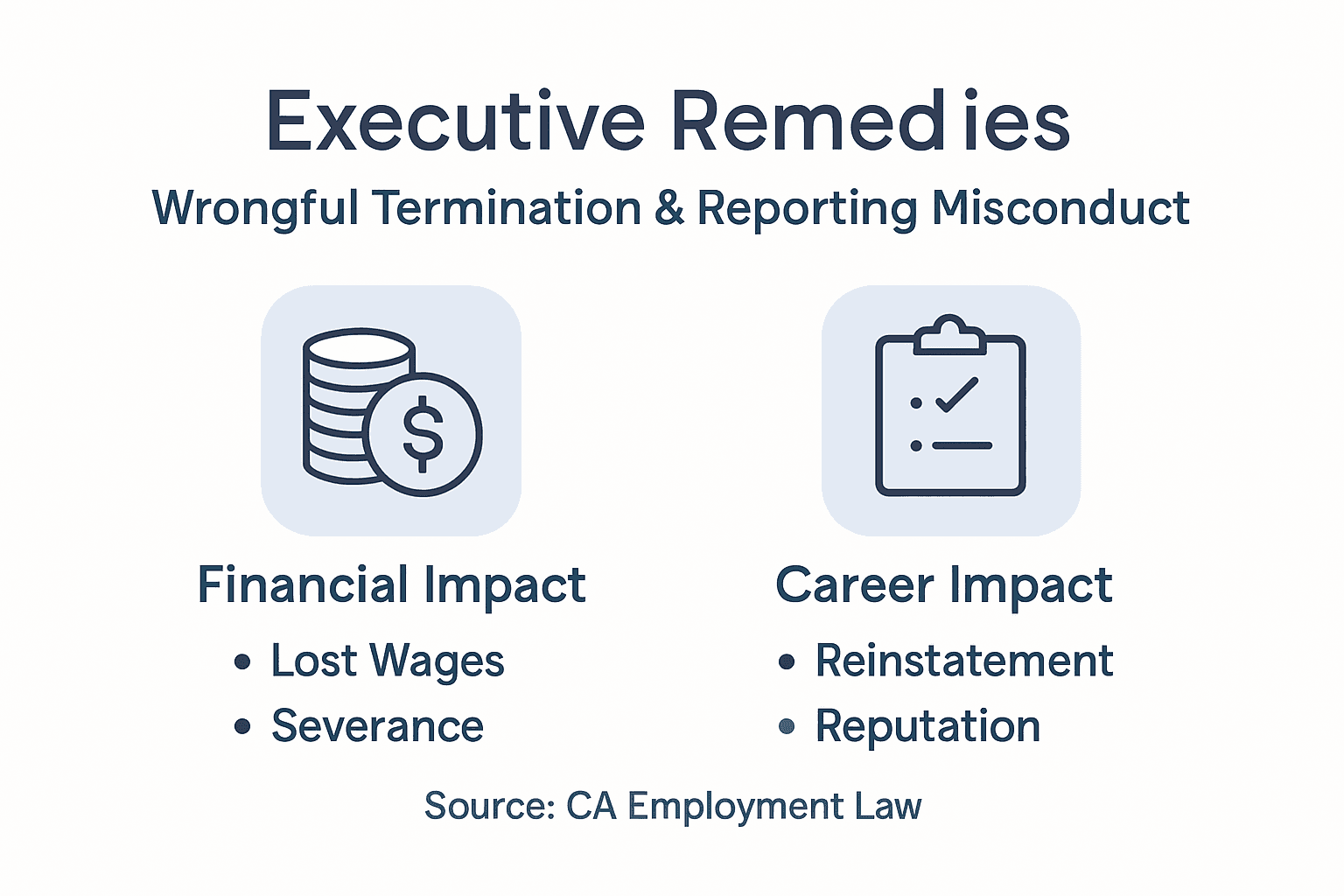
Here’s a comparison of legal remedies available for executives facing wrongful termination:
| Remedy Type | Financial Impact | Career Impact | Application Criteria |
|---|---|---|---|
| Reinstatement | Restores salary stream | Recovers lost position | Proven unjust termination |
| Back Pay | Compensates lost wages | Validates claim | Documented financial losses |
| Compensatory Damages | Covers related expenses | Acknowledges harm | Evidence of emotional/career harm |
| Punitive Damages | Adds penalty to employer | Deterrent effect | Demonstrated extreme misconduct |
Pro tip: Document every interaction and communication related to your misconduct report to strengthen potential legal claims and create a clear timeline of events.
Types of Retaliation in Los Angeles Workplaces
In Downtown Los Angeles, workplace retaliation takes many sophisticated forms that can devastate an executive’s career and professional reputation. Workplace retaliation represents any adverse action an employer takes against an employee who has engaged in legally protected activities, such as reporting misconduct, discrimination, or unethical practices.
Executives may encounter various subtle and overt forms of workplace retaliation, which can manifest through multiple professional channels:
- Professional isolation and exclusion from critical meetings
- Sudden negative performance evaluations without substantive justification
- Reduction in responsibilities or job duties
- Blocking potential promotions or career advancement opportunities
- Creating unreasonable work conditions designed to provoke resignation
- Publicly humiliating or undermining the employee’s professional standing
- Imposing impossible performance standards
Employers often utilize complex strategies to disguise retaliatory actions, making them challenging to identify and prove. These tactics can include systematic undermining of an executive’s credibility, strategic marginalization within organizational hierarchies, and calculated efforts to diminish professional opportunities.
Subtle retaliation techniques frequently involve psychological manipulation and strategic professional degradation. Employers might engage in behaviors that appear neutral on the surface but are designed to create a hostile work environment, ultimately forcing the executive to consider resignation.
Retaliation is not always obvious. The most dangerous forms are often the most carefully concealed.
Legal protections exist to shield executives from these destructive workplace practices. Executives who recognize these patterns can document and challenge retaliatory behaviors, potentially securing legal remedies and protecting their professional trajectory.
Pro tip: Maintain a comprehensive, contemporaneous record of all interactions, communications, and incidents that might suggest retaliatory conduct to build a strong potential legal case.
California Laws Protecting Whistleblowers
California’s robust legal framework provides comprehensive protections for employees who expose workplace misconduct, particularly in Downtown Los Angeles’s competitive professional environment. California Labor Code protections ensure that executives can report unethical or illegal practices without fear of professional retaliation, creating a critical safeguard for workplace integrity.
The state’s whistleblower laws are designed to shield employees who engage in legally protected activities, which include:
- Reporting violations of state or federal statutes
- Documenting unsafe working conditions
- Refusing to participate in illegal activities
- Testifying in workplace investigations
- Reporting discriminatory practices
- Exposing financial misconduct
- Revealing potential regulatory violations
Whistleblower protections extend beyond immediate termination, covering a wide range of potential retaliatory actions. Employers are strictly prohibited from creating policies or environments that might discourage employees from reporting misconduct, with significant legal consequences for violations.
Whistleblower laws are not just legal protections—they are fundamental safeguards of professional ethics and organizational transparency.
The legal landscape provides multiple avenues for executives to seek remedies, including potential reinstatement, compensation for lost wages, and additional damages for career disruption. These protections recognize the critical role employees play in maintaining workplace accountability and preventing systemic misconduct.
Pro tip: Consult with an employment law specialist immediately after experiencing potential retaliation to preserve your legal rights and documentation.
Critical Evidence in Retaliation Claims
In Downtown Los Angeles’s competitive professional landscape, building a compelling retaliation claim requires meticulous documentation and strategic evidence gathering. Critical evidence for workplace retaliation demands a comprehensive approach that establishes a clear connection between protected activities and adverse employment actions.
Executives pursuing retaliation claims must focus on collecting the following types of crucial evidence:
- Detailed written documentation of protected activities
- Chronological timeline of events
- Performance records before and after reporting misconduct
- Email communications demonstrating potential retaliatory intent
- Witness statements from colleagues
- Internal memos or communications suggesting discriminatory practices
- Official complaint records and investigation documents
Temporal evidence plays a critical role in substantiating retaliation claims. Courts often examine the proximity between an employee’s protected activity and subsequent adverse actions, looking for suspicious patterns that suggest intentional workplace misconduct.
Timing is everything. The closer the adverse action occurs to the protected activity, the stronger the potential retaliation claim.
Documentary evidence becomes the cornerstone of successful legal challenges. Executives must preserve comprehensive records, including performance evaluations, communication logs, and any documentation that demonstrates a sudden shift in professional treatment after reporting misconduct.

Pro tip: Create a confidential, comprehensive digital archive of all relevant workplace communications and interactions to support potential future legal proceedings.
Executive Rights and Employer Liabilities
In Downtown Los Angeles’s complex employment landscape, executives possess robust legal protections against unwarranted termination and discriminatory practices. California executive rights establish comprehensive safeguards that define the boundaries of employer actions and employee protections.
Executive contracts and legal frameworks provide multiple layers of protection, including:
- Contractual termination clause specifications
- Protection against discriminatory dismissal
- Mandatory due process requirements
- Severance agreement provisions
- Protection from retaliatory employment actions
- Guaranteed performance-based evaluation standards
- Legal recourse for breach of contract
Employer liabilities extend beyond simple monetary compensation, encompassing potential legal consequences that can significantly impact organizational reputation and future hiring practices. Companies found in violation of executive rights may face:
- Substantial financial penalties
- Mandatory reinstatement
- Compensation for lost wages and opportunities
- Punitive damages
- Mandated policy reforms
- Professional reputation damage
Legal protections are not just about individual rights, but about maintaining systemic workplace integrity and accountability.
Contractual safeguards represent a critical mechanism for protecting executive professional interests. These agreements typically outline specific conditions under which termination can occur, providing a structured framework for employment relationships and potential dispute resolution.
The table below summarizes key executive rights versus employer liabilities:
| Executive Rights | Employer Liabilities | Business Consequences |
|---|---|---|
| Contract protection clauses | Financial penalties | Reputation damage |
| Due process requirements | Mandatory reinstatement | Impact on future hiring |
| Protection from retaliation | Compensation for lost wages | Policy reform mandates |
| Performance-based evaluation | Punitive damages | Potential negative publicity |
Pro tip: Have an employment attorney carefully review your executive contract before signing to ensure comprehensive protection against potential workplace misconduct.
Recovering Damages and Restoring Reputation
For Downtown Los Angeles executives facing wrongful termination, the legal process of recovering professional damages extends far beyond financial compensation. The strategic pursuit of legal remedies involves comprehensive efforts to rebuild professional credibility and secure comprehensive financial recovery.
Executives may seek multiple categories of damages, including:
- Lost base salary and projected compensation
- Forfeited performance bonuses and stock options
- Lost retirement and healthcare benefits
- Emotional distress compensation
- Punitive damages in cases of extreme misconduct
- Legal fees and litigation expenses
- Potential future earning capacity restoration
Reputation management becomes a critical parallel track in the legal recovery process. Successful claims not only provide financial restitution but also serve to publicly validate the executive’s professional integrity and challenge unwarranted termination.
Effective legal strategies transform workplace injustice into a powerful narrative of professional resilience and accountability.
Strategic legal documentation plays a crucial role in both financial recovery and reputation restoration. Meticulously compiled evidence demonstrates the executive’s commitment to professional standards and exposes potential systemic workplace misconduct.
Pro tip: Work closely with your employment attorney to develop a comprehensive legal strategy that addresses both financial compensation and professional reputation rehabilitation.
Protect Your Rights After Reporting Misconduct in Downtown Los Angeles
Facing wrongful termination or retaliation after reporting workplace misconduct can feel isolating and overwhelming. If you are an executive in Downtown Los Angeles dealing with unfair treatment, reduced responsibilities, or sudden termination tied to your whistleblowing efforts, you need expert guidance that understands the complex protections available under California law. Key challenges include proving a direct link between your report and adverse actions, securing vital evidence, and navigating strong employer resistance.
At Shirazi Law Office, we specialize in helping executives assert their rights and recover lost wages, reputation, and professional standing. With a focus on Wrongful Termination and a deep understanding of issues affecting professionals in Downtown Los Angeles, our strategic legal representation ensures your voice is heard and your career protected. Do not wait until your job prospects are damaged further—take action now to safeguard your future and hold your employer accountable. Visit us at Shirazi Law Office to schedule a consultation and start fighting for your rights today.
Frequently Asked Questions
What is wrongful termination after reporting misconduct?
Wrongful termination occurs when an employer fires an employee for reasons that violate legal protections, particularly for reporting illegal activities, harassment, or discrimination.
What legal protections do executives have against retaliation?
Executives are protected under whistleblower laws from retaliation for reporting misconduct, which includes actions like termination, demotion, or creating a hostile work environment.
What types of evidence are crucial for a retaliation claim?
Critical evidence includes documentation of protected activities, performance records, emails showing retaliatory intent, and witness statements that support the claim.
What remedies are available for executives facing wrongful termination?
Executives may seek remedies such as reinstatement, back pay, compensatory damages for lost wages, and punitive damages against the employer for extreme misconduct.





[…] is illegal. If your employer punishes you for asserting your rights, that’s another violation. Wrongful termination after reporting misconduct is unlawful and strengthens your legal […]