
Many employees at Los Angeles media firms assume that California’s at-will employment rule means they are powerless if they get fired. That assumption is wrong. Media employees in LA, including those at major studios like Paramount, have brought significant wrongful termination and retaliation lawsuits that resulted in real legal outcomes. Your job, your reputation, and your financial future matter. This guide breaks down what wrongful termination actually means for media workers, which laws protect you, how studios defend these claims, and exactly what steps to take if you believe your firing was unlawful.
Table of Contents
- What counts as wrongful termination in LA media firms?
- Key legal protections for media employees in Hancock Park and LA
- How media employers respond to wrongful termination claims
- What to do if you suspect wrongful termination or retaliation
- A fresh perspective: Why subtle retaliation is the most overlooked risk in LA media jobs
- How an LA wrongful termination firm can help you move forward
- Frequently asked questions
Key Takeaways
| Point | Details |
|---|---|
| Protected terminations | Not all firings are legal in at-will California media jobs—laws protect you from discrimination, retaliation, and mass layoffs without notice. |
| Evidence is essential | Document everything—winning claims against big studios often turn on your records versus their stated reasons. |
| Act fast | Strict filing deadlines mean you should consult a media-focused employment attorney quickly after losing your job. |
| Specialized support | Hancock Park and LA firms understand creative industry disputes and can help you assert your rights confidentially. |
What counts as wrongful termination in LA media firms?
Now that you’ve got the core question in mind, let’s dig into how wrongful termination is defined, especially for employees in the media sector.
California is an at-will state, which means an employer can generally end your employment at any time. But that rule has important exceptions. California law protects employees against firings that violate public policy, anti-discrimination laws, and retaliation statutes. In plain terms, your employer cannot fire you for an illegal reason, even if they frame it as a business decision.
In media and creative workplaces, wrongful termination often surfaces in specific ways. Common triggers include:
- Discrimination based on race, gender, age, disability, or pregnancy
- Whistleblowing, such as reporting safety violations, financial fraud, or harassment
- Taking protected leave under the California Family Rights Act (CFRA) or the federal Family and Medical Leave Act (FMLA)
- Mass layoffs that violate the WARN Act’s required notice periods
- Retaliation after filing a complaint with HR or a government agency
Recent Paramount lawsuits illustrate just how real these claims are at major studios. Employees have alleged disability discrimination, retaliation after medical leave, and WARN Act violations following large-scale layoffs.
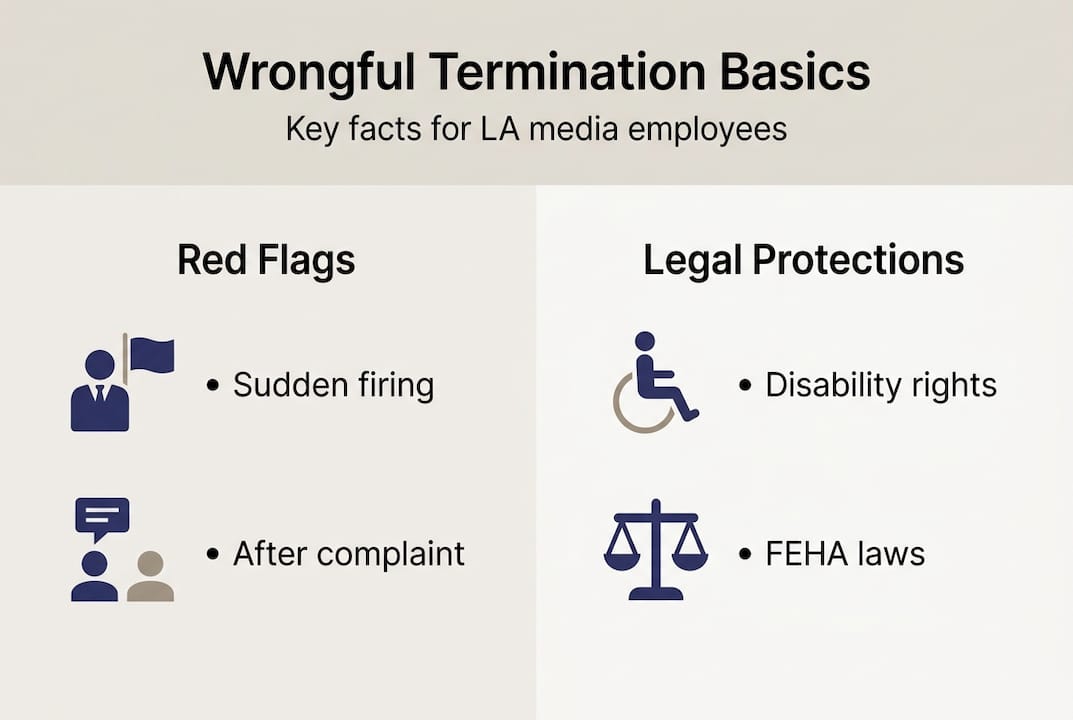
So what are the red flags that your firing may have been illegal? Watch for terminations that happen shortly after you reported misconduct, requested medical leave, filed an HR complaint, or disclosed a disability. Timing matters enormously in these cases.
Pro Tip: Write down a timeline of events as soon as possible after your termination. Note dates, conversations, and any changes in how you were treated before the firing. This record can become critical evidence.
A wrongful termination overview can help you see whether your situation fits one of these protected categories. The key takeaway is this: at-will does not mean your employer can fire you for any reason. It means they cannot fire you for an illegal reason.
Key legal protections for media employees in Hancock Park and LA
Understanding what counts as wrongful termination, the next step is to know exactly what legal tools are available to you.
Several powerful laws protect LA media workers. Here is a summary of the most relevant ones:
| Law | What it covers | Key remedy |
|---|---|---|
| FEHA (Fair Employment and Housing Act) | Discrimination and harassment based on protected characteristics | Back pay, damages, attorney fees |
| Labor Code §1102.5 | Whistleblower retaliation | Reinstatement, lost wages, civil penalties |
| CFRA / FMLA | Medical and family leave protections | Job restoration, back pay |
| WARN Act | 60-day notice before mass layoffs | Up to 60 days’ back pay and benefits |
Protections under FEHA, Labor Code whistleblower provisions, CFRA/FMLA, and the WARN Act collectively give media employees a strong foundation to challenge unlawful firings. These are not abstract rights. They translate into real money and real outcomes.
Paramount’s recent restructuring is a sharp example. After the Skydance merger, WARN Act class actions were filed following the layoff of approximately 1,000 workers, with employees arguing the company failed to provide the legally required 60 days’ notice. That case is a reminder that even the largest studios are not above the law.
If you believe your rights were violated, here is a general sequence of steps for pursuing a claim:
- File a complaint with the California Civil Rights Department (CRD) for FEHA violations
- Request a right-to-sue letter if you want to proceed in court
- File your lawsuit within the applicable deadline (often one year for CRD claims)
- Pursue discovery to gather evidence from your employer
- Negotiate a settlement or proceed to trial
“Your case isn’t just a file number. It’s your livelihood, your future, and your story.”
If your termination involved a disability, reviewing your disability discrimination rights is an important early step. Similarly, executives facing complex separation issues should look at wrongful termination risks for senior employees to understand what additional protections may apply.
Timelines are critical. Missing a filing deadline can end your case before it begins. Act quickly.
How media employers respond to wrongful termination claims
With the legal context clear, it’s vital to anticipate how big employers like Paramount respond to these claims.

Studios and large media companies rarely admit wrongdoing. Their legal teams are experienced and well-resourced. Understanding their playbook helps you build a stronger case.
The most common employer defenses include:
- Performance issues: Claiming you were fired for poor work, missed deadlines, or attitude problems
- Business restructuring: Arguing the role was eliminated for financial or operational reasons
- Reduction in force: Framing your termination as part of a broader layoff, not a targeted action
Paramount and other employers often cite performance issues as their primary defense, while employee success typically depends on clear records and documentation that contradict that narrative.
Here is a side-by-side look at how employer arguments stack up against strong employee evidence:
| Employer argument | Strong employee counter-evidence |
|---|---|
| Poor performance | Positive reviews, awards, or raises before the firing |
| Role eliminated | Similar roles filled after your departure |
| Neutral layoff | Termination closely followed a complaint or leave request |
| Policy violation | No prior warnings or inconsistent enforcement |
In one notable Paramount settlement, an employee reached a resolution after alleging discriminatory treatment. Cases like this show that documented evidence can shift the outcome significantly.
Pro Tip: Save every performance review, email, and HR communication to a personal device or account before you lose access. Once you are terminated, company systems are often locked immediately.
If your termination followed a medical leave or disability accommodation request, the connection between those events and your firing can be powerful evidence. Learn more about retaliation after medical leave and how courts evaluate that timing.
Avoid the common mistake of waiting to gather evidence. The window to collect records closes fast after termination.
What to do if you suspect wrongful termination or retaliation
Knowing both sides of these cases gives you an edge. Here’s how to make sure you’re protected if you suspect wrongful termination.
The first 48 to 72 hours after a termination are the most important. Your actions in that window can make or break your case. Follow these steps:
- Request a written explanation of why you were terminated. Ask HR for a termination letter if one was not provided.
- Review your employment agreement, offer letter, and any severance documents before signing anything.
- Preserve all evidence immediately. Forward relevant emails to a personal account. Screenshot messages if allowed.
- Write a detailed timeline of events leading up to your firing, including any complaints you made or leave you took.
- Contact an employment attorney as soon as possible to assess your options before deadlines pass.
Documents to gather right away include:
- Termination letter or notice
- Prior performance reviews (especially positive ones)
- HR emails and written communications
- Any complaints you filed internally or externally
- Your employment contract and employee handbook
- Pay stubs and records of hours worked
Consult a media-focused LA legal specialist quickly due to strict filing deadlines and the unique factors that apply in the entertainment industry. Many attorneys offer free initial consultations, so there is no financial risk in getting an early opinion.
If you work in a creative role, a guide for Fairfax creative directors covers industry-specific nuances that general employment guides often miss. The entertainment industry has unique dynamics that affect how retaliation and wrongful termination claims play out.
Pro Tip: Even if you are not sure whether your termination was illegal, a confidential consultation costs you nothing and gives you clarity. Most people are surprised by how strong their case actually is.
A fresh perspective: Why subtle retaliation is the most overlooked risk in LA media jobs
Beyond the basic steps, there is a risk that most guides and even some attorneys overlook: subtle, gradual retaliation that never results in a single dramatic firing.
In media and creative environments, retaliation rarely looks like what you see in movies. It is not always a sudden termination the day after you file a complaint. More often, it is a slow squeeze. Your projects get reassigned. Your schedule shifts to something unworkable. Your manager stops including you in meetings. You are passed over for a promotion you clearly earned. Eventually, the environment becomes so hostile that you feel forced to resign. That is called constructive discharge, and it is legally treated the same as a wrongful termination.
Subtle retaliation like increased scrutiny after medical leave or remote work requests can form the basis of a strong legal claim if properly documented. The challenge is that most employees do not recognize these patterns as retaliation until it is too late.
What actually wins these cases is not a single smoking-gun email. It is a pattern. Dates, witnesses, changed responsibilities, and a clear before-and-after picture of how you were treated. Generic HR records rarely capture this. Your own contemporaneous notes do.
If you work in a creative role and have experienced any of these shifts after a complaint or leave request, reviewing your disability discrimination protections is a smart starting point. The law sees through the gradual squeeze when the evidence is there.
How an LA wrongful termination firm can help you move forward
If you’re concerned about your rights or just want expert guidance, the right legal team can make all the difference in what comes next.
At Shirazi Law Office, we focus exclusively on employment law for employees, executives, and senior professionals throughout Los Angeles. We understand the media industry, the power dynamics at large studios, and the tactics employers use to avoid accountability. Whether you are dealing with a sudden termination, a forced resignation, or ongoing retaliation, we provide a confidential case evaluation to help you understand your options. Our team can guide you through wrongful termination claims, anti-discrimination legal strategies, and the full range of California employment protections. Reach out to our LA employment lawyers today for a free, no-obligation consultation.
Frequently asked questions
Is it possible to challenge a termination if my employer claims poor performance?
Yes. If you have documentation showing retaliation, discrimination, or that the performance claim is a pretext, you can still build a strong wrongful termination case.
What remedies can I get if I win a wrongful termination case?
Winning employees can recover back pay, reinstatement, and punitive damages depending on the facts and which laws were violated.
How soon do I need to act after being fired?
Strict filing deadlines apply, often one year for California Civil Rights Department claims, so contacting an attorney as soon as possible is essential.
Does the WARN Act apply if there are media layoffs at different locations?
Yes. The WARN Act applies when large groups are laid off across multiple locations, and WARN Act class actions following Paramount’s layoffs of hundreds of workers confirm that notification rules apply regardless of how many sites are involved.