

More than half of American executives who report unethical conduct in Downtown Los Angeles face retaliation risks that threaten their careers. When whistleblowing exposes serious corporate misconduct, it can feel isolating and perilous. Understanding how wrongful termination and whistleblower protections function under California law gives you the knowledge to defend your rights and safeguard your professional reputation against powerful employers.
Table of Contents
- Defining Wrongful Termination And Whistleblowing
- California Laws Protecting Whistleblowers
- How Retaliation Manifests In Downtown LA Firms
- Obligations Of Employers And Employee Rights
- Steps To Take If Wrongfully Terminated
- Common Mistakes To Avoid During Claims
Key Takeaways
| Point | Details |
|---|---|
| Understanding Wrongful Termination | Wrongful termination occurs when an employee is fired for illegal reasons, violating employment protections. |
| Whistleblower Protections in California | Employees reporting misconduct are protected from retaliation, ensuring they can disclose unethical practices safely. |
| Impact of Retaliation | Retaliation can manifest in various ways, including negative performance reviews and professional ostracization, affecting career growth. |
| Documentation is Crucial | Keep detailed records of any interactions related to whistleblowing and termination, as they are vital for legal protection. |
Defining Wrongful Termination and Whistleblowing
In Downtown Los Angeles’ complex corporate landscape, wrongful termination represents a serious legal violation where an employee is fired for illegal reasons that violate federal or California employment protections. Whistleblowing involves reporting illegal or unethical practices within an organization, which triggers specific legal safeguards for employees who expose workplace misconduct.
Under California law, wrongful termination occurs when an employer fires an employee for reasons that contravene public policy, employment contracts, or statutory protections. This can include terminating someone for reporting workplace safety violations, discriminatory practices, financial fraud, or other illegal activities. The state’s robust employment regulations ensure that workers cannot be punished for acting in the public interest or asserting their legally protected rights.
Whistleblower protections are particularly critical in Downtown LA’s competitive business environment. Employees who report misconduct are shielded from retaliation, which means an employer cannot legally fire, demote, reduce pay, or take adverse employment actions against someone who has made a good faith report of illegal activities. These protections extend across various sectors, from technology firms in the Financial District to entertainment companies in nearby Hollywood, providing critical safeguards for workers who choose to speak up.
Pro tip: Document every interaction and communication related to your whistleblowing report, including dates, times, and witnesses, to create a comprehensive record that can protect your legal interests.
California Laws Protecting Whistleblowers
California has established comprehensive legal protections for employees who expose workplace misconduct through robust whistleblower protection statutes. Labor Code Section 1102.5 provides extensive safeguards that shield workers across private and public sectors from retaliation when reporting potential legal violations, unsafe working conditions, or unethical practices.
The California Whistleblower Protection Act covers a wide range of disclosure scenarios, ensuring employees can report misconduct without fear of professional consequences. This legislation protects workers who communicate with government agencies, supervisors, or law enforcement about potential violations. Importantly, the law extends protection even when an employee’s good faith report ultimately does not prove substantive – the intent to expose potential wrongdoing is the critical factor in maintaining legal protection.
Specifically, the law prohibits employers from retaliating against whistleblowers through various means, including termination, demotion, reduction in pay, or creating a hostile work environment. These protections apply across diverse industries in Downtown Los Angeles, from technology startups to entertainment companies, ensuring employees can speak up about workplace irregularities without risking their professional careers. The legal framework recognizes that employees play a crucial role in maintaining workplace integrity and preventing systemic misconduct.
Pro tip: Preserve all documentation related to your whistleblowing report, including emails, witness statements, and contemporaneous notes, to create a robust record that can substantiate your protected disclosure.
How Retaliation Manifests in Downtown LA Firms
Retaliation against whistleblowers in Downtown Los Angeles can take numerous subtle and overt forms, extending far beyond direct termination. Employment law professionals understand that workplace retaliation often involves sophisticated tactics designed to marginalize and discourage employees who expose organizational misconduct.
In the competitive business landscape of Downtown LA, retaliatory actions frequently manifest through professional ostracization and strategic career undermining. These tactics might include purposeful exclusion from critical meetings, denial of professional development opportunities, unexpected negative performance evaluations, reduced work responsibilities, or creating an increasingly hostile work environment. Technology firms, entertainment companies, and financial institutions are particularly prone to implementing these sophisticated forms of workplace retaliation that can effectively punish whistleblowers without obvious legal exposure.
Some of the most damaging retaliatory strategies involve professional reputation destruction. Employers might strategically spread negative narratives about a whistleblower’s performance, reliability, or professional capabilities, making future job prospects challenging. They could intentionally provide negative references, block internal promotions, or create bureaucratic obstacles that make continued employment increasingly difficult and psychologically exhausting. These calculated actions are designed to signal to other potential whistleblowers that speaking up carries significant professional consequences.

Here’s a summary of how retaliation may appear in Downtown LA firms:
| Retaliation Method | Typical Example | Potential Impact |
|---|---|---|
| Professional Exclusion | Left out of key meetings | Limits career growth |
| Negative Performance Review | Sudden criticism despite past success | Harms reputation, future raises |
| Reduced Responsibilities | Key projects taken away | Diminishes advancement prospects |
| Hostile Work Environment | Increased scrutiny or cold behavior | Causes stress and isolation |
| Damaged References | Employer gives poor recommendations | Reduces future job options |
Pro tip: Maintain a contemporaneous, detailed record of all interactions, communications, and potential retaliatory actions, as this documentation can become critical evidence if you need to pursue legal protection.
Obligations of Employers and Employee Rights
California law establishes clear legal obligations for employers regarding whistleblower protections, creating a robust framework that mandates comprehensive safeguards for employees who report workplace misconduct. Employer responsibilities extend far beyond mere non-interference, requiring active implementation of policies that protect workers who expose illegal activities or refuse to participate in unethical practices.
Employers in Downtown Los Angeles are legally required to maintain transparent reporting mechanisms that allow employees to disclose potential violations without fear of professional repercussions. This includes establishing internal complaint procedures, protecting the confidentiality of whistleblowers, and ensuring that no retaliatory actions can be taken against employees who make good faith reports. The legal framework demands that companies create an environment where reporting misconduct is not only permitted but actively encouraged as a mechanism for maintaining organizational integrity.
Employee rights under these protections are comprehensive and multifaceted. Workers have the right to report potential legal violations to government agencies, supervisors, or law enforcement without suffering adverse employment consequences. This protection covers a wide range of disclosures, including safety violations, financial fraud, discriminatory practices, and other forms of organizational misconduct. Critically, these rights extend beyond the immediate act of reporting, providing ongoing protection against subtle or overt forms of professional retaliation that might emerge in the weeks or months following a whistleblower’s disclosure.
Pro tip: Consult with an employment law specialist before making a formal report to understand the full scope of your legal protections and develop a strategic approach to whistleblowing.
Steps to Take if Wrongfully Terminated
When facing potential wrongful termination after whistleblowing in Downtown Los Angeles, immediate and strategic action is crucial. Exploring your legal practice areas can help you understand the critical steps needed to protect your professional rights and potential legal recourse.
The first critical step involves documenting everything related to your termination and the events leading up to it. This means preserving all communications, performance reviews, emails, witness contact information, and any evidence that suggests your termination was retaliatory. Contemporaneous documentation serves as powerful evidence, demonstrating a clear timeline of events that potentially reveals discriminatory or retaliatory employment practices. Collect personnel files, performance records, communication logs, and any written or digital correspondence that might substantiate your claim of wrongful termination.
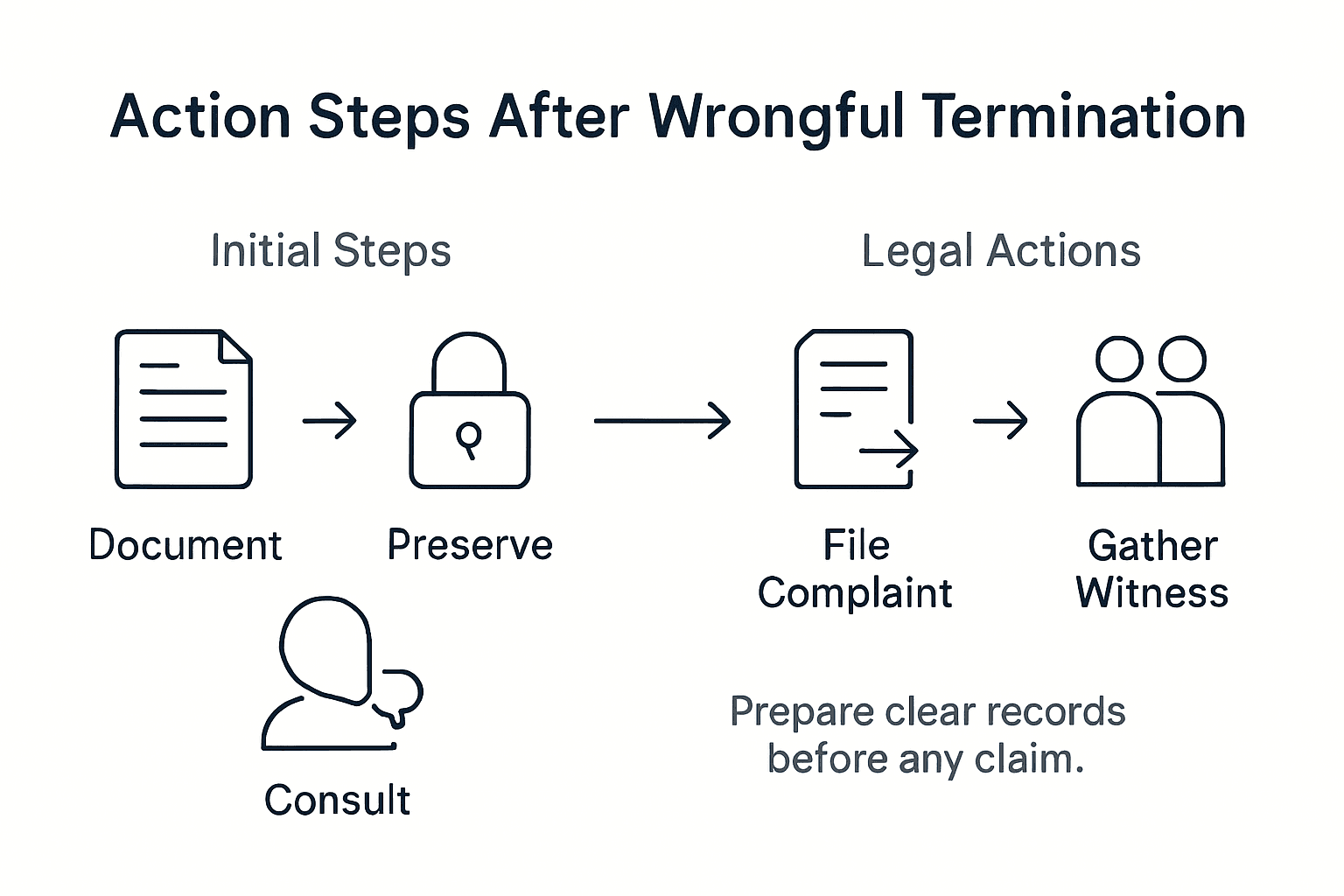
Next, file a formal complaint with appropriate government agencies such as the California Labor Commissioner’s Office or the Equal Employment Opportunity Commission (EEOC). These agencies can investigate your claim and potentially provide administrative remedies or issue right-to-sue letters. Simultaneously, consult with an employment law specialist who understands the nuanced landscape of whistleblower protections in Downtown Los Angeles. An experienced attorney can help you assess the strength of your case, understand potential legal strategies, and determine whether pursuing litigation or negotiating a settlement represents the most advantageous path forward.
Pro tip: Maintain a detailed, chronological journal of all events surrounding your termination, including dates, times, participants, and specific details, which can become critical evidence in potential legal proceedings.
Common Mistakes to Avoid During Claims
In the complex landscape of whistleblower protection, employees often undermine their own legal claims through well-intentioned but strategic missteps. Understanding potential practice areas can help prevent critical errors that might compromise your wrongful termination case.
One of the most significant mistakes is emotional oversharing or discussing your case indiscriminately. Social media posts, casual conversations with former colleagues, or heated discussions can provide employers with ammunition to discredit your claims. Every communication can potentially be used as evidence, so maintaining strict confidentiality about your case is crucial. Avoid making public statements, posting about your termination online, or discussing details with individuals who are not directly involved in your legal strategy.
Another critical error involves failing to preserve comprehensive documentation or acting impulsively without legal guidance. Many employees inadvertently destroy potential evidence by deleting emails, losing communication records, or confronting former employers directly without strategic preparation. This can significantly weaken your legal position. Employers have sophisticated legal teams designed to challenge whistleblower claims, and any inconsistency or gaps in your documentation can be exploited to undermine your narrative of retaliation or wrongful termination.
The following table outlines common mistakes and their consequences during a whistleblower claim:
| Mistake | Why It’s Harmful | How to Avoid |
|---|---|---|
| Oversharing details | Weakens case if used by employer | Maintain full confidentiality |
| Deleting evidence | Removes critical proof of retaliation | Secure all documentation |
| Acting without attorney | May make strategic errors | Consult a legal specialist |
| Public statements online | Creates evidence against your claim | Avoid social media posts |
| Inconsistent recordkeeping | Undermines credibility in proceedings | Log events promptly |
Pro tip: Create a dedicated, secure digital folder to store all potential evidence, and consult with an employment law specialist before taking any independent actions that might compromise your legal claim.
Protect Your Rights After Wrongful Termination in Downtown Los Angeles
Facing wrongful termination or retaliation after whistleblowing in Downtown Los Angeles can leave you feeling isolated and uncertain about your next move. If you have encountered unfair treatment like professional exclusion, hostile work environments, or unjust termination for exposing workplace misconduct, you are not alone. Understanding your legal rights under California law is essential to protecting your career and reputation.
At Shirazi Law Office, we specialize in employment law cases involving wrongful termination, workplace retaliation, and whistleblower protections. Our experienced team helps employees, executives, and senior managers navigate these complex challenges with strategic legal advice and dedicated representation. Do not wait for retaliation to escalate. Access critical guidance, preserve your evidence, and fight for the justice you deserve by contacting us today. Learn more about how we can assist you with your unique situation by visiting our Practice Areas page or start with a confidential consultation through our main website. Your professional future depends on timely action—reach out now.
Frequently Asked Questions
What constitutes wrongful termination after whistleblowing?
Wrongful termination occurs when an employee is fired for illegal reasons, such as reporting violations of law, public policy, or unethical practices in the workplace. This includes actions like reporting safety violations, discriminatory practices, or fraud.
What legal protections do whistleblowers have in California?
California law provides robust protections for whistleblowers under Labor Code Section 1102.5, shielding employees from retaliation when they report illegal activities or unsafe working conditions, even if the report does not lead to a proven violation.
How can I prove retaliation if I believe I was wrongfully terminated?
To prove retaliation, you should document all communications related to your termination, including emails, witness statements, and performance reviews, which can help establish a timeline and context for your claim of wrongful termination.
What steps should I take if I suspect my employer retaliated against me after whistleblowing?
If you suspect retaliation, you should immediately document all related events and communications, file a complaint with relevant government agencies, and consult with an employment law specialist for guidance on potential legal action.





[…] whistleblowers, recognizing the critical role employees play in exposing organizational misconduct. Wrongful termination protections provide comprehensive safeguards for executives and employees who report unethical or illegal […]
[…] during a routine review, or that budget constraints forced difficult decisions. This is why wrongful termination following whistleblowing requires examining the full context rather than just the immediate trigger. Courts and employment lawyers look for patterns. Did your […]
[…] Wrongful Termination After Whistleblowing in Downtown LA […]