

TL;DR:
- Workplace retaliation can include subtle actions like schedule changes and exclusion, not just firings.
- Document incidents immediately with detailed notes and communications to strengthen legal claims.
- California law offers strong protections, and early action improves chances of a favorable outcome.
Many medical clinic employees in Pico-Robertson assume that retaliation only counts when something dramatic happens, like an outright firing or a public confrontation. That assumption leaves a lot of people unprotected. In reality, California law recognizes a wide range of actions as retaliation, including subtle shifts in scheduling, exclusion from team meetings, or a sudden change in how your supervisor speaks to you. If you’ve reported a concern at work and noticed things getting quietly worse, your instincts may be right. This guide walks you through what retaliation actually looks like in clinic settings, how to document it, and what legal steps you can take to protect yourself.
Table of Contents
- What is workplace retaliation in Pico-Robertson medical clinics?
- Common forms of retaliation reported in medical clinics
- How to document and report retaliation effectively
- Legal protections and your options for action in Pico-Robertson
- A fresh perspective: Why small, early actions often matter most
- Connect with an experienced attorney for Pico-Robertson medical staff
- Frequently asked questions
Key Takeaways
| Point | Details |
|---|---|
| Retaliation takes many forms | Both obvious punishments and subtle or cumulative changes can qualify as illegal retaliation. |
| Document everything early | Chronological notes and evidence can make or break your case, so start tracking incidents immediately. |
| Local legal help matters | Attorneys familiar with Pico-Robertson clinics and California law will give you the best chance of a positive outcome. |
| Protected even if not proven | You are shielded by law as long as your complaint was made with reasonable belief, even if it’s later found unsubstantiated. |
What is workplace retaliation in Pico-Robertson medical clinics?
Workplace retaliation happens when an employer punishes you for doing something legally protected. That includes reporting unsafe conditions, filing a complaint about discrimination, refusing to participate in illegal activity, or even just asking questions about your rights. Under California law, retaliation is broadly defined and covers both public and private medical clinics.
The most common misconception is that retaliation has to be dramatic to count. It doesn’t. Cumulative, subtle workplace harms also qualify as retaliation, not just overt actions. That means a pattern of small changes, taken together, can form a legally actionable case.
Here are examples of what retaliation can look like in a medical clinic setting:
- Termination or forced resignation after filing a complaint
- Demotion or removal from a preferred role or team
- Shift reductions or unfavorable schedule changes
- Assignment to more difficult or less desirable patients without explanation
- Exclusion from meetings, training, or advancement opportunities
- Increased scrutiny or sudden negative performance reviews
- Hostile treatment from supervisors or coworkers following a protected complaint
Clinic-specific retaliation is worth understanding on its own terms. In a small Pico-Robertson clinic, the team is tight-knit. Retaliation can look like being quietly left off a group chat, losing your preferred shift after raising a billing concern, or being reassigned to a less desirable unit after reporting a patient safety issue. These changes can feel personal rather than professional, and that’s exactly what makes them easy to dismiss.
Another important point: you are protected even if your complaint turns out to be wrong. If you had a reasonable, good-faith belief that something unlawful was happening, the law protects your right to speak up. Your employer cannot legally punish you for trying to do the right thing.
“Retaliation doesn’t always arrive with a formal notice. Sometimes it looks like a slow erosion of your role, your relationships, and your opportunities. Recognizing that pattern early is the first step toward protecting yourself.”
Understanding healthcare retaliation risk factors specific to your field can help you identify warning signs before they escalate into something harder to reverse.
Common forms of retaliation reported in medical clinics
Pico-Robertson is home to a diverse range of healthcare providers. Healthcare providers in Pico-Robertson include dental clinics, family resource centers, and prenatal specialists. Each of these settings has its own team dynamics, and retaliation can take different forms depending on the size and structure of the clinic.
Here is a breakdown of the most frequently reported retaliatory actions in medical clinic environments:
| Type of retaliation | How it typically appears |
|---|---|
| Schedule changes | Fewer hours, undesirable shifts, last-minute changes |
| Role changes | Demotion, removal from care teams, reassignment |
| Social exclusion | Left out of meetings, team communications, or training |
| Performance targeting | Sudden negative reviews after a complaint |
| Increased supervision | Micromanagement that didn’t exist before |
| Pay or benefit changes | Unexplained reduction in compensation or benefits |
What makes clinic retaliation especially difficult to prove is that each action, on its own, might seem minor or even explainable. The supervisor might say the schedule changed due to staffing needs. The performance review might be framed as routine feedback. But when these actions follow a protected complaint, the pattern tells a different story.

In small clinics, the power dynamics are also more concentrated. A single administrator or clinic director may control your schedule, your assignments, and your performance reviews. That concentration of authority makes it easier for retaliation to happen and harder for employees to push back without support.
Some additional patterns to watch for:
- Being left out of decisions you were previously involved in
- Colleagues suddenly becoming distant or cold after your complaint
- Increased documentation of your errors while similar errors by others go unaddressed
- Being denied requests that were routinely approved before
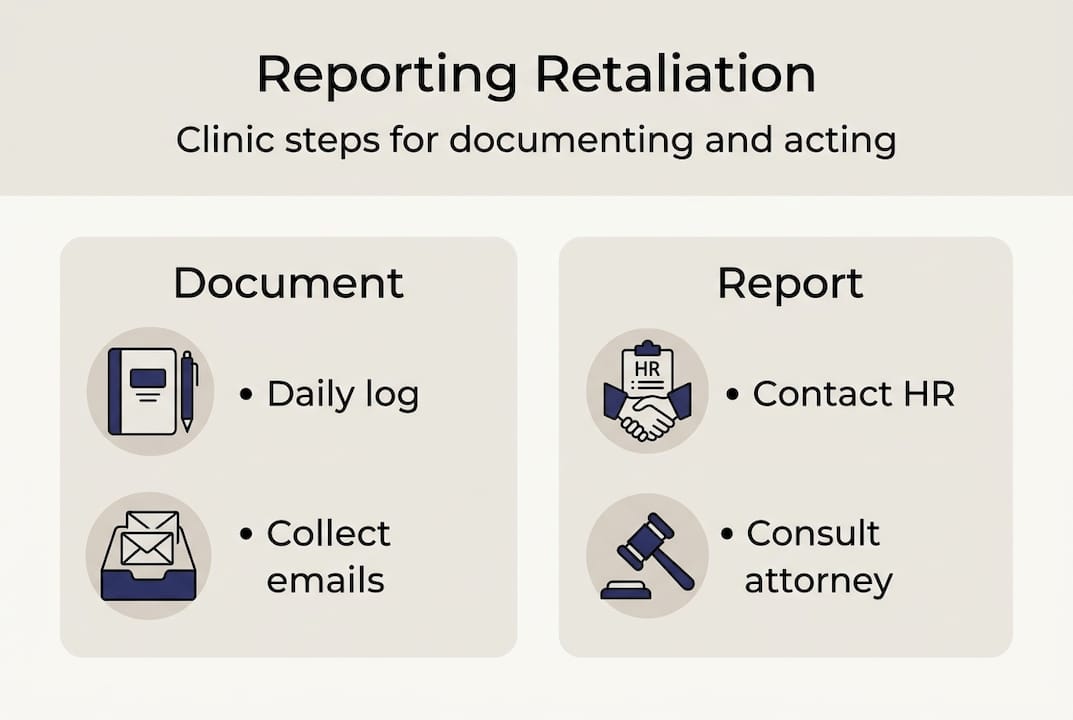
Pro Tip: Keep a daily log, even for minor changes. Note the date, what happened, who was involved, and any relevant context. California courts consider the overall pattern of behavior, not just isolated incidents. A detailed log gives your attorney the clearest picture of what you experienced. You can find local legal counsel who understands clinic-specific dynamics and can assess your situation accurately.
If you recently returned from medical leave and noticed changes in your treatment, that timing matters. Protecting your career after leave is a specific area where California law provides strong protections.
How to document and report retaliation effectively
Documentation is the foundation of any retaliation claim. Without it, your case depends on memory and credibility alone. With it, you have a record that can withstand scrutiny. Here’s how to build that record effectively.
- Start immediately. As soon as you suspect retaliation, begin writing down what’s happening. Don’t wait until things get worse.
- Record specifics. For each incident, note the date, time, location, what was said or done, who was present, and how it affected your work.
- Save all communications. Keep copies of emails, texts, performance reviews, and any written notices. Forward work emails to a personal account if your employer’s policy allows it.
- Note witnesses. If a coworker saw or heard something relevant, write that down. You may not need to involve them immediately, but knowing who was present is valuable.
- Report internally. Notify HR or clinic leadership in writing. This creates a paper trail and gives the employer a chance to respond. Keep a copy of everything you submit.
- File with a government agency. You can report to the California Civil Rights Department (formerly DFEH) or the Equal Employment Opportunity Commission (EEOC). Filing with these agencies is often a required step before pursuing a lawsuit.
“The strongest retaliation cases are built on clear, consistent documentation combined with early legal guidance. Evidence gathered in the first weeks often determines the outcome months later.”
One critical legal detail: California recognizes a 120-day presumption in retaliation cases. If adverse action occurs within 120 days of a protected complaint, the law presumes a connection. That presumption shifts the burden and strengthens your position significantly.
Pro Tip: Consult an attorney before filing formal complaints if possible. An attorney can help you frame your complaint in the most legally effective way and avoid common mistakes that can weaken your case. Understanding the full workplace retaliation process in California will help you move through each step with confidence.
Legal protections and your options for action in Pico-Robertson
California offers some of the strongest employee protections in the country. Several laws apply directly to medical clinic staff in Pico-Robertson.
- California Labor Code Section 1102.5 prohibits retaliation against employees who report violations of law to government agencies or internally.
- FEHA (Fair Employment and Housing Act) protects employees from retaliation related to discrimination complaints based on race, gender, disability, pregnancy, and more.
- California Whistleblower Protection Act covers employees who report waste, fraud, or safety violations.
- Federal protections under Title VII and the ADA also apply to qualifying clinics.
Here’s a comparison of your main reporting options:
| Option | Timeline | Likely outcome |
|---|---|---|
| Internal HR complaint | Immediate | Internal investigation, possible correction |
| California Civil Rights Dept. | File within 3 years | Agency investigation, mediation, or right-to-sue letter |
| EEOC complaint | File within 300 days | Federal investigation or right-to-sue letter |
| Civil lawsuit | After right-to-sue letter | Damages, reinstatement, attorney fees |
| Settlement negotiation | Anytime with attorney | Faster resolution, confidential terms |
Knowing when to escalate matters. If internal complaints are ignored or retaliation continues after you report it, that’s a strong signal to involve an attorney. California law is employee-protective, and local legal help consistently produces better outcomes for affected workers.
For executives and senior clinical staff, the stakes can be even higher. Executive retaliation rights are a specialized area where the legal strategy differs from standard employee claims. And if your situation involves reporting misconduct, understanding the legal impact of reporting misconduct can help you anticipate what comes next.
A fresh perspective: Why small, early actions often matter most
After working with medical employees across Los Angeles, one pattern stands out clearly. Most people wait too long. They talk themselves out of acting because the changes seem minor. A shift moved here, a meeting missed there. They wonder if they’re overreacting. By the time they seek help, months of evidence have gone unrecorded and the legal window has narrowed.
Here’s what experience shows: the employees who achieve the best outcomes are rarely the ones with the most dramatic stories. They’re the ones who noticed something early, started writing it down, and reached out before the situation became a crisis. A nurse who documented three weeks of unexplained schedule changes had a stronger case than a colleague who waited six months for something more obvious to happen.
Subtle retaliation is often the most calculated kind. Employers know that small changes are harder to prove and easier to explain away. That’s exactly why early action matters. Reporting retaliation early gives you the clearest legal advantage.
Pro Tip: Don’t self-censor. If something feels wrong after you raised a concern at work, trust that instinct enough to at least consult an attorney. A conversation costs nothing, and it could protect everything.
Connect with an experienced attorney for Pico-Robertson medical staff
If you work in a medical clinic in Pico-Robertson and believe you’re facing retaliation, you don’t have to figure this out alone. Shirazi Law Office represents clinic employees, healthcare workers, and medical professionals throughout Los Angeles, with a deep understanding of how these situations unfold in real workplace settings. The firm responds quickly, handles every matter with discretion, and treats your situation with the seriousness it deserves.
Whether you’re dealing with wrongful termination, need clarity on discrimination law guidance, or simply want to understand your options, the right support makes a real difference. Speak with an employment attorney today and take the first step toward protecting your career and your rights.
Frequently asked questions
What counts as workplace retaliation in a Pico-Robertson medical clinic?
Any negative action taken against you for reporting or opposing unlawful activity can count as retaliation, including subtle changes like reduced hours or shift reassignments. Subtle harms can count even if the action isn’t overt or extreme, and protection applies even if your original complaint isn’t later proven.
What should I do if I suspect I’m being retaliated against?
Start documenting each incident in detail right away, then contact HR or an employment attorney as soon as possible. Chronological documentation and early legal counsel are the two most important steps you can take.
Can I be protected if my retaliation complaint turns out to be unfounded?
Yes. You’re protected as long as you had a reasonable, good-faith belief that retaliation occurred. Protection applies even if the belief is later disproven by an investigation.
Why choose a local employment attorney in Pico-Robertson?
Local attorneys understand the specific clinics, workplace dynamics, and legal nuances in the area, which puts you in a stronger position. Local legal help consistently produces more effective outcomes for employees navigating retaliation claims.