

Many Beverly Grove employees think any negative workplace comment after filing an HR complaint qualifies as defamation. California law sets much higher standards. You must prove false statements were made with malice and caused distinct reputational harm beyond job termination. This guide clarifies legal standards, evidentiary burdens, and practical strategies for protection and remedies under 2026 California employment law.
Table of Contents
- Understanding Workplace Defamation And California Law
- Legal Elements And Burdens Of Proof In Defamation Claims
- Employer Defenses And Qualified Privileges In California
- Impact Of Internal HR Complaints And Investigations On Defamation Risks
- Practical Strategies For Employees Facing Defamation Allegations
- Get Expert Legal Help For Workplace Defamation In Beverly Grove
Key takeaways
| Point | Details |
|---|---|
| Legal definition | California law defines workplace defamation as false, unprivileged statements harming reputation or occupation, distinguishing written libel from spoken slander. |
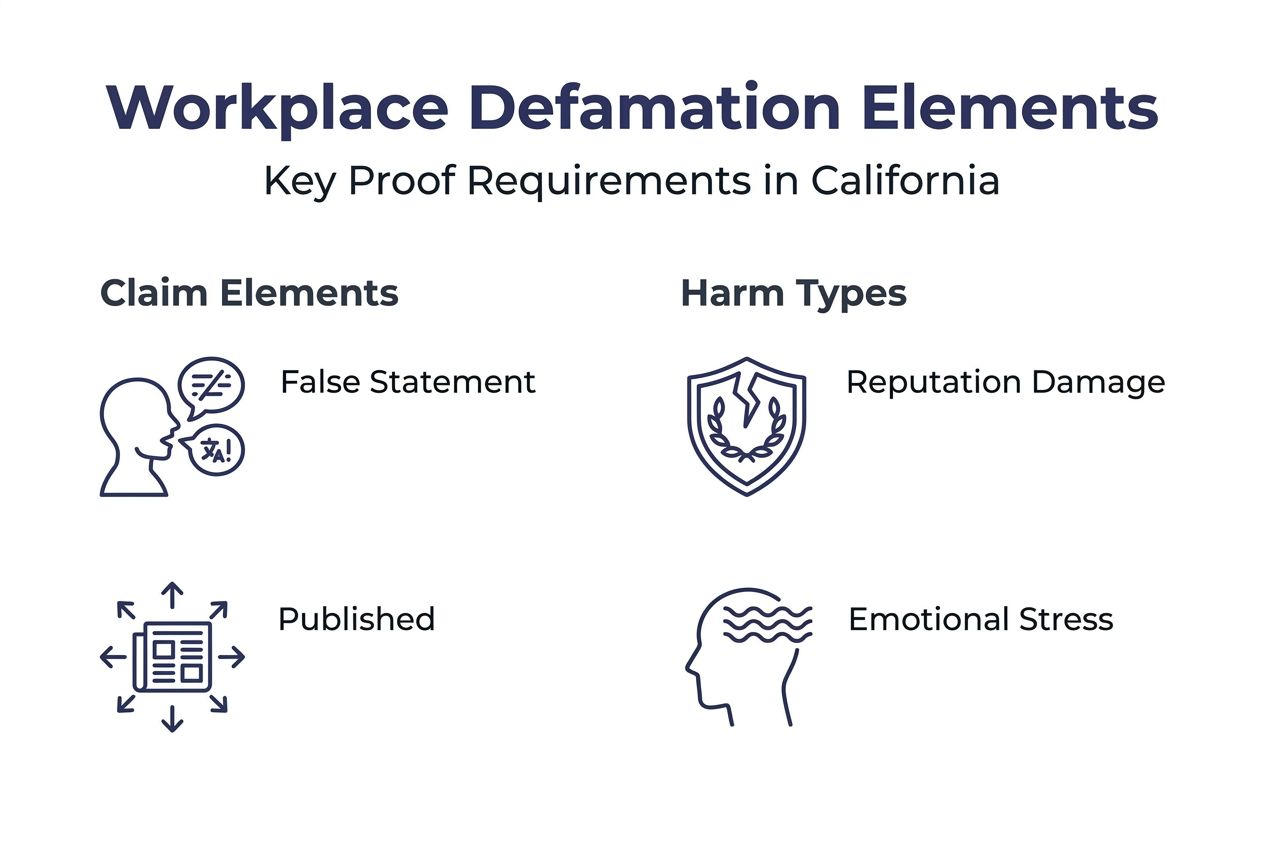
| Proof requirements | You must establish falsity, publication to others, malice when privilege applies, and reputational damages separate from termination. |
| Employer protections | Qualified privileges protect performance reviews and references unless employees prove malice or reckless disregard for truth. |
| HR complaint impact | Defamation claims cannot succeed based solely on termination conduct without separate reputational harm beyond job loss. |
| Practical response | Document all defamatory statements immediately, preserve evidence systematically, and consult specialized employment counsel promptly. |
Understanding workplace defamation and California law
Workplace defamation occurs when someone makes false statements that harm your professional reputation or ability to work. The legal framework distinguishes between two primary types: libel involves written defamation like emails or performance reviews, while slander covers spoken statements during meetings or conversations.
California Civil Code Sections 45 through 47 identify specific defamatory categories. These include false accusations of criminal conduct, claims of professional incompetence, statements suggesting you have a loathsome disease, and allegations harming your business or occupation. Understanding these categories helps you recognize when workplace statements cross legal boundaries.
Many employees mistakenly believe broad protection exists against any negative workplace communication. The reality proves far more nuanced. Not every critical comment, even if unfair or harsh, qualifies as defamation under California law. Courts require specific proof that statements were objectively false, not merely opinions or subjective evaluations.
The workplace context after internal HR complaints creates particular complexity. Employers often document complaints, investigations, and disciplinary actions. These records may contain statements you consider defamatory, but legal protections often shield employer communications made during legitimate business processes. Recognizing this distinction becomes crucial when evaluating potential workplace defamation Beverly Hills claims.
Key elements that define actionable workplace defamation include:
- False factual statements, not opinions or subjective assessments
- Communication to third parties beyond you and the speaker
- Absence of legal privilege or proof that privilege was abused through malice
- Measurable harm to your professional reputation or employment prospects
- Clear causation linking the statement to specific damages you suffered
Working with an experienced employment lawyer in Beverly Grove helps you navigate these complex distinctions and determine whether your situation meets California’s demanding legal standards for defamation claims.
Legal elements and burdens of proof in defamation claims
Proving workplace defamation requires satisfying multiple legal elements simultaneously. You carry the burden of establishing each component with sufficient evidence to overcome employer defenses and legal privileges.

The first element demands proof that statements were objectively false. Opinions, subjective evaluations, or substantially true statements cannot support defamation claims regardless of how damaging they feel. You must demonstrate specific factual inaccuracies that can be proven or disproven through evidence.
Publication constitutes the second critical element. The defamatory statement must have been communicated to at least one person other than yourself. Internal emails copied to multiple recipients, statements made during meetings with witnesses, or information shared with prospective employers all satisfy this requirement.
Reputational harm beyond termination represents a particularly challenging element. California courts increasingly require proof that defamatory statements caused damage separate from job loss itself. Demonstrating harm to your professional reputation, difficulty securing new employment, or damage to business relationships becomes essential for successful claims.
Malice requirements intensify when employers assert qualified privileges. You must prove the speaker knew statements were false or acted with reckless disregard for truth. This demanding standard protects employers who make good faith communications during legitimate business processes, even if those communications later prove inaccurate.
The burden of proof follows this sequence:
- Identify the specific false statement with precision and context
- Document who received the communication and when publication occurred
- Gather evidence proving the statement’s objective falsity through records or testimony
- Demonstrate reputational harm through lost opportunities, damaged relationships, or professional setbacks
- Collect proof of malice if employer privileges apply, showing intentional falsity or reckless disregard
Pro Tip: Create detailed timelines documenting every defamatory incident, including dates, witnesses, exact words used, and immediate impacts. This organized evidence becomes invaluable when proving malice to overcome employer privileges or demonstrating the statement’s falsity to your attorney.
Understanding workplace defamation in LA requires recognizing that emotional distress alone rarely satisfies damage requirements. Courts demand concrete evidence of professional harm, making thorough documentation of your job search struggles, lost opportunities, or damaged industry relationships essential for building credible claims.
Employer defenses and qualified privileges in California
California law grants employers substantial protections when making workplace communications. Qualified privilege under Civil Code Section 47 and Labor Code Section 1053 shields many employer statements from defamation liability, creating significant obstacles for employee claims.
Qualified privilege covers communications made in good faith during employment evaluations, disciplinary proceedings, and reference requests. Employers can share performance concerns, investigation findings, and reasons for termination without defamation liability unless employees prove the privilege was abused through malice or reckless disregard for truth.
The scope of protection varies based on communication type and context:
| Communication Type | Privilege Scope | Malice Requirement |
|---|---|---|
| Performance reviews | Broad protection for subjective assessments and good faith evaluations | Must prove intentional falsity or reckless disregard for known facts |
| Reference letters | Protection for honest opinions and factual information shared with prospective employers | Requires evidence of spite, ill will, or knowing falsehoods |
| Internal investigations | Shield for statements made during legitimate workplace inquiries | Must demonstrate statements were made to harm rather than investigate |
| Disciplinary communications | Coverage for warnings and corrective action documentation | Needs proof of fabricated allegations or malicious intent |
Performance reviews and disciplinary comments receive protection unless they contain objectively false factual statements made with malice. This distinction matters because subjective opinions about your performance quality, attitude, or work style rarely qualify as defamatory even when harsh or unfair.
Overcoming qualified privilege requires substantial evidence of employer bad faith. You must prove the employer knew statements were false when made or showed reckless indifference to truth. Circumstantial evidence like timing, inconsistencies in employer statements, or departures from standard procedures can help establish malice.
Pro Tip: Preserve all employer communications including emails, texts, and meeting notes. Compare official statements to informal communications to identify contradictions suggesting malice. Document instances where employers deviated from established policies or made statements inconsistent with known facts.
Understanding how privileges protect workplace defamation in LA and Hollywood workplace defamation cases helps you assess claim viability realistically. Courts rarely strip away these protections without compelling evidence of intentional falsity or spite.
Impact of internal HR complaints and investigations on defamation risks
Internal HR complaints create complex legal intersections between defamation claims and wrongful termination cases. Recent California appellate decisions have narrowed the circumstances under which employees can recover defamation damages related to internal investigation processes.
The Hearn v. PG&E decision established crucial limitations. Courts confirmed defamation claims cannot succeed when based solely on statements made during internal investigations or termination processes that cause no reputational harm separate from job loss. This ruling requires employees to prove damages beyond unemployment itself.
Statements made during HR investigations typically receive qualified privilege protection. Employers can document complaint details, investigation findings, and disciplinary rationales without defamation liability unless malice is proven. This protection extends to communications with HR personnel, legal counsel, and managers with legitimate business reasons to receive information.
The distinction between defamation and wrongful termination matters significantly. Wrongful termination claims challenge the legality of your firing based on protected activity, discrimination, or policy violations. Defamation claims specifically target false statements harming your reputation. While both may arise from the same situation, they require different proof and offer separate remedies.
Navigating internal complaints while protecting yourself from defamation requires careful attention to several factors:
- Submit written complaints documenting specific incidents with dates, witnesses, and factual details
- Maintain copies of all complaint submissions and employer responses for your records
- Avoid making inflammatory or unsubstantiated allegations that could expose you to counterclaims
- Document any retaliatory statements or communications following your complaint
- Track changes in how colleagues, supervisors, or clients treat you after investigations begin
- Note discrepancies between investigation findings and actual evidence or witness accounts
Understanding the relationship between internal complaints and wrongful termination Beverly Hills jobs helps you pursue appropriate legal remedies. Focusing defamation claims on statements causing distinct reputational harm rather than termination itself increases success likelihood under current California law.
Practical strategies for employees facing defamation allegations
Taking immediate, organized action when you believe workplace defamation has occurred protects your legal options and strengthens potential claims. Systematic documentation and strategic response maximize your ability to prove claims or defend your reputation.
Employees must document defamatory occurrences and seek legal counsel promptly to protect reputational and legal rights effectively. Creating comprehensive records establishes timelines, preserves evidence, and provides your attorney with the detailed information needed to evaluate claim viability.
Effective documentation practices include:
- Record exact statements with dates, times, speakers, and all witnesses present
- Save emails, texts, performance reviews, and written communications containing potentially defamatory content
- Photograph or screenshot social media posts, internal messaging, or digital communications before deletion
- Obtain written statements from witnesses who heard defamatory comments or observed reputational impacts
- Track job applications, interviews, and professional opportunities lost after defamatory statements circulated
- Document changes in workplace treatment, client relationships, or professional network responses
Seeking specialized legal counsel early provides crucial advantages. Employment lawyers experienced in California defamation law can evaluate whether your situation meets legal standards, identify viable claims, and advise on strategic responses. Early consultation prevents missteps that could undermine future litigation or settlement negotiations.
Maintaining professionalism throughout the process protects your credibility and legal position. Avoid responding to defamation with your own inflammatory statements, social media posts, or confrontational communications. Courts evaluate your conduct when assessing damages and credibility, making measured responses essential.
Pro Tip: Create a detailed incident log using spreadsheet software with columns for date, incident type, people involved, exact statements or actions, witnesses, and immediate impacts. Update this log daily while memories remain fresh. This organized timeline becomes invaluable evidence for your attorney and strengthens your case presentation.
Understanding how retaliation claims Culver City startups and executive retaliation claims Los Angeles intersect with defamation helps you pursue comprehensive legal strategies addressing all workplace wrongs you’ve experienced.
Get expert legal help for workplace defamation in Beverly Grove
Facing workplace defamation after filing HR complaints requires experienced legal guidance. California employment law’s complexity and demanding proof standards make professional representation essential for protecting your reputation and asserting your rights effectively.
Shirazi Law Office provides dedicated support for Beverly Grove employees and executives experiencing defamation and retaliation following internal complaints. Our focus on California employment law gives you access to attorneys who understand the nuanced interplay between defamation claims, qualified privileges, and employer defenses under current 2026 legal standards.
We help clients throughout Los Angeles navigate complex employment lawyer in Los Angeles matters including workplace defamation, retaliation, and wrongful termination in LA. Our approach combines thorough case evaluation, strategic evidence gathering, and aggressive advocacy to recover damages and protect your professional reputation.
Whether you’re facing defamation, discrimination, or retaliation, understanding your rights under employee rights 2025 discrimination laws strengthens your position. Contact us for personalized legal counsel addressing your specific workplace challenges.
FAQ
What must I prove to win a workplace defamation case in California?
You must prove the defamatory statement was false, published to others, made without privilege or with malice, and caused reputational harm beyond termination. These elements ensure a valid claim under California law. Courts require concrete evidence for each component, making thorough documentation essential.
Can negative performance reviews be considered defamation?
Negative reviews are generally protected by qualified privilege unless they contain false factual statements made with malice. Subjective opinions about your work quality or attitude rarely qualify as defamation. You must prove intentional falsity or reckless disregard for truth to challenge reviews successfully.
How do internal HR complaints affect defamation claims?
Internal investigations may produce statements that could be defamatory if false and malicious. However, courts require reputational harm beyond termination for claims to succeed, limiting defamation recovery in some situations. Understanding this distinction helps you pursue proper legal avenues for addressing workplace wrongs.
What steps should I take if I face defamation after reporting to HR?
Document all defamatory statements and communications carefully with dates, witnesses, and exact wording. Seek timely consultation with experienced employment law counsel who can evaluate your situation under current California standards. Avoid reacting impulsively and maintain detailed records of all relevant incidents and their professional impacts.