
Over one third of American educators with disabilities report workplace accommodation failures that directly threaten their career and well-being. For professionals in Los Angeles, these challenges often mean being denied the tools or support legally required for full participation. Understanding the rights that protect you can be the first step toward real change when institutional barriers stand in the way.
Table of Contents
- Defining Workplace Accommodation Failures In Education
- Types And Examples Of Accommodation Failures
- California Disability Law For Education Workers
- Common Barriers And Compliance Issues
- Employee Rights, Legal Risks, And Recourse
Key Takeaways
| Point | Details |
|---|---|
| Workplace Accommodation Rights | Educators with disabilities are entitled to reasonable accommodations under the Americans with Disabilities Act to ensure equal employment opportunities. |
| Understanding Legal Protections | California law provides broader protections than federal laws, requiring a good faith interactive process for accommodation requests. |
| Documentation is Essential | Maintaining detailed records of accommodation requests and institutional responses is critical for legal protection and advocacy. |
| Addressing Compliance Barriers | Educational institutions must actively combat systemic barriers and increase awareness to comply with legal accommodation requirements. |
Defining Workplace Accommodation Failures in Education
Workplace accommodation failures represent critical legal and ethical challenges within educational environments, particularly for educators with disabilities. Reasonable workplace accommodations are fundamental rights protected under the Americans with Disabilities Act (ADA), designed to ensure equal employment opportunities and professional functionality.
In the educational context, accommodation failures occur when school districts, universities, or educational institutions fail to provide necessary modifications that enable qualified professionals with disabilities to perform their essential job functions. These failures can manifest through multiple mechanisms: inadequate workspace adjustments, refusal to modify work schedules, denial of assistive technologies, or creating barriers that prevent full professional participation.
The U.S. Department of Labor emphasizes that accommodation failures fundamentally undermine the core principles of workplace equality. Equal employment opportunities demand proactive strategies that recognize and support diverse workforce capabilities. For educators, this might mean providing ergonomic classroom equipment, offering communication assistance, modifying lecture delivery methods, or restructuring administrative responsibilities to align with an individual’s specific disability requirements.
Key Elements of Accommodation Failures Include:
- Refusing to engage in the interactive accommodation process
- Dismissing documented medical recommendations
- Imposing unreasonable performance standards without appropriate support
- Creating hostile work environments that discourage disability disclosure
Pro tip: Document every interaction and request related to workplace accommodations, maintaining a clear, dated record that can serve as critical evidence if legal intervention becomes necessary.
Types and Examples of Accommodation Failures
Workplace accommodation failures in educational settings encompass a wide range of systemic and individualized challenges that prevent educators with disabilities from performing their professional responsibilities effectively. Accommodation implementation challenges can manifest through complex and often subtle mechanisms that undermine workplace equity and professional development.

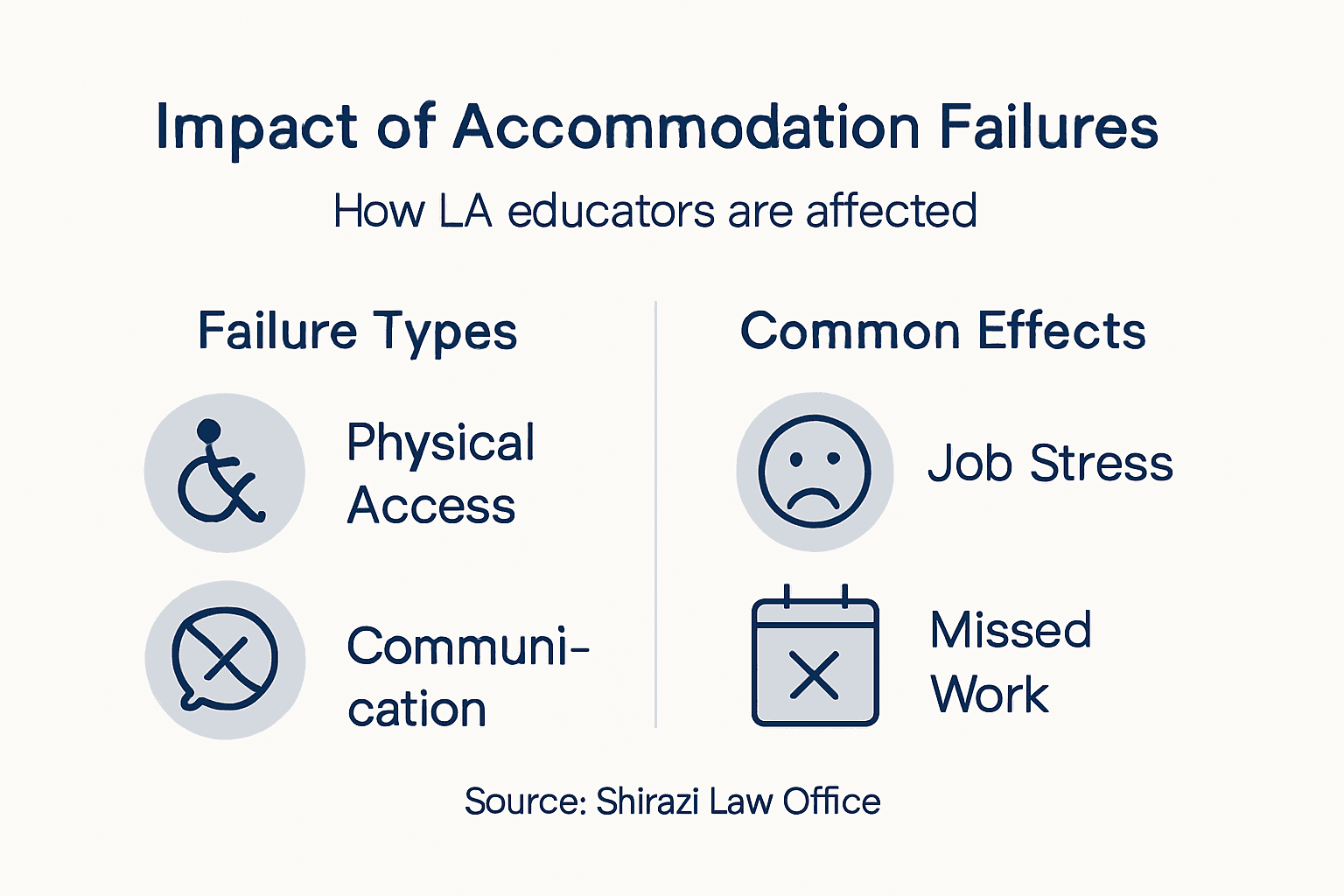
One primary category of accommodation failures involves communication and resource barriers. These include refusing to provide necessary assistive technologies, failing to modify instructional materials, and creating inaccessible workplace environments. Institutional accessibility policies frequently perpetuate these challenges by maintaining rigid structures that do not adequately recognize diverse workforce capabilities. For educators, this might mean lacking screen reading software, being denied ergonomic classroom equipment, or experiencing limited physical accessibility in lecture halls and administrative spaces.
Specific accommodation failure types can be categorized into several critical domains:
Physical Accommodation Failures:
- Inadequate workspace modifications
- Lack of wheelchair accessible teaching areas
- Insufficient adaptive technology provisions
- Poorly designed workstations
Communication Accommodation Failures:
- Refusing sign language interpreter services
- Failing to provide materials in alternative formats
- Ignoring documented communication assistance needs
- Inconsistent implementation of communication support
Procedural Accommodation Failures:
- Dismissing medical documentation
- Avoiding interactive accommodation processes
- Creating bureaucratic barriers to accommodation requests
- Implementing punitive performance evaluations
Pro tip: Maintain comprehensive documentation of all accommodation requests, interactions, and institutional responses to build a clear evidentiary trail for potential legal protection.
To better understand accommodation failures, here is a summary of failure domains and their typical workplace impacts:
| Failure Domain | Typical Example | Resulting Workplace Impact |
|---|---|---|
| Physical | No adaptive technology provided | Increased fatigue, decreased productivity |
| Communication | Ignored request for interpreter | Professional isolation, miscommunication |
| Procedural | Unacknowledged medical documentation | Delayed support, higher stress levels |
| Policy | Outdated accessibility guidelines | Persistent inequity, higher turnover |
California Disability Law for Education Workers
California stands at the forefront of disability protection for education workers, offering some of the most comprehensive legal frameworks in the United States. Disability rights protections extend far beyond federal standards, particularly through the Fair Employment and Housing Act (FEHA), which provides robust safeguards for educators with disabilities in Los Angeles and throughout the state.
The California legal landscape distinguishes itself through broader and more inclusive definitions of disability. Employment discrimination standards mandate that educational employers must engage in a meaningful, good faith interactive process when addressing accommodation needs. This requirement goes significantly beyond federal guidelines, placing a higher burden on institutions to demonstrate genuine efforts to support workers with disabilities.
Key Legal Protections for California Educators Include:
- Expanded definition of disability
- Mandatory interactive accommodation process
- Protection against discriminatory employment practices
- Requirement for reasonable workplace modifications
- Legal recourse for unaddressed accommodation needs
Critical Legal Requirements for Educational Employers:
- Proactively identify potential accommodation needs
- Document all accommodation interaction processes
- Provide substantive responses to disability-related requests
- Demonstrate no undue hardship when denying accommodations
- Maintain confidentiality of medical information
Pro tip: Meticulously document every accommodation request, institutional response, and communication to build a comprehensive record that can protect your legal rights.
The following table compares key California and federal protections for educators with disabilities:
| Aspect | California Law (FEHA) | Federal Law (ADA) |
|---|---|---|
| Disability Definition | Broader, more inclusive | Stricter medical criteria |
| Employer Obligation | Good faith interactive process | Reasonable effort required |
| Legal Recourse | State DFEH or civil court | EEOC or federal court |
| Confidentiality Rules | Strict and specific | Generally enforced |
Common Barriers and Compliance Issues
Educational institutions frequently encounter significant challenges when implementing disability accommodations, often stemming from systemic misunderstandings and institutional resistance. Workplace accommodation barriers reveal complex organizational dynamics that systematically undermine effective disability support mechanisms for educators in Los Angeles and across California.
The most pervasive compliance issues emerge from a combination of institutional ignorance and bureaucratic complexity. Accommodation compliance requirements demonstrate that many educational employers fail to understand their legal obligations, frequently misinterpreting what constitutes reasonable accommodation or undue hardship. This misinterpretation leads to a cascade of discriminatory practices that directly impact educators with disabilities, creating workplace environments that are fundamentally exclusionary.
Primary Institutional Barriers Include:
- Lack of comprehensive disability awareness training
- Insufficient understanding of legal accommodation requirements
- Inadequate communication protocols
- Financial misconceptions about accommodation costs
- Organizational resistance to structural modifications
Critical Compliance Failure Mechanisms:
- Refusing to initiate interactive accommodation processes
- Imposing excessive documentation requirements
- Denying accommodations without substantive justification
- Failing to conduct individualized disability assessments
- Creating bureaucratic obstacles to reasonable modifications
Pro tip: Develop a comprehensive written record of all accommodation requests, institutional responses, and communication to establish a clear legal trail that protects your professional rights.
Employee Rights, Legal Risks, and Recourse
Employees with disabilities in educational settings possess robust legal protections that safeguard their professional rights and opportunities. Employee accommodation rights encompass a comprehensive framework that allows individuals to request workplace modifications without fear of discrimination or professional retaliation.
The legal landscape provides multiple avenues for recourse when accommodation rights are violated. Disability discrimination protections empower educators to challenge institutional practices through strategic legal mechanisms. These include filing formal complaints with the Equal Employment Opportunity Commission (EEOC), pursuing mediation, or initiating legal action that can result in workplace modifications, potential financial compensation, and systemic organizational changes.
Key Employee Rights in Accommodation Disputes:
- Request reasonable workplace modifications
- Receive individualized accommodation assessments
- Protection from discriminatory retaliation
- Confidential medical information handling
- Access to administrative complaint processes
Legal Recourse Mechanisms:
- EEOC complaint filing
- State agency investigations
- Administrative hearings
- Mediation proceedings
- Potential civil litigation
Pro tip: Maintain a comprehensive, dated documentation trail of all accommodation requests, institutional responses, and communication to strengthen potential legal claims and protect your professional rights.
Protect Your Rights Against Workplace Accommodation Failures in Los Angeles Education
Educators facing workplace accommodation failures often experience denial of essential modifications, inadequate communication support, and procedural hurdles that directly impact their professional success and well-being. These challenges undermine your rightful protections under California law and can create a hostile, exclusionary work environment. If you have faced refusal to engage in the interactive accommodation process or dismissal of medical documentation, you deserve knowledgeable legal support to defend your rights.
At Shirazi Law Office, we specialize in Workplace Disability Discrimination claims and understand the complexities surrounding accommodation failures in education. Our team is dedicated to helping Los Angeles educators, including those in Westwood, assert their rights and hold employers accountable for compliance with state and federal disability laws. Don’t let inadequate accommodations or discriminatory practices jeopardize your career or well-being. Contact us today at Shirazi Law Office to schedule a consultation and take the critical first step toward securing the workplace support you deserve.
Frequently Asked Questions
What are workplace accommodation failures in education?
Workplace accommodation failures occur when educational institutions do not provide necessary modifications for educators with disabilities, hindering their ability to perform essential job functions effectively.
What are some common types of accommodation failures?
Common types of accommodation failures include physical failures (like inadequate workspace modifications), communication failures (such as refusing interpreter services), and procedural failures (like avoiding the interactive accommodation process).
What legal protections exist for educators with disabilities?
Educators with disabilities are protected by laws such as the Americans with Disabilities Act (ADA) and the Fair Employment and Housing Act (FEHA), which mandate reasonable accommodations and protect against discrimination.
How can educators document their accommodation requests?
Educators should keep a detailed record of all accommodation requests, including dates, interactions, and institutional responses, as this can serve as crucial evidence if legal intervention is needed.





[…] employees with disabilities experience workplace accommodation failures that violate their rights. Denials without legitimate reasons, prolonged delays, or failure to […]