

Graduate researchers and medical staff in Westwood have faced over $500,000 in denied raises and wage cuts since 2023, exposing systemic pay violations at UCLA and affiliated medical facilities. Many affected workers remain unaware of their legal protections under California employment law and union contracts. This guide explains common wage and hour violations targeting Westwood academic and medical employees, clarifies union protections available through collective bargaining agreements, and outlines legal remedies to recover lost wages in 2026. You will learn how to recognize violations, document your claims, and access expert legal support to protect your rights.
Table of Contents
- Understanding Wage And Hour Violations Affecting Westwood Graduate Researchers And Medical Staff
- Union Protections And Contracts For Graduate Researchers And Medical Staff
- Legal Remedies And Recent Outcomes For Westwood Wage Disputes
- Protecting Your Rights And Seeking Help For Wage Violations In Westwood Workplaces
- Get Expert Legal Help For Wage And Hour Violations In Westwood
- Frequently Asked Questions
Key takeaways
| Point | Details |
|---|---|
| Recent violations | Thousands of Westwood graduate researchers and medical staff lost wages through denied raises and pay cuts since 2023. |
| Union power | UAW Local 4811 represents over 33,000 workers and negotiates contracts ensuring fair pay and mandatory paid training. |
| Legal remedies | Workers can file complaints with labor boards, pursue collective bargaining enforcement, or bring wage claim lawsuits. |
| Documentation matters | Keeping detailed records of hours worked and communications strengthens any wage claim or grievance. |
Understanding wage and hour violations affecting Westwood graduate researchers and medical staff
Wage theft and pay violations have become widespread problems for academic researchers and medical staff working at UCLA and affiliated Westwood medical facilities. These violations take multiple forms, from outright denial of promised raises to sudden pay cuts and unpaid mandatory work hours. Understanding these patterns helps you recognize when your employer crosses legal boundaries.
The most visible example emerged in 2023 when SRAs were collectively denied over $500,000 in promised raises at UCLA’s Olympic Analytical Lab. Student Research Assistants had negotiated and received written commitments for wage increases, only to have management reverse course without explanation. Workers organized protests and filed grievances, highlighting how institutions sometimes fail to honor compensation agreements even when documented in writing.
Medical staff faced similar challenges when UCLA Health took over West Valley Medical Center in March 2024. Per diem workers were initially paid less than promised after the transition, creating immediate financial hardship for employees who had accepted positions based on specific pay rates. The wage reductions appeared suddenly on paychecks, leaving workers scrambling to understand what happened and how to challenge the discrepancies.
These incidents represent broader patterns of wage and hour law noncompliance in academic medical settings:
- Misclassification of employees to avoid overtime pay requirements
- Unpaid hours for mandatory meetings, training sessions, and orientation programs
- Failure to provide meal and rest breaks as required under California law
- Delayed or denied wage increases promised in employment contracts
- Incorrect calculation of overtime rates for employees working extended shifts
“When institutions control both your paycheck and your career advancement, speaking up about wage violations feels risky. That power imbalance makes wage theft particularly damaging in academic medical settings where workers fear retaliation.”
Employers initially delayed correcting these wage issues, forcing workers to pursue formal complaints through unions and legal channels. The resistance to voluntary compliance demonstrates why understanding your rights and available remedies becomes essential. Many violations continue for months or years before workers realize they can challenge unfair pay practices through wage and hour disputes in LA legal processes.
Recognizing these violation patterns early allows you to document problems and seek help before losing additional wages. The next section explains how union protections and collective bargaining contracts create frameworks to prevent and remedy these violations.
Union protections and contracts for graduate researchers and medical staff
Union representation provides crucial protections against wage violations for Westwood academic and medical workers. Graduate Student Researchers and Academic Student Employees at UC Berkeley are represented by UAW 4811, whose contract expires Jan 1, 2026. This union represents approximately 33,000 workers across the University of California system, giving members substantial collective bargaining power to negotiate fair wages and working conditions.
The UAW Local 4811 contract establishes specific protections that directly address common wage violations. Most importantly, job-related training, including orientation, is considered paid time under the UC-UAW 4811 Collective Bargaining Agreements. This provision prevents employers from requiring unpaid work during onboarding and training periods, a common source of wage theft in academic settings.
Key contract features protecting your wages include:
- Minimum salary floors that prevent arbitrary pay reductions
- Clear overtime calculation methods for employees exceeding standard hours
- Mandatory paid time for all job-related training and orientation sessions
- Grievance procedures to challenge wage discrepancies and denied raises
- Protection against retaliation when workers report pay violations
When you suspect a wage violation, the union grievance process provides a structured path to resolution. Start by documenting the specific violation with dates, amounts, and any written communications about your pay. Contact your union steward or representative to file a formal grievance. The union will investigate your claim and negotiate with management on your behalf, often securing backpay and corrected wages without requiring litigation.
The contract expiration in January 2026 creates both challenges and opportunities for Westwood workers. Current negotiations will determine wage protections, training compensation, and grievance procedures for the next contract period. Active participation in union meetings and contract discussions helps ensure new agreements address ongoing wage violation patterns affecting graduate researchers and medical staff.
Pro Tip: Attend all mandatory orientations and training sessions, then immediately verify these hours appear as paid time on your next paycheck. If orientation hours are missing, file a grievance within 30 days to preserve your right to backpay under the contract.
Union membership also provides access to legal resources and representation when employers refuse to correct wage violations voluntarily. Many workers hesitate to challenge powerful institutions individually, but collective action through unions reduces retaliation risks and increases success rates. The union’s legal team can pursue wage and hour violations downtown LA cases when internal grievances fail to resolve disputes.
Understanding your contract rights creates a foundation for protecting your wages, but knowing available legal remedies becomes equally important when violations occur.
Legal remedies and recent outcomes for Westwood wage disputes
Workers facing wage violations have multiple legal pathways to recover lost wages and hold employers accountable. California employment law provides robust protections, and recent cases demonstrate how Westwood graduate researchers and medical staff successfully reclaimed unpaid wages through strategic legal action.
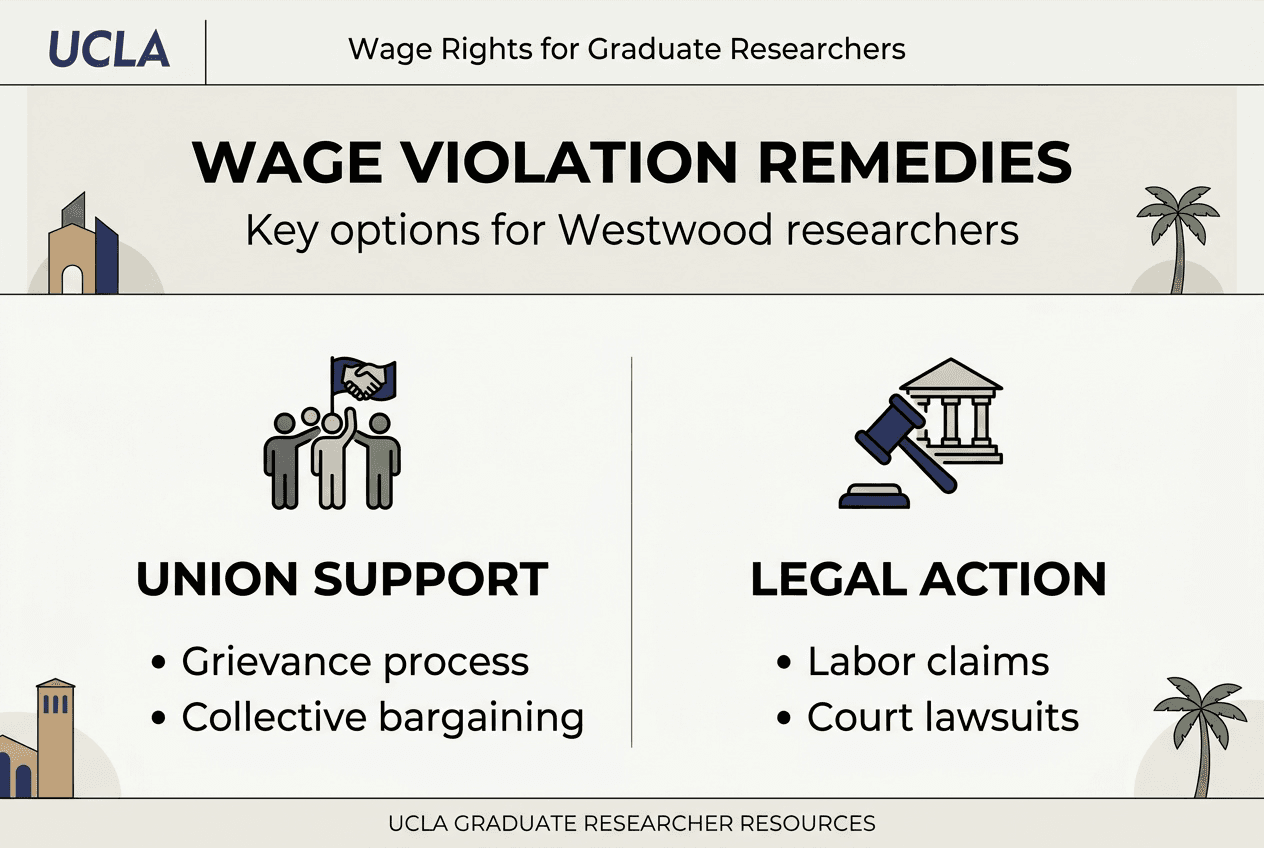
The most direct remedy involves filing wage claims with the California Labor Commissioner’s Office. This administrative process allows workers to pursue unpaid wages, denied raises, and overtime violations without hiring an attorney. The Labor Commissioner investigates claims, holds hearings, and can order employers to pay back wages plus penalties and interest. This option works well for straightforward violations with clear documentation.
Collective bargaining enforcement through unions offers another powerful remedy. UPTE secured backpay and corrected pay rates for per diem workers post UCLA hospital takeover in 2024, demonstrating how union advocacy can resolve wage disputes affecting multiple employees simultaneously. The union negotiated directly with UCLA Health management, ultimately forcing the institution to acknowledge its wage calculation errors and compensate affected workers.
Wage claim lawsuits in civil court provide the most comprehensive remedy for complex violations or cases involving significant damages. These lawsuits can recover unpaid wages, liquidated damages, attorney’s fees, and penalties for willful violations. Class action lawsuits become appropriate when wage violations affect large groups of workers, allowing employees to pool resources and share litigation costs.
UAW Local 4811 represents over 33,000 workers negotiating contracts that impact wage protections into 2026, showing how ongoing collective bargaining creates systemic remedies beyond individual cases. These negotiations address root causes of wage violations by establishing clear pay structures, mandatory paid training policies, and stronger grievance procedures.
The following table compares common wage violations with available legal remedies and typical outcomes:
| Violation Type | Legal Remedy Options | Typical Outcomes |
|---|---|---|
| Denied promised raises | Union grievance, Labor Commissioner claim, breach of contract lawsuit | Backpay for raise amount from promised effective date, plus interest |
| Unpaid orientation/training | Union grievance, wage claim | Payment for all training hours at regular or overtime rate |
| Incorrect overtime calculation | Labor Commissioner claim, wage lawsuit | Unpaid overtime wages, liquidated damages, penalties |
| Pay cuts without notice | Union grievance, wage claim, contract lawsuit | Restoration of original pay rate, backpay for reduced wages |
| Misclassification to avoid overtime | Labor Commissioner claim, class action lawsuit | Reclassification, unpaid overtime, penalties, attorney’s fees |
Pro Tip: Keep meticulous records of all work hours, including start times, end times, meal breaks, and any work performed outside scheduled shifts. Save all emails, text messages, and written communications about your pay, schedule, and job duties. This documentation becomes essential evidence when pursuing any wage claim or grievance.
The success of recent Westwood wage cases demonstrates that legal remedies work when workers document violations and pursue claims persistently. However, timing matters significantly. California’s statute of limitations restricts how far back you can claim unpaid wages, making prompt action essential when you discover violations.
Legal remedies become most effective when combined with practical steps to protect your rights and prevent ongoing violations. Understanding how to recognize problems early and access appropriate resources helps you respond quickly when wage issues arise. For complex cases involving wage and hour disputes in LA or unpaid overtime wage violations LA, consulting an employment attorney ensures you pursue the most effective remedy for your situation.
Protecting your rights and seeking help for wage violations in Westwood workplaces
Recognizing wage violations early and taking immediate action protects your rights and prevents ongoing wage theft. Many Westwood graduate researchers and medical staff miss violations because they assume complex pay structures or academic employment norms justify irregular compensation. Understanding what to look for helps you identify problems before losing substantial wages.
Start by carefully reviewing every pay stub against your employment contract and recorded work hours. Compare your actual hourly rate, total hours paid, and overtime compensation to what your contract promises. Look for missing hours, incorrect rates, or unexplained deductions. Even small discrepancies can indicate systematic problems that affect multiple pay periods.
Track your hours worked independently using a personal log, phone app, or calendar. Record your start time, end time, meal breaks, and any work performed outside scheduled shifts. UAW orientations are mandatory and count as paid time, foundational to knowing rights under the contract. If these hours do not appear on your paycheck, you have clear evidence of a violation.
When you identify a possible violation, take these steps:
- Document the specific issue with dates, amounts, and supporting evidence like pay stubs and timesheets
- Review your employment contract and union agreement to confirm the violation
- Contact your union representative or steward to discuss filing a grievance
- Report the issue to your HR department in writing, keeping copies of all communications
- Consult an employment attorney if the violation is substantial or your employer retaliates
Filing complaints internally through union representatives or HR often resolves wage issues without litigation. Unions have established relationships with university and medical facility management, making informal resolution more likely. However, document all internal complaints and responses in case you need to pursue formal legal action later.
For violations that internal processes cannot resolve, filing complaints with California labor agencies provides government enforcement support. The Labor Commissioner’s Office investigates wage claims and can order employers to pay back wages plus penalties. The process is free and does not require an attorney, though legal representation often improves outcomes in complex cases.
Union membership provides significant advantages when protecting your wage rights. Members access collective bargaining protections, grievance procedures, and legal resources that individual workers cannot obtain alone. Active participation in union meetings and contract negotiations helps shape workplace protections and ensures your concerns reach decision makers.
Consulting an employment attorney specializing in wage and hour law becomes essential when violations are substantial, ongoing, or involve retaliation. Attorneys can evaluate whether your case warrants a lawsuit, negotiate with employers on your behalf, and represent you in court or administrative proceedings. Many employment attorneys work on contingency, meaning you pay legal fees only if you recover wages.
Timing matters significantly for wage claims. California generally allows three years to file wage claims from the date of violation, but some claims have shorter limits. Waiting too long can permanently bar your right to recover lost wages. Act promptly when you suspect violations to preserve your legal options.
Beyond wage issues, understanding your broader employment rights helps you recognize related violations. Familiarize yourself with Westwood non-compete agreements that may restrict your career options and medical leave and disability rights that protect you during health challenges. Comprehensive knowledge of employment law empowers you to advocate effectively for fair treatment across all workplace issues.
Get expert legal help for wage and hour violations in Westwood
When wage violations threaten your financial security and career, experienced legal representation makes the difference between recovering lost wages and walking away empty handed. The Law Office of Brian Y. Shirazi, PC specializes in employment lawyer in Los Angeles cases, including complex wage and hour disputes affecting Westwood graduate researchers and medical staff.
Our firm understands the unique challenges facing academic and medical employees in Westwood. We have successfully represented workers in wage and hour disputes in LA involving denied raises, unpaid training, overtime violations, and misclassification. We provide personalized case evaluation, aggressive advocacy, and strategic guidance to maximize your recovery and protect you from retaliation.
Contact us today for a free consultation to discuss your wage claim. We will review your documentation, explain your legal options, and develop a strategy tailored to your situation. Our comprehensive employment law services also address employee rights and discrimination laws, wrongful termination, and workplace retaliation, ensuring complete protection for your workplace rights.
Frequently asked questions
What is considered a wage and hour violation for graduate researchers and medical staff?
Wage violations include unpaid overtime, denied promised raises, misclassification to avoid overtime pay, unpaid mandatory training or orientation, and pay cuts without proper notice. Any situation where your employer fails to pay wages owed under your contract or California law constitutes a violation.
How can unions like UAW Local 4811 protect my wage rights?
Unions negotiate collective bargaining agreements that establish minimum wages, mandatory paid training, overtime protections, and grievance procedures. Union representation provides legal resources and collective bargaining power to challenge violations and recover lost wages. Members can file grievances that force employers to address pay discrepancies through structured resolution processes.
What steps should I take if I suspect a wage violation at Westwood?
Immediately begin tracking your work hours independently and comparing them to your pay stubs. Review your employment contract and union agreement to confirm the violation. Report the issue to your union representative and HR in writing, keeping copies of all communications. Consult a wage and hour attorney promptly if the violation continues or your employer retaliates.
How long do I have to file a wage claim in California?
California generally allows three years from the date of violation to file wage claims, but some claims have shorter statutes of limitations. Waiting too long permanently bars your right to recover unpaid wages. Consult an employment attorney as soon as you discover a violation to ensure you file within applicable deadlines and preserve all available remedies.