

Facing a restrictive contract at a leading Westwood medical institution like UCLA Health can leave even seasoned professionals unsure of their rights. California stands apart, making most non-compete agreements unenforceable and fiercely protecting your career mobility. Understanding the real meaning and limits of these contracts helps you avoid unnecessary self-censorship or financial risk, ensuring you can advance your career in Los Angeles’s dynamic healthcare environment.
Table of Contents
- Defining Non-Compete Agreements In Westwood
- Types And Clauses Specific To UCLA Health Roles
- California Laws Affecting Health Professional Non-Competes
- Career, Legal, And Financial Risks For Medical Executives
- Navigating Disputes And Exit Options Legally
Key Takeaways
| Point | Details |
|---|---|
| Non-Compete Agreements in California | Non-compete agreements are generally unenforceable in California, especially for healthcare professionals, emphasizing the right to work freely. |
| Alternative Restrictive Covenants | UCLA Health may use non-disclosure and non-solicitation clauses instead of non-competes to protect business interests while complying with state law. |
| Legal and Career Risks | Medical executives may self-limit their career options due to fear of unenforceable non-compete agreements, potentially stalling their professional growth. |
| Seek Legal Advice | Before signing or resigning from any agreement, it’s crucial to have an employment law attorney review your contract to understand your rights and obligations. |
Defining Non-Compete Agreements in Westwood
A non-compete agreement is a contract between an employer and employee that restricts the worker from engaging in competing business activities after leaving the job. These agreements typically limit where you can work, what type of work you can do, and for how long after separation. In healthcare settings like UCLA Health, such agreements may claim to protect patient relationships, confidential information, or business operations.
California’s approach to non-competes differs dramatically from most states. Non-compete agreements in California are broadly prohibited, particularly for healthcare employees. The state prioritizes your right to earn a living and compete freely in your profession, even after leaving an employer.
Why Westwood Health Professionals Face These Agreements
Despite California law, UCLA Health and other Westwood medical institutions may still present non-compete agreements during hiring or as conditions of promotion. Employers argue they need protection against losing staff to competing practices. They claim agreements protect patient relationships, proprietary medical protocols, or institutional investments in training.
The reality is different. California courts have consistently ruled against enforcement of non-competes, treating them as unreasonable restraints on employment. What makes this critical for you:
- Your employer may pressure you to sign even if the agreement cannot be enforced
- You might self-censor your career options because you mistakenly believe the agreement is binding
- You could lose years of earning potential by accepting artificially limited post-employment opportunities
- Fear of legal action from your former employer may prevent you from pursuing better positions
What Non-Competes Actually Attempt to Control
These agreements typically restrict three categories of activity. Understanding what yours targets helps you recognize overreach.
Geographic restrictions limit where you can practice. A Westwood agreement might prohibit working within 5 miles, 10 miles, or even broader areas. Time restrictions set how long the prohibition lasts, often claiming 1 to 3 years post-employment. Scope restrictions define what “competing” work means—sometimes broadly enough to include any medical practice in your field.
The more restrictive the agreement, the stronger the evidence it violates California policy. Courts look at reasonableness using a three-part test: Is the restriction necessary to protect legitimate business interests? Is it reasonable in time and geography? Does it impose undue hardship on you?
California law presumes non-competes are void and unenforceable unless an employer proves otherwise—which is extremely difficult.
Health professionals often don’t realize that signing doesn’t mean you’re bound. Many Westwood doctors, nurses, and medical administrators have negotiated better positions or started competing practices despite signed agreements. The problem is fear and misinformation.

Pro tip: Before signing any employment agreement at a Westwood healthcare facility, have an employment law attorney review it. Understanding what you’re actually signing—and what’s unenforceable—prevents years of unnecessary career limitations.
Types and Clauses Specific to UCLA Health Roles
UCLA Health doesn’t rely solely on non-compete agreements because California courts would strike them down. Instead, the institution uses alternative restrictive covenants that accomplish similar goals while staying within legal bounds. Understanding what you’re actually signing matters far more than the agreement’s title.
The most common restrictive covenants at UCLA Health fall into distinct categories. Alternative restrictive covenants like non-disclosure agreements and non-solicitation clauses protect proprietary information and patient relationships while complying with state law. These agreements are enforceable in California, making them the weapon of choice for healthcare employers.
Non-Disclosure Agreements (NDAs)
Non-disclosure agreements restrict you from sharing confidential information about patients, treatment protocols, research data, or institutional operations. For UCLA Health physicians, nurses, and administrators, these typically cover:
- Patient health information and treatment details
- Proprietary medical protocols and procedures
- Research findings and clinical trial data
- Business operations, financial information, and strategic plans
- Trade secrets regarding equipment, software, or methodologies
NDAs are generally enforceable in California because they protect legitimate business interests without restricting your right to work. The key difference: you can work for competitors, just not using or disclosing UCLA Health’s confidential information.
Non-Solicitation Clauses
These agreements prohibit you from recruiting UCLA Health employees or soliciting patients after you leave. A non-solicitation of employees clause prevents poaching staff. A non-solicitation of patients clause restricts you from contacting patients to follow them to a new practice.
Courts view employee non-solicitation more favorably than patient non-solicitation. Some Westwood cases have struck down broad patient non-solicitation clauses as unreasonable restraints on your ability to practice medicine.
Garden Leave and Liquidated Damages Clauses
Some UCLA Health agreements include garden leave provisions requiring you to remain on payroll for weeks or months after resignation while sitting idle. Liquidated damages clauses set predetermined penalty amounts if you breach restrictions, rather than making UCLA Health prove actual damages.
Courts scrutinize liquidated damages clauses carefully—if the penalty appears designed to prevent competition rather than estimate genuine losses, it may be unenforceable.
These clauses create financial pressure even if the underlying restrictions are void. You might pay $50,000 in penalties rather than risk litigation, even if you’d ultimately win.
Confidentiality Language Specific to Medical Roles
Physicians and clinical staff face broader confidentiality obligations than administrative roles. UCLA Health agreements often restrict publication of research, case studies, or clinical outcomes. They may prohibit discussing treatment innovations or patient outcomes at conferences.
Be cautious of language stating confidentiality lasts “perpetually” or “indefinitely.” Some California courts have limited perpetual restrictions, especially when they prevent you from practicing your profession.
Pro tip: Request specific definitions of “confidential information” and “proprietary” before signing—vague language gives UCLA Health maximum leverage to claim you’ve breached, even if your actions were entirely legitimate.
Here’s how common UCLA Health contract clauses compare in enforceability and impact:
| Clause Type | Enforceability in California | Main Purpose | Typical Impact on Career |
|---|---|---|---|
| Non-Compete | Generally unenforceable | Restrict post-employment work | High if not challenged |
| Non-Disclosure (NDA) | Enforceable | Protect confidential information | Low if compliant |
| Non-Solicitation | Sometimes enforceable | Limit recruitment/patient contact | Moderate, depends clause |
| Garden Leave | Rarely enforceable | Delay new employment transition | Moderate if imposed |
| Liquidated Damages | Scrutinized closely | Pre-set penalties for breach | High financial risk |
California Laws Affecting Health Professional Non-Competes
California’s legal framework stands alone in protecting worker mobility. The state prioritizes your right to work in your profession over employer interests, even when those employers claim legitimate business reasons for restrictions. This protection matters especially for healthcare professionals navigating complex institutional agreements.
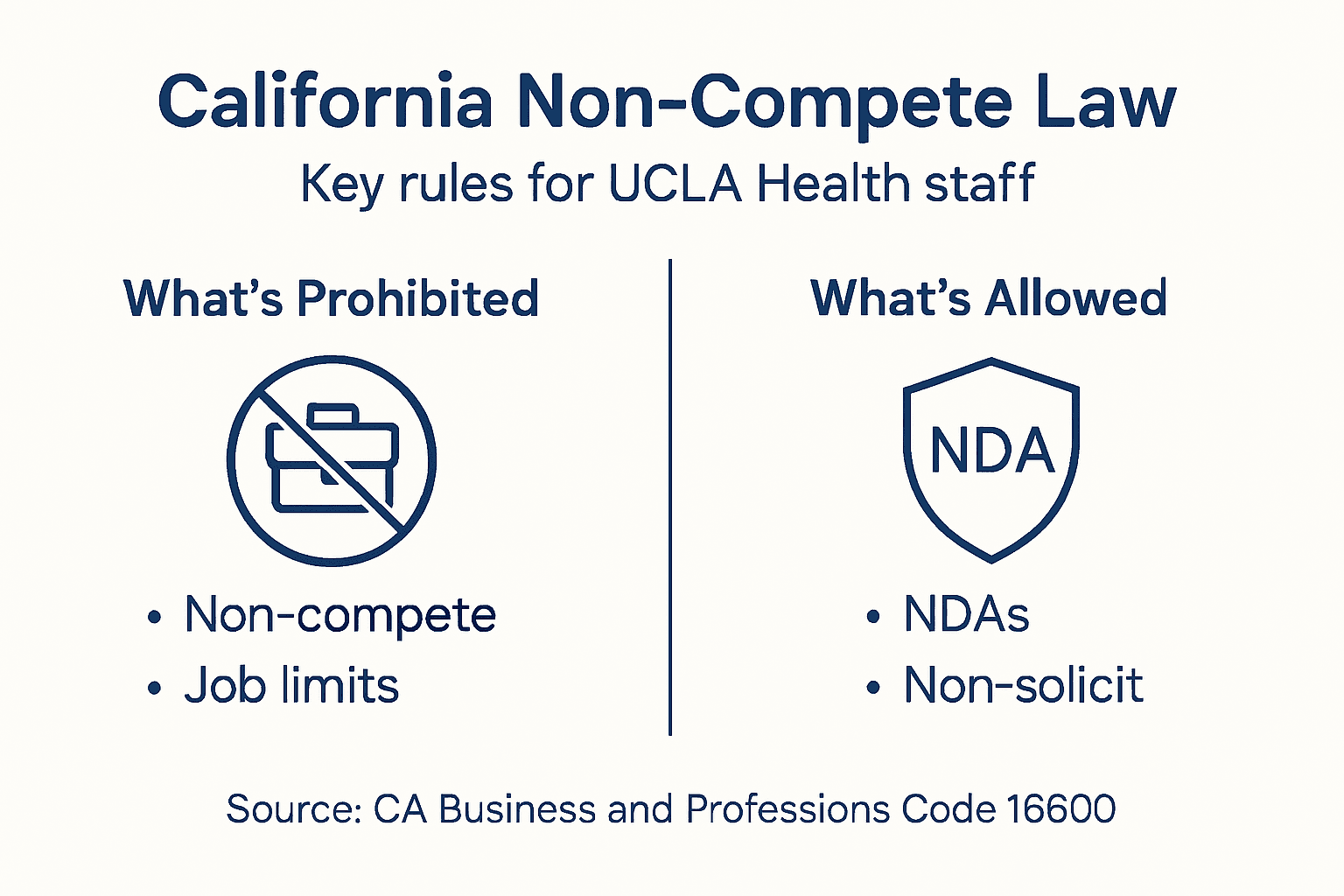
The foundation of this protection comes from Business and Professions Code section 16600. California law broadly prohibits non-compete agreements for health professionals with limited exceptions. This statute doesn’t just make non-competes unenforceable—it declares them void. You cannot be bound by them, period.
The 2024 Strengthened Protections
California didn’t stop with section 16600. New legislation effective January 2024 strengthens these prohibitions significantly. These changes directly impact UCLA Health and all Westwood healthcare employers.
The new statutes extend non-compete prohibitions regardless of where or when you signed the agreement. This matters if you signed your UCLA Health agreement five years ago out of state. It still applies. The law also introduces mandatory notification requirements—employers must inform you that non-competes are unenforceable under California law.
Key provisions of the 2024 updates include:
- Employers must provide written notice that non-competes cannot be enforced in California
- The prohibition applies to agreements signed anywhere, even if governed by other states’ law
- Healthcare employers face stricter compliance standards than other industries
- Violations create grounds for legal action against the employer
Limited Exceptions You Should Know
California’s prohibition has narrow exceptions that rarely apply to UCLA Health professionals. These exceptions involve:
Sale of business. If you own and sell your medical practice, you can agree not to compete with the buyer for a reasonable period.
Partnership dissolution. Partners dissolving a practice may restrict competing within a defined area for a limited time.
Employment as part of seller’s duties. If you’re being retained as an employee after a business sale, reasonable non-compete restrictions may apply.
These exceptions don’t protect UCLA Health because you’re an employee, not a business owner selling an asset. UCLA Health cannot leverage these exceptions to enforce non-competes against you.
The burden falls entirely on the employer to prove a narrow exception applies—courts presume all non-competes are void unless proven otherwise.
What “Unenforceable” Really Means
Calling an agreement unenforceable doesn’t mean you can ignore it. UCLA Health could still sue you, claiming breach. You would need to defend yourself by proving the agreement violates California law. Many professionals avoid this entirely by settling or accepting false restrictions out of fear.
The real protection comes from knowing the law backs you. You don’t have to comply with an unenforceable agreement. You can pursue your career freely, work for competitors, and build competing practices without legal consequences.
Pro tip: Keep a copy of Business and Professions Code section 16600 and California’s 2024 updates with your employment file—if UCLA Health pressures you about non-compete compliance, reference the statute to clarify your actual rights.
Career, Legal, and Financial Risks for Medical Executives
Signing a non-compete at UCLA Health feels routine during onboarding. Most executives don’t realize the cascading risks that follow, even if the agreement is ultimately unenforceable. The damage starts before litigation even begins.
Medical executives at UCLA Health face three interconnected risk categories. Legal risks arise if you unknowingly sign or attempt to enforce non-compete agreements in California, where such clauses are unenforceable. Financial risks emerge from litigation costs and lost opportunities. Career risks stem from self-imposed restrictions based on fear and misinformation.
The Career Mobility Problem
The biggest risk isn’t UCLA Health suing you—it’s you limiting yourself. Many Westwood medical executives believe their non-compete is binding and avoid better opportunities out of caution. You might reject a Chief Medical Officer position at a competing hospital because you think the agreement prohibits it.
Years pass. Your career stagnates. Your earning potential shrinks. All while the restriction had no legal force.
This psychological trap affects:
- Promotion opportunities at competing healthcare systems
- Leadership roles at private practices or medical groups
- Consulting positions with rival institutions
- Starting your own medical venture or practice
- Speaking engagements and conference participation with competitors
The restriction doesn’t need to be enforced to damage your career—your fear does the damage.
Financial Risks: The Real Cost
Litigation expenses mount quickly if UCLA Health sues, claiming breach. Even if you ultimately win, defending yourself costs $50,000 to $200,000 in legal fees. Settlement pressure becomes intense when facing these costs.
Lost income opportunities add up over time. If you reject three better-paying positions because of agreement fear, you’ve lost hundreds of thousands in earnings. Healthcare executives must navigate a complex legal landscape across states, where financial risks include lost employment opportunities and litigation expenses.
Negotiation disadvantage weakens your position when changing employers. New institutions may demand indemnification if you’re subject to non-compete claims. You might accept lower compensation to address their concerns.
Legal Risks Beyond Enforcement
Even California’s protections create litigation exposure. UCLA Health could file a lawsuit claiming breach, forcing you to defend yourself. The burden falls on you to prove the agreement violates California law. Until judgment, uncertainty clouds your position.
Ambiguous contract language amplifies this risk. If your non-compete contains vague definitions of “competing activities” or “proprietary information,” UCLA Health has leverage to claim violations broadly. You might accidentally breach without realizing it.
Escalation to other states creates additional exposure. If you take a position in Nevada or Arizona, out-of-state courts might view California non-competes differently. What’s unenforceable in California might be enforceable elsewhere, creating cross-border liability.
Medical executives who assume non-competes are binding self-impose career restrictions worth hundreds of thousands of dollars, often unnecessarily.
Reputational and Professional Risks
Disputes over non-competes can damage professional relationships and institutional credibility. If UCLA Health files litigation against you, other healthcare employers notice. The dispute becomes part of your professional record. Even if you win, the association lingers.
Pro tip: Have an employment attorney review your UCLA Health agreement before you resign or accept a competing position—understanding your actual obligations prevents costly mistakes and unnecessary career limitations.
Navigating Disputes and Exit Options Legally
When you decide to leave UCLA Health, your non-compete agreement suddenly feels urgent. The clock starts ticking. You wonder if accepting your new position violates the agreement. Fear sets in. This is exactly when you need clarity, not panic.
Navigating disputes involving non-compete agreements requires understanding California’s specific legal protections. Disputes require understanding jurisdiction-specific laws and potential enforcement limits. In California, you have significant leverage—the law backs your mobility. But you need to understand your options and move strategically.
Step One: Get Legal Review Before Acting
Don’t resign from UCLA Health until an employment attorney reviews your agreement. This single step prevents costly mistakes and positions you for success. Your attorney can identify:
- Which clauses are unenforceable under California law
- Which restrictions might actually apply (NDAs, non-solicitation limits)
- What UCLA Health could realistically enforce
- Whether your new position likely triggers disputes
- How to document your actions to protect yourself
The cost of legal review ($2,000-$5,000) is trivial compared to litigation expenses or accepting a lower-paying position due to restriction fear.
Understanding Your Exit Options
You have more options than you realize. If UCLA Health’s non-compete is unenforceable, you can simply leave and accept any position. If NDAs and non-solicitation clauses apply, you can still leave—just not using UCLA Health’s confidential information or recruiting their staff.
Negotiate a severance agreement. UCLA Health might offer severance in exchange for acknowledging their restrictions or agreeing to limited cooperation. Use this as leverage to clarify what restrictions actually apply.
Request a written clarification letter. Ask UCLA Health to specify what activities you cannot pursue post-employment. Their response (or refusal) reveals their confidence in enforcement.
Challenge the agreement proactively. Some executives file declaratory judgment actions before leaving, asking courts to declare non-competes unenforceable. This removes uncertainty before you resign.
Managing Risk During Transition
Even knowing California law protects you, reduce litigation exposure while transitioning. Simple precautions include:
- Avoiding UCLA Health confidential information at your new position
- Not recruiting UCLA Health staff for at least 6 months
- Documenting that your new work doesn’t use confidential information
- Not disparaging UCLA Health publicly
- Preserving communications showing you acted in good faith
These steps matter less for legal protection and more for avoiding settlement pressure. UCLA Health is less likely to sue if your conduct appears reasonable.
This table summarizes steps for reducing risk when exiting UCLA Health under a restrictive agreement:
| Action Step | Risk Reduced | Why It Matters |
|---|---|---|
| Legal review of agreement | Litigation and career | Identifies unenforceable clauses |
| Avoid recruiting former colleagues | Litigation | Lessens employer retaliation risk |
| Do not use confidential info | Litigation and career | Upholds legal and ethical duties |
| Request written clarification | Career and negotiation | Documents employer’s stance |
When UCLA Health Threatens Legal Action
If UCLA Health sends a cease-and-desist letter, don’t panic or comply with overly broad demands. Have your attorney respond. Most healthcare institutions back down once they understand California law. If they proceed, you have a strong defense—but don’t navigate this alone.
Medical executives who move carefully with legal guidance preserve career options while protecting themselves from litigation—even when non-competes are ultimately unenforceable.
Pro tip: Before resigning from UCLA Health, have an attorney send a confidential opinion letter detailing what restrictions likely apply and what you can safely do at your new position—this documentation protects you if disputes arise later.
Protect Your Career and Rights Against Unlawful Non-Compete Agreements
Facing a non-compete agreement at UCLA Health or any Westwood healthcare employer can be confusing and intimidating. You might feel trapped by vague restrictions and fear costly litigation or lost job opportunities even when California law strongly favors your right to work freely. The risk of self-imposed career limitations, financial penalties, and legal battles is very real for medical professionals unaware of their true rights under California’s employment laws.
At Shirazi Law Office, we specialize in helping healthcare executives and professionals challenge unfair non-compete agreements and navigate complex employment contracts with confidence. Our expert legal team understands the nuances of California’s statutory protections including Business and Professions Code section 16600 and the latest 2024 updates that safeguard your freedom to pursue your career. We help you:
- Understand which contract clauses are enforceable and which are void
- Strategically negotiate employment agreements and exit options
- Defend your rights if your employer threatens litigation
- Avoid costly mistakes that stunt your professional growth
Do not let misunderstanding or fear limit your career or earnings. Get the trusted guidance you need today to assert your rights and protect your future. Visit Shirazi Law Office now to schedule a consultation. Taking swift action could save you tens of thousands in legal fees and lost opportunities.
Frequently Asked Questions
What are non-compete agreements, and how do they affect UCLA Health employees?
Non-compete agreements are contracts that restrict employees from working in competing businesses after leaving their job. For UCLA Health employees, such agreements may limit where they can work, what type of work they can do, and for how long after separation, despite these agreements generally being unenforceable in California.
Are non-compete agreements enforceable in California for healthcare professionals?
No, non-compete agreements are broadly prohibited in California, especially for healthcare professionals. This means UCLA Health employees cannot be bound by such agreements, as California law prioritizes the right to work and compete freely in one’s profession.
What should I do if I am pressured to sign a non-compete agreement at UCLA Health?
If you are pressured to sign a non-compete agreement, it’s advisable to consult an employment law attorney. They can help you understand your rights, determine which agreements may be unenforceable, and guide you on how to negotiate your position.
What are the potential consequences of signing a non-compete agreement at UCLA Health?
Signing a non-compete agreement, even if unenforceable, can lead to career limitations, lost income opportunities, and increased legal risks. Many professionals might self-censor their career options out of fear or misinformation regarding the agreement’s enforceability.





[…] it must be enforceable. That assumption is wrong, and it costs people real opportunities. Non-competes are generally void under California Business and Professions Code section 16600, which protects your right to work in […]