
Nearly one in five American retail workers in Los Angeles report wage and overtime disputes each year. When your paycheck falls short or extra hours go unpaid, it affects not just your finances but your sense of fairness and respect at work. Family-owned stores can often overlook strict regulations, making these problems even more common. This article highlights crucial workplace rights, offering clear guidance to empower employees facing unpaid wages and overtime issues.
Table of Contents
- What Wage and Overtime Disputes Mean
- Common Disputes in Family-Owned Retail
- California Laws Governing Wages and Overtime
- Employee Rights and Employer Obligations
- Filing and Resolving Wage Claims in Los Angeles
- Preventing Disputes and Seeking Legal Help
Key Takeaways
| Point | Details |
|---|---|
| Wage and Overtime Disputes Are Common | Legal disputes often arise in retail settings over unpaid wages or misclassified worker status. California laws provide strong protections for employees. |
| Family-Owned Retail Challenges | Unique disputes may occur in family-owned businesses due to informal practices and unclear compensation structures. Employers should establish clear agreements. |
| California’s Comprehensive Labor Laws | California mandates stronger wage and overtime protections than federal laws, including overtime pay for hours worked over 8 in a day. |
| Importance of Accurate Record-Keeping | Both employees and employers should maintain detailed records of hours worked and pay to avoid disputes and support claims if needed. |
What Wage and Overtime Disputes Mean
Wage and overtime disputes are legal conflicts between employees and employers regarding compensation and work hours. These disputes often arise when workers believe they have not received fair payment for their labor, including proper overtime compensation, minimum wage violations, or misclassification of employment status. In Los Angeles retail settings, such disputes can involve complex interpretations of state and federal labor regulations.
At their core, these disputes typically center on specific labor law violations involving unpaid wages, incorrect overtime calculations, or improper worker classifications. Retail employees might experience issues like being required to work off the clock, not receiving mandated rest breaks, or being paid less than the legally required minimum wage. California labor laws provide strong protections for workers, making these disputes particularly significant in protecting employee rights.
Common types of wage and overtime disputes in Los Angeles retail environments include situations where employers fail to pay overtime rates for hours worked beyond 40 per week, deny required meal and rest breaks, or misclassify workers as independent contractors to avoid providing proper compensation. These violations can result in significant financial losses for employees and potential legal action to recover unpaid wages and penalties.
Pro tip: Keep detailed records of all hours worked, including any off-the-clock tasks or additional responsibilities, as documentation is crucial in proving wage and overtime disputes.
Common Disputes in Family-Owned Retail
Family-owned retail businesses in Los Angeles often face unique wage and overtime dispute challenges that differ from larger corporate environments. These small businesses frequently struggle with complex employment regulations, sometimes unintentionally violating labor laws due to limited understanding of legal requirements. Typical disputes arise from informal management practices, unclear compensation structures, and inconsistent record-keeping.

Key disputes in family-owned retail settings frequently involve wage classification issues such as misclassifying family members or long-term employees as independent contractors, failing to pay proper overtime rates, or inconsistently tracking work hours. Relatives working in the business might be asked to perform tasks without compensation, work extended hours without additional pay, or handle responsibilities outside their formal job descriptions.
Additional common disputes include inconsistent scheduling practices, lack of formal break policies, and unclear compensation agreements. Family dynamics can complicate these issues, with owners sometimes believing that family members should work without standard employment protections. However, California labor laws apply equally to family-owned businesses, mandating fair wages, proper overtime compensation, and consistent workplace standards regardless of business size or familial relationships.
Pro tip: Implement a formal, written employment agreement for all family members working in the business, clearly outlining compensation, hours, and job responsibilities to prevent potential wage disputes.
California Laws Governing Wages and Overtime
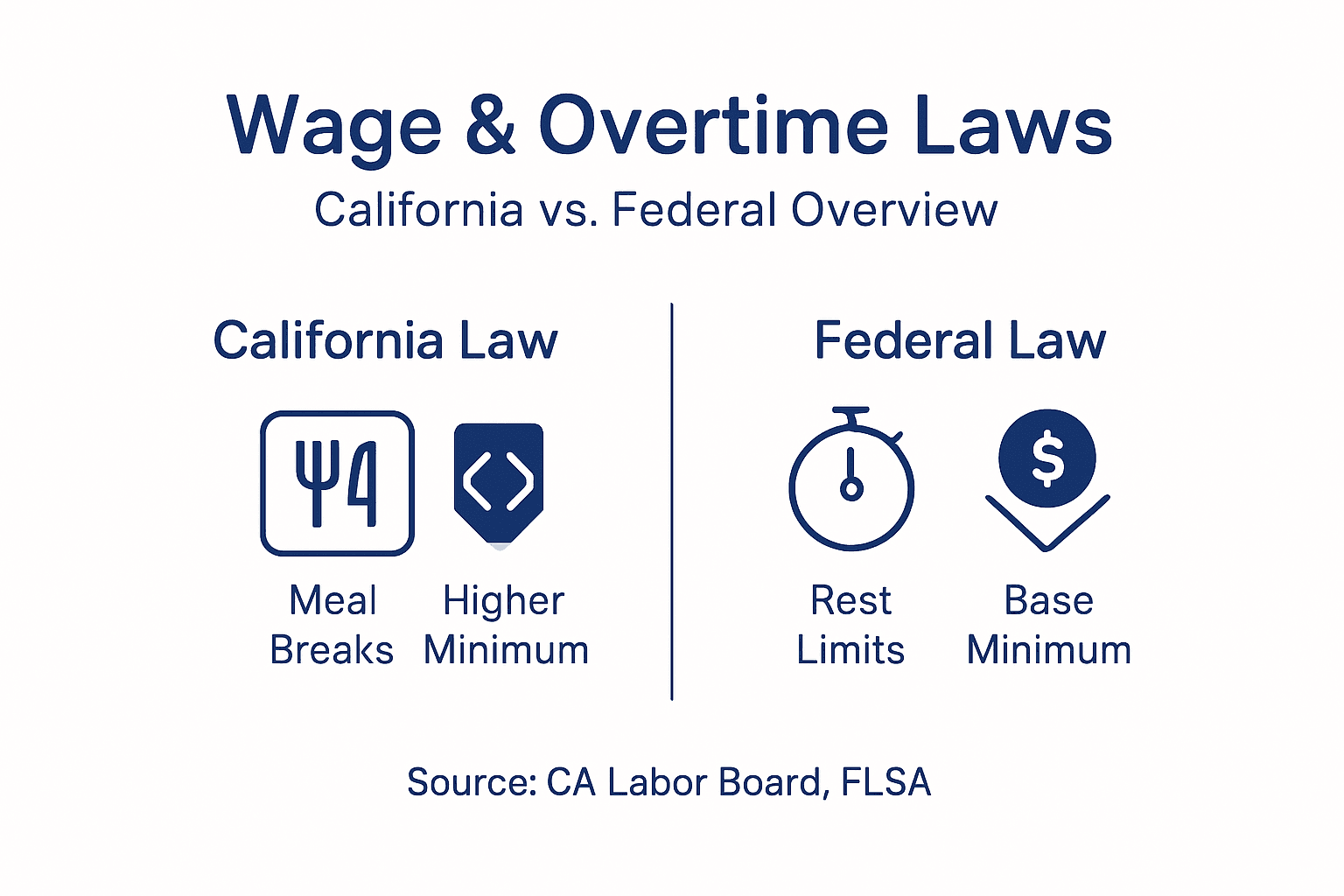
California has some of the most robust wage and overtime protections in the United States, offering significantly stronger safeguards for workers compared to federal standards. These comprehensive laws are designed to ensure fair compensation and prevent exploitation across various industries, including retail settings. Overtime regulations mandate that employees receive 1.5 times their regular pay rate for hours worked beyond eight in a single day or 40 in a workweek, with double time required for work exceeding 12 daily hours.
The state’s wage laws go beyond federal minimums, establishing clear guidelines for meal breaks, rest periods, and minimum wage requirements. Employers in Los Angeles retail environments must provide a 30-minute unpaid meal break for shifts longer than five hours and a second meal break for shifts exceeding 10 hours. California also maintains a higher minimum wage than the federal standard, with rates that vary between state and local jurisdictions, providing additional financial protection for workers.
Retail businesses must carefully navigate complex worker classification rules, as misclassifying employees can result in significant legal penalties. The state applies strict criteria to determine whether workers should be classified as employees or independent contractors, with a presumption favoring employee status. This approach ensures that workers receive appropriate wages, overtime compensation, and other legal protections, regardless of the size or structure of the business.
Pro tip: Maintain detailed, accurate time records for all employees, including exact start and end times, break periods, and total hours worked, to protect both employers and employees from potential wage disputes.
Here’s a quick comparison of California and Federal wage and overtime laws:
| Regulation Aspect | California Law Highlights | Federal Law (FLSA) Highlights |
|---|---|---|
| Overtime Eligibility | After 8 hrs/day or 40/week | After 40 hrs/week |
| Minimum Wage Rates | Higher, varies by municipality | Lower, fixed at $7.25/hr |
| Meal and Rest Breaks | Strict rules, required breaks | No federal break requirements |
| Employee Classification | Presumption of employee status | More flexibility for employers |
Employee Rights and Employer Obligations
In Los Angeles retail settings, employees have specific legal protections that employers must carefully observe. Employee rights in wage regulations encompass fundamental protections including minimum wage guarantees, overtime compensation, and protection from workplace retaliation. Retail workers are entitled to receive at least the state minimum wage, with additional rights to overtime pay at 1.5 times their regular rate for hours worked beyond eight in a day or 40 in a week.
Employers have critical obligations that extend beyond simple wage payments. These responsibilities include maintaining accurate time records, providing mandated meal and rest breaks, and ensuring transparent compensation practices. Los Angeles retail businesses must comply with both California state laws and federal regulations, which means paying overtime, respecting worker classification rules, and preventing any form of wage theft or discriminatory compensation practices.
Key employer obligations involve preventing workplace violations such as misclassifying workers, failing to pay proper overtime, and denying mandated breaks. Retail managers must understand that ignorance of the law is not a defense, and violations can result in significant financial penalties, potential lawsuits, and damage to the business’s reputation. This includes correctly tracking work hours, providing accurate pay statements, and respecting employees’ rights to discuss wages and working conditions without fear of retaliation.
Pro tip: Retain copies of all employment documentation, including time records, pay stubs, and communication about wages, for at least four years to protect yourself in potential wage dispute scenarios.
Filing and Resolving Wage Claims in Los Angeles
Employees experiencing wage violations in Los Angeles have multiple avenues to file and resolve their claims, with the California Labor Commissioner’s Office serving as the primary administrative route. Wage dispute resolution typically begins with filing a wage claim through the Division of Labor Standards Enforcement, which investigates potential workplace compensation violations and can order employers to pay unpaid wages.
The claim filing process involves several critical steps. Employees must submit a detailed wage claim form documenting specific instances of wage theft, unpaid overtime, or other compensation violations. This documentation should include pay stubs, time records, employment contracts, and any communication demonstrating wage discrepancies. The Labor Commissioner’s Office will then investigate the claim, potentially conducting interviews with both the employee and employer, and can hold administrative hearings to determine appropriate compensation.
If administrative remedies prove insufficient, employees have the right to pursue civil litigation to recover unpaid wages, penalties, and potentially additional damages. Los Angeles retail workers can file lawsuits in state or federal court, depending on the specific nature of the wage violations. These legal actions can result in recovering not just unpaid wages, but also liquidated damages, attorney fees, and other compensation for workplace violations. Workers should be aware that strict timelines exist for filing claims, with most wage dispute actions requiring filing within three years of the violation.
Pro tip: Gather and preserve all employment documentation, including pay stubs, work schedules, and communication with employers, before initiating a wage claim to strengthen your legal position.
Preventing Disputes and Seeking Legal Help
Preventing wage and overtime disputes in Los Angeles retail environments requires proactive communication, clear documentation, and understanding of employment rights. Effective legal communication begins with maintaining comprehensive records of work hours, wages, and any workplace interactions that might relate to compensation. Employees should consistently track their hours, keep copies of pay stubs, and document any conversations about wages or overtime requirements.
Retail workers can take several strategic steps to minimize the potential for wage disputes. This includes requesting written job descriptions, understanding their classification status, and requesting clarification about wage and overtime policies. Employees should review their pay stubs carefully, ensuring all hours worked are correctly recorded and compensated. If discrepancies emerge, workers should first address concerns directly with their supervisor or human resources department, documenting all communication.
When internal resolution proves unsuccessful, seeking legal help becomes crucial. Employment lawyers specializing in wage and hour disputes can provide critical guidance, evaluate the strength of a potential claim, and recommend the most appropriate course of action. Los Angeles workers have multiple legal avenues, including filing claims with the California Labor Commissioner’s Office, pursuing administrative hearings, or initiating civil litigation to recover unpaid wages and potential additional damages.
Pro tip: Create a dedicated digital or physical folder to store all employment-related documents, including pay stubs, schedules, and communication records, which can be invaluable if legal disputes arise.
This table summarizes strategic actions for retail workers to prevent and address wage disputes:
| Action Step | Purpose | Impact on Legal Protection |
|---|---|---|
| Track work hours | Document hours and breaks | Strengthens wage claim evidence |
| Review pay stubs | Verify compensation accuracy | Detects unpaid wages early |
| Clarify job descriptions | Set clear expectations | Reduces misclassification risks |
| Seek legal advice promptly | Navigate disputes effectively | Maximizes recovery of owed wages |
Protect Your Rights in Wage and Overtime Disputes
Wage and overtime disputes in Los Angeles retail can leave employees feeling frustrated and uncertain about their legal options. If you are facing challenges such as unpaid overtime, misclassification, or denied meal breaks, you deserve knowledgeable support to defend your rights. Understanding California’s strict wage and hour laws is crucial to holding employers accountable and recovering what you are legally owed.
At Shirazi Law Office, we specialize in Wage and Hour Disputes and provide strategic representation tailored to the complex nature of employment issues in retail settings. Do not let unlawful wage practices go unchallenged. Visit Shirazi Law Office today to learn how we can help you navigate your claim and protect your financial and professional future. You can also explore local support available in Hollywood and surrounding areas to get personalized guidance. Take the first step now to ensure your rights are upheld and your wages are secured.
Frequently Asked Questions
What should I do if I believe my employer is not paying me overtime?
If you suspect that your employer is not compensating you for overtime as required by law, gather all relevant documentation, such as pay stubs and time records, and consider filing a wage claim with the California Labor Commissioner’s Office.
How can I prove that I worked unpaid hours?
To prove that you worked unpaid hours, maintain detailed records of your work hours, including exact start and end times, break times, and any off-the-clock work. Documentation is crucial for supporting your claim.
What are my rights regarding meal and rest breaks in a retail job?
Employees in California are entitled to a 30-minute unpaid meal break for shifts longer than five hours, and a second meal break for shifts exceeding 10 hours. Additionally, you have the right to a paid 10-minute rest break for every four hours worked.
What happens if my employer misclassifies my employment status?
If your employer misclassifies you as an independent contractor instead of an employee, you may be missing out on benefits such as overtime pay, health insurance, and other worker protections. You can file a claim to address misclassification issues and recover any unpaid wages.





[…] Wage and Overtime Disputes in Los Angeles Retail […]