

Staying late in a Downtown Los Angeles office, only to see no extra pay in your next check, feels unfair and frustrating. Many office employees find themselves logging extra hours or answering emails after hours, yet never seeing that time reflected properly in their wages. California law offers some of the strongest overtime protections in the nation, but employers often use tactics like misclassification or off-the-clock work to withhold rightful compensation. If these problems sound familiar, understanding your rights and legal options could help you recover lost wages and protect your future pay.
Table of Contents
- Core Definition Of Unpaid Overtime Violations
- Types Of Wage Violations In Office Jobs
- California Law On Overtime And Pay Rights
- How Employee Misclassification Leads To Wage Theft
- Legal Remedies And Recovery For Violated Workers
- Common Employer Tactics And Risks To Avoid
Key Takeaways
| Point | Details |
|---|---|
| Understanding Overtime Rights | California law requires employers to pay time and one-half for overtime hours worked over 40 hours per week, with additional protections beyond federal standards. |
| Importance of Accurate Timekeeping | Documenting actual work hours is crucial to substantiate claims of unpaid overtime and identify potential violations. |
| Recognizing Misclassification | Misclassification of employees as independent contractors or exempt can strip away legal protections, impacting wage rights significantly. |
| Legal Remedies Available | Workers can pursue claims for unpaid wages, including penalties and interest, through the California Labor Commissioner’s Office or civil lawsuits. |
Core Definition Of Unpaid Overtime Violations
Unpaid overtime violations occur when employers fail to compensate employees for hours worked beyond the standard 40-hour workweek at the legally required rate. In California and under federal law, this is a straightforward but frequently violated obligation. When you work overtime, your employer must pay you at least time and one-half (1.5 times) your regular hourly rate for those additional hours. The violation happens the moment your employer knowingly withholds this compensation or fails to record your actual work hours accurately. For office employees in Downtown Los Angeles and surrounding areas, this violation can silently drain thousands of dollars from your paycheck over months or years.
The legal framework is clear and unambiguous. Under the Fair Labor Standards Act, overtime pay requirements apply to most employees unless they qualify for a specific exemption. California law actually goes further than federal requirements in many cases, offering stronger protections. Your employer must maintain accurate records of all hours you work, and there’s no legal limit on how many hours you can be required to work in a week. What matters is that once you exceed 40 hours, each additional hour gets compensated at the overtime rate. Many employers in office settings circumvent this requirement through several tactics: failing to count certain activities as “work time,” requiring you to work “off the clock” before or after shifts, misclassifying employees as independent contractors, or simply neglecting to pay the calculated overtime despite having records of the hours worked.
What makes these violations particularly insidious in office environments is their invisibility. Unlike warehouse workers or retail employees whose overtime is often obvious, office employees frequently work extended hours without explicit time tracking. You might stay late to finish a project, respond to emails during evening hours, or work through lunch without any formal documentation. Your employer may claim these hours don’t “count” or weren’t “authorized,” yet California law doesn’t actually require authorization for overtime work to be compensable. If your employer knew or should have known you were working, that time must be paid. The violation is complete the moment you perform work without receiving proper compensation. For many office workers in areas like Century City, Beverly Hills, and West Hollywood, this can represent substantial uncompensated labor that compounds over years of employment.
Understanding whether you’re experiencing an unpaid overtime violation requires examining three key elements: whether hours were actually worked, whether you fall under an exemption category, and whether your employer properly compensated those hours at the correct rate. The burden falls on your employer to prove exemptions apply, not on you to prove they don’t. If you’re salaried but regularly work 50, 55, or 60 hours per week without additional compensation, you’re likely experiencing a violation. If your employer deducts pay for partial days, reduces your salary, or manipulates your classification to avoid overtime obligations, that’s also a violation. The damages can be substantial, including back wages, penalties, and in many cases, additional damages for wage statement violations or misclassification.
Pro tip: Start documenting your actual work hours immediately using a simple spreadsheet or time-tracking app, recording start and end times daily, even if your employer doesn’t formally track them. This documentation becomes critical evidence if you need to pursue a wage claim, and it prevents disputes about hours worked.
Types Of Wage Violations In Office Jobs
Office environments create unique conditions where wage violations flourish precisely because they’re harder to detect. Unlike factory floors with time clocks or retail stores with registers, office work often exists in a gray zone where the distinction between “work” and “non-work” blurs. The most common violations that affect office employees include unpaid overtime, misclassification as independent contractors, off-the-clock work, illegal paycheck deductions, and denial of meal and rest breaks. Each of these violations represents a direct theft of compensation you’ve already earned. Understanding what qualifies as a wage violation in your specific role is the first step toward protecting yourself.
Unpaid overtime remains the most prevalent violation in office settings, but it takes different forms than most employees realize. You might not receive overtime pay even when you work 50 or 60 hours weekly if your employer classifies you as salaried. Your salary might look respectable on paper, but it can disguise chronic underpayment when divided across your actual hours worked. Misclassification as an independent contractor is another widespread problem. Your employer might call you a “contractor” or “freelancer” while controlling how, when, and where you work, what tools you use, and what output you produce. This classification strips away overtime protections, minimum wage requirements, and eligibility for benefits. Common wage and hour violations also include off-the-clock work, where employers expect you to answer emails, attend virtual meetings, or complete tasks before clocking in or after clocking out. In Downtown Los Angeles office towers and Century City corporate buildings, this happens constantly and silently.
Illegal paycheck deductions represent another category of violations that office workers frequently encounter. Your employer might deduct for equipment, uniforms, training materials, or “advances” on future bonuses. California law is strict about paycheck deductions. Employers cannot deduct from your paycheck for business expenses unless the deduction doesn’t reduce you below minimum wage. Some offices impose cash register shortages on individual employees or charge workers for mistakes. Others deduct for meal periods you didn’t take or rest breaks you couldn’t use due to workflow demands. Denial of meal and rest breaks is itself a violation, but many employers compound this by also refusing to compensate for the time lost. If you’re required to remain on premises or available during what should be break time, that time must be paid at your regular rate. Office workers in Beverly Hills, West Hollywood, and Hollywood often face pressure to work through lunch without compensation, with employers claiming the unpaid time will be “made up” later, which rarely happens.

The subtlety of wage violations in office environments lies in their legitimacy on the surface. A salaried position feels prestigious and permanent, making it harder to question whether you’re actually earning minimum wage when broken down hourly. An independent contractor arrangement offers flexibility and often higher base rates, obscuring that you’ve lost all legal protections. A request to “quickly check emails” before logging in seems reasonable, but multiply that across 50 employees checking emails 30 minutes daily, and that’s 25 hours of uncompensated labor weekly. Illegal deductions might be framed as policy adjustments or temporary corrections rather than acknowledged as wage theft. The key distinction is whether your employer has the legal right to the money being withheld or the work being performed without compensation. If the answer is no, it’s a violation, regardless of how your employer frames it or what agreement you signed.
Below is a summary of common wage violations in office settings and their impacts:
| Violation Type | Example Scenario | Typical Financial Impact |
|---|---|---|
| Unpaid Overtime | Working 50+ hours salaried with no extra pay | Thousands lost per year |
| Misclassification | Labeled as contractor under employer control | Loss of benefits, overtime, taxes owed |
| Off-the-Clock Work | Answering emails before/after shift | Dozens of hours unpaid monthly |
| Illegal Deductions | Deducting for equipment or missed breaks | Reduces take-home pay below minimum wage |
| Denied Meal/Rest Breaks | Required to work during lunch | Lost rest time and potential wage penalties |
Pro tip: Request an itemized breakdown of your pay, including hours worked and rates applied, and compare it against your own time records over the past three months to identify patterns of underpayment before they accumulate into larger disputes.
California Law On Overtime And Pay Rights
California offers significantly stronger overtime protections than federal law, which is why understanding state law matters far more than federal minimums for Los Angeles office employees. While the federal Fair Labor Standards Act requires overtime only for hours exceeding 40 per week, California goes much further. The state requires overtime pay at one and one-half times your regular rate for hours worked over eight in a single day or 40 in a week. But California doesn’t stop there. If you work more than 12 hours in a day, you receive double time for those excess hours. If you work on your seventh consecutive day, you earn at least one and one-half times your regular rate for the first eight hours and double time for any hours beyond eight on that seventh day. These daily and weekly overtime requirements stack, meaning you get whichever calculation results in the highest pay. This multi-layered approach exists specifically because California recognizes that employees need protection beyond simple weekly hour counts.
The 2024 updates to California employment law tightened overtime protections even further. The minimum salary threshold for exempt employees increased to $66,560 annually, up from previous years. This matters directly to office workers because it means more employees qualify for overtime pay. If you earn less than $66,560 per year, your employer cannot classify you as exempt from overtime, regardless of your job title or responsibilities. Many office employees in Downtown Los Angeles, Century City, Beverly Hills, and West Hollywood have been misclassified as “exempt” specifically to avoid overtime obligations. The higher salary threshold closes this loophole. California’s Department of Industrial Relations adjusts these thresholds annually, ensuring they keep pace with inflation and preventing employers from using outdated salary levels to deny overtime. The logic is straightforward: a salary that seemed adequate five years ago may not reflect your actual economic situation today, so California updates the threshold yearly.
Exemptions from overtime exist in California, but they’re narrower than most employers claim. The major exemptions include certain executive, administrative, and professional employees, but these require specific tests beyond just job title or salary. An employee must satisfy all of the following to qualify as exempt: earning at least the threshold salary, performing primarily exempt duties, and exercising independent judgment in those duties. Your employer cannot simply call you “management” or “professional” and strip away overtime rights. You might have “supervisor” in your title while spending most of your day performing non-exempt work. The burden falls on your employer to prove you meet every element of an exemption. If any doubt exists, the law favors paying overtime. For office employees experiencing wage disputes, this principle becomes critical. Understanding wage and hour disputes in detail helps clarify whether your specific situation involves a legitimate exemption or misclassification.
What makes California law particularly employee-friendly is that it provides no exemption for “salaried” status alone. Many employers believe that paying someone a salary automatically eliminates overtime obligations. This is false under California law. You could earn $100,000 annually on a salary basis and still qualify for overtime if your actual duties don’t fit a legal exemption. You could work 60 hours weekly and be entitled to substantial overtime compensation regardless of your salary structure. The California Department of Industrial Relations enforces these protections strictly, and violations can result in back wages, penalties, and damages. For office workers in West Hollywood, Beverly Hills, and surrounding Los Angeles neighborhoods, this legal framework means your employer’s classification decisions are not final or binding. If they’ve wrongly classified you, you retain legal remedies to recover unpaid wages dating back several years.
Here’s a quick comparison of California and federal overtime protections for office employees:
| Criteria | California Law | Federal Law |
|---|---|---|
| Overtime Trigger | Over 8 hrs/day OR 40 hrs/week | Only over 40 hrs/week |
| Overtime Rate | 1.5x after 8 hrs/day or 40 hrs/week | 1.5x after 40 hrs/week |
| Double Time | After 12 hrs/day or 8 hrs on 7th day | Not provided |
| Annual Exempt Salary Threshold (2024) | $66,560 | About $35,568 |
| Exemptions | Strict duties & salary tests | Job duties & salary basis |
| Meal/Rest Breaks Protected | Yes, strict rules | Not addressed |
Pro tip: Calculate your effective hourly wage by dividing your annual salary by 2,080 hours, then compare this to your state’s overtime threshold to determine if you should qualify for overtime pay, and document this calculation as evidence if you pursue a claim.
How Employee Misclassification Leads To Wage Theft
Employee misclassification is arguably the most deliberate form of wage theft, and it happens constantly in Los Angeles office environments. When your employer labels you as an independent contractor instead of an employee, or calls you exempt when you should be non-exempt, they’re not making an innocent mistake. They’re systematically removing legal protections that cost them money. Employee misclassification as independent contractors or exempt employees is a leading cause of wage theft, denying workers overtime pay, benefits, and protections including Social Security and workers’ compensation coverage. This distinction matters enormously. A misclassified employee loses access to minimum wage guarantees, overtime pay, meal and rest break compensation, and any employer-provided benefits. The financial impact compounds over years. An office worker in Downtown Los Angeles misclassified as a contractor might work 50 to 60 hours weekly without ever receiving overtime compensation. Another employee wrongly labeled exempt might see their effective hourly wage drop below minimum wage when divided across actual hours worked.
The mechanics of misclassification work deceptively well for employers. They control every aspect of your work: what you do, when you do it, where you do it, what tools you use, and what the final output must be. Yet they call you a contractor and claim you’re running an independent business. You have no freedom to set your own hours, no ability to work for competitors, no control over your schedule or workflow. You attend mandatory meetings, follow company policies, and answer to management. But because you’re labeled a contractor, you pay both employee and employer portions of Social Security taxes, receive no unemployment insurance, and have no workers’ compensation. Your employer avoids payroll taxes, overtime obligations, and benefit costs. The misclassification creates an economic benefit for them while transferring costs and risks entirely to you.
Misclassification in office settings often targets specific worker populations. An office worker in Century City or Beverly Hills performing administrative work might be labeled a contractor to avoid overtime. A marketing professional in West Hollywood might be classified as exempt from overtime despite spending most of their time on non-exempt tasks. A data analyst in Hollywood might be told they’re an independent contractor while working under direct supervision with no autonomy. The common thread is that the misclassification allows the employer to avoid paying overtime, which represents the largest potential cost savings. State enforcement efforts have intensified. Attorneys General increasingly focus on misclassification enforcement, partnering with local agencies and labor organizations to recover lost wages and uphold worker rights. This means your state has resources investigating these violations even when you haven’t filed a formal claim.
The legal reality is that misclassification decisions are not binding on you or the law. Your employer cannot decide your classification unilaterally. Courts and regulatory agencies apply specific tests that ignore employer labels and focus on actual working conditions. If you work under an employer’s control, perform work integral to the business, and lack real independence, you’re an employee regardless of your contract language or how your employer describes the relationship. The misclassification itself constitutes a wage violation. You’re entitled to recover unpaid overtime wages, penalties, and in many cases additional damages. The lookback period in California extends several years, meaning you might recover substantial compensation. For office employees who’ve been misclassified for years, this recovery can be significant. Understanding employee contractor misclassification specifically clarifies your rights and what legal options exist if you’ve been wrongly classified.
Pro tip: Review your actual working conditions against the IRS ABC test: Control (does the employer control your work), Business Integration (is your work integral to the business), and Independent Business (do you operate a genuinely independent business), and if you fail any prong, you’re likely an employee regardless of your classification.
Legal Remedies And Recovery For Violated Workers
When your employer violates wage and hour laws, California provides multiple pathways to recover the money you’ve earned. The remedies are substantial and designed to punish employers who deliberately steal wages while compensating workers fully. You can recover unpaid wages, overtime compensation, penalties, interest on delayed payments, and in many cases, additional damages that go beyond simple wage replacement. The goal of these remedies isn’t just to make you whole financially, but to create economic consequences severe enough that employers stop wage theft entirely. For office employees in Downtown Los Angeles, Century City, Beverly Hills, and surrounding areas, understanding these remedies means understanding your actual negotiating position.
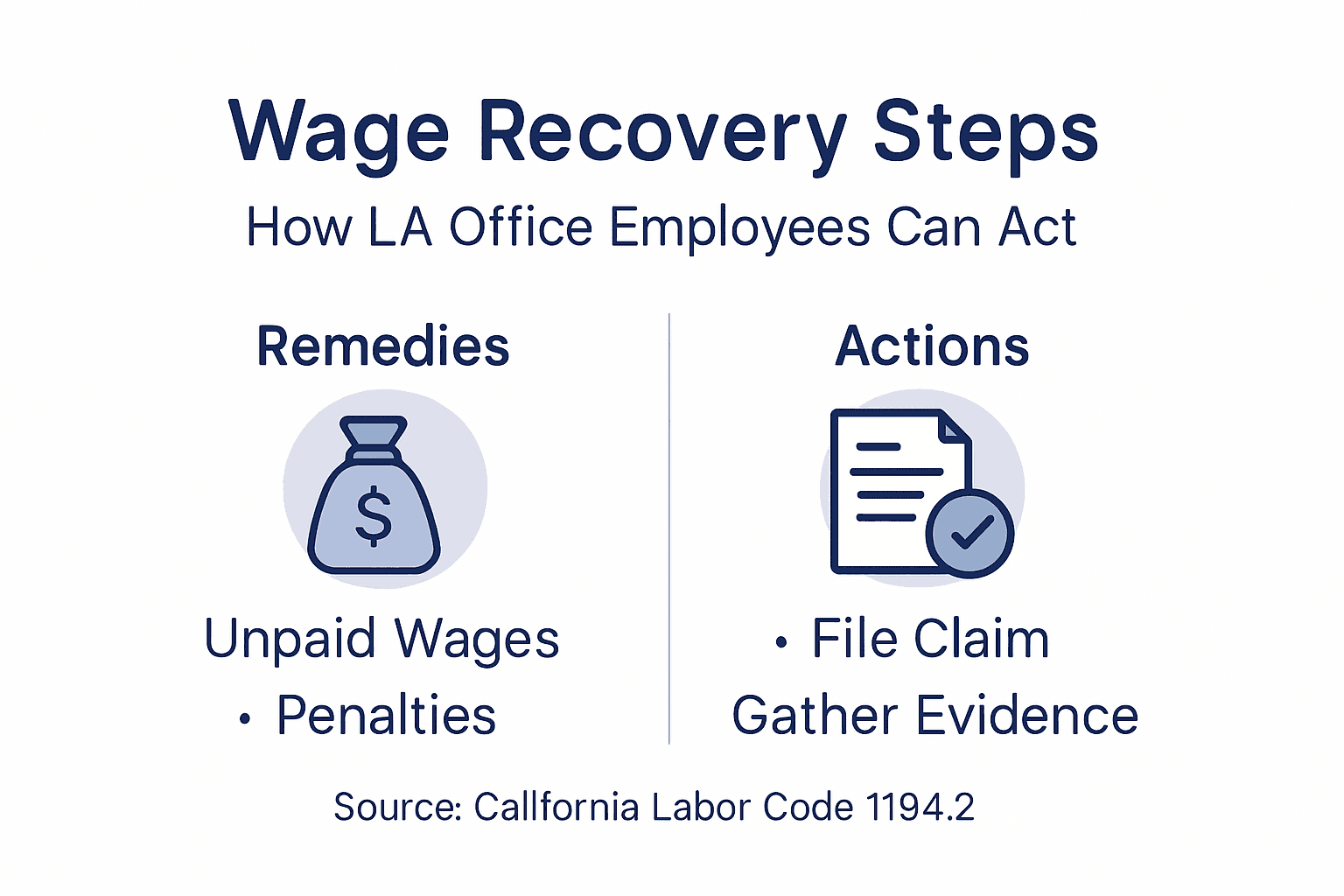
The primary remedy is recovery of unpaid wages themselves. Under California Labor Code 1194.2, employees can recover unpaid wages including overtime, with additional penalties such as liquidated damages and interest. This means if you worked 55 hours weekly for two years without receiving overtime compensation, you can recover every penny of that unpaid overtime, calculated at the proper rate. But the statute goes further. You also recover liquidated damages, which typically equal the unpaid wages themselves, effectively doubling your recovery. This penalty exists specifically to deter employers from wage theft. Interest accrues on unpaid wages from the date they were due, compounding your total recovery. For an office worker owed $15,000 in unpaid overtime, the total recovery including liquidated damages and interest could easily exceed $35,000 or more, depending on how long the violation continued.
You have two main avenues for pursuing recovery. The first is filing a claim with the California Labor Commissioner’s Office, which is a administrative process available to all workers regardless of immigration status. The Labor Commissioner’s Office enforces wage laws and adjudicates claims for unpaid wages, overtime, and violations, investigating and helping recover owed wages and penalties. You can file a claim without attorney representation, though having legal assistance significantly increases recovery. The process is relatively straightforward, and you don’t need to prove your case with absolute certainty. The burden is on your employer to show they complied with wage laws. If they cannot, you win. The second avenue is a civil lawsuit, which allows recovery of additional damages beyond what the Labor Commissioner can award, including attorney fees and costs. Civil litigation also enables class action lawsuits where multiple employees pursue claims together against the same employer, which is common in office settings where wage violations affect entire departments.
California also recognizes penalties for specific violations beyond unpaid wages. If your employer failed to provide accurate wage statements showing hours worked and rates applied, that’s a separate violation with its own penalties. If they retaliated against you for complaining about wage violations, that’s actionable retaliation with additional damages. If they misclassified you as an independent contractor or exempt employee to avoid overtime obligations, you recover not just unpaid wages but also penalties for the misclassification itself. These penalties compound, creating substantial total recovery. An office worker in West Hollywood experiencing multiple overlapping violations could recover unpaid wages, liquidated damages, wage statement penalties, retaliation damages, and interest all from a single claim. The law recognizes that wage theft often involves deliberate choices by management, and it penalizes those choices severely. Understanding wage and hour violations in detail helps clarify what specific remedies apply to your particular situation. The statute of limitations for wage claims extends three years for actions brought before the Labor Commissioner and four years for civil lawsuits, meaning you can recover wages dating back years even if the violations ended long ago.
Pro tip: Gather all pay stubs, time records, emails showing work performed outside regular hours, and documentation of any complaints you made to management about wage violations, as this evidence directly increases your recovery amount and strengthens your claim.
Common Employer Tactics And Risks To Avoid
Employers who engage in wage theft develop predictable patterns. Understanding these tactics helps you recognize violations early and protects you from falling victim to schemes designed to obscure unpaid compensation. The most common tactics involve manipulating time records, redefining work activities, pressuring employees into silence, and creating documentation that contradicts actual working conditions. Office environments in Downtown Los Angeles, Century City, and Beverly Hills are particularly vulnerable to these tactics because office work lacks the obvious time markers of factory or retail settings. Your employer might not be malicious. They might genuinely believe their practices are legal. But belief doesn’t change the law, and ignorance doesn’t excuse violations. What matters is understanding what’s happening so you can protect yourself.
One widespread tactic involves the “off the clock” work expectation. Your employer expects you to answer emails, attend virtual meetings, or complete urgent tasks before clocking in or after clocking out. They might frame this as “flexibility” or “professional responsibility.” The reality is that if you’re performing work your employer knew or should have known about, that time must be compensated. Some employers explicitly tell employees not to record certain hours, claiming “we don’t have budget for overtime this week.” Others use softer pressure: commenting on your time records, questioning why you logged certain hours, or praising employees who consistently underreport their actual time. A West Hollywood marketing professional might spend two hours daily responding to client emails from home in the evening, with their employer tacitly accepting this work but never compensating it. A Downtown Los Angeles administrative assistant might arrive 30 minutes early to prepare files for the day, with their employer routinely starting meetings at their scheduled start time rather than accounting for preparation work. These patterns accumulate into thousands of dollars in unpaid wages.
Another dangerous tactic involves salary manipulation disguised as policy. Your employer might announce a “salary restructuring” that reduces your annual pay while simultaneously increasing expectations for hours worked. They might implement automatic deductions from your paycheck for alleged “advances” on future bonuses, equipment costs, or training materials. They might claim that meal periods you took are being deducted from your salary, even though California law requires meal periods to be paid if you cannot leave the workplace or if workflow prevents you from taking them. Some employers require employees to sign agreements acknowledging they understand they’re “exempt” from overtime, trying to create contractual evidence supporting their classification decisions. These agreements are not binding on California law. Your status is determined by actual duties and working conditions, not what you signed. An office worker in Beverly Hills might sign an agreement stating they’re exempt, then spend 70 percent of their time performing non-exempt clerical work. The agreement doesn’t change their legal status.
The most insidious tactic involves retaliation against employees who question wage violations. An office worker in Hollywood who asks about overtime compensation might suddenly receive negative performance reviews, be excluded from meetings, or face termination shortly after raising concerns. Retaliation itself is illegal under California law and creates separate damages beyond wage recovery. Your employer cannot punish you for asserting your legal rights. If you’ve complained about unpaid overtime and subsequently face adverse employment action, that’s retaliation. Understanding workplace retaliation specifically clarifies what conduct constitutes illegal retaliation and what remedies apply. Some employers use more subtle retaliation, like reassigning you to less desirable positions, reducing your hours, or excluding you from opportunities you previously received. These tactics aim to make you regret complaining and discourage other employees from speaking up.
The risks of ignoring these tactics extend beyond immediate financial loss. Wage violations compound over time. Two years of 10 hours of unpaid monthly overtime becomes $24,000 in unpaid wages before penalties and interest. Five years becomes $60,000. If you remain silent about violations, they typically continue and accelerate. Your employer calculates that the cost of paying overtime is higher than the risk of being caught, so they continue the practice. The longer you wait to address violations, the more wages accumulate, but also the harder it becomes to prove exactly what you worked when. Early documentation prevents disputes later.
Pro tip: If your employer pressures you to work off the clock, send them an email immediately documenting the request, the time worked, and the work performed, creating a written record that protects you if you later need to prove the violation occurred.
Protect Your Right To Fair Pay For Every Hour Worked
Unpaid overtime wage violations silently steal hard-earned money from Los Angeles office employees. If you regularly work beyond 40 hours without proper compensation, face misclassification as an exempt employee or contractor, or endure off-the-clock work demands, you are likely experiencing wage theft. These violations cause significant financial harm and can escalate quickly if left unaddressed. Understanding your rights under California law and acting decisively is crucial to reclaiming what is legally owed.
The Wage and Hour Disputes team at Shirazi Law Office stands ready to help office professionals across Downtown Los Angeles and beyond enforce their pay rights. Waiting only increases your losses and strengthens employer defenses. Take control of your wage rights today by visiting Shirazi Law Office for trusted guidance and robust legal representation focused on holding employers accountable and maximizing your recovery.
Frequently Asked Questions
What constitutes an unpaid overtime violation?
An unpaid overtime violation occurs when an employer fails to pay employees for hours worked beyond the standard 40-hour workweek at the legally required overtime rate, which is typically one and a half times the regular hourly wage.
How can I tell if I’m misclassified as an independent contractor?
You may be misclassified if your employer controls your work activities, determines your work schedule, and provides tools for your job. If you do not have the independence typical of a contractor, you may actually be an employee entitled to overtime pay.
What should I do if I suspect my employer is violating wage laws?
If you suspect a violation, start by documenting your actual work hours using a spreadsheet or time-tracking app. Gather evidence such as pay stubs and emails. You can file a claim with the Labor Commissioner’s Office or consider consulting with an attorney to discuss your options.
What are the potential consequences for employers who violate wage laws?
Employers who violate wage laws may face substantial penalties, including the requirement to pay back wages, legal interest on delayed payments, and additional liquidated damages. They may also encounter lawsuits, damage to their reputation, and increased scrutiny from labor enforcement agencies.