

TL;DR:
- Sexual harassment in Downtown LA hospitality includes unwanted touching, inappropriate comments, and retaliation.
- Workers should document incidents, report officially to employers, and understand legal protections against retaliation.
- Employers can be held liable if they know about harassment and fail to act, especially regarding customer misconduct.
A Soho House bartender near Downtown Los Angeles recently alleged she was drugged and raped by her supervisor, a case that shocked many but surprised few who work in the industry. Sexual harassment is not a rare exception in Downtown LA’s hospitality scene. It is a persistent, documented problem. If you work in a hotel, bar, or restaurant near LA Live and have experienced unwanted conduct, you are not alone and you are not without options. This guide explains what the law says, what your rights are, and exactly what you can do to protect yourself.
Table of Contents
- Understanding workplace sexual harassment in Downtown LA hospitality
- How harassment uniquely affects LA Live hospitality workers
- Legal rights and protections for Downtown LA hospitality staff
- Steps to take if you experience or witness harassment
- A fresh perspective: What most Downtown LA hospitality employees miss about harassment cases
- Connect with expert legal help for LA hospitality workers
- Frequently asked questions
Key Takeaways
| Point | Details |
|---|---|
| Harassment is not part of the job | Hospitality workers near LA Live have the right to a safe, respectful workplace regardless of industry pressures. |
| Document and report early | Keeping written records and filing official complaints promptly strengthens your legal position. |
| Employers are legally responsible | If management knows about harassment and does nothing, they may be liable under state and federal law. |
| Seek legal guidance if needed | If reporting does not resolve the issue, a specialized employment lawyer can help protect your rights. |
Understanding workplace sexual harassment in Downtown LA hospitality
Sexual harassment in the workplace is not just about extreme incidents. The law recognizes a wide range of conduct as illegal, and understanding where the line is drawn matters for every hospitality worker in Downtown Los Angeles.
Under California’s Fair Employment and Housing Act (FEHA) and federal Title VII, sexual harassment falls into two main categories. Quid pro quo harassment happens when a supervisor ties job benefits, like a promotion or keeping your shifts, to sexual favors. Hostile work environment harassment occurs when unwanted conduct based on sex is severe or pervasive enough to make your workplace intimidating or abusive. You do not need to be physically touched for a hostile environment claim to apply.
In hospitality settings near LA Live, harassment can look like:
- Unwanted touching from a coworker, manager, or guest
- Persistent sexual comments or jokes in the kitchen or bar area
- Supervisors making scheduling decisions based on whether an employee “plays along”
- Retaliation after an employee refuses a manager’s advances
- Customers making repeated, graphic remarks while staff are expected to smile and serve
These are not edge cases. A recent lawsuit against P.F. Chang’s in Los Angeles alleged sexual harassment and retaliation against an employee, illustrating how these patterns appear even at well-known restaurant chains.
“Sexual harassment in hospitality is underreported precisely because workers fear losing income, shifts, or their jobs entirely. That fear does not make the conduct legal.”
Many workers in Downtown LA’s restaurants and hotels stay silent because they believe harassment is simply part of the job. It is not. California law is clear: employers who know about harassment and fail to act can be held liable. Learning more about sexual harassment in LA is a critical first step toward understanding your rights. Workers across the city, including those in West Hollywood risks areas, face similar patterns, and the legal framework applies equally throughout Los Angeles County.
How harassment uniquely affects LA Live hospitality workers
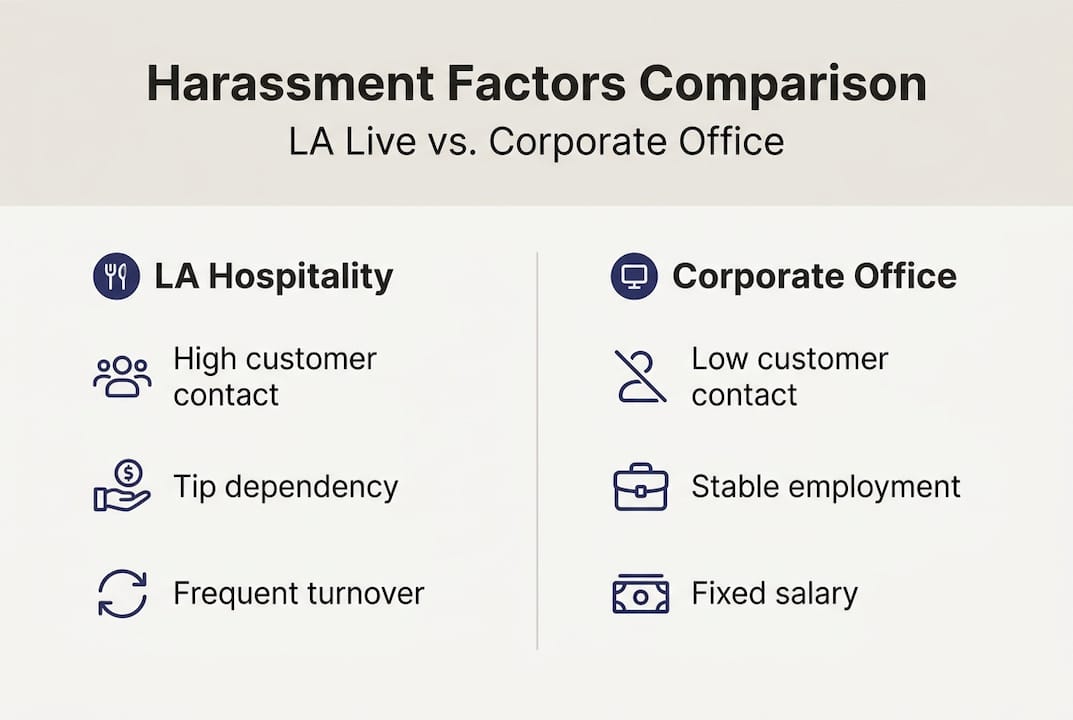
Working near LA Live means working in one of the highest-traffic entertainment districts in California. The energy is fast, the crowds are large, and the pressure to keep customers happy is constant. That environment creates specific risks that workers in corporate offices simply do not face.

Tip dependency is one of the most significant factors. When a significant portion of your income comes from gratuities, tolerating bad behavior from customers can feel financially necessary. A former Nobu Malibu server who settled a harassment suit demonstrated how tip-based roles leave workers especially vulnerable when employers fail to intervene. That vulnerability is not a personal weakness. It is a structural problem that the law recognizes.
Here is a direct comparison of how harassment risk differs between hospitality and corporate office settings:
| Factor | Hospitality near LA Live | Corporate office |
|---|---|---|
| Customer contact | High, often unsupervised | Low to moderate |
| Tip dependency | Common | Rare |
| Late-night shifts | Frequent | Uncommon |
| Staff turnover | High | Lower |
| Formal HR access | Often limited | Usually available |
| Supervisor oversight | Inconsistent | More structured |
High turnover is another real challenge. When staff rotate quickly, patterns of harassment can reset. New employees may not know what happened before them, and harassers can continue their behavior without accountability.
Coercive behavior from supervisors is also more common in hospitality. A manager controlling your schedule holds significant power over your income. That power imbalance can make it difficult to say no, and it can make retaliation feel inevitable if you do speak up.
Employers are not off the hook when the harasser is a customer. If management is aware that a guest is behaving inappropriately and does nothing, the employer may share legal responsibility. Understanding hostile work environment claims can help you evaluate whether your situation meets the legal threshold.
Pro Tip: After any problematic interaction, write down exactly what happened, including the date, time, location, what was said or done, and who witnessed it. Do this immediately, even if it involved a customer rather than a coworker.
Legal rights and protections for Downtown LA hospitality staff
You have real legal protections, and they apply whether you are a full-time hotel concierge or a part-time bar-back working event nights near LA Live.
Here is a summary of the key legal protections available to you:
| Law | Coverage | Key protection |
|---|---|---|
| Title VII (federal) | Employers with 15+ employees | Prohibits sex-based harassment |
| FEHA (California) | Employers with 5+ employees | Broader state-level protections |
| California Labor Code | All workers | Retaliation protections |
| DFEH process | All California workers | Free complaint filing option |
California’s FEHA offers stronger protections than federal law in several ways. It covers smaller employers, allows longer filing windows, and permits larger damage awards. That matters for hospitality workers at smaller venues near Downtown LA.
A critical legal principle: employers can be liable for harassment if they knew or should have known about it and failed to take corrective action. This means that reporting to a manager, even informally, can trigger your employer’s legal obligation to act.
“The law does not require you to tolerate harassment until it becomes extreme. Even a pattern of unwanted comments can meet the legal standard for a hostile work environment.”
If you experience harassment, here are the steps to take:
- Document immediately. Write down every incident with dates, times, and witnesses.
- Report in writing. Submit a written complaint to your manager or HR department.
- Keep copies. Save all emails, texts, and written responses you receive.
- Note any changes. Track whether your schedule, duties, or treatment changes after you report.
- Escalate if needed. If your employer does not act, file a complaint with the California Civil Rights Department.
- Consult a lawyer. An employment attorney can assess your situation and advise on next steps.
Retaliation after reporting is illegal. California law, including protections detailed in resources on West Hollywood sexual harassment law and hostile work environment West Hollywood cases, makes clear that punishing an employee for reporting is itself a separate legal violation. Understanding retaliation protection in LA can help you recognize when your employer has crossed a legal line.
Steps to take if you experience or witness harassment
Knowing your rights is one thing. Taking action is another. Here is a practical checklist for anyone experiencing or witnessing harassment in a Downtown LA hospitality workplace.
If harassment happens to you:
- Write down what happened immediately, including all details
- Save any texts, emails, or social media messages related to the incident
- Identify coworkers who may have witnessed the conduct
- Report the incident in writing to your manager or HR, and keep a copy
- If your manager is the harasser, report to their supervisor or directly to HR
- Track any changes to your schedule, duties, or treatment after you report
If you witness harassment:
- Document what you saw with dates and details
- Offer to be a witness for the affected coworker
- Report what you observed through official channels if you feel safe doing so
Retaliation is a serious risk. After reporting, some employers reduce shifts, change schedules, or create conditions that push workers to quit. A P.F. Chang’s lawsuit in Los Angeles alleged exactly this kind of retaliation following a harassment complaint. Recognizing retaliation after reporting is essential because it is often subtle at first.
Common employer mistakes include dismissing complaints as “misunderstandings,” failing to investigate, or retaliating against the person who reported. If your employer responds this way, that response itself may strengthen your legal case.
Pro Tip: Always submit your complaint in writing, even if you have already spoken to someone verbally. A written complaint creates a paper trail that can be critical if you later pursue a legal claim. An email to HR with a clear subject line is often enough to establish that your employer had official notice.
If internal processes fail, consulting with an employment lawyer is the right next step. An attorney can evaluate your documentation, explain your options, and help you decide whether to file a formal complaint or pursue litigation. Resources on wrongful termination after reporting can also help you understand what remedies may be available if your employment was ended as a result of speaking up.
A fresh perspective: What most Downtown LA hospitality employees miss about harassment cases
Most guides focus on coworker harassment. That is important, but it misses a major source of harm in hospitality: customer conduct. Workers near LA Live deal with intoxicated, entitled, or aggressive guests regularly. Many never think to document those interactions because they assume nothing can be done. That assumption is wrong.
When you report a harassing customer to management and nothing changes, your employer may have just created legal liability for themselves. The paper trail you build around customer incidents can be just as powerful as documentation of coworker behavior.
Another overlooked truth: informal complaints rarely protect you. Telling a coworker or venting to a shift supervisor does not trigger your employer’s legal obligations. Only a formal, documented complaint does that. Many workers skip this step out of fear or hope that things will improve on their own. They rarely do.
Fear of losing tips or retaliation keeps real reporting rates far below what official numbers suggest. That silence benefits employers, not workers. Empowerment comes from taking documented, official action, not from enduring in silence. Reading more about sexual harassment in LA can help you understand how the law actually works in your favor when you take the right steps.
Connect with expert legal help for LA hospitality workers
If you are facing sexual harassment or retaliation in a Downtown LA hospitality job, you do not have to figure this out alone. Shirazi Law Office represents employees across Los Angeles who are standing up against unlawful workplace conduct. Whether you are dealing with a hostile work environment, wrongful termination, or retaliation after reporting, the firm can provide a confidential assessment of your situation. Learn more about your employee legal rights, connect with an experienced employment lawyer in LA, or explore your wrongful termination rights. Your case matters, and the right legal guidance can make all the difference.
Frequently asked questions
What qualifies as sexual harassment in a Downtown LA restaurant or bar?
Unwanted touching, suggestive remarks, persistent requests, or any conduct that creates a hostile work environment count as sexual harassment under California law. Even repeated verbal conduct without physical contact can meet the legal standard.
Are employers liable for customer harassment in hospitality jobs?
Yes, if management knows about customer harassment and does not intervene, the employer can be held legally responsible. Cases like the Nobu Malibu settlement show that tip-based workers have successfully pursued claims in exactly these circumstances.
What protections exist against retaliation for reporting harassment?
California law forbids employers from retaliating against workers for reporting harassment, and victims can seek remedies if it happens. Retaliation such as reduced shifts or termination after a complaint is itself an independent legal violation.
What should I do first if I experience harassment at work?
Immediately document the incident in writing, report it formally to your manager or HR, and keep copies of everything for your records.
How soon must I file a claim for workplace harassment in California?
You generally have three years from the date of the incident to file a state claim under FEHA, but acting quickly preserves your evidence and strengthens your position.