

Over one third of all American workers report having witnessed or experienced some form of workplace retaliation. For tech and gaming executives in Culver City, these disputes create high-stakes risks that can threaten careers and reputations. Understanding how California law protects executives accused of wrongdoing or speaking out is critical for making informed decisions and minimizing legal exposure in this fast-moving industry.
Table of Contents
- Defining Workplace Retaliation in California
- Types of Retaliation at Tech and Media Startups
- Protected Activities and Legal Foundations
- California Laws Governing Retaliation Claims
- Executive Rights, Employer Liability, and Typical Risks
- Key Compliance Strategies and Mistakes to Avoid
Key Takeaways
| Point | Details |
|---|---|
| Understanding Retaliation | Workplace retaliation occurs when an employer punishes an employee for participating in legally protected activities, violating California law. |
| Types of Retaliation | Major forms include direct retaliation, such as termination, and subtle tactics like professional isolation or reputation damage. |
| Legal Protections | California laws, particularly FEHA, shield employees who engage in protected activities from retaliatory actions by employers. |
| Proactive Compliance | Startups should implement strong policies and documentation practices to minimize retaliation risks and foster a culture of transparency. |
Defining Workplace Retaliation in California
Workplace retaliation represents a complex legal challenge for executives in California startups, particularly in innovation hubs like Culver City. Workplace retaliation occurs when an employer punishes an employee for engaging in legally protected activities, such as reporting discrimination, harassment, or organizational misconduct.
Under California law, retaliation involves adverse employment actions designed to discourage employees from asserting their legal rights. These actions can include termination, demotion, reduced work hours, schedule changes, or creating a hostile work environment. The Fair Employment and Housing Act (FEHA) provides robust protections, especially for organizations with five or more employees, ensuring workers can speak up without fear of professional consequences.
Proving workplace retaliation requires demonstrating three critical elements: First, the employee must have engaged in a legally protected activity. Second, the employer must have taken an adverse action. Third, the employee must establish a direct causal connection between the protected activity and the adverse action. This means showing that the employer’s negative response was a direct result of the employee’s protected conduct, not due to legitimate performance or business reasons.
Pro tip: Document every interaction and communication related to your protected workplace activity, as contemporaneous evidence can be crucial in substantiating a potential retaliation claim.
Types of Retaliation at Tech and Media Startups
Tech and media startups in Culver City often experience unique workplace dynamics that can manifest complex forms of retaliation. Professional retaliation extends far beyond traditional punitive actions, encompassing subtle yet damaging strategies designed to marginalize employees who challenge organizational norms or report misconduct.
In the high-stakes environment of technology and media enterprises, retaliation can take several nuanced forms. These include professional isolation, where an executive is deliberately excluded from critical meetings, communication channels, or strategic conversations. Reputation damage represents another sophisticated retaliation technique, wherein employers might strategically undermine an individual’s professional credibility through negative performance evaluations, reduced recommendation opportunities, or strategic gossip within professional networks.

Additional retaliation tactics specific to tech and media startups might involve manipulating work assignments, creating impossible performance metrics, or systematically reducing an employee’s career advancement opportunities. Career obstruction can manifest through blocking promotions, reassigning challenging projects, or creating work conditions that make professional growth essentially impossible. Some startups might also employ more indirect strategies like reducing compensation, modifying bonus structures, or implementing punitive performance improvement plans that are designed to create a hostile work environment.
Pro tip: Maintain a comprehensive, dated record of all professional interactions, project assignments, and communication that could potentially demonstrate a pattern of retaliatory behavior.
Below is a summary table highlighting the main differences between direct and subtle forms of workplace retaliation found in tech and media startups:
| Retaliation Type | Common Examples | Detection Challenge | Impact on Career Progression |
|---|---|---|---|
| Direct Retaliation | Termination, demotion | Usually clear and documented | Immediate, often severe |
| Subtle Retaliation | Isolation, reputation sabotage | Harder to prove, often covert | Slow but cumulative professional harm |
Protected Activities and Legal Foundations
Protected activities form the critical legal framework that shields employees from workplace retaliation in California’s dynamic startup ecosystem. California law provides comprehensive protections for employees who engage in legally sanctioned actions that expose workplace misconduct, ensuring workers can speak up without fear of professional consequences.
These protected activities encompass a broad range of professional conduct, including reporting discrimination, harassment, wage violations, safety concerns, and other illegal workplace practices. Employees are legally shielded when they file formal complaints with human resources, participate in internal investigations, provide witness testimony, or support colleagues experiencing workplace violations. The Fair Employment and Housing Act (FEHA) specifically guarantees that executives and employees can assert their rights through multiple channels, whether internally within their organization or through external governmental agencies.
The legal foundations protecting workplace rights extend beyond immediate reporting mechanisms. They include safeguarding employees who request reasonable accommodations, challenge discriminatory practices, file workers’ compensation claims, or refuse to participate in activities that would violate established laws. For tech and media startups in Culver City, this means creating an environment where transparency and ethical conduct are not just encouraged, but legally protected. Employees cannot be punished for acting in good faith to uphold legal and ethical standards, regardless of the potential discomfort such actions might create for management.
Pro tip: Consult with an employment law specialist before making any formal workplace complaint to understand the full scope of your legal protections and develop a strategic approach to addressing workplace issues.
California Laws Governing Retaliation Claims
California’s comprehensive legal framework provides robust protections against workplace retaliation, establishing multiple layers of defense for employees in technology and media startups. The cornerstone of these protections includes the Fair Employment and Housing Act (FEHA) and Labor Code Section 1102.5, which create extensive safeguards against retaliatory actions by employers seeking to punish workers for asserting their legal rights.
The legal landscape for retaliation claims in California encompasses a wide range of protective statutes. These laws prohibit employers from taking adverse actions against employees who engage in protected activities, such as reporting workplace discrimination, participating in investigations, filing complaints about illegal practices, or speaking out against harassment. Specific protections extend to various scenarios, including whistleblower protections, anti-discrimination measures, and safeguards for employees who request reasonable accommodations or challenge unethical workplace practices.
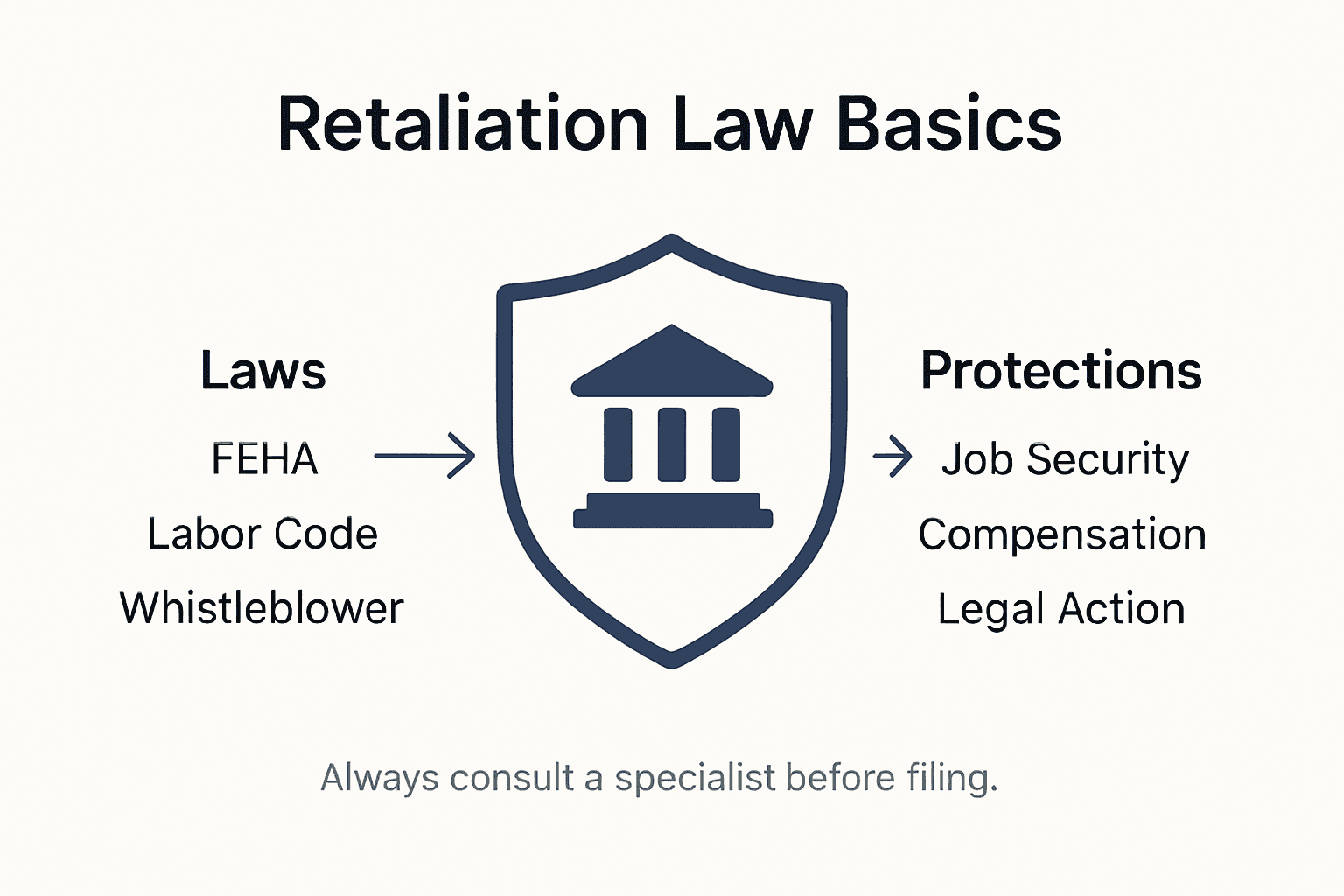
California’s legal approach to retaliation is particularly nuanced, providing multiple avenues for employees to seek justice. The state’s laws not only protect workers from direct punitive actions like termination or demotion but also shield against more subtle forms of retaliation, such as professional isolation, negative performance evaluations, or systematic attempts to undermine an employee’s professional reputation. This comprehensive approach ensures that employees in Culver City startups can challenge workplace misconduct without fear of professional repercussions, creating a more transparent and accountable work environment.
Pro tip: Maintain a detailed, contemporaneous record of all workplace interactions and potential retaliatory actions, as documentation is crucial in substantiating legal claims under California employment laws.
Here’s a quick reference table comparing key California retaliation laws and their core protections:
| Law/Section | Protected Activities | Primary Safeguards |
|---|---|---|
| Fair Employment and Housing Act (FEHA) | Reporting discrimination, seeking accommodations | Protects against adverse workplace actions |
| Labor Code Section 1102.5 | Whistleblowing, reporting violations | Forbids employer retaliation for lawful reporting |
Executive Rights, Employer Liability, and Typical Risks
Wrongful termination claims involving California executives represent complex legal challenges with substantial potential consequences, particularly in high-stakes technology and media environments. Executives possess unique legal protections that extend beyond standard employee rights, recognizing their critical role in organizational governance and ethical standards.
The legal framework for executive rights in California encompasses multiple layers of protection, addressing both direct and subtle forms of workplace retaliation. Employers face significant liability for actions that could be interpreted as punitive or discriminatory, including financial damages, potential injunctions, and severe reputational harm. These protections cover a range of scenarios, from explicit termination to more nuanced professional sabotage, such as strategic marginalization, intentional career obstruction, or systematic attempts to undermine an executive’s professional standing.
Typical risks for executives in Culver City startups include complex contractual disputes, confidentiality challenges, and strategic workplace maneuvers designed to pressure high-level professionals out of their positions. These risks are particularly pronounced in fast-moving technology sectors, where power dynamics and competitive pressures can create environments ripe for potential legal conflicts. Executives must remain vigilant, understanding that their legal protections require active documentation, strategic communication, and a comprehensive approach to preserving their professional integrity and career trajectory.
Pro tip: Consult with an employment law specialist immediately upon experiencing any workplace actions that might constitute potential retaliation, as timing and documentation are critical in protecting your executive rights.
Key Compliance Strategies and Mistakes to Avoid
Effective compliance strategies are essential for California startups seeking to minimize workplace retaliation risks, requiring a proactive and strategic approach to organizational management. Successful risk mitigation demands comprehensive policies, robust training programs, and a consistent commitment to transparent workplace practices that protect both employees and organizational interests.
The compliance framework for Culver City startups must emphasize several critical elements. Consistent documentation of performance issues, neutral investigation protocols, and evenhanded application of workplace policies are fundamental to preventing potential retaliation claims. Employers should be particularly cautious about taking any adverse actions within 90 days of an employee’s protected activity, as California law creates a presumptive retaliation environment during this period. This requires meticulous record keeping, clear performance benchmarks, and demonstrable evidence of legitimate, non-discriminatory decision making.
Key mistakes to avoid include impulsive disciplinary actions, inconsistent policy enforcement, and failing to maintain confidentiality during internal investigations. Startups must develop robust training programs that educate managers about recognizing and preventing retaliatory behaviors, create clear reporting mechanisms for potential workplace issues, and foster a culture of open communication. Building an organizational environment that values transparency, respects employee rights, and provides multiple channels for addressing workplace concerns can significantly reduce legal vulnerabilities and potential litigation risks.
Pro tip: Implement a comprehensive internal audit process that regularly reviews employment decisions, performance evaluations, and workplace interactions to proactively identify and mitigate potential retaliation risks.
Protect Your Rights Against Workplace Retaliation in Culver City Startups
Navigating retaliation claims can be overwhelming, especially when subtle forms like professional isolation or career obstruction are jeopardizing your executive position. The complex legal protections under California law demand experienced guidance to ensure your voice is heard without fear of further punishment. Whether you face termination threats, negative performance evaluations, or hostile work environments, understanding your legal rights is the first step toward reclaiming control.
At Shirazi Law Office, we specialize in defending executives and senior management against wrongful termination and retaliation in Los Angeles startups and media companies. Our strategic approach focuses on detailed documentation, robust legal protection, and preserving your professional reputation. Do not wait while retaliation damages your career—reach out now to discuss your situation and learn how we can help you assert your rights with confidence. Visit our main website to schedule a consultation and protect your future today.
Frequently Asked Questions
What constitutes workplace retaliation in startups?
Workplace retaliation occurs when an employer punishes an employee for engaging in legally protected activities, such as reporting discrimination or harassment, which can include actions like termination, demotion, or professional isolation.
How can executives prove a retaliation claim in California?
To prove a retaliation claim, an executive must demonstrate three elements: they engaged in a legally protected activity, the employer took an adverse action against them, and there is a direct causal connection between the two actions.
What are some subtle forms of retaliation that may occur in tech startups?
Subtle forms of retaliation can include professional isolation, reputation damage through negative evaluations or gossip, manipulation of work assignments, and creating impossible performance metrics, all of which can negatively impact an executive’s career progression.
What protections do California laws provide for executives against retaliation?
California law, particularly through the Fair Employment and Housing Act (FEHA) and Labor Code Section 1102.5, prohibits employers from taking adverse actions against executives who engage in protected activities, ensuring they can report misconduct without fear of punishment.





[…] Retaliation Claims in Culver City Startups – Protecting Executives […]