

TL;DR:
- Non-compete agreements are generally unenforceable under California law for UCLA professionals in Westwood. Employers rely more on NDAs and non-solicitation clauses, which are enforceable if narrowly written. Consulting an employment lawyer is crucial to understand and protect your career rights.
If you work at UCLA or UCLA Health in Westwood and a contract clause is making you second-guess your next career move, you are not alone. Many professionals assume that because a non-compete appears in their employment agreement, it must be enforceable. That assumption is wrong, and it costs people real opportunities. Non-competes are generally void under California Business and Professions Code section 16600, which protects your right to work in your chosen field. This guide walks you through what the law actually says, which contract clauses still matter, and exactly what to do when restrictive language shows up in your employment paperwork.
Table of Contents
- Understanding non-compete agreements in Westwood
- Common contract clauses: what to look for (and what matters)
- California’s policy on worker mobility: how Westwood compares
- What to do if you encounter a non-compete or restrictive clause
- The uncomfortable truth: non-compete myths and missed opportunities
- Get help with Westwood employment contract issues
- Frequently asked questions
Key Takeaways
| Point | Details |
|---|---|
| Non-competes mostly void in Westwood | California law makes most non-compete agreements for UCLA professionals unenforceable. |
| Watch for enforceable alternatives | NDAs and non-solicitation clauses in UCLA contracts can still be enforced if written narrowly. |
| Legal advice prevents self-limiting | Consulting a local employment lawyer protects your career and helps negotiate contract terms. |
| California leads in worker mobility | UCLA professionals benefit from strong job-switching and career advancement protections. |
Understanding non-compete agreements in Westwood
A non-compete agreement is a contract clause that tries to prevent you from working for a competitor or starting a competing business after leaving your employer. In most states, these clauses carry real legal weight. In California, they almost never do.
California Business and Professions Code section 16600 is one of the strongest employee protections in the country. It voids any contract that restrains a person from engaging in a lawful profession, trade, or business. For UCLA professionals in Westwood, this means that even if your employment contract includes a non-compete clause, that clause is generally unenforceable under California law.
There are narrow exceptions, but they rarely apply to employees. The law recognizes limited carve-outs in specific situations:
- Sale of a business, where the seller agrees not to compete with the buyer
- Dissolution of a partnership or limited liability company
- Certain situations involving the sale of a business owner’s interest
These exceptions to California’s non-compete law are designed for business transactions, not for rank-and-file employees or even most executives. If you are a physician, researcher, administrator, or staff member at UCLA Health, the exceptions almost certainly do not apply to you.
Key statistic: California is one of only a handful of states that broadly bans non-compete agreements for employees, making it a national outlier in protecting worker mobility rights.
Here is the practical problem. Even when a clause is legally void, seeing it in a contract can make you hesitate. You might turn down a job offer or avoid starting a practice because you fear legal consequences. That fear is exactly what some employers count on. Reviewing non-compete agreements in LA with an experienced attorney before signing removes that uncertainty.
Pro Tip: Never assume a clause is enforceable just because it is written into a contract. Have counsel review any restrictive language before you sign or before you make a career decision based on it.
Common contract clauses: what to look for (and what matters)
Understanding the law is only part of the equation. Let’s break down the kinds of clauses that still land in UCLA and Westwood contracts, and which ones actually have teeth.
Because non-competes are unenforceable, many employers have shifted to alternatives. UCLA Health professionals in Westwood may still encounter non-compete language, but employers increasingly rely on NDAs and non-solicitation clauses to protect their interests. These tools are different, and they can be enforceable if written correctly.

Non-disclosure agreements (NDAs) restrict you from sharing confidential information such as patient data, proprietary research, or internal business strategies. An NDA that is narrowly focused on genuinely confidential material is generally valid. However, broad NDAs risk invalidation if they are written so broadly that they effectively restrain trade or prevent you from using general skills and knowledge in your career.
Non-solicitation agreements restrict you from recruiting your former colleagues or contacting specific clients after leaving. Courts in California have generally upheld these when they are narrowly tailored to actual clients or coworkers you had direct contact with.
| Clause type | Typically enforceable in California? | Key condition |
|---|---|---|
| Non-compete | No | Void under section 16600 |
| NDA | Yes, if narrow | Must not restrain general trade |
| Non-solicitation (clients) | Often yes | Must target specific, known clients |
| Non-solicitation (employees) | Often yes | Must be narrowly tailored |
Before you sign any employment contract, work through these steps:
- Read every clause carefully, not just the job title and salary
- Flag any language that restricts your future employment or business activities
- Look for terms like “confidential,” “proprietary,” “solicit,” or “compete”
- Ask your employer to clarify what specific information or conduct each clause covers
- Consult an attorney before agreeing to any language that limits your professional freedom
If you need guidance on handling non-compete clauses or reviewing a contract before signing, legal counsel can help you understand exactly what you are agreeing to.
Pro Tip: Restrictive clauses are often negotiable. You can ask your employer to remove a non-compete entirely, narrow the scope of an NDA, or limit a non-solicitation clause to specific clients. Most employers expect some negotiation.
California’s policy on worker mobility: how Westwood compares
Having explored contract details, it is vital to see how California stacks up nationwide and how UCLA professionals benefit from the state’s approach.
California’s ban on non-competes is not just a legal technicality. It reflects a deliberate policy choice that favors innovation, career mobility, and employee freedom over employer control. The results are measurable.
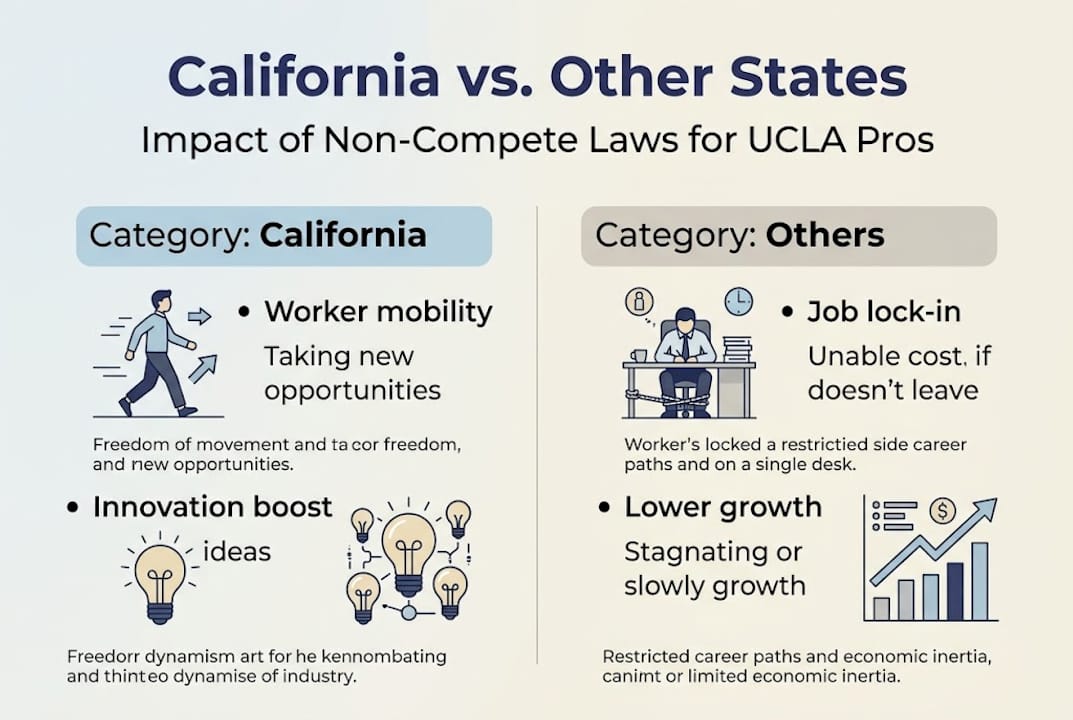
UCLA Anderson research shows that non-competes in high-enforcement states increase employee retention post-acquisition by 11%, but they reduce patent value by 40%. That trade-off tells a clear story. Employers gain short-term retention, but the workforce becomes less productive and less innovative. California’s ban avoids this outcome entirely.
For professionals working in healthcare and academia, the benefits are especially significant:
- Physicians can move between health systems without legal barriers
- Researchers can take their expertise to new institutions or startups
- Administrators can pursue leadership roles across the industry
- Staff can seek better pay and conditions without fear of lawsuits
| State policy | Retention effect | Patent/productivity effect |
|---|---|---|
| Non-compete enforcement | +11% retention | -40% patent value |
| California ban (no enforcement) | Neutral to positive | Higher innovation output |
One important nuance: if you previously worked in another state and signed a non-compete there, California law may still protect you. Multi-state workers benefit from California protections even for prior agreements, provided your employment is now based in California. This is a powerful protection that many professionals are not aware of.
The contrast with other states is sharp. In states that enforce non-competes aggressively, professionals often stay in jobs they want to leave, decline better offers, or avoid starting businesses. California’s policy removes those barriers. For UCLA professionals in Westwood, this means you have more freedom than most of your counterparts nationwide, as long as you know how to use it.
Understanding the California non-compete impact on your specific situation, especially if your role involves multi-state responsibilities, is worth discussing with a knowledgeable employment attorney.
What to do if you encounter a non-compete or restrictive clause
Understanding your rights is empowering, but taking action when contract issues arise is just as important.
The most common mistake professionals make is assuming that every clause in a contract is automatically enforceable. That assumption leads to self-censorship. People turn down jobs, avoid starting practices, or stay in toxic workplaces because they believe a piece of paper has more power than it actually does.
Here is a practical step-by-step approach when you encounter a restrictive clause:
- Do not panic. A non-compete clause in a California contract is almost certainly void. Its presence does not mean you are legally bound.
- Document the clause. Keep a copy of the full contract and highlight every restrictive provision.
- Research the type of clause. Is it a true non-compete, an NDA, or a non-solicitation agreement? Each carries different legal weight.
- Do not self-limit. Fear of unenforceable non-competes is one of the most common reasons professionals miss out on better opportunities. Do not let a void clause make your career decisions for you.
- Consult an employment lawyer. Before signing, before leaving, or before accepting a new role, get a professional opinion on what the clause actually means.
- Negotiate. Ask for the clause to be removed or narrowed. Most employers will comply when they understand the legal landscape.
Knowing when to seek employment lawyer guidance is critical. If your employer threatens legal action based on a non-compete, if you have been denied a job because of one, or if you are unsure whether a clause applies to your situation, those are all strong reasons to consult counsel promptly.
You should also be aware of related rights. If your employer retaliates against you for refusing to sign a non-compete or for leaving to take a better job, that retaliation may be unlawful. Understanding your wage violation rights in Westwood and broader employment protections can be just as important as understanding non-compete law.
Pro Tip: If an employer insists on a non-compete clause after you have raised California law, that is a red flag about how they treat employee rights generally. It may tell you something important about the workplace you are considering joining.
The uncomfortable truth: non-compete myths and missed opportunities
Here is what most legal guides will not say directly. The clause itself is rarely the biggest obstacle. The bigger problem is the belief that the clause matters more than it does.
We have seen professionals with strong careers stay stuck in roles that were harming them, professionally and personally, because they were convinced a non-compete would destroy them if they left. In California, that fear is almost always unfounded. The law is clear. The non-compete analysis consistently points in one direction: employees have the right to move.
Self-censorship driven by misunderstanding can do more damage to your career than any lawsuit ever would. An employer who relies on a void clause to keep you in place is counting on you not knowing your rights. That is not a legal strategy on their part. It is a power play.
California empowers mobility, but only if you know your rights and are willing to assert them. Legal advice is not just for when things go wrong. It is a tool for making informed decisions before you sign, before you leave, and before you let a contract clause redirect the course of your career.
Get help with Westwood employment contract issues
If you are a UCLA professional in Westwood dealing with a non-compete clause, an NDA, or any restrictive contract language, you do not have to figure it out alone. Shirazi Law Office works directly with employees, executives, and senior management throughout Los Angeles, providing clear and practical guidance on employment contracts and workplace rights. Whether you need a contract reviewed before signing or representation in a dispute, a Westwood employment lawyer can help you understand your position and protect your career. You can also explore detailed employee rights info to stay informed about your protections under California law. Your next career move should be yours to make.
Frequently asked questions
Are non-compete agreements enforceable for UCLA professionals in Westwood?
Non-competes are generally void in California, including for UCLA professionals in Westwood, because state law prioritizes employee mobility over employer restrictions. Very narrow exceptions exist for business sales but rarely apply to employees.
What kinds of contract clauses should UCLA professionals be cautious of if not non-competes?
NDAs and non-solicitation clauses can still restrict certain actions and are enforceable if narrowly tailored, so they deserve careful review before you sign any employment agreement.
Can an employer fire me for refusing to sign a non-compete at UCLA?
A non-compete is unenforceable in California, and retaliating against you for refusing to sign one may expose your employer to legal risk. Consulting an employment attorney can help you understand your protections in that situation.
What should I do if I am asked to sign a non-compete as a new UCLA hire?
Ask for clarification, consult with an employment lawyer before signing, and request that the clause be removed, since non-competes are generally not legal in California employment contracts.
Does California law protect out-of-state UCLA employees working in Westwood?
Yes, California’s non-compete ban can apply to multi-state workers at UCLA, potentially overriding prior out-of-state agreements once your employment is based in California.