

Restrictive employment clauses often leave creative leaders in Culver City questioning how to protect business interests without running afoul of California law. With the introduction of Senate Bill 699 and Assembly Bill 1076, California now bans nearly all non-compete agreements, making such contracts essentially unenforceable and empowering employees with strong legal recourse. This shift means executives must rethink how to retain talent and address disputes, relying on employee mobility rights and alternative protections in a rapidly evolving regulatory environment.
Table of Contents
- Non-compete Clauses In California Employment
- Key Legislative Developments Affecting Non-competes
- Variations And Exceptions To The Non-compete Ban
- Employee Rights And Employer Obligations Under SB 699
- Risks, Enforcement Pitfalls, And Practical Alternatives
Key Takeaways
| Point | Details |
|---|---|
| Non-compete clauses largely unenforceable | California prohibits non-compete agreements, enhancing employee mobility and professional growth. |
| Legislation impacts all employers | New laws empower employees against restrictive contracts, applicable even to out-of-state companies. |
| Legal recourse for employees | Employees can sue for damages and recover attorney’s fees if subjected to non-compete restrictions. |
| Employers’ revised compliance requirements | Companies must review existing agreements, inform employees about unenforceability, and adopt protective measures that respect employee rights. |
Non-compete clauses in California employment
California maintains a unique stance on non-compete clauses that dramatically differs from many other states. Employers in Culver City and across California face strict legal restrictions when attempting to limit employee mobility through contractual agreements. The state has long viewed non-compete agreements as fundamentally anti-competitive.
The legal landscape transformed significantly with recent legislation enacted in January 2024. Two key bills – Senate Bill 699 and Assembly Bill 1076 – reinforced California’s strong position against non-compete restrictions. These laws impose comprehensive prohibitions that extend far beyond previous interpretations:
- Employers cannot require or enforce non-compete agreements
- Employees gain a private right of action against employers attempting to impose such restrictions
- Potential damages and attorney’s fees are available to employees
- Agreements are presumed void, with extremely narrow exceptions
The statutory framework provides robust protections for creative professionals in Culver City’s dynamic employment ecosystem. Non-compete clauses are now essentially unenforceable, giving workers unprecedented freedom to change jobs and pursue opportunities across different companies and projects.
Under California law, employers are explicitly prohibited from preventing employees from working for competitors or starting their own competing businesses. This approach recognizes that talent mobility and professional growth should not be artificially constrained by restrictive contractual provisions. The legislation applies not just to California-based employers, but can potentially impact out-of-state companies attempting to restrict former employees’ job prospects.
Key Legal Implications for Creatives:
- Complete freedom to change employers
- Protection against retaliatory employment practices
- Enhanced ability to negotiate compensation and opportunities
- Reduced risk of legal challenges when transitioning between jobs
Pro tip: If you encounter a non-compete agreement in California, consult an employment lawyer immediately to understand your rights and potential challenges to the contract.
Key legislative developments affecting non-competes
The landscape of non-compete agreements has undergone dramatic transformation in 2024, with unprecedented federal and state-level legislative actions reshaping employment mobility. Nationwide non-compete restrictions represent a significant shift in employment law, fundamentally altering how businesses can restrict employee movement.
The Federal Trade Commission (FTC) introduced groundbreaking regulations that fundamentally challenge traditional non-compete practices. Key provisions of these new rules include:
- Banning most non-compete agreements nationwide
- Applying restrictions to employees, contractors, and volunteers
- Creating narrow exceptions for senior executives
- Requiring employers to notify workers about agreement unenforceability
These federal regulations complement California’s existing stringent stance against non-compete clauses. Workforce mobility has become a critical legal and economic priority, with lawmakers increasingly recognizing the importance of professional flexibility and economic opportunity.
The implementation timeline presents significant challenges for employers. Effective September 4, 2024, the FTC’s rule will render most existing non-compete agreements unenforceable. This unprecedented move aims to promote economic dynamism by preventing employers from artificially constraining worker opportunities and suppressing wage growth.
Here’s a quick comparison of non-compete laws in California vs. the new U.S. federal rule:
| Issue | California Law (2024) | FTC Federal Rule (2024) |
|---|---|---|
| Coverage | All employees and contracts | Employees, contractors, volunteers |
| Main Ban Effective Date | January 2024 | September 4, 2024 |
| Enforcement Rights | Employee can sue employers | FTC enforcement, private lawsuits |
| Notable Exceptions | Trade secrets, business sale | Senior executives, business sale |
| Notification Requirement | Yes, employer must inform | Yes, employer must inform |
| Extra-territorial Reach | Applies to out-of-state deals | May cover non-U.S. employers if U.S. based |
Potential Implications for Creative Professionals:
- Increased job market flexibility
- Reduced legal barriers to career transitions
- Enhanced negotiation power for employees
- Greater opportunities for entrepreneurial ventures
Pro tip: Carefully review any existing non-compete agreements with an employment lawyer to understand your rights under the new federal regulations.
Variations and exceptions to the non-compete ban
Although California maintains one of the most stringent approaches to non-compete agreements, legal nuances still exist that create limited pathways for employer protections. The state’s approach recognizes that while broad restrictions on employee mobility are unacceptable, certain narrow exceptions can safeguard legitimate business interests.
Critical exceptions to California’s non-compete ban typically involve protecting sensitive business assets and preventing potential economic harm. These rare instances include:
- Protecting genuine trade secrets
- Preventing disclosure of confidential business information
- Restricting direct solicitation of clients or employees
- Narrowly defined sale of business agreements
The legal landscape for creative professionals in Culver City requires careful navigation. Employers cannot broadly restrict an employee’s ability to work, but they can still implement strategic protections through carefully crafted agreements that focus on specific, measurable business interests.

Most exceptions require extremely precise language and demonstrable economic justification. Courts consistently prioritize employee mobility and professional freedom, meaning any restrictive provisions must pass strict scrutiny. This approach ensures that non-compete-like restrictions cannot be used as a mechanism for unfairly constraining worker opportunities or suppressing professional growth.
Key Protective Strategies for Businesses:
- Implement robust confidentiality agreements
- Define clear boundaries for trade secret protection
- Create specific, time-limited disclosure restrictions
- Focus on protecting legitimate business interests
Pro tip: Consult an employment lawyer to draft narrowly tailored agreements that protect business interests without infringing on employee mobility rights.
Employee rights and employer obligations under SB 699
Senate Bill 699 represents a watershed moment for employee protections in California, fundamentally reshaping the landscape of non-compete agreement enforcement. The legislation provides unprecedented safeguards for current, former, and prospective employees against restrictive employment practices.
Key provisions of SB 699 establish critical rights and responsibilities for both employees and employers:
- Prohibiting employers from entering into noncompete agreements
- Granting employees a private right of action
- Allowing recovery of damages and legal fees
- Extending protections to contracts signed outside California
The legal framework introduces significant consequences for employers who attempt to restrict employee mobility. Companies can no longer rely on traditional methods of limiting professional movement, with strict penalties for violations that extend beyond state boundaries.
Creative professionals in Culver City now have robust legal protections against contractual restrictions. Employers must carefully navigate these new regulations, understanding that attempts to enforce noncompete agreements can result in substantial legal and financial repercussions. The law effectively dismantles previous mechanisms used to control employee career trajectories.
Critical Employer Compliance Requirements:
- Immediately review and invalidate existing noncompete agreements
- Notify current and former employees about unenforceable clauses
- Avoid any threats of legal action related to job mobility
- Implement transparent hiring and employment practices
Pro tip: Document and maintain clear communication with employees about their rights under SB 699, protecting both the organization and individual workers.
Risks, enforcement pitfalls, and practical alternatives
Navigating non-compete restrictions requires strategic approaches that balance legitimate business interests with employee mobility. Non-compete negotiation challenges reveal the complex landscape of modern employment protections in California’s creative sectors.
Employers face significant risks when attempting to enforce overly restrictive agreements, including:
- Potential legal invalidation
- Substantial litigation costs
- Damage to professional relationships
- Reputational harm in competitive industries
The legal strategy for protecting business interests now demands more nuanced approaches. Instead of broad non-compete restrictions, employers can implement targeted protective measures that respect employee rights while safeguarding critical business assets.
Practical alternatives have emerged that provide more robust and legally sustainable protections. Confidentiality agreements, non-solicitation clauses, and carefully crafted intellectual property provisions offer employers meaningful safeguards without the legal vulnerabilities associated with traditional non-compete restrictions.
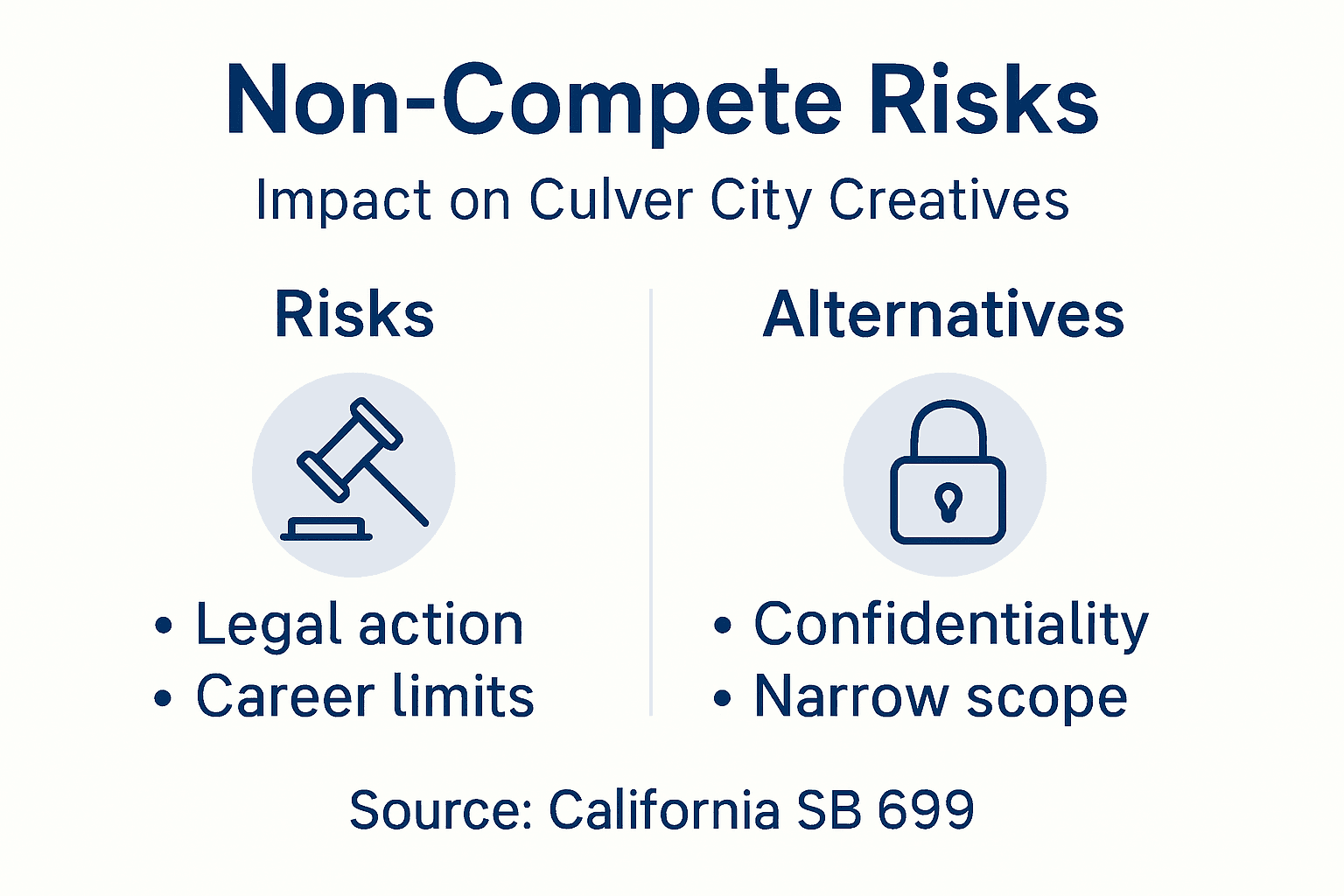
The following table summarizes practical alternatives to non-compete agreements for protecting business interests:
| Alternative Approach | Primary Goal | Business Benefit |
|---|---|---|
| Confidentiality Agreement | Protect secret information | Safeguards sensitive materials |
| Non-solicitation Clause | Limit direct client hiring | Preserves customer relationships |
| IP Assignment Provision | Secure intellectual property | Retains ownership of creations |
| Retention-based Pay | Incentivize employee loyalty | Reduces turnover risk |
Strategic Protective Alternatives:
- Implement robust confidentiality agreements
- Develop narrow, specific non-solicitation clauses
- Create intellectual property protection strategies
- Design compensation structures that incentivize retention
Pro tip: Consult with an employment law specialist to design legally compliant protection strategies that balance business needs with employee mobility rights.
Protect Your Creative Career From Unlawful Non-Compete Restrictions in Culver City
Non-compete disputes create major challenges for creatives trying to build their careers in Culver City. If you face unfair limits on your job mobility or worry about unlawful non-compete agreements restricting your professional freedom, you are not alone. These restrictions can block your opportunities, undermine your earning potential, and cause serious stress in an ever-changing employment landscape.
Shirazi Law Office specializes in defending employees against non-compete violations and employment disputes in Culver City. Our team understands the complex protections under California law that safeguard your rights as a creative professional. We help you challenge unlawful agreements, negotiate fair terms, and protect your career. Do not wait until your future is compromised.
Explore our dedicated Culver City practice page and learn more about how we fight for clients facing Non-Compete Agreements issues. Take control of your professional path today by contacting us at Shirazi Law Office for a consultation. Protect your right to work freely and pursue the opportunities you deserve.
Frequently Asked Questions
What are non-compete clauses, and how do they affect creatives in Culver City?
Non-compete clauses are contractual agreements that restrict employees from working with competitors or starting similar businesses after leaving their job. In Culver City, these clauses are largely unenforceable, providing creatives with greater freedom to change jobs and pursue new opportunities.
What recent legislative changes affect non-compete agreements in California?
The recent enactment of Senate Bill 699 and Assembly Bill 1076 in January 2024 has reinforced California’s stance against non-compete agreements. These laws prohibit the enforcement of non-compete agreements, allowing employees to take legal action against employers who attempt to impose such restrictions.
What protections do employees have under the new California laws regarding non-compete agreements?
Employees now have the right to sue employers who attempt to enforce non-compete clauses, recover damages, and be compensated for attorney’s fees. The agreements are presumed void, offering robust protections for employee mobility and professional growth.
Are there any exceptions to the non-compete ban in California?
Yes, while California prohibits non-compete clauses, there are narrow exceptions that include protecting genuine trade secrets, preventing disclosure of confidential information, and regulating direct solicitation of clients or employees during specific business sale agreements. However, these exceptions are strictly scrutinized by the courts.
Recommended
- Non-Compete Agreements in LA | LA Employment Lawyer
- Battles On Non-Compete Agreements in Century City
- Non-Compete Disputes: Impact on California Tech Careers
- Non-Compete Agreements: Executive Mobility in Century City
- Navigating Rule 7.2: A Guide to Ethical Attorney Advertising in California – Case Quota