

Facing a contract that limits where you can work after leaving your role is a reality for many executives in Century City’s entertainment and tech sectors. The stakes are high, as non-compete agreements can restrict professional growth and complicate career transitions. With California’s explicit prohibition on most non-compete agreements and recent 2024 laws expanding employee protections, understanding your legal rights is more important than ever for maintaining career flexibility and protecting your executive mobility.
Table of Contents
- Defining Non-Compete Agreements In California
- Types And Scope Of Restrictive Covenants
- Legislative Changes Shaping Executive Mobility
- Executive Rights And Employer Obligations
- Risks, Litigation Trends, And Common Pitfalls
- Legal Remedies And Strategies For Compliance
Key Takeaways
| Point | Details |
|---|---|
| Non-Compete Agreements in California | These agreements are largely unenforceable due to California’s stringent laws that prioritize employee mobility. |
| Recent Legislative Changes | New laws in 2024, including Senate Bill 699 and Assembly Bill 1076, enhance employee protections against non-compete agreements. |
| Legal Obligations for Employers | Employers must provide clear notifications regarding the invalidity of non-compete clauses and show legitimate business interests for any workforce restrictions. |
| Risks of Overly Restrictive Agreements | Poorly drafted non-compete clauses can lead to significant legal challenges and potential penalties for employers. |
Defining Non-Compete Agreements in California
Non-compete agreements represent legal contracts designed to restrict employees from working for competing businesses or launching rival enterprises after leaving their current employment. In California, these agreements face significant legal scrutiny and substantial limitations. California employment law has long maintained a stringent stance against non-compete clauses, viewing them as potential barriers to employee mobility and professional advancement.
The legal landscape for non-compete agreements in California fundamentally differs from many other states. California courts and legislators consistently prioritize workers’ rights to pursue professional opportunities without undue constraints. Specifically, California Business and Professions Code Section 16600 establishes a clear prohibition against agreements that restrain individuals from engaging in a lawful profession, trade, or business. This means most non-compete agreements are considered void and unenforceable from the outset.
Recent legislative developments have further solidified California’s employee-friendly approach. New laws enacted in 2024 such as Senate Bill 699 and Assembly Bill 1076 have expanded protections for employees. These statutes not only reinforce existing prohibitions but also impose penalties on employers who attempt to enforce or draft non-compete agreements. The laws apply retroactively and provide employees with robust legal mechanisms to challenge such restrictive contracts.
Pro tip: If you encounter a non-compete agreement in California, consult an employment attorney to understand your rights and potential legal recourse.
Types and Scope of Restrictive Covenants
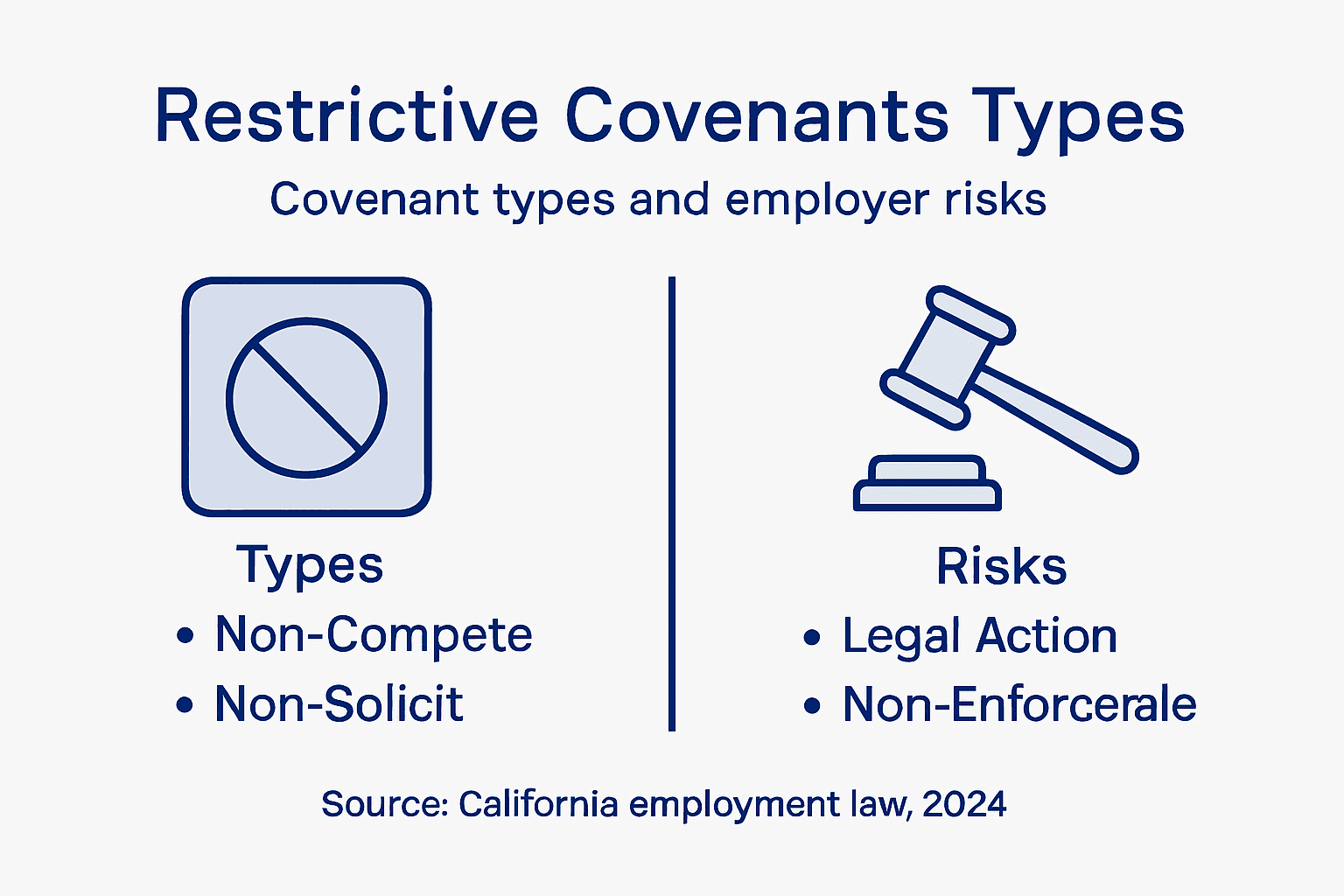
Restrictive covenants represent a complex set of legal agreements designed to protect employers’ business interests while potentially limiting employee mobility. Restrictive covenant types typically encompass three primary categories: noncompete agreements, nonsolicitation agreements, and nondisclosure agreements. Each covenant serves a distinct purpose in safeguarding organizational intellectual property and competitive positioning.
Noncompete agreements aim to prevent employees from working with direct competitors for a specified period after leaving their current employment. Nonsolicitation agreements specifically prohibit former employees from recruiting clients or other employees from their previous workplace. Nondisclosure agreements protect confidential information, trade secrets, and proprietary business methodologies. The enforceability of these covenants varies significantly across different jurisdictions, with states like California maintaining particularly strict limitations on such restrictive mechanisms.
Here’s a quick comparison of the main types of restrictive covenants:
| Type of Covenant | Primary Purpose | Typical Duration | Enforceability in California |
|---|---|---|---|
| Noncompete | Prevent working for competitors | 6-24 months | Mostly unenforceable |
| Nonsolicitation | Limit recruiting from former employer | 12-24 months | Often unenforceable |
| Nondisclosure | Protect confidential information | Indefinite or specified | Generally enforceable |
Employee covenant evaluations typically follow a “rule of reason” approach, where courts balance the legitimate business interests against potential harm to employee professional opportunities. Key considerations include the geographic scope of restrictions, duration of the covenant, and the specific subject matter being protected. Some states impose rigorous scrutiny on these agreements, requiring demonstrable evidence of legitimate business needs and reasonable constraints that do not unduly burden an employee’s ability to earn a living.
Pro tip: Always carefully review the specific language and terms of any restrictive covenant, and consider consulting an employment attorney to understand your rights and potential implications.
Legislative Changes Shaping Executive Mobility
The landscape of executive employment in California has undergone significant transformation with recent legislative developments that fundamentally reshape workplace mobility. California’s new noncompete laws in 2024 represent a landmark shift in protecting employee rights, particularly for executives seeking new professional opportunities. Assembly Bill 1076 and Senate Bill 699 have effectively dismantled traditional barriers that previously restricted professional movement across competitive industries.
These legislative changes introduce robust protections for executives by explicitly prohibiting noncompete agreements that historically limited job transitions. The new statutes not only invalidate existing noncompete clauses but also impose substantial penalties on employers who attempt to enforce such restrictive covenants. This legal framework fundamentally transforms the employment landscape by prioritizing individual professional mobility over employers’ attempts to restrict career advancement.
Nationwide enforcement mechanisms now enable executives to challenge noncompete agreements regardless of where they were originally executed. The laws require employers to proactively notify employees about the void status of any previously existing noncompete agreements, creating unprecedented transparency in employment relationships. These changes signal a profound shift towards protecting worker mobility and preventing unfair employment practices that have traditionally limited professional growth and opportunity.
Pro tip: Retain copies of all employment agreements and consult with an employment attorney to fully understand your rights under these new legislative changes.
Executive Rights and Employer Obligations
Executive employment relationships are fundamentally governed by a complex interplay of rights and responsibilities, with recent legislative developments significantly reshaping traditional power dynamics. Employer obligations now demand greater transparency and respect for employee mobility, particularly in California, where legal frameworks strongly protect workers’ professional autonomy. Employers must carefully navigate increasingly stringent regulations that limit their ability to restrict employee movement through noncompete agreements.
The legal landscape now requires employers to demonstrate substantial justification for any workforce restrictions. Legitimate business interests must be carefully balanced against an executive’s right to pursue professional opportunities. This means employers cannot arbitrarily impose blanket restrictions that prevent executives from utilizing their professional skills and expertise. Noncompete agreements that previously served as barriers to career advancement are now largely unenforceable, particularly in California, where state law provides robust protections for employee mobility.

Federal regulatory changes have further expanded executive rights by broadly defining worker protections and limiting employers’ ability to enforce restrictive covenants. The Federal Trade Commission’s 2024 rule represents a watershed moment in employment law, effectively invalidating most noncompete agreements and compelling employers to reassess their traditional approaches to talent retention. These regulations fundamentally reframe the relationship between employers and executives, prioritizing individual professional freedom over corporate control.
Pro tip: Carefully document all employment agreements and consult with an employment attorney to understand the full scope of your rights under current legal frameworks.
Risks, Litigation Trends, and Common Pitfalls
Non-compete agreement battles in Century City represent a complex legal landscape fraught with significant risks for both employers and executives. Litigation involving noncompete agreements frequently centers on the delicate balance between protecting legitimate business interests and preserving employee mobility. Employers face substantial challenges in crafting agreements that can withstand legal scrutiny, particularly in California’s notoriously employee-friendly legal environment.
The risks for employers are multifaceted and potentially devastating. Attempting to enforce overly broad noncompete clauses can result in significant financial penalties, potential injunctions, and substantial reputational damage. Common pitfalls include drafting agreements with unreasonable geographic or temporal restrictions, failing to demonstrate genuine business protection needs, and implementing contracts that directly contradict state and federal regulations. These missteps can expose companies to potential private rights of action and substantial legal challenges.
The following table summarizes common pitfalls in drafting noncompete agreements and their consequences:
| Common Mistake | Legal Risk | Potential Consequence |
|---|---|---|
| Overly broad restrictions | Violation of state laws | Risk of contract voidance |
| Lack of clear justification | Fails business interest test | Damages and legal fees |
| Ignoring recent legislation | Noncompliance penalties | Fines and reputational harm |
| Poor documentation | Difficult enforcement | Loss of protection |
Recent legal challenges have dramatically transformed the litigation landscape, with courts and regulatory bodies increasingly skeptical of noncompete agreements. The 2024 Federal Trade Commission rule and expanded state laws have created a regulatory environment that heavily favors employee mobility. Litigation trends now show a pronounced uptick in cases challenging noncompete agreements, with courts more likely to invalidate contracts that impose unfair restraints on workers’ professional opportunities.
Pro tip: Consult an employment attorney before drafting or attempting to enforce any noncompete agreement to ensure compliance with current legal standards.
Legal Remedies and Strategies for Compliance
Employers in Century City face increasingly complex legal requirements when addressing non-compete agreements. California noncompete laws provide specific remedies designed to protect employee mobility and prevent unfair restrictive practices. The legal framework now empowers employees with robust mechanisms to challenge overly restrictive employment contracts, including provisions for injunctive relief, potential damages, and recovery of attorneys’ fees.
Strategic compliance demands a comprehensive approach that goes beyond simply eliminating existing noncompete clauses. Employers must proactively develop alternative protective measures that safeguard legitimate business interests without impeding employee career progression. This typically involves crafting narrowly tailored nondisclosure agreements, implementing robust confidentiality protocols, and designing strategic employment contracts that respect worker mobility while protecting critical organizational knowledge.
Compliance strategies now require employers to provide explicit written notifications to current and former employees about the invalidity of any previously existing noncompete agreements. The legal landscape demands proactive communication, careful documentation, and a nuanced understanding of evolving regulatory requirements. Employers must continuously monitor legislative developments and adapt their employment practices to maintain legal compliance and minimize potential litigation risks.
Pro tip: Regularly audit your employment agreements with legal counsel to ensure ongoing compliance with the latest California noncompete regulations.
Protect Your Professional Future in Century City with Expert Legal Support
Facing challenges with non-compete agreements in Century City can feel overwhelming and unfair. These restrictive covenants often threaten your career growth and professional freedom by limiting opportunities in your field. If you are an executive, senior manager, or employee navigating these complex agreements, understanding your rights and employer obligations is essential to safeguard your future.
At Shirazi Law Office, we specialize in helping clients confront these issues head-on. Our dedicated team offers strategic representation tailored to the unique challenges in Century City and surrounding areas. Whether you need guidance on restrictive covenants or personalized support in executive employment matters, our expertise in Non-Compete Agreements and Senior Management Representation ensures you are armed with the strongest possible legal protections.
Do not wait until a non-compete contract jeopardizes your career. Visit Shirazi Law Office today to learn how we can help you assert your rights and pursue your professional goals with confidence. Take the first step toward reclaiming your career freedom now.
Frequently Asked Questions
What is a non-compete agreement?
A non-compete agreement is a legal contract that restricts an employee from working for competing businesses or starting a rival business after leaving their current job.
Are non-compete agreements enforceable in California?
Most non-compete agreements are generally unenforceable in California due to strong legal protections for employee mobility as outlined by the California Business and Professions Code Section 16600.
What recent legislative changes have affected non-compete agreements?
In 2024, new laws such as Assembly Bill 1076 and Senate Bill 699 were enacted, strengthening employee protections and imposing penalties on employers who attempt to enforce non-compete agreements.
What should I do if I’m presented with a non-compete agreement?
If you are presented with a non-compete agreement, it’s advisable to consult an employment attorney to understand your rights and explore potential legal recourse.





[…] Battles On Non-Compete Agreements in Century City […]
[…] professionals working in non-compete battles in Century City, these protections prove particularly valuable. The concentration of entertainment businesses in […]