

California retail workers filed over 2,400 wage and hour class action lawsuits in 2025 alone, with Mid-Wilshire employees leading the charge against major chains. If you’ve worked unpaid overtime, missed breaks, or received inaccurate pay stubs, you’re not alone. This guide explains how class actions empower you to recover wages collectively, recognize common violations, and take action against employers who exploit systemic loopholes.
Table of Contents
- Overview Of California Wage And Hour Laws For Retail Workers
- Common Wage And Hour Violations By Large Retail Chains In Mid-Wilshire
- Wage And Hour Class Actions In The California Retail Sector
- Recent Case Studies Of Successful Mid-Wilshire Retail Wage Class Actions
- Practical Guidance On Evidence Collection And Legal Counsel
- How We Can Help With Your Wage And Hour Class Action
- What Is A Wage And Hour Class Action Lawsuit?
Key takeaways
| Point | Details |
|---|---|
| California law mandates meal and rest breaks | Retail workers must receive a 30-minute meal break for shifts over five hours and a 10-minute rest break every four hours. |
| Large retail chains frequently violate wage laws | Off-the-clock work, employee misclassification, and inaccurate wage statements are common issues in Mid-Wilshire. |
| Class actions reduce costs and increase recovery | Joining a class action lowers your legal expenses by approximately 60% and strengthens bargaining power. |
| Legal representation improves outcomes significantly | Hiring experienced counsel correlates with 70% higher settlement amounts in wage and hour disputes. |
| Evidence collection is essential for success | Keep detailed logs of hours worked, breaks missed, and copies of all wage statements to support your claim. |
Overview of California wage and hour laws for retail workers
California’s wage and hour laws create clear protections for retail employees, yet many workers remain unaware of their rights. Understanding these foundational rules helps you identify when your employer crosses legal lines.
Wage and overtime laws require employers to provide an uninterrupted 30-minute meal break for any shift exceeding five hours. If your shift runs longer than ten hours, you’re entitled to a second meal break. Rest breaks follow a similar pattern: you must receive a paid 10-minute break for every four hours worked or major fraction thereof.
Retail workers also have the right to receive accurate itemized wage statements with each paycheck. These statements must detail total hours worked, pay rates, gross and net wages, and all deductions. Missing or incorrect information violates California Labor Code Section 226.
Overtime pay kicks in when you work more than eight hours in a single day or over 40 hours in a week. The rate increases to 1.5 times your regular pay for these hours, and doubles for any hours beyond 12 in one day. Here are the core protections every retail worker should know:
- Meal breaks of 30 minutes for shifts over five hours
- Rest breaks of 10 minutes every four hours worked
- Accurate wage statements showing all hours and deductions
- Overtime pay at 1.5x for hours over 8 per day or 40 per week
- Double time pay for hours exceeding 12 in a single day
These laws form the backbone of fair treatment in California retail. When employers ignore them, you have legal options. Issues like pregnancy discrimination and sexual harassment also intersect with wage violations, creating compounding workplace problems that demand attention.
Common wage and hour violations by large retail chains in Mid-Wilshire
Mid-Wilshire’s retail landscape features major chains that serve thousands of customers daily, yet these same employers frequently cut corners on employee pay. Recognizing these patterns helps you spot violations in your own workplace.
Working off the clock ranks among the most widespread abuses. Managers pressure employees to arrive early to set up displays or stay late to close registers without clocking in. Every minute of this unpaid time adds up, and off-the-clock work violates California labor standards.

Misclassification represents another major problem. Retailers label workers as independent contractors to avoid paying overtime, benefits, and payroll taxes. If your employer controls your schedule, provides equipment, and directs your daily tasks, you’re likely an employee, not a contractor. Employee misclassification denies you critical protections and wages.
Inaccurate wage statements hide true hours worked and create confusion about actual pay. When statements omit break times, round down hours, or fail to list overtime separately, you can’t verify if you received fair compensation. This opacity benefits employers while leaving you in the dark.
Missed or interrupted meal and rest breaks are routine in fast-paced retail environments. Managers call you back from breaks to help customers or handle registers, cutting your legally protected rest time. Each violation entitles you to one hour of pay at your regular rate. Common violations include:
- Requiring work before or after scheduled shifts without pay
- Labeling employees as contractors to dodge overtime obligations
- Providing incomplete or misleading wage statements
- Interrupting or denying required meal and rest breaks
- Rounding down hours worked to reduce payroll costs
Pro Tip: Keep a personal log of your actual clock-in and clock-out times, along with notes on any missed or interrupted breaks. Compare these records to your official wage statements monthly to catch discrepancies early.
Wage and hour class actions in the California retail sector
Class action lawsuits transform individual grievances into collective power, allowing employees facing similar violations to sue as a unified group. This approach reshapes the legal landscape for retail workers battling systemic wage theft.
When you join a class action, you share legal costs with dozens or hundreds of coworkers experiencing identical issues. Class actions reduce costs by approximately 60% per plaintiff compared to solo lawsuits. Pooling resources makes hiring top employment attorneys financially viable for workers who couldn’t afford representation alone.
Class actions also create stronger bargaining leverage. A single employee suing a multibillion-dollar retailer faces steep odds, but a group of 200 workers with documented violations commands serious attention. Employers recognize the reputational and financial risks of losing a large class action, motivating quicker and more generous settlements.
Successful class actions often recover millions in unpaid wages and deter future violations through court-ordered workplace reforms. These cases set legal precedents that benefit all retail workers, not just class members. Here’s how class actions stack up against individual lawsuits:
| Comparison Factor | Class Action | Individual Lawsuit |
|---|---|---|
| Legal costs per person | Low (shared across group) | High (borne alone) |
| Settlement amounts | Often larger due to collective claims | Typically smaller |
| Case duration | 12-24 months average | 18-36 months average |
| Employer response | Serious settlement negotiations | May contest aggressively |
| Impact on workplace practices | Systemic reforms ordered | Limited to individual remedy |
Joining a class action maximizes your claim’s impact while minimizing out-of-pocket expenses. You maintain the right to opt out if you prefer to sue independently, but most employees benefit from collective action. Steps to participate include:
- Identify violations you’ve experienced that match the class action’s claims
- Gather evidence like wage statements, schedules, and break logs
- Contact the attorneys representing the class to confirm eligibility
- Complete required paperwork to officially join the lawsuit
- Cooperate with discovery requests and attend hearings if needed
Pro Tip: You don’t need to be a perfect employee to join a class action. Even if you were disciplined or terminated, wage violations still entitle you to recovery.
Class actions level the playing field, giving wage and hour dispute victims the resources to challenge powerful employers. They prove that collective action works when individual efforts fall short. Whether you’re fighting overtime violations or pursuing claims in Beverly Hills, the class action model offers a proven path to justice.
Recent case studies of successful Mid-Wilshire retail wage class actions
Real cases demonstrate how Mid-Wilshire retail employees have used class actions to recover substantial unpaid wages and force workplace improvements. These examples show what’s possible when workers unite against violations.
Mid-Wilshire employees recovered $3.5 million in unpaid wages from class actions against Target and Walmart between 2022 and 2025. These lawsuits addressed off-the-clock work, missed breaks, and inaccurate wage statements affecting hundreds of workers across multiple Los Angeles locations.
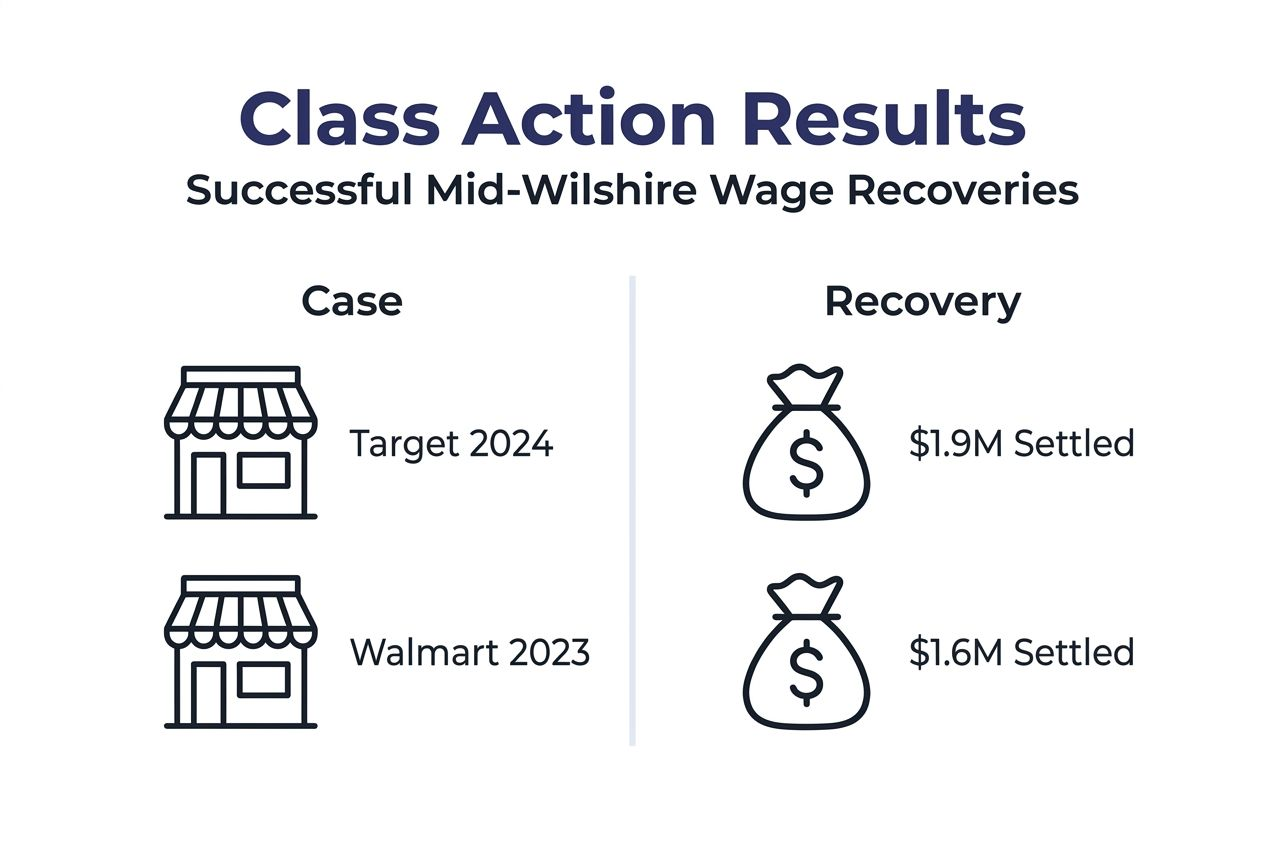
The Target case involved 340 employees who worked unpaid pre-shift setup and post-shift closing tasks. The settlement included back pay for missed breaks and reforms requiring accurate time tracking. Walmart faced similar claims from 280 workers denied proper meal breaks during peak shopping seasons. Both cases set important precedents for retail accountability.
Another notable action targeted a major apparel retailer for misclassifying sales associates as independent contractors. The 150-member class recovered overtime pay, benefits, and penalties totaling $1.8 million. The court ordered the company to reclassify all similar positions as employees going forward.
| Case Name | Year | Estimated Recovery | Employees Impacted | Key Violations |
|---|---|---|---|---|
| Target Off-Clock Class Action | 2023-2024 | $2.1 million | 340 | Unpaid pre/post-shift work, missed breaks |
| Walmart Break Denial Settlement | 2022-2023 | $1.4 million | 280 | Interrupted meal breaks, inaccurate statements |
| Apparel Retailer Misclassification | 2024-2025 | $1.8 million | 150 | Independent contractor fraud, unpaid overtime |
These victories highlight the power of class actions to recover wages and reform workplace practices. They also demonstrate that Mid-Wilshire employment lawyers can effectively challenge even the largest retail corporations.
Successful cases share common elements: strong documentation, clear violation patterns, and experienced legal representation. Workers who kept personal records and reported issues early strengthened their claims significantly. The Los Angeles court system has shown increasing willingness to hold retailers accountable for systemic wage theft.
These outcomes inspire confidence that justice is achievable. Whether you’re confronting gender discrimination or wage violations, these cases prove that collective action delivers results.
Practical guidance on evidence collection and legal counsel
Building a strong wage and hour class action starts with solid evidence and expert legal guidance. Taking these practical steps now protects your rights and strengthens your potential claim.
Keep detailed personal logs of every shift you work. Record your actual start and end times, including any work performed before clocking in or after clocking out. Note when you took meal breaks, how long they lasted, and if anyone interrupted them. This documentation becomes critical when your official records conflict with reality.
Save copies of every wage statement and pay stub you receive. Create both digital and physical backups stored in a safe place your employer can’t access. These documents prove what your employer reported versus what you actually worked. Compare them monthly to your personal logs to spot patterns of underpayment.
Identify specific violations before approaching an attorney. Did your employer deny breaks? Require off-the-clock work? Misclassify your position? Pay incorrect overtime rates? Provide incomplete wage statements? Clear examples help lawyers assess your case quickly and accurately.
Consult an experienced employment law attorney who specializes in wage and hour disputes as soon as you suspect violations. Legal representation correlates with 70% higher settlement amounts in wage and hour class actions. Attorneys evaluate whether your situation fits an existing class action or warrants a new lawsuit. Steps to take include:
- Document every shift with precise start, end, and break times in a personal log
- Collect and securely store all wage statements and pay stubs
- Photograph your schedule, timecards, and any relevant workplace notices
- Identify coworkers experiencing similar violations who might join your claim
- Schedule a confidential consultation with a wage and hour attorney
- Provide your documentation and describe violation patterns clearly
- Follow your attorney’s guidance on next steps and evidence preservation
Pro Tip: Start documenting immediately, even before consulting an attorney. The longer you wait, the harder it becomes to reconstruct accurate records of hours worked and breaks missed.
Attorneys who handle class actions work on contingency, meaning you pay nothing unless you win. This arrangement removes financial barriers and aligns your lawyer’s interests with maximizing your recovery. Experienced counsel navigates complex class certification procedures, coordinates with other class members, and negotiates settlements that reflect the full value of your claims.
Don’t let fear of retaliation stop you from documenting violations or seeking legal help. California law prohibits employers from punishing workers who assert their wage and hour rights. If you face discipline or termination after raising concerns, you may have additional retaliation claims that strengthen your overall case.
Whether you’re dealing with misclassification issues or other wage violations, thorough evidence collection and early legal consultation dramatically improve your chances of success. The National Law Journal research confirms that represented plaintiffs consistently achieve better outcomes, making professional guidance an essential investment in your financial recovery.
How we can help with your wage and hour class action
If you’re a Mid-Wilshire retail employee facing wage violations, professional legal support can make the difference between recovering what you’re owed and walking away empty-handed. Our firm specializes in wage and hour disputes throughout Los Angeles, with deep experience in class action representation.
We help you assess whether your situation qualifies for an existing class action or warrants new legal action. Our team gathers evidence, coordinates with other affected employees, and builds compelling cases that hold large retailers accountable. We handle every aspect of the legal process so you can focus on your life and work.
Contact our Los Angeles employment lawyers for a confidential consultation to discuss your wage and hour concerns. We’ll review your documentation, explain your legal options, and outline realistic timelines and outcomes. Early contact improves your chances of timely resolution and higher recoveries.
Pro Tip: Don’t wait until you’ve left your job to pursue a claim. Current employees have the same rights as former workers, and acting sooner preserves evidence and strengthens your case.
Our services include comprehensive case evaluation, class action coordination, settlement negotiation, and trial representation when necessary. We stay current on evolving employee rights and 2026 discrimination laws to provide the most effective advocacy possible. Reach out today to protect your rights and recover the wages you’ve earned.
What is a wage and hour class action lawsuit?
A wage and hour class action is a lawsuit where multiple employees with similar wage violation claims sue their employer collectively. This legal mechanism allows workers to pool resources, share costs, and pursue justice as a unified group rather than fighting alone. Class actions streamline cases involving widespread violations and significantly improve both bargaining power and recovery chances for individual workers.
How can I tell if I qualify to join a wage and hour class action?
You generally qualify if you worked for the employer during the disputed time period and experienced wage violations similar to those alleged in the class action. Common qualifying factors include missed breaks, off-the-clock work, or misclassification affecting multiple employees. Consult an employment attorney to confirm your eligibility based on your specific work history and the nature of the wage issues you experienced.
What types of wage violations are most common in Mid-Wilshire retail?
Mid-Wilshire retail workers most frequently face off-the-clock work requirements, missed or interrupted meal and rest breaks, employee misclassification as independent contractors, and inaccurate wage statements that obscure true hours worked. These violations result in unpaid wages and systematic labor law breaches that affect dozens or hundreds of employees at single retail locations.
Why should I consider joining a class action instead of suing alone?
Class actions reduce your individual legal costs by sharing expenses across all participants, typically lowering your personal financial burden by about 60% compared to solo lawsuits. They also increase potential settlement amounts by combining many similar claims into one powerful case. Class actions hold large employers accountable more effectively than individual suits, creating both immediate financial recovery and long-term workplace improvements that benefit all employees.