

Feeling singled out because of your race, gender, or age can quickly make even the most prestigious Mid-Wilshire office feel overwhelming. In California, a hostile work environment occurs when unwelcome conduct based on protected characteristics becomes so severe or pervasive that it creates a truly intimidating or offensive atmosphere. Understanding this definition is the crucial first step if you need to protect your rights or seek legal recourse against persistent harassment or discrimination at work.
Table of Contents
- Defining Hostile Work Environment In California
- Types Of Unlawful Conduct And Examples
- Legal Standards For Proving A Claim
- Employee Rights And Employer Responsibilities
- Steps To Take If Experiencing Harassment
Key Takeaways
| Point | Details |
|---|---|
| Definition of Hostile Work Environment | A hostile work environment in California arises from unwelcome conduct based on protected characteristics that creates an intimidating atmosphere affecting employment conditions. |
| Legal Standards | To prove a claim, three core elements must be established: unwelcome conduct, based on a protected characteristic, and severity or pervasiveness affecting the work environment. |
| Documentation Importance | Keeping detailed records of incidents, including dates and impacts, is crucial for substantiating claims and ensuring employer accountability. |
| Employee Rights & Responsibilities | Employees have the right to a harassment-free workplace and can report incidents without fear of retaliation, while employers must have anti-harassment policies and take prompt corrective action. |
Defining Hostile Work Environment in California
In California, understanding what legally constitutes a hostile work environment is the foundation of any claim seeking to hold an employer accountable. A hostile work environment occurs when unwelcome conduct based on protected characteristics becomes severe or pervasive enough to create an intimidating, hostile, or offensive atmosphere that substantially alters the terms and conditions of employment. This isn’t simply about being unhappy at work or having a difficult supervisor. The law recognizes a meaningful distinction between ordinary workplace friction and conduct that crosses into illegal territory.
California’s framework requires courts and administrative bodies to assess hostile work environment claims using a two-part analysis. First, they apply an objective standard: would a reasonable person in your position find the conduct hostile? Second, they apply a subjective standard: did you actually perceive the conduct as hostile? Both must be satisfied. The unwelcome conduct must be based on protected characteristics such as race, gender, age, religion, sexual orientation, disability, or gender identity under California’s Fair Employment and Housing Act (FEHA). Occasional offhand comments or minor annoyances don’t meet the threshold. The conduct must be more than trivial and must meaningfully interfere with your work performance or psychological well-being.
For professionals and executives in Mid-Wilshire medical offices and professional settings, this means recognizing that hostile conduct can take many forms: persistent demeaning comments about your background, exclusion from client opportunities based on a protected characteristic, unwanted physical contact, repeated jokes targeting your identity, or a pattern of undermining your authority based on gender or age. A single incident, no matter how severe, may constitute harassment, while a pattern of lesser incidents combined together may establish a hostile environment. What matters legally is whether the cumulative effect substantially altered your working conditions. Employers have an obligation to maintain an anti-harassment workplace and to respond promptly and effectively when complaints are raised.
Pro tip: Document specific instances of hostile conduct with dates, times, locations, who was present, and what was said or done. Keep this record separate from work materials, and note how each incident affected your work performance or emotional well-being, as this evidence becomes crucial when establishing whether the environment was objectively and subjectively hostile.
Types of Unlawful Conduct and Examples
Unlawful conduct that creates a hostile work environment takes many forms, and understanding the specific behaviors that cross the legal line helps you recognize when a situation has become actionable. The conduct must be based on a protected characteristic—your race, gender, age, religion, sexual orientation, disability, or gender identity. What distinguishes illegal harassment from everyday workplace stress is that harassment must be severe or pervasive enough to substantially alter your working conditions. This means isolated incidents may not qualify, but patterns of behavior or a single egregious act often will.
Common types of unlawful conduct include racial harassment such as slurs, mocking accents, or stereotypical comments about your background. Sexual harassment encompasses unwelcome advances, repeated requests for dates despite being declined, inappropriate touching, sexual jokes directed at you, or comments about your body or appearance. Religious harassment involves derogatory remarks about your faith, pressure to participate in religious activities, or mocking your religious practices. Age and disability harassment can range from comments like “you’re too old for this role” to excluding you from opportunities because of your age or disability status, or failing to provide reasonable accommodations. In professional office environments like those in Mid-Wilshire, you might experience exclusion from important meetings or client relationships based on gender, being talked over or having your ideas dismissed because of your age, or being passed over for promotions despite strong performance because of your protected status.
It’s important to recognize that employers can be held liable even when harassment originates from co-workers or third parties if they fail to investigate complaints promptly, take corrective action, or allow the behavior to continue unchecked. A single severe incident—such as a racial slur from a supervisor or unwanted physical contact—can establish a hostile environment immediately. A pattern of lesser incidents over time, such as consistent belittling remarks or systematic exclusion, can also meet the legal threshold when their cumulative effect substantially alters your work experience. The key is documenting what happened, understanding whether it’s based on a protected characteristic, and recognizing whether a reasonable person would find it offensive or hostile.
Pro tip: Keep detailed records of each incident including the date, time, location, exact words or actions, who witnessed it, and how it affected your work or emotional state, as this documentation becomes essential evidence if you need to file a formal complaint or pursue legal action.
Legal Standards for Proving a Claim
Proving a hostile work environment claim in California requires meeting specific legal standards that courts apply consistently. You must demonstrate three core elements: the conduct was unwelcome, it was based on a protected characteristic, and it was severe or pervasive enough to create an intimidating, hostile, or offensive work environment. This isn’t a subjective threshold where your personal discomfort alone determines the outcome. Courts apply what’s called the “totality of circumstances” test, meaning they examine the full context of what happened rather than judging isolated events in a vacuum. To establish liability, employers must have known or should have known about the harassment and failed to take immediate corrective action to stop it.

The severity and pervasiveness analysis works like this: conduct can be either severe enough that a single incident crosses the line, or pervasive enough that a pattern of behavior meets the threshold. A severe incident might include a racial slur from a supervisor, unwanted physical contact of a sexual nature, or a threat based on your protected status. Pervasive conduct involves repeated, ongoing behavior that accumulates over time—like consistent age-based jokes, systematic exclusion from client meetings based on gender, or persistent undermining of your authority because of your disability status. Courts consider factors like the frequency of the conduct, how long it occurred, whether it was physically threatening or humiliating, and whether it targeted you because of a protected characteristic. For professionals in Mid-Wilshire medical offices and legal practices, this might mean comparing whether comments about your age happened once or regularly, whether exclusion from key client relationships was isolated or systematic, or whether performance evaluations consistently undervalued your work while praising similarly situated colleagues of a different protected status.
Here’s a quick comparison of severe versus pervasive conduct in hostile work environment claims:
| Legal Standard | Severe Conduct | Pervasive Conduct |
|---|---|---|
| Definition | Single egregious incident | Repeated ongoing behavior |
| Typical Examples | Racial slur from a supervisor | Regular age-based jokes |
| Legal Impact | May establish liability immediately | Liability built from cumulative effect |
| Evidence Needed | Detailed report of incident | Comprehensive log of multiple events |
Employer liability hinges on what they knew and when they knew it. Your employer cannot claim ignorance if you reported the harassment through proper channels. They have an affirmative obligation to investigate complaints promptly, take corrective measures to stop the behavior, and prevent retaliation. If they fail to act despite knowledge of the problem, they’re liable. This is where documentation becomes critical—your records showing what you reported to whom and when establish that the employer had notice of the problem.
Pro tip: When reporting harassment to your employer, use their formal complaint procedures in writing (email is ideal), describe the incidents specifically, state the protected characteristic involved, and request a written acknowledgment of your complaint to create an undeniable record of employer notice.
Employee Rights and Employer Responsibilities
Your rights as an employee in California are substantial and legally protected. You have the fundamental right to work in an environment free from harassment and discrimination based on protected characteristics. This right isn’t aspirational or conditional—it’s a legal entitlement backed by California’s Fair Employment and Housing Act. Beyond the right to a safe workplace, you also have the right to report harassment without fear of retaliation, to have your complaints investigated promptly and thoroughly, and to seek remedies through administrative agencies or the courts if your employer fails to address the problem. When you experience a hostile work environment, California law recognizes that you deserve compensation for the harm caused, including lost wages if you had to leave your job, emotional distress, and in some cases, punitive damages to punish egregious employer conduct.
Employers carry substantial responsibilities that are equally clear under the law. Your employer must adopt and maintain written anti-harassment policies that define prohibited conduct, explain reporting procedures, and outline the consequences for violations. Employers must take immediate and appropriate action to prevent and correct workplace harassment through training, investigation, and corrective measures. If you report harassment through proper channels and your employer ignores it, delays investigating, or takes inadequate corrective steps, they become liable. Your employer cannot simply claim ignorance about problems in their workplace. They have an affirmative duty to create a workplace culture where harassment is not tolerated, which means training supervisors and employees, establishing clear reporting mechanisms, and following up on complaints. For professional offices in Mid-Wilshire, this means your practice must have documented policies in place, supervisors must understand their reporting obligations, and when you come forward with concerns about age discrimination in client assignments or gender bias in case allocation, the practice must respond with genuine investigation and remedial action.
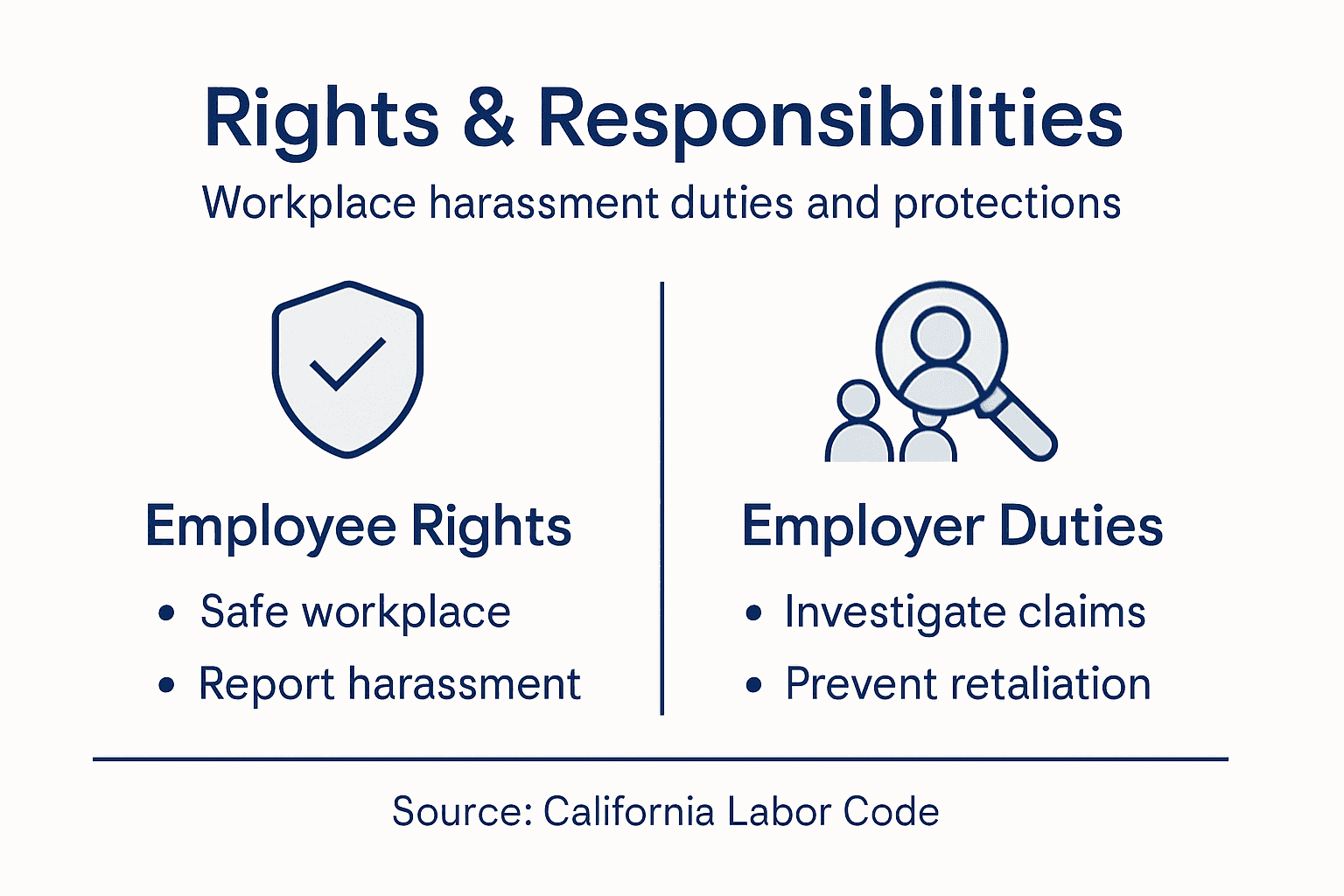
For reference, these are key employee rights and employer responsibilities in California:
| Employee Right | Employer Responsibility | Impact on Workplace |
|---|---|---|
| Work free from harassment | Have anti-harassment policies | Promotes respectful environment |
| Report without retaliation | Investigate complaints promptly | Builds trust in complaint process |
| Seek remedies if ignored | Prevent and stop harassment | Reduces liability risk |
| Protection under FEHA | Provide supervisor training | Ensures legal compliance |
Employees are encouraged to report harassment internally or to relevant state or federal agencies like the California Labor Commissioner or the EEOC. Your employer cannot retaliate against you for making a report in good faith, even if the investigation doesn’t substantiate every allegation. Retaliation—whether through discipline, demotion, reduced hours, or termination—is itself illegal. An employer’s defense to a hostile work environment claim hinges on whether they can show they took reasonable preventative steps and whether you unreasonably failed to use available remedial procedures. This means your documentation of reporting efforts becomes critical evidence. If you reported the problem and your employer did nothing, you’ve strengthened your claim significantly.
Pro tip: Know your employer’s anti-harassment policy inside and out, follow the reporting procedures exactly as written, and keep copies of all documentation showing you’ve complied with internal complaint processes, as this creates a clear record of employer notice and your good faith efforts to resolve the matter internally.
Steps to Take if Experiencing Harassment
When you’re experiencing harassment at work, your immediate instinct might be to ignore it and hope it stops. Stop. That approach rarely works. Instead, take deliberate action that protects you legally and creates a documented record of the problem. Your first step is to clearly communicate that the conduct is unwelcome. If you feel safe doing so, tell the person directly that their behavior is inappropriate and must stop. Use clear language: “Your comments about my age are offensive and inappropriate. I need you to stop.” This direct approach sometimes ends the problem immediately, and it also establishes that you found the conduct unwelcome, which is a required element of any future claim. Document this conversation including when it occurred and what you said.
Your next critical step is documenting all incidents carefully with dates, times, locations, who was present, and exactly what happened. Keep this record in a secure location outside of work, not in shared drives or company systems. Write down the impact on you: did the conduct affect your work performance, cause you emotional distress, or make you consider leaving? This documentation becomes invaluable evidence if you eventually need to file a complaint. Then, report the behavior according to your company’s policies to a supervisor, manager, human resources representative, or designated official. Use written communication whenever possible. Email your report so you have proof of when you reported the problem and what you reported. Be specific and concise: describe which incidents occurred, when they happened, the protected characteristic involved, how the conduct affected you, and what remedial action you’re requesting. Ask for acknowledgment of receipt and for a timeline for investigation.
If your employer fails to investigate promptly, takes inadequate corrective action, or retaliates against you for reporting, you have the right to file a charge with the California Labor Commissioner or the Equal Employment Opportunity Commission. Most administrative agencies require you to file within specific timeframes, often 180 to 300 days depending on the jurisdiction. For professionals in Mid-Wilshire offices facing age bias in client assignments, gender discrimination in case work, or other protected characteristic harassment, this external filing option protects your rights when internal processes fail. Throughout this process, remain professional and avoid retaliation of your own, as this strengthens your position and protects your credibility if your claim proceeds.
Pro tip: Create a detailed harassment log stored securely outside work containing dates, times, locations, witnesses, exact words or actions, and the impact on you, then follow your company’s reporting procedures in writing via email to create an undeniable record of your complaint and employer notice.
Protect Your Rights Against Hostile Work Environments in Mid-Wilshire
Facing unwelcome conduct that alters your work conditions based on your protected characteristics can be overwhelming and isolating. If you are dealing with persistent discrimination or harassment that impacts your job performance and emotional well-being, you do not have to navigate this challenge alone. Understanding your legal protections under California law and the critical importance of documenting and reporting such behavior is the first step toward reclaiming control.
At Shirazi Law Office, we specialize in fighting hostile work environment claims specifically within the Mid-Wilshire professional community. Our team is dedicated to helping employees, executives, and senior management secure justice and hold employers accountable for unlawful treatment. Learn more about how we approach these complex cases by visiting our Hostile Work Environment and Mid-Wilshire practice areas.
If you are experiencing harassment or discrimination that affects your career and peace of mind, act now to protect your rights. Contact Shirazi Law Office at https://www.shirazilawoffice.com/ for a confidential consultation and strategic legal guidance tailored to your situation. Your workplace should be safe and respectful. Let us help you make it so.
Frequently Asked Questions
What constitutes a hostile work environment in Mid-Wilshire offices?
A hostile work environment arises when unwelcome conduct based on protected characteristics is severe or pervasive enough to create an intimidating, offensive atmosphere that significantly alters employment conditions.
How can I prove that I am experiencing a hostile work environment?
To prove a claim, you must demonstrate that the conduct was unwelcome, based on a protected characteristic, and severe or pervasive enough to make the work environment hostile. Collect detailed documentation of each incident to strengthen your case.
What should I do if I encounter harassment at work?
You should first communicate that the conduct is unwelcome if it’s safe to do so, then document all incidents meticulously, and report the behavior according to your company’s procedures in writing to create an official record.
What are my rights as an employee regarding harassment in the workplace?
As an employee, you have the right to work in an environment free from harassment based on protected characteristics, to report harassment without fear of retaliation, and to seek remedies if your complaints are not addressed adequately.





[…] Hostile Work Environment Claims: Impact on Mid-Wilshire Offices […]
[…] Hostile Work Environment Claims in Mid-Wilshire Offices – Law Office of Brian Y. Shirazi, PC […]