

When Scarlett Johansson secured a $179 million arbitration award against Disney over streaming release terms, she illuminated a reality many Hollywood executives face: major studios often interpret contracts in ways that maximize their profits while minimizing yours. From equity cancellations to bad faith development deals, employment lawyer in Hollywood cases reveal a pattern of sophisticated contract manipulation. Understanding the legal landscape, your rights under California employment law, and strategic dispute resolution options empowers you to protect your career and financial interests when conflicts arise with powerful entertainment corporations.
Table of Contents
- Common Legal Issues In Hollywood Executive Contract Disputes
- Strategic Legal Representation For Executives In Contract Disputes
- Navigating Contract Terms And Employee Rights In Hollywood Disputes
- Resolving Disputes: Arbitration, Litigation, And Negotiation Tactics
- Explore Expert Employment Law Support
- Frequently Asked Questions About Hollywood Executive Contract Disputes
Key takeaways
| Point | Details |
|---|---|
| Common disputes | Executive conflicts typically involve breach of employment agreements, equity cancellation, and fiduciary duty violations. |
| Specialized counsel | Entertainment litigators from firms like Bird Marella and O’Melveny provide strategic advantages in complex studio disputes. |
| Contract precision | Precise definitions of theatrical, gross, and exclusivity terms prevent studio exploitation of ambiguous language. |
| Resolution methods | Arbitration offers privacy and speed but limits discovery compared to litigation’s broader evidence gathering. |
| California protections | State employment law provides strong anti-discrimination and wage protections, though union agreements may affect individual claims. |
Common legal issues in Hollywood executive contract disputes
Hollywood executive contract disputes with major studios typically center on several recurring legal claims. Breach of employment agreements, equity cancellation, fiduciary duty violations, and failure to develop projects in good faith represent the most frequent conflict points. These disputes often emerge when studios reinterpret contract terms after circumstances change, or when promised equity suddenly disappears following corporate restructuring.
The CAA versus Range Media Partners case exemplifies how equity conflicts escalate into $40 million disputes. When senior executives leave to form competing ventures, studios frequently claim breach of fiduciary duty or misappropriation of confidential information. These allegations serve dual purposes: recovering financial damages and deterring other executives from similar departures. Understanding this tactical dimension helps you anticipate studio responses when contract tensions surface.
Bad faith development claims trace back to landmark precedents like Locke v. Warner Brothers, where courts established that studios cannot create sham development deals merely to satisfy contractual obligations. While courts generally defer to studios’ creative discretion, they will intervene when evidence demonstrates deliberate sabotage or abandonment of projects. This legal framework creates a narrow but viable path for executives whose projects receive token development efforts designed to fail.
Common dispute patterns include:
- Studios redefining “theatrical release” to exclude streaming premieres after contracts are signed
- Cancellation of profit participation or equity stakes during corporate mergers
- Retaliation against executives who question accounting practices or contract compliance
- Termination of first-look deals without good faith efforts to develop submitted projects
- Disputes over exclusivity clauses when executives pursue outside opportunities
| Dispute Type | Typical Studio Defense | Executive Legal Strategy |
|---|---|---|
| Equity cancellation | Corporate restructuring necessity | Demonstrate contractual vesting and bad faith timing |
| Development bad faith | Creative discretion and business judgment | Prove systematic abandonment or sham efforts |
| Compensation disputes | Contract interpretation favoring studio | Establish industry custom and negotiation history |
| Fiduciary duty claims | Misappropriation of opportunities | Show proper disclosure and independent development |
These case patterns reveal studios’ sophisticated approach to contract disputes. They leverage superior resources, in-house legal teams, and institutional knowledge to position conflicts favorably. Recognizing these dynamics early allows you to build stronger documentation, preserve evidence, and engage experienced Hollywood employment lawyer counsel before disputes escalate beyond negotiation.
Strategic legal representation for executives in contract disputes
Specialized entertainment litigators bring critical advantages when you face contract disputes with major studios. Firms like Bird Marella, O’Melveny & Myers, and Lavely & Singer maintain deep expertise in entertainment industry practices, studio negotiation tactics, and California employment law nuances. These attorneys understand how studios structure deals, where vulnerabilities exist in standard contract language, and which legal theories prove most effective in dispute resolution.

John Berlinski’s representation of Scarlett Johansson demonstrates the impact of skilled advocacy. His strategy secured a $179 million arbitration award by meticulously documenting how Disney’s streaming release violated contractual theatrical distribution promises. This case illustrates how expert counsel transforms contract language into enforceable obligations, even against entertainment industry giants with unlimited legal resources.
Early engagement with specialized counsel protects both immediate interests and long-term career prospects. When you consult attorneys before disputes escalate, they can:
- Review existing contracts to identify ambiguous terms studios might exploit
- Document communications and decisions establishing your good faith performance
- Negotiate integration clauses and waivers that preserve your legal claims
- Structure new agreements with precise definitions preventing future disputes
- Develop proactive strategies if you anticipate studio resistance to contract terms
Pro Tip: Engage legal counsel when you first notice contract interpretation disagreements, not after studios formally dispute obligations. Early documentation of your position and studio communications creates evidentiary advantages that become impossible to reconstruct after conflicts escalate.
High-profile cases demonstrate how attorney selection impacts outcomes. When CAA faced equity disputes with departing executives, the choice of counsel determined whether conflicts resolved through confidential settlements or protracted public litigation. Attorneys with established relationships and reputations in entertainment law can leverage these connections for favorable negotiated resolutions, while maintaining credible litigation threats if studios refuse reasonable settlements.
Your legal team should combine entertainment industry knowledge with employment law expertise. Many contract disputes involve overlapping issues: wrongful termination, workplace retaliation, discrimination claims, and wage disputes. Attorneys who understand both entertainment contracts and California employment statutes can develop multifaceted legal strategies that pressure studios through various liability theories, increasing settlement leverage and potential damages.
The representation strategy extends beyond legal arguments to career protection. Skilled attorneys negotiate confidentiality provisions, non-disparagement clauses, and positive reference agreements that preserve your professional reputation. They also structure settlements to minimize tax implications and maximize long-term financial benefits, considerations that significantly impact your net recovery beyond headline settlement figures.
Navigating contract terms and employee rights in Hollywood disputes
Precise contract language determines whether you can enforce promised compensation and benefits. The Scarlett Johansson case revealed how studios exploit ambiguous definitions of “theatrical release” to redirect revenue streams away from profit participants. When your contract lacks specific definitions for terms like gross receipts, exclusivity periods, or development milestones, studios gain interpretive flexibility that inevitably favors their financial interests.
Critical contract terms requiring precise definition include:
- Theatrical versus streaming release windows and revenue allocation
- Gross receipts calculations, including which deductions studios can apply
- Exclusivity scope, specifying prohibited activities and permitted outside work
- Development milestones triggering payment obligations or contract renewals
- Audit rights allowing you to verify studio accounting and contract compliance
Audit rights represent your most powerful contract enforcement tool. Studios maintain complex accounting systems that often underreport profits or misallocate expenses. Without contractual audit rights, you cannot verify whether studios accurately calculate your compensation. When negotiating contracts, insist on provisions allowing annual audits by independent accountants, with studios bearing costs if audits reveal underpayments exceeding specified thresholds.
| Contract Element | Weak Language | Strong Language |
|---|---|---|
| Release definition | “Theatrical or streaming release” | “Exclusive theatrical release of minimum 45 days before any streaming availability” |
| Gross receipts | “Studio’s gross receipts” | “All revenues received from any exploitation, before any deductions except third-party payments” |
| Audit rights | “May review records upon request” | “Annual audit rights by independent CPA, studio pays costs if underpayment exceeds 5%” |
| Exclusivity | “Exclusive services to studio” | “Exclusive first-look for feature films, excluding television, podcasts, and book projects” |
California employment law provides additional protections beyond contract terms. State anti-discrimination statutes and wage laws apply even to high-level executives, creating statutory rights that contracts cannot waive. When studios terminate you or cancel equity during disputes, these actions may constitute retaliation or discrimination if connected to protected activities like reporting harassment or questioning illegal practices.
Pro Tip: Document all communications about contract performance, project development, and compensation disputes. Studios often claim verbal agreements or informal understandings that contradict written contracts. Your contemporaneous emails and meeting notes become critical evidence establishing actual contract terms and studio bad faith.
Union collective bargaining agreements add complexity to individual employment rights. Directors Guild, Writers Guild, and Screen Actors Guild contracts may preempt certain California employment law protections, requiring you to pursue grievances through union procedures rather than individual lawsuits. Understanding how union agreements interact with your personal contract determines which legal remedies remain available when disputes arise.
Your employment status affects available legal claims. California courts distinguish between employees and independent contractors, with employees receiving broader protections under wage laws, anti-discrimination statutes, and wrongful termination doctrines. Studios sometimes misclassify executives as independent contractors to avoid employment obligations. If you work exclusively for one studio, follow their direction, and use their resources, you likely qualify as an employee regardless of contract labels.
Workplace defamation claims provide another avenue when studios make false statements damaging your professional reputation. Hollywood workplace defamation protections allow you to recover damages if studios spread lies about your performance, ethics, or reasons for contract termination. These claims prove particularly valuable when studios attempt to justify disputed terminations through false narratives that harm your ability to secure future employment.
Resolving disputes: arbitration, litigation, and negotiation tactics
Arbitration clauses appear in most Hollywood executive contracts, requiring private dispute resolution rather than public litigation. Arbitration offers confidentiality and faster resolution, protecting your reputation and accelerating final outcomes. The Johansson case demonstrated arbitration’s effectiveness, producing a substantial award without years of court proceedings. However, arbitration’s limited discovery rules can restrict your ability to gather evidence of studio misconduct.
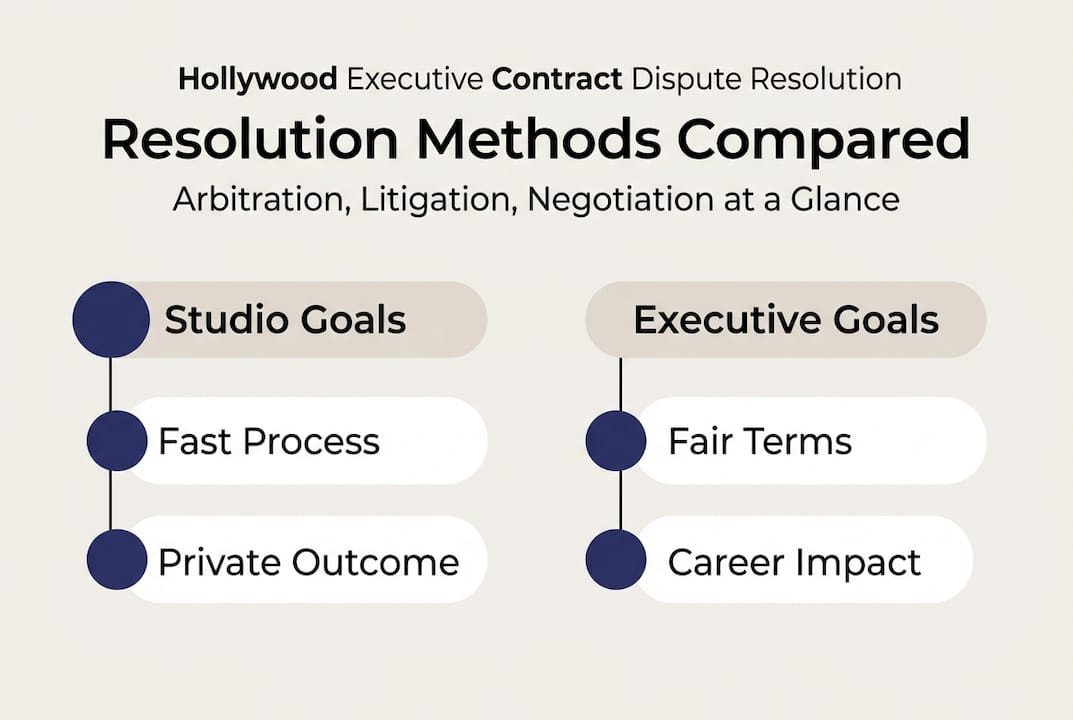
Litigation provides broader discovery tools, allowing you to subpoena internal studio documents, depose executives, and uncover evidence that arbitration procedures might exclude. Courts also create public records that can pressure studios to settle rather than expose embarrassing internal practices. When your dispute involves potential fraud, systematic contract violations, or patterns affecting multiple executives, litigation’s extensive discovery may justify its higher costs and longer timeline.
Key arbitration advantages:
- Confidential proceedings protect your professional reputation and prevent public disclosure of contract terms
- Faster resolution, typically concluding within 12 to 18 months versus 3 to 5 years for litigation
- Expert arbitrators with entertainment industry knowledge who understand complex contract provisions
- Lower procedural costs due to streamlined rules and limited motion practice
- Final awards with minimal appeal rights, providing closure and certainty
Litigation benefits include:
- Comprehensive discovery allowing extensive document requests and depositions
- Public proceedings that create reputational pressure on studios to settle
- Broader remedies including injunctive relief and punitive damages
- Jury trials when contract interpretation involves factual disputes about intent
- Appellate review correcting legal errors in trial court decisions
| Factor | Arbitration | Litigation |
|---|---|---|
| Timeline | 12 to 18 months | 3 to 5 years |
| Discovery scope | Limited, focused | Extensive, broad |
| Confidentiality | Private proceedings | Public record |
| Cost | Moderate | High |
| Appeal rights | Minimal | Full appellate review |
Negotiation remains the most cost-effective dispute resolution method. Most executive contract disputes settle before formal arbitration or litigation concludes. Your negotiation leverage depends on evidence quality, legal claim strength, and studio’s desire to avoid public controversy. When you document contract violations thoroughly and engage experienced counsel, studios often prefer confidential settlements over risking adverse arbitration awards or damaging litigation publicity.
Courts and arbitrators generally defer to studios’ business judgment regarding creative decisions, making bad faith claims difficult to prove. You must demonstrate systematic abandonment or sham development efforts, not merely disappointing results or changed priorities. This high evidentiary standard makes early settlement negotiations attractive when your evidence suggests bad faith but might not conclusively prove it under legal standards.
Effective negotiation tactics include:
- Presenting organized evidence timelines showing studio’s evolving positions on contract interpretation
- Identifying specific contract language supporting your position with reference to negotiation history
- Demonstrating how industry custom and practice interpret ambiguous terms in your favor
- Calculating damages precisely, including lost compensation, equity value, and career harm
- Maintaining professional communications that position you as reasonable party seeking fair resolution
When studios face retaliation claim legal rights exposure, they often settle quickly to avoid discovery into broader workplace practices. If your contract dispute arose after you reported harassment, questioned accounting irregularities, or raised legal compliance concerns, these retaliation theories substantially increase settlement pressure. Studios recognize that retaliation claims can expose systemic problems extending far beyond individual contract disagreements.
Explore expert employment law support
Navigating contract disputes with major studios requires specialized legal knowledge combining entertainment industry expertise with California employment law mastery. Professional representation protects your immediate financial interests while preserving long-term career prospects through strategic dispute resolution. Whether you face equity cancellations, development bad faith, or wrongful termination during contract conflicts, experienced counsel ensures studios cannot exploit their superior resources and institutional advantages.
The Law Office of Brian Y. Shirazi focuses exclusively on protecting employee rights and discrimination laws for executives and senior management throughout Los Angeles. Our practice concentrates on employment-related disputes affecting Hollywood professionals, including contract breaches, workplace retaliation, and executive termination issues. We combine deep knowledge of entertainment industry practices with proven litigation skills, helping clients assert their rights and recover full damages.
Consultation with an employment lawyer in Los Angeles experienced in executive disputes ensures you understand your legal options and develop tailored strategies protecting your interests. Early engagement allows us to review existing contracts, document potential violations, and position your case for favorable resolution through negotiation, arbitration, or litigation. Contact our office to discuss how our employment law services can support your specific situation.
Frequently asked questions about Hollywood executive contract disputes
When should I choose arbitration versus litigation for my contract dispute?
Choose arbitration when you prioritize confidentiality, faster resolution, and lower costs, particularly if your contract evidence is strong and discovery needs are limited. Select litigation when you need extensive discovery to prove studio bad faith, when public pressure might encourage settlement, or when your dispute involves fraud or systematic violations affecting multiple parties.
What contract terms most frequently cause disputes with studios?
Ambiguous definitions of theatrical release, gross receipts calculations, exclusivity scope, and development milestones create the most disputes. Studios exploit vague language to redirect revenue, claim broader exclusivity than intended, or avoid development obligations. Insist on precise definitions and audit rights when negotiating contracts.
What steps should I take if I suspect my studio is acting in bad faith?
Document all communications about project development, contract performance, and studio decisions affecting your interests. Preserve emails, meeting notes, and any evidence showing systematic abandonment or sham efforts. Consult retaliation claim guidance counsel before confronting the studio, as your approach affects both legal claims and settlement leverage.
How does California law protect me during contract termination disputes?
California employment law prohibits termination based on discrimination, retaliation for protected activities, or violation of public policy. Even if your contract allows at-will termination, studios cannot fire you for reporting harassment, questioning illegal practices, or exercising legal rights. Wrongful termination executive claims provide damages beyond contract remedies when termination violates employment statutes.
How can I protect my equity interests during studio disputes?
Review your equity agreements for vesting schedules, change-of-control provisions, and termination effects on unvested shares. Document all communications about equity value and corporate restructuring. If studios cancel or dilute your equity during disputes, this may constitute breach of contract or bad faith, particularly when timing suggests retaliation for asserting contract rights.
Do union collective bargaining agreements limit my individual legal claims?
Union agreements may preempt certain California employment law protections, requiring you to pursue grievances through guild procedures rather than individual lawsuits. However, many executive contracts include terms beyond union minimums, and some claims like fraud or intentional interference remain available despite union coverage. Analyze how your specific union agreement interacts with individual contract terms and statutory rights.