
Women make up roughly half the entertainment workforce, yet only 32% of speaking roles went to women in 2024. That gap is not a coincidence. It reflects a deeper pattern of gender discrimination that runs through talent agencies, studios, and production companies along Sunset Boulevard. If you work in this industry and feel sidelined, underpaid, or harassed because of your gender, you are not imagining it. This guide explains what the law says, how discrimination actually shows up in agency culture, and what concrete steps you can take to protect your career and your rights.
Table of Contents
- The reality of gender discrimination along Sunset Boulevard
- How gender discrimination manifests in talent agencies
- Legal rights and protections for entertainment professionals
- What to do if you experience discrimination: Steps and resources
- Connect with experienced legal support in West Hollywood
- Frequently asked questions
Key Takeaways
| Point | Details |
|---|---|
| Gender bias is persistent | Discrimination and harassment in Hollywood agencies remain common despite increased awareness and legal action. |
| Understand your legal rights | Federal, California, and West Hollywood laws provide protections and options for victims of gender discrimination. |
| Documentation is vital | Detailed records of incidents and actions help build stronger cases and protect victims. |
| Specialized lawyers are available | West Hollywood hosts several firms with a track record in entertainment industry discrimination cases. |
The reality of gender discrimination along Sunset Boulevard
Gender discrimination is not always a loud, obvious act. It can be overt, like being passed over for a promotion because of your gender. It can be subtle, like being assigned lower-profile clients than your male colleagues. Or it can be systemic, baked into pay structures, casting decisions, and agency culture in ways that are hard to name but impossible to ignore.
Along Sunset Boulevard, these patterns show up in talent agencies, casting offices, and production studios every day. Women are steered toward certain roles. Older women face a double burden of sexism and ageism. LGBTQ+ professionals encounter discrimination that intersects gender identity with workplace bias. The numbers tell a stark story.
| Metric | Data point |
|---|---|
| Women’s share of speaking roles (2024) | 32% |
| Women in entertainment reporting harassment | 54% to 81% |
| Female characters over 40 | Roughly 25% of all characters over 40 |
The post-#MeToo era brought real change in public awareness, but persistent pay gaps and underrepresentation remain. Intersectional realities make this worse. A woman who is also over 40 or identifies as LGBTQ+ faces compounding barriers that the law recognizes as distinct and serious. If you have experienced sexual harassment in West Hollywood, or if your situation involves LGBTQ+ employment discrimination, California law provides specific protections worth understanding.
“In entertainment and hospitality, between 54% and 81% of women report experiencing harassment, making these among the highest-risk industries for gender-based misconduct.”
These are not abstract statistics. They represent real professionals whose careers and livelihoods are at stake.
How gender discrimination manifests in talent agencies
Talent agencies hold enormous power over careers. Agents control access to auditions, negotiate contracts, and shape public perception of their clients. That power creates fertile ground for bias.
Historically, agency culture rewarded aggressive, male-dominated hierarchies. Women were underrepresented in senior agent roles and often assigned to less lucrative client rosters. Post-#MeToo scrutiny changed some of that, but the shift has been uneven. Major lawsuits against agencies including ICM, CAA, and WME exposed patterns of sexual harassment and assault that had been tolerated for years. More recently, a CAA lawsuit settlement involving Julia Ormond highlighted how agencies’ fiduciary responsibilities to clients are now under serious legal scrutiny.
| Agency responsibility | Pre-#MeToo norm | Post-#MeToo standard |
|---|---|---|
| Responding to harassment complaints | Often ignored or minimized | Required prompt investigation |
| Client protection duties | Loosely defined | Legally scrutinized as fiduciary duty |
| Pay equity in agent roles | Rarely audited | Increasingly subject to legal challenge |
Everyday discrimination in agencies often looks like this:
- Pay disparities between male and female agents at the same level
- Female clients assigned to less experienced or less connected agents
- Promotions tied to social dynamics that exclude women
- Retaliation against those who raise concerns internally
For a deeper look at how Hollywood harassment lawsuits have shaped legal standards, and what entertainment harassment cases reveal about agency liability, those resources offer valuable context.
Pro Tip: Start documenting now. Keep a private log of dates, times, what was said or done, and who witnessed it. Save emails and texts. This record becomes critical evidence if you decide to pursue a legal claim.
Legal rights and protections for entertainment professionals
California offers some of the strongest employee protections in the country. Here is what applies to you.
Federal law: Title VII of the Civil Rights Act prohibits gender discrimination in workplaces with 15 or more employees. It covers hiring, firing, pay, promotions, and working conditions.
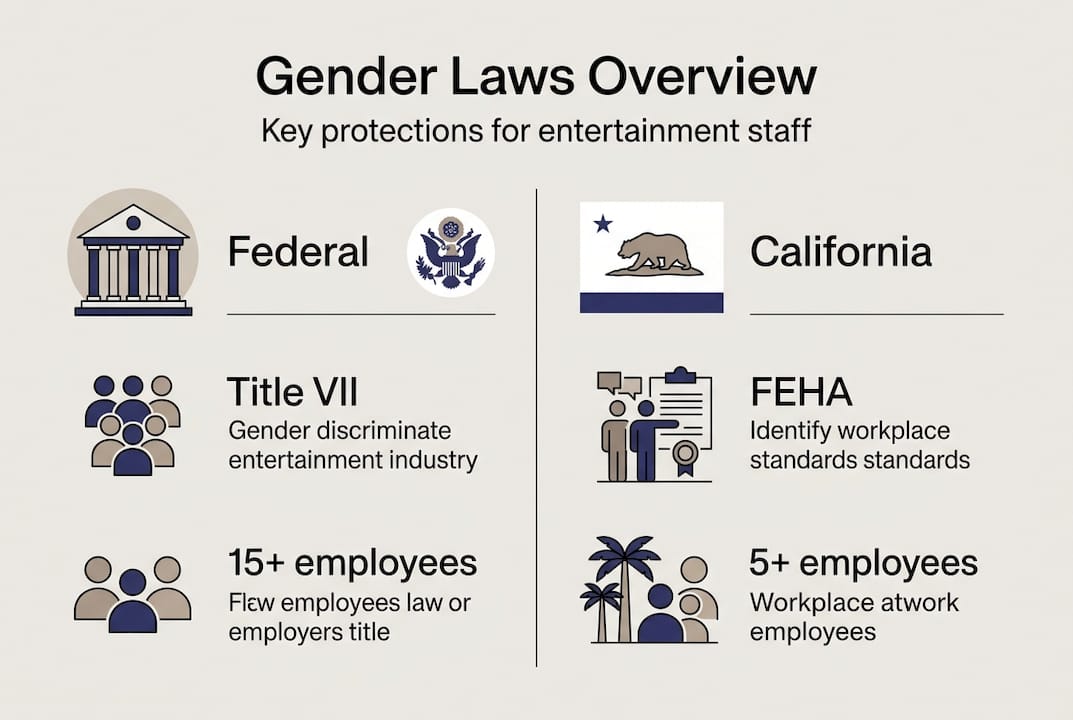
California law: The Fair Employment and Housing Act (FEHA) goes further. It applies to employers with five or more employees and covers a broader range of protected characteristics, including gender identity and sexual orientation.
West Hollywood: The city has its own ordinances reinforcing these protections, particularly for workers in entertainment and hospitality. Law firms specializing in gender discrimination in this area understand the local landscape well.
Key legal concepts to know:
- Hostile work environment: Severe or pervasive conduct based on gender that makes your workplace intolerable
- Disparate impact: Neutral-seeming policies that disproportionately harm women or other protected groups
- Retaliation: Any adverse action taken against you for reporting discrimination or participating in an investigation
To prove discrimination, you generally need to show that you belong to a protected class, that you suffered an adverse employment action, and that your gender was a motivating factor. Employers often respond with claims that decisions were based on performance or business need. An experienced employment lawyer in West Hollywood can help you anticipate and counter those defenses.
Retaliation is especially common in entertainment. Professionals who speak up often find themselves quietly blacklisted or passed over. California law treats retaliation claims in Hollywood seriously, and West Hollywood retaliation protections are among the strongest in the state.
Pro Tip: Statutes of limitations are strict. Under FEHA, you generally have three years from the discriminatory act to file a complaint with the Civil Rights Department. Under Title VII, the window can be as short as 180 days. Do not wait.
What to do if you experience discrimination: Steps and resources
Knowing your rights is one thing. Acting on them is another. Here is a practical framework built for entertainment professionals in the West Hollywood area.
Step-by-step process:
- Document everything. Write down incidents as they happen. Include dates, locations, names, and exact words used. Save any written communications.
- Review your employment agreement. Some contracts include arbitration clauses that affect where and how you can bring a claim.
- Report internally if safe to do so. File a complaint with HR or a supervisor above the person responsible. Keep a copy of everything you submit.
- File with the appropriate agency. You can file a complaint with California’s Civil Rights Department (formerly DFEH) or the federal Equal Employment Opportunity Commission (EEOC). Filing preserves your legal rights.
- Consult an employment attorney. Do this early, ideally before you file internally or with a government agency. An attorney can help you avoid missteps that could weaken your case.
For freelancers and contractors, the path is slightly different. California’s AB5 law has expanded protections for many workers previously classified as independent contractors. If you work on a project basis for agencies or studios, you may still have legal recourse.
Useful resources in the West Hollywood area include legal aid organizations, entertainment industry unions like SAG-AFTRA, and advocacy groups focused on gender equity in media. Employment lawyers in Hollywood who focus on entertainment cases understand the specific dynamics of agency relationships and can advise on the best path forward.
Firms serving this community include Shirazi Law Office and others with experience in entertainment employment disputes.
“The earlier you consult with an attorney, the more options you have. Waiting often means losing evidence, missing deadlines, and narrowing your legal remedies.”
That is not just legal advice. It is practical reality in an industry where relationships move fast and memories fade.
Connect with experienced legal support in West Hollywood
If you are facing gender discrimination at a talent agency or entertainment company along Sunset Boulevard, you do not have to navigate this alone. Shirazi Law Office focuses exclusively on employment law and represents professionals who are standing up to powerful interests in the entertainment industry. Whether your situation involves pay inequity, hostile work environment, wrongful termination, or retaliation, the firm provides confidential case evaluations and strategic representation tailored to your circumstances. Explore your options for gender discrimination legal help, understand your employee rights under 2025 and 2026 discrimination laws, and learn about your wrongful termination rights before it is too late to act.
Frequently asked questions
What qualifies as gender discrimination at a talent agency?
Any adverse action based on your gender, including pay gaps, unfair casting decisions, or harassment, may qualify as gender discrimination under California and federal law. Gender inequality in Hollywood is well documented and legally actionable when it affects your employment conditions.
Is age discrimination a gender issue in entertainment?
Yes. Ageism and sexism frequently overlap in this industry, and only about 25% of characters over 40 are women, reflecting how older women face compounding career barriers that men in the same age group typically do not.
How fast should I act if I experience discrimination?
You should consult a lawyer or file a complaint as soon as possible. Strict deadlines apply under both California and federal law, and waiting can limit your legal options significantly.
Are retaliation protections strong in West Hollywood?
Yes. California provides robust protections against retaliation for employees who report discrimination, and West Hollywood employment law firms regularly handle retaliation cases in the entertainment sector with strong legal tools available to workers.