

You reported harassment to HR, took medical leave, or filed a discrimination complaint. When you returned to work, your manager stopped inviting you to client meetings, your hours were quietly reduced, or you were placed on a sudden Performance Improvement Plan. In Fairfax District’s fast-paced influencer marketing agencies and digital media startups, retaliation often follows protected activity through subtle exclusion rather than outright termination. This guide explains your legal protections, common retaliation tactics in creative workplaces, and actionable steps to defend your rights when employers punish you for asserting workplace protections.
Table of Contents
- Key takeaways
- Understanding workplace retaliation in Fairfax District influencer marketing agencies
- Legal protections under California law for Fairfax District employees
- Nuances and challenges of retaliation claims in influencer marketing agencies
- What to do if you face workplace retaliation in Fairfax District influencer marketing startups
- Need expert legal help with retaliation claims in Fairfax District?
- Frequently asked questions
Key Takeaways
| Point | Details |
|---|---|
| Protected activity retaliation | Retaliation often follows protected actions like medical leave or reporting discrimination, making it essential to document and act quickly. |
| California protections | California FEHA and Labor Code prohibit retaliation and protect employees who report harassment or discrimination. |
| Subtle retaliation tactics | Retaliation commonly appears as exclusion from meetings, reduced hours, or reassignment rather than outright firing. |
| Documentation and timing | Keeping contemporaneous records and linking timing to protected activity strengthens claims for back pay, damages, and other remedies. |
Understanding workplace retaliation in Fairfax District influencer marketing agencies
Retaliation in creative industries looks different from traditional corporate environments. Fairfax District sees retaliation risks post-medical leave and wrongful termination, such as demotion, exclusion, and reduced hours in creative roles. You might notice your manager stops assigning you to high-profile influencer campaigns after you return from pregnancy leave. Your desk gets moved away from the creative team after you report sexual harassment. Your schedule shrinks from full-time to part-time hours following a wage complaint.
These tactics avoid the legal exposure of immediate termination while effectively pushing employees out. A content manager at a West Hollywood digital agency reported pregnancy discrimination and found herself excluded from strategy meetings within days. An account executive who took FMLA leave returned to discover his client portfolio reassigned to junior staff. A social media director who questioned unpaid overtime suddenly received her first negative performance review in three years.
Common retaliation tactics in influencer marketing startups:
- Sudden introduction of Performance Improvement Plans with unrealistic metrics
- Exclusion from client meetings, creative briefs, or team communications
- Reassignment to less visible projects or lower-status accounts
- Schedule reductions disguised as budget cuts or workflow optimization
- Increased scrutiny of work product that previously received praise
- Isolation from collaborative projects and team-building activities
Pro Tip: Document every workplace change within 24 hours of occurrence. Screenshot emails, save calendar invites showing meeting exclusions, and note any verbal comments from supervisors. Timing evidence connecting your protected activity to adverse actions becomes critical proof in retaliation claims.
Fast-paced creative environments make these patterns harder to recognize. Startups frequently reorganize teams, shift priorities, and adjust staffing. Employers exploit this fluidity to disguise retaliation as normal business operations. You need to distinguish legitimate workflow changes from targeted punishment. If negative changes cluster immediately after you filed a complaint or returned from protected leave, you’re likely experiencing retaliation after medical leave. Similar patterns appear in Culver City startups where creative agencies use informal management structures to avoid accountability.
“The most effective retaliation in digital media workplaces doesn’t appear in termination letters. It shows up in meeting invitations you stop receiving, projects you’re no longer assigned, and conversations that happen without you.”
Legal protections under California law for Fairfax District employees
California FEHA prohibits retaliation for reporting discrimination or harassment; Labor Code 1102.5 protects whistleblowers; FMLA and ADA protect leave-related retaliation. Multiple state and federal laws create overlapping protections for employees who assert workplace rights. Understanding which statutes apply to your situation determines your legal options and potential remedies.
The Fair Employment and Housing Act covers employers with five or more employees, protecting workers who oppose discriminatory practices or participate in FEHA investigations. If you reported gender discrimination, pregnancy harassment, or disability bias, FEHA prohibits your employer from demoting you, reducing your hours, or creating hostile conditions in response. California Labor Code 1102.5 protects whistleblowers who report illegal activities, safety violations, or regulatory noncompliance to government agencies or internally. The Family and Medical Leave Act and Americans with Disabilities Act prohibit retaliation against employees who take protected medical or disability leave.
Protected activities that trigger legal safeguards:
- Filing discrimination or harassment complaints with HR or government agencies
- Requesting reasonable accommodations for disabilities or religious practices
- Taking FMLA leave for serious health conditions or family care
- Reporting wage theft, unpaid overtime, or meal break violations
- Opposing illegal business practices or safety violations
- Participating in workplace investigations as a witness
| Law | Employer Coverage | Protected Activity | Remedies Available |
|—–|——————-|——————–|——————–||
| California FEHA | 5+ employees | Discrimination complaints, harassment reports | Back pay, emotional distress damages, punitive damages |
| Labor Code 1102.5 | All employers | Whistleblowing illegal conduct | Lost wages, reinstatement, attorney fees |
| FMLA | 50+ employees | Medical and family leave | Back pay, benefits restoration, liquidated damages |
| ADA | 15+ employees | Disability accommodation requests | Compensatory damages, reinstatement, policy changes |
Successful retaliation claims often recover back pay for lost wages, compensatory damages for emotional distress, and up to three times wages in certain whistleblower cases. Courts may order reinstatement to your previous position, removal of negative performance reviews, or policy changes preventing future retaliation. In cases involving particularly egregious employer conduct, punitive damages punish intentional violations and deter similar behavior. The McConnell v. Innovative precedent established important standards for proving retaliation in California employment cases.
Pro Tip: California law allows you to pursue claims under multiple statutes simultaneously. An employee who reported sexual harassment and then took medical leave might have viable claims under both FEHA and FMLA if the employer retaliated. Consulting with specialists in employee rights and discrimination laws helps identify all applicable protections. Understanding wrongful termination standards also matters when retaliation escalates to firing.
Nuances and challenges of retaliation claims in influencer marketing agencies
Proving retaliation in small creative startups presents unique obstacles. Nonprofits and digital media startups often lack formal HR, making retaliation claims harder to navigate; employers may claim restructuring as cover for retaliation. Most Fairfax District influencer agencies employ fewer than 50 people, operate with minimal human resources infrastructure, and frequently reorganize teams based on client needs. These characteristics create perfect cover for disguised retaliation.
Employers defend adverse actions by citing legitimate business reasons. They claim your project reassignment resulted from shifting client priorities, not your harassment complaint. They argue schedule reductions affected multiple employees due to budget constraints, not just you after taking medical leave. They insist the Performance Improvement Plan addresses longstanding performance issues, not your recent whistleblowing. These defenses force you to prove the stated reasons are pretextual covers for retaliatory intent.
| Employer Defense | Employee Counter-Evidence | Why Timing Matters |
|---|---|---|
| “Budget cuts required schedule reductions” | Only your hours decreased; others maintained full-time status | Changes occurred within weeks of protected activity |
| “Client needs drove project reassignments” | You previously managed similar accounts successfully | Reassignment followed discrimination complaint by days |
| “Performance issues justified the PIP” | No prior negative reviews; sudden criticism post-leave | First documented concerns appeared after FMLA return |
| “Restructuring eliminated your position” | New hire filled similar role with different title | Position recreated shortly after your termination |
Small startups also lack the paper trails common in larger corporations. Decisions happen in casual conversations rather than formal meetings. Managers communicate through Slack messages that disappear or verbal instructions with no written record. Performance feedback occurs informally without documentation until retaliation requires justification. This informal culture benefits employers defending against claims while disadvantaging employees gathering evidence.
Challenges specific to creative industry retaliation:
- Subjective performance metrics make it harder to disprove employer criticisms
- Frequent workflow changes provide cover for targeted reassignments
- Informal communication channels reduce documentary evidence
- Small team sizes mean fewer potential witnesses to corroborate your account
- Creative roles involve collaborative work where exclusion appears subtle
Pro Tip: Start documenting immediately when you notice pattern changes. If your manager typically assigns projects via email but suddenly gives verbal instructions after your complaint, send confirmation emails summarizing the conversation. If team meetings previously appeared on shared calendars but you’re now excluded without record, note the dates and attendees. Creating your own paper trail compensates for informal workplace practices. Similar documentation strategies prove valuable in Hollywood retaliation claims and film and TV set retaliation where informal hierarchies dominate.
What to do if you face workplace retaliation in Fairfax District influencer marketing startups
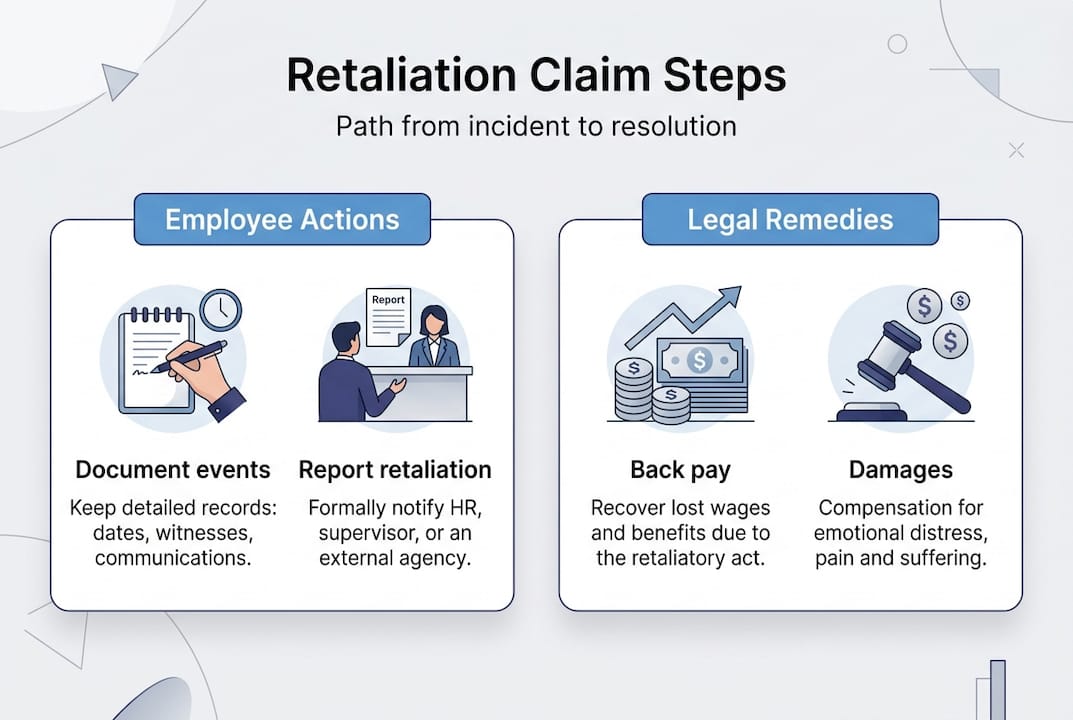
Taking immediate action when you suspect retaliation protects your legal rights and strengthens potential claims. Proving retaliation requires documenting timing and employer actions; legal remedies include back pay and damages. Follow these steps to build your case and preserve your options.
1. Document everything immediately
Create a detailed timeline connecting your protected activity to subsequent adverse actions. Record dates, times, people involved, and specific changes to your work conditions. Save all relevant emails, text messages, Slack conversations, and performance reviews. Screenshot calendar invites showing meeting exclusions or schedule changes. Note any verbal comments from supervisors about your complaint, leave, or protected activity.

2. Report retaliation through proper channels
If your company has human resources, file a formal written complaint describing the retaliatory conduct. Even if you doubt HR will help, creating an internal record matters for later legal claims. If the company lacks HR infrastructure, report to your direct supervisor’s manager or the highest-level executive available. Keep copies of all complaints and any responses you receive.
3. Preserve evidence of your work quality
Gather proof contradicting any performance-based justifications for adverse actions. Collect positive performance reviews, client testimonials, successful project examples, and awards or recognition received before the retaliation. If your employer suddenly criticizes work quality, document specific examples showing your performance remained consistent.
4. Consult an employment lawyer early
Don’t wait until you’re terminated to seek legal advice. Employment lawyers in Los Angeles can evaluate your situation, advise on evidence collection, and explain your options before retaliation escalates. Early consultation often prevents employers from manufacturing additional justifications for adverse actions. Lawyers also help determine whether you should file complaints with government agencies or pursue direct legal action.
5. File complaints with appropriate agencies
You can file retaliation complaints with the California Civil Rights Department (formerly DFEH) or the federal Equal Employment Opportunity Commission depending on which laws apply. These agencies investigate claims, attempt resolution, and issue right-to-sue letters enabling you to pursue court cases. Strict deadlines apply, so don’t delay filing. Understanding wrongful termination after reporting misconduct helps you recognize when retaliation crosses into illegal firing.
Pro Tip: Continue performing your job duties at the highest level possible despite retaliation. Employers often use any work quality decline to justify adverse actions retroactively. Maintaining excellent performance despite hostile conditions strengthens your case by eliminating legitimate performance defenses. If retaliation makes your job impossible, document the specific ways employer actions prevent you from succeeding. Knowledge of retaliation after medical leave protections becomes especially important if you need additional time off due to stress from retaliatory treatment.
Need expert legal help with retaliation claims in Fairfax District?
Navigating workplace retaliation in influencer marketing agencies requires understanding both employment law and creative industry dynamics. The informal structures, subjective performance metrics, and rapid changes common in digital media startups make retaliation cases more complex than traditional employment disputes. Early consultation with lawyers who understand these nuances significantly improves your chances of successful resolution.
Specialized employment lawyers can evaluate the strength of your retaliation claim, guide evidence collection strategies, and advise on timing for internal complaints versus legal action. They understand how to counter employer defenses about restructuring or performance issues by building compelling timelines and documentation. Whether you’re facing subtle exclusion tactics or outright termination, experienced legal counsel helps you assert your rights under California discrimination laws and recover damages for retaliatory treatment. If retaliation has escalated to firing, understanding wrongful termination protections becomes critical for pursuing all available remedies.
Frequently asked questions
What is workplace retaliation in influencer marketing startups?
Workplace retaliation is any adverse employment action taken because you engaged in protected activity like filing complaints, taking medical leave, or reporting illegal conduct. In influencer marketing agencies, retaliation often appears as exclusion from meetings, reduced hours, project reassignments, or sudden performance criticism rather than immediate termination. The key element is the connection between your protected activity and the negative treatment that follows.
What laws protect employees from retaliation in Fairfax District?
California’s Fair Employment and Housing Act prohibits retaliation for reporting discrimination or harassment. Labor Code 1102.5 protects whistleblowers who report illegal activities or safety violations. The Family and Medical Leave Act and Americans with Disabilities Act prevent retaliation for taking protected medical or disability leave. These laws apply to employers of varying sizes and provide overlapping protections depending on your situation.
How can I prove workplace retaliation has occurred?
Successful retaliation claims require evidence connecting your protected activity to subsequent adverse actions. Document the timing of changes in your work conditions, noting how quickly negative treatment followed your complaint or leave. Collect emails, performance reviews, and calendar invites showing altered responsibilities or exclusions. Gather witness statements from coworkers who observed the changes. The closer the timing between protected activity and adverse actions, the stronger your circumstantial evidence of retaliatory intent.
What legal remedies are available for retaliation victims in Fairfax District?
California law provides multiple remedies for proven retaliation claims. You can recover back pay for lost wages and benefits resulting from adverse actions. Courts may award compensatory damages for emotional distress and harm to your professional reputation. Certain whistleblower cases allow up to three times your actual damages. Additional remedies include reinstatement to your previous position, removal of negative performance reviews, policy changes preventing future retaliation, and attorney fees. Particularly egregious cases may result in punitive damages punishing intentional violations.
When should I consult an employment lawyer about retaliation?
Consult a lawyer as soon as you notice pattern changes suggesting retaliation, not after you’re terminated. Early legal guidance helps you document evidence effectively, understand which laws protect your situation, and make strategic decisions about internal complaints versus legal action. Lawyers can also communicate with your employer to stop ongoing retaliation before it escalates. Waiting until after termination limits your options and makes evidence collection more difficult. Most employment lawyers offer initial consultations to evaluate your case and explain your rights.
Recommended
- Seasoned Employment Lawyer in Fairfax District
- Workplace Retaliation in LA | Los Angeles Employment Lawyer
- Retaliation After Medical Leave in Fairfax District – Law Office of Brian Y. Shirazi, PC
- Fairfax District Hostile Work Scenes in Streetwear – Law Office of Brian Y. Shirazi, PC
- Top San Marino Workplace Retaliation Lawyers