

Working in Downtown Los Angeles near Crypto.com Arena, you expect fairness and equal treatment every day. Facing subtle or direct discrimination because of your disability can leave you feeling isolated and powerless. Both California and federal laws offer strong protections for your rights at work. This guide explains what counts as disability discrimination, highlights your legal safeguards, and shows practical steps to defend your rights against unfair treatment or retaliation.
Table of Contents
- Defining Disability Discrimination In Corporate Offices
- Types Of Discriminatory Practices Near Crypto.com Arena
- Federal And California Laws Protecting Disabled Employees
- Reasonable Accommodations And The Interactive Process
- What To Do If Your Rights Are Violated
Key Takeaways
| Point | Details |
|---|---|
| Disability Discrimination Defined | Disability discrimination occurs when an employer treats an employee unfavorably due to their disability in any aspect of employment. |
| Legal Protections Under ADA and FEHA | The Americans with Disabilities Act and California’s Fair Employment and Housing Act provide substantial protections against disability discrimination in the workplace. |
| Rights to Reasonable Accommodations | Employees are entitled to reasonable accommodations without retaliation, and employers must engage in a collaborative process to address accommodation requests. |
| Action Steps for Violations | Document all incidents of discrimination and file complaints with appropriate federal or state agencies to preserve legal rights and seek remedies. |
Defining Disability Discrimination in Corporate Offices
Disability discrimination in the workplace happens when an employer treats you unfavorably because of your disability. This can occur during hiring, firing, pay decisions, promotions, job assignments, or training—essentially any employment decision. If you work in a corporate office near Crypto.com Arena and experience this treatment, you have legal protections under California and federal law.
The Americans with Disabilities Act (ADA) provides the foundation for these protections. Disability discrimination occurs when employers treat qualified employees unfavorably because of a disability in any aspect of employment. The ADA defines disability broadly as a physical or mental condition that substantially limits major life activities or bodily functions.
Your employer’s obligations are clear and specific:
- Treat you equally with non-disabled colleagues in hiring and advancement decisions
- Provide reasonable accommodations unless doing so creates undue hardship
- Never retaliate against you for requesting accommodations or asserting your rights
- Keep your medical information confidential and separate from personnel files
- Ensure your workplace is accessible and free from hostile treatment based on disability
Discrimination doesn’t always look obvious—it can be a subtle pattern of unfavorable treatment, exclusion from projects, or denial of opportunities that non-disabled colleagues receive.
What makes this more complex is that discrimination can be direct or indirect. Direct discrimination is when your boss explicitly states they won’t promote you because of your condition. Indirect discrimination is when seemingly neutral policies have a disproportionate impact on people with disabilities—like a scheduling system that doesn’t accommodate your medical appointments.
In corporate offices across Downtown Los Angeles, disability discrimination sometimes appears as denial of reasonable accommodations. Your employer might claim accommodations are too costly, even when they’re not. They might refuse flexible work arrangements for someone managing a chronic condition. They might exclude you from meetings or social events because of assumptions about your abilities.
Compare examples of direct versus indirect disability discrimination in offices:
| Discrimination Type | Example Scenario | Typical Result |
|---|---|---|
| Direct | Manager denies promotion due to visible disability | Missed advancement opportunity |
| Indirect | Company policy denies flexible scheduling for all | Hardship for employees needing medical appointments |
| Perception-Based | Worker treated differently due to assumed past illness | Isolation or unequal treatment |
California employment law extends protections beyond the ADA through the Fair Employment and Housing Act (FEHA). FEHA often provides stronger protections than federal law. Federal laws such as the ADA and Rehabilitation Act prohibit discrimination against people with disabilities in employment-related activities, including hiring, pay, benefits, firing, and promotions. These protections apply to employers with 15 or more employees.
Retaliation is also illegal. If you request an accommodation or file a complaint about discrimination, your employer cannot demote you, cut your hours, or create a hostile environment in response. This protection extends to anyone who assists you in asserting your rights.
Pro tip: Document every interaction related to your disability—accommodation requests, denial of accommodations, comments from managers, and changes in your work situation—because this creates a clear record if you need to pursue a legal claim.
Types of Discriminatory Practices Near Crypto.com Arena
Discrimination against employees with disabilities takes many forms in corporate offices. Some practices are obvious and intentional, while others operate quietly through policies that seem neutral but harm people with disabilities. Understanding these patterns helps you recognize what’s happening in your workplace.
Discriminatory practices in employment include denying opportunities, failing to accommodate, harassment, and retaliation against employees who assert their rights. Near Crypto.com Arena, where corporate headquarters and professional offices cluster in Downtown Los Angeles, these practices affect employees across industries.
Common discriminatory practices include:
- Refusing to hire qualified candidates because of disability, even when they can perform essential job functions
- Denying promotions or raises to employees with disabilities while advancing less-qualified colleagues
- Assigning worse shifts, territories, or projects as punishment for disclosing a disability
- Excluding employees from meetings, training programs, or networking events
- Subjecting you to invasive medical inquiries or requiring unnecessary medical exams
- Paying less than colleagues without disabilities for the same work
Discrimination doesn’t require intentional malice—it happens when policies or decisions have a disparate impact on people with disabilities, whether intended or not.
Retaliation is another critical form of discrimination. Once you request an accommodation or complain about unfair treatment, your employer cannot legally penalize you. Yet many employees experience exactly this: denied requests after disclosure, sudden performance criticisms, isolation from team activities, or being passed over for promotions they previously would have received.
Harassment based on disability is also unlawful. This includes offensive comments about your condition, mimicking your symptoms, spreading rumors about your medical status, or creating an environment where colleagues treat you differently. Discriminatory practices encompass bias in hiring, promotion, job assignment, termination, compensation, retaliation, and harassment.
In Downtown Los Angeles corporate settings, disability discrimination sometimes happens through denial of reasonable accommodations. Your employer might claim remote work options cost too much, when they’re already available to non-disabled employees. They might refuse flexible scheduling for medical appointments while allowing others time off for personal reasons.
Discrimination can also involve your perceived disability or disability history, not just actual current conditions. If you had cancer years ago and are now healthy, employers cannot discriminate based on that history. Similarly, if an employer incorrectly believes you have a disability, that mistaken perception doesn’t excuse discriminatory treatment.
Pro tip: Keep records of any communications about your disability, accommodation requests, managers’ responses, and any changes to your role or pay—these documents are crucial evidence if you later need to prove a pattern of discrimination.
Federal and California Laws Protecting Disabled Employees
You have protection under multiple layers of law. Federal statutes and California state law work together to safeguard your employment rights if you have a disability. Understanding which laws apply to your situation strengthens your position if discrimination occurs.
The Americans with Disabilities Act (ADA) is the primary federal protection. It covers employers with 15 or more employees and prohibits discrimination in all employment decisions. The ADA requires employers to provide reasonable accommodations unless doing so creates undue hardship. Federal laws protect individuals with disabilities from discrimination and require employers to provide reasonable accommodations in hiring, pay, benefits, firing, and promotions.
California goes further. The Fair Employment and Housing Act (FEHA) provides stronger protections than federal law in several ways. FEHA applies to employers with just five or more employees, covers more conditions as disabilities, and allows for larger damage awards. In California, FEHA and federal laws such as the ADA and Rehabilitation Act protect employees with disabilities from discrimination through requirements like reasonable accommodations, nondiscrimination in recruitment, confidentiality, and protection against harassment and retaliation.
Key protections these laws provide:
- Right to reasonable accommodations for your disability without retaliation
- Protection from discrimination in hiring, firing, pay, promotions, and assignments
- Confidentiality of your medical information
- Right to be treated equally with non-disabled employees
- Protection against harassment based on your disability
- Right to file complaints and participate in investigations without penalty
- Ability to recover damages if you experience discrimination
California law often provides greater protection than federal law—this matters in Downtown Los Angeles where FEHA sometimes gives you stronger claims than ADA alone.
The Rehabilitation Act offers additional federal protection for federal contractors and those receiving federal funding. Many corporate offices near Crypto.com Arena work with federal agencies or receive federal contracts, making this law relevant.
California also has specific statutes addressing medical privacy. Your employer cannot require medical exams or ask disability-related questions unless directly job-related. They must keep medical records separate from your personnel file.
These laws are enforced by the Equal Employment Opportunity Commission (EEOC) at the federal level and the California Civil Rights Department (CRD) at the state level. You can file complaints with either agency, and California law typically allows you to pursue both administrative and court remedies.
The key advantage in California is the ability to file in state court under FEHA, which often provides stronger protections and remedies than federal court under the ADA. You can pursue both federal and state claims simultaneously.
Here is a summary comparing federal and California disability discrimination laws:
| Law/Agency | Employer Size Covered | Scope of Protection | Damages/Remedies |
|---|---|---|---|
| ADA (Federal) | 15+ employees | Covers major life activities and requires reasonable accommodations | Compensatory, injunctive, attorney fees |
| FEHA (California) | 5+ employees | Broader disability definition, more covered conditions | Larger damages, punitive allowed |
| Rehabilitation Act | Federal contractors/funding | Applies to federal agencies and contractors | Similar to ADA, additional oversight |
| EEOC/CRD | N/A | Enforce federal/state disability employment laws | Investigations, mediation, enforcement |
Pro tip: When facing discrimination in Downtown Los Angeles, consider filing complaints with both the EEOC and California Civil Rights Department simultaneously—this preserves all your legal options and timelines without forcing you to choose one avenue.
Reasonable Accommodations and the Interactive Process
When you have a disability, your employer is legally required to provide reasonable accommodations. These are modifications or adjustments that help you perform your job effectively. Understanding how this process works protects your rights in the workplace.
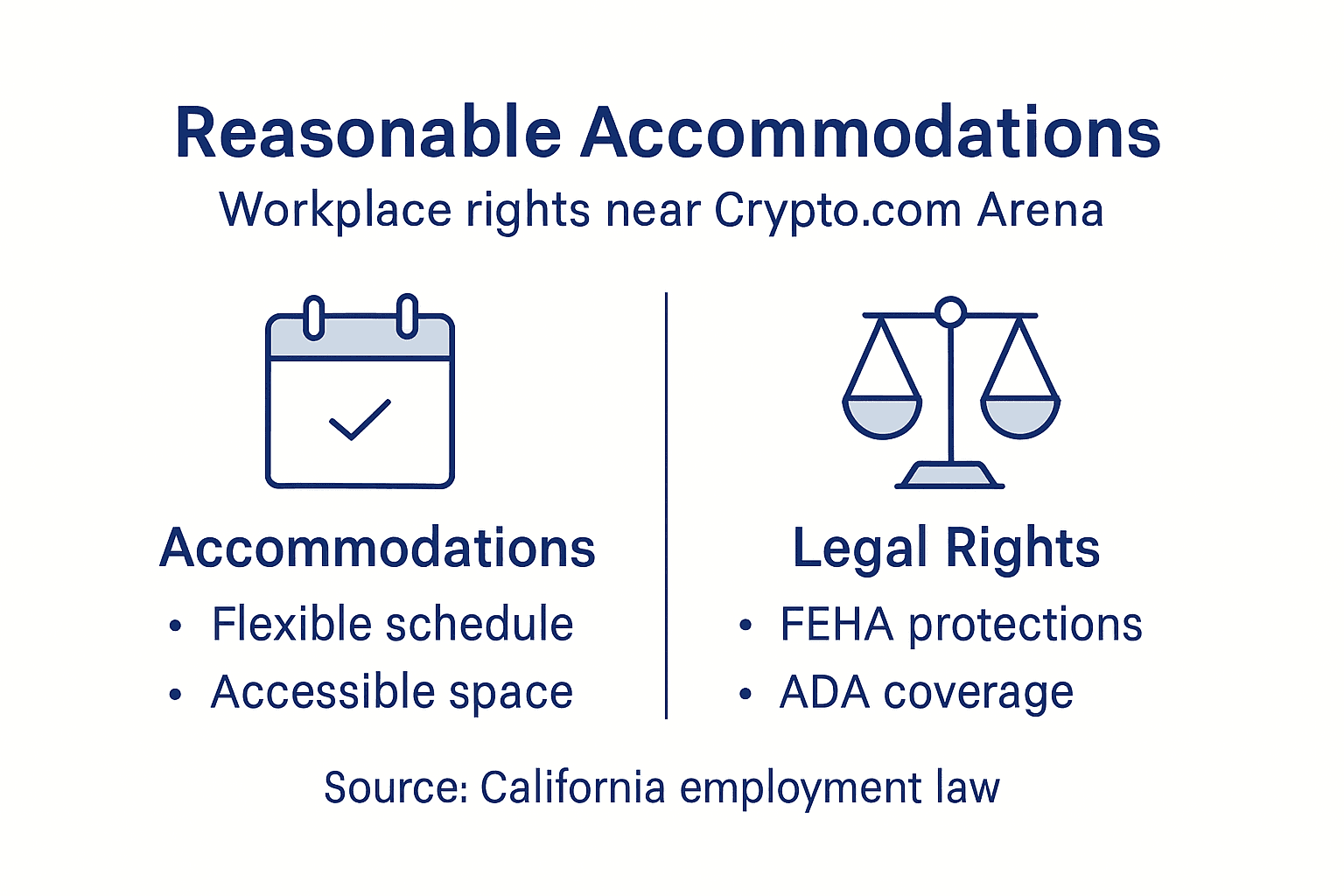
Reasonable accommodations can take many forms. Reasonable accommodations under the ADA include modifications or adjustments to a job, work environment, or hiring process that enable qualified individuals with disabilities to perform essential job functions. In Downtown Los Angeles corporate offices, these might include flexible schedules for medical appointments, remote work options, ergonomic equipment, assistive technology, or modifications to physical spaces.
Common reasonable accommodations include:
- Modified work schedules or telecommuting arrangements
- Accessible parking or facility modifications
- Assistive technology or software tools
- Job restructuring or role adjustments
- Extended break times for medical needs
- Adjustments to communication methods or materials
- Changes to meeting formats or attendance requirements
The interactive process is your right—it’s a collaborative conversation where your employer must listen to your needs and work with you to find effective solutions.
The interactive process is how accommodations actually happen. This is a dialogue between you and your employer that begins when you request an accommodation. The interactive process is a collaborative dialogue between an employer and employee that begins when a reasonable accommodation request is made, involving identification of limitations caused by disability and exploration of possible accommodations.
Your employer can request medical documentation to support your needs. This is reasonable. However, they must act in good faith and timely manner, not use requests for information as delays or excuses. They must consider alternative accommodations if your first request isn’t feasible.
What employers cannot do is ignore your request, deny accommodations without explanation, or claim cost is the only reason. They must engage seriously. If an accommodation truly causes undue hardship—significant difficulty or expense—they must explore alternatives with you.
Many employees with disabilities experience workplace accommodation failures that violate their rights. Denials without legitimate reasons, prolonged delays, or failure to engage in the interactive process are all unlawful.
You should document your accommodation request in writing—email is perfect. Keep records of all communications, rejections, and any reasons given. This creates evidence if you later need to prove your employer failed in their legal obligation.

Pro tip: Submit your accommodation request in writing and request written responses from your employer—this creates a clear paper trail proving you made the request and documenting their response, which is invaluable if discrimination occurs.
What to Do If Your Rights Are Violated
If you experience disability discrimination at your corporate office near Crypto.com Arena, you have legal remedies. Taking action protects your rights and holds your employer accountable. Understanding your options helps you move forward strategically.
Start by documenting everything. Write down dates, times, people involved, what happened, and any witnesses. Keep copies of emails, messages, performance reviews, and any communications about your disability or accommodation requests. This documentation becomes your evidence.
Before filing formal complaints, consider your internal options. Many employers have HR departments and complaint procedures. File a written complaint with your HR department and keep a copy for yourself. This creates an internal record, though it’s not required before taking legal action.
You have the right to file a complaint with the appropriate federal agency such as the EEOC for employment-related disability discrimination issues. In California, you can also file with the California Civil Rights Department (CRD). These agencies investigate your claim at no cost to you.
Key steps when filing complaints:
- File within required time limits (typically 180-300 days depending on location)
- File with both EEOC and California CRD if you want maximum protection
- Provide detailed facts, dates, and how the discrimination affected you
- Include copies of supporting documentation
- File in writing or online through the agency’s portal
Filing administrative complaints preserves your legal rights and creates an official record—even if you later pursue private litigation.
The agency will contact you for additional information. They may mediate between you and your employer, investigate independently, or issue findings. The EEOC may investigate the claim, attempt mediation, or pursue legal action to resolve the discrimination.
You can also pursue private legal action in court. California law often allows you to file in state court under FEHA while federal claims proceed separately. Many discrimination cases result in settlements, back pay, damages for emotional distress, and attorney fees.
Retaliation after filing is illegal. If your employer punishes you for asserting your rights, that’s another violation. Wrongful termination after reporting misconduct is unlawful and strengthens your legal position.
Consider consulting an employment lawyer. They can evaluate your case, advise on strategy, and represent you through complaints and litigation. Many attorneys work on contingency, meaning you pay nothing upfront.
Pro tip: File your administrative complaint immediately if you’re nearing the deadline, even if you’re still gathering information—you can supplement the complaint later, and missing the deadline means losing your right to sue entirely.
Protect Your Workplace Rights Against Disability Discrimination Near Crypto.com Arena
If you are facing unfair treatment or denial of reasonable accommodations at your Downtown Los Angeles corporate office, you do not have to face this alone. Disability discrimination, retaliation, and harassment can seriously damage your career and well-being. Key terms like “reasonable accommodations,” “interactive process,” and protections under the Americans with Disabilities Act and California’s Fair Employment and Housing Act are complex but crucial for your rights.
Shirazi Law Office specializes in protecting employees just like you who work in Los Angeles, including those near Crypto.com Arena. We understand the challenges of navigating disability discrimination and can help you document your case, enforce your legal protections, and pursue fair compensation. Do not let denial of accommodations or retaliation disrupt your professional growth or peace of mind.
Take action now before time runs out on filing complaints or legal claims. Contact us through our website at Shirazi Law Office to schedule a consultation. Learn how our focused expertise in disability discrimination and other workplace rights can help secure the justice you deserve. Your workplace dignity and career deserve strong advocacy today.
Frequently Asked Questions
What constitutes disability discrimination in the workplace?
Disability discrimination occurs when an employer treats an employee unfavorably due to their disability, affecting aspects like hiring, firing, promotions, or pay decisions.
What are reasonable accommodations in the workplace for employees with disabilities?
Reasonable accommodations are modifications or adjustments that enable qualified individuals with disabilities to perform their job effectively, such as flexible schedules, ergonomic tools, or assistive technology.
What should I do if I experience disability discrimination at work?
Document everything related to the discrimination, including dates, interactions, and communications. Consider filing a complaint with your HR department and, if necessary, with the EEOC or California Civil Rights Department.
What legal protections do employees with disabilities have?
Employees with disabilities are protected under the Americans with Disabilities Act (ADA) and California’s Fair Employment and Housing Act (FEHA), which prohibit discrimination, require reasonable accommodations, and protect against retaliation.
Recommended
- Disability Accommodation Issues for UCLA Employees
- Independent Contractor vs Employee Disputes – Impact in Downtown LA – Law Office of Brian Y. Shirazi, PC
- Recent California Employment Verdicts – Impact on Downtown LA – Law Office of Brian Y. Shirazi, PC
- Employee vs Contractor Misclassification in Downtown LA





[…] retaliatory behavior from employers who view disabled employees as liabilities. Understanding workplace disability rights in downtown LA can help you connect what you are experiencing to a legal […]