

TL;DR:
- Disability bias in creative agencies often occurs subtly through exclusion, comments, or retaliation.
- Employees should document incidents promptly and understand their rights under California law.
- Seeking legal advice early improves chances of protecting rights and securing remedies.
California’s creative agencies may seem progressive, but disability bias is a real and costly problem. A former Equinox trainer won $32.2M in a disability discrimination verdict, proving that California courts take these cases seriously. If you work at a creative agency and feel your disability is being used against you, you are not alone. This article will walk you through how to recognize bias, understand your rights under California law, document your experience, and take action before it is too late.
Table of Contents
- Understanding disability bias in creative agencies
- Recognizing signs of disability discrimination on the job
- Your rights and remedies: California law and complaint process
- Documenting your case and seeking legal representation
- Why seeking legal advice quickly makes all the difference
- Connect with experienced disability rights lawyers in Los Angeles
- Frequently asked questions
Key Takeaways
| Point | Details |
|---|---|
| Disability bias is present | Even without publicized cases in Carthay, creative agencies in California face real disability discrimination risks. |
| Documentation is vital | Keeping detailed records of requests and responses is critical for any legal claim or complaint. |
| Legal rights are strong | California law, especially FEHA, provides robust protection and strong remedies for disabled employees. |
| Act quickly | Filing complaints and consulting an attorney early maximizes your chances of a successful outcome. |
| Expert help matters | Specialized employment lawyers can secure better results and guide you through a complex process. |
Understanding disability bias in creative agencies
Disability bias does not always look like an outright refusal. It can be subtle. An employer might quietly exclude you from a key project after you request medical leave. A manager might make offhand comments about your “reliability” after you disclose a health condition. These are not just bad workplace moments. They are potentially illegal acts under California law.
In creative agencies specifically, the fast-paced, always-on culture can make it harder to spot discrimination. Expectations around long hours, constant availability, and high output can mask discriminatory intent behind the language of “performance” or “team fit.” This is exactly why disability discrimination in LA is such a pressing concern for employees in these environments.
Common forms of disability bias in creative workplaces include:
- Refusing to provide reasonable accommodations like flexible hours or remote work options
- Terminating or demoting employees shortly after they request medical leave
- Excluding disabled employees from client meetings, pitches, or promotions
- Making negative comments about an employee’s health or physical limitations
- Failing to engage in the legally required interactive process for accommodations
High-profile cases are shedding light on how widespread this problem is. In the entertainment and creative sectors, disability claims often involve failure to accommodate medical leave and retaliation after employees assert their rights. Range Media Partners, a talent management company, was sued for discrimination and retaliation, signaling that even well-known creative businesses are not immune.
As for agencies specifically located in the Carthay area, no publicized cases involving disability bias have surfaced yet. But that does not mean the risk is lower. It means employees there may not yet know their rights or may not have spoken up.
“Disability bias in creative agencies is often invisible until it is too late. Knowing what to look for is the first step to protecting yourself.”
Recognizing signs of disability discrimination on the job
Spotting discrimination while you are in the middle of it is genuinely hard. You might second-guess yourself, wondering if the treatment you are receiving is just a rough patch or something more serious. Here is how to tell the difference.
The most common warning signs follow a pattern. Look for these specific behaviors:
- Denied accommodations without explanation. Your employer refuses your request for adjusted hours or a modified workload without offering alternatives or engaging in a discussion.
- Sudden performance issues after disclosure. Your reviews were positive until you disclosed your condition or requested leave. Then the criticism started.
- Exclusion from opportunities. You are left off project teams, client calls, or promotion lists after your health situation becomes known.
- Hostile or dismissive attitudes. Coworkers or supervisors make comments that minimize your condition or question your ability to do your job.
- Retaliation after asserting rights. You are passed over, reassigned to less desirable work, or even terminated after asking for accommodations.
Retaliation is one of the most serious forms of disability discrimination. Accommodation requests often trigger retaliatory behavior from employers who view disabled employees as liabilities. Understanding workplace disability rights in downtown LA can help you connect what you are experiencing to a legal framework.

National research confirms this is not just a California problem. An employer challenges study found that coworker and client attitudes remain among the top barriers for employees with disabilities in the workplace. You also have the right to know your accommodation rights in Westwood and across Los Angeles.
Pro Tip: Keep a running journal of every incident, including dates, what was said, who was present, and how it made you feel professionally. This contemporaneous record can be powerful evidence later.
Your rights and remedies: California law and complaint process
California offers some of the strongest employee protections in the country. Understanding the legal landscape gives you real power.
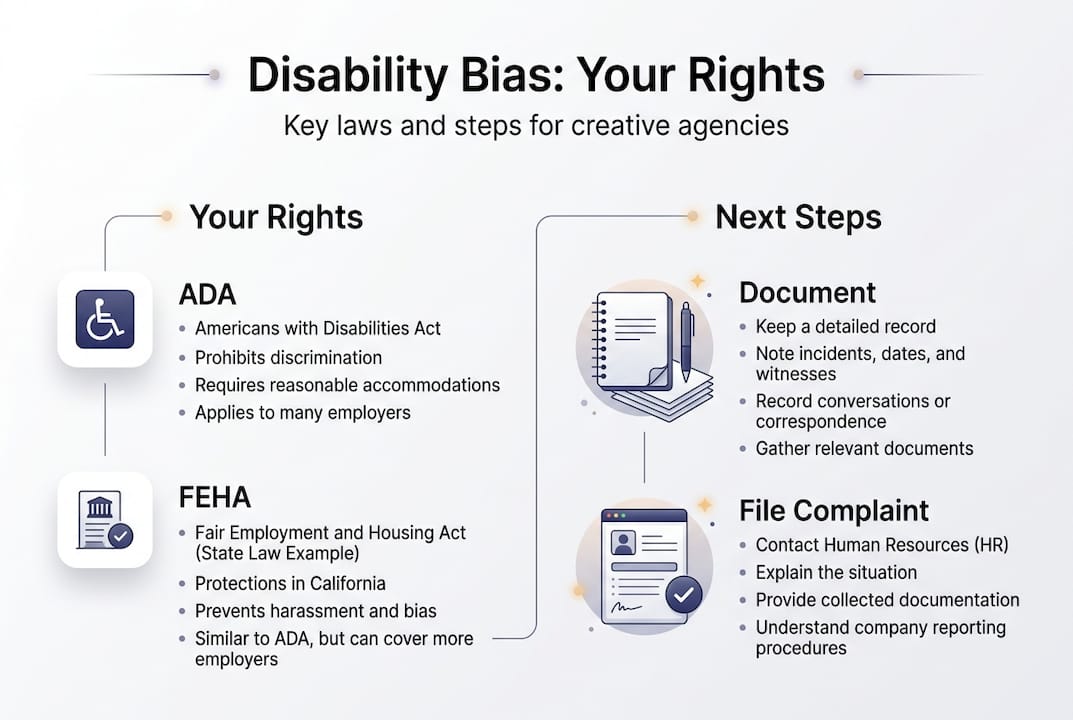
Federal and state protections compared
| Law | Coverage | Key protections |
|---|---|---|
| Americans with Disabilities Act (ADA) | Employers with 15+ employees | Reasonable accommodations, no retaliation |
| California FEHA | Employers with 5+ employees | Broader definition of disability, stronger remedies |
| California Family Rights Act (CFRA) | Employers with 5+ employees | Protected medical leave, job restoration |
California’s Fair Employment and Housing Act (FEHA) covers more employers and defines disability more broadly than federal law. That means more employees in creative agencies qualify for protection here than almost anywhere else in the country.
Here is what you need to do to protect your rights:
- Document every accommodation request and your employer’s response, in writing whenever possible
- Participate in the interactive process, which is the legally required back-and-forth between you and your employer to find a workable solution
- File a complaint with the Civil Rights Department (CRD) within three years of the discriminatory act
- Preserve all related communications, including emails, texts, and meeting notes
The 2026 disability discrimination guide from Shirazi Law Office provides a clear breakdown of these steps. You should also review your medical leave rights if your employer has denied or interfered with protected leave.
The CRD complaint process requires filing within three years, engaging the interactive process, and documenting all requests and responses. Missing this window can permanently close the door on your legal options.
Pro Tip: Even if you are unsure whether what happened qualifies as discrimination, consult a lawyer before filing. A misstep in the complaint process can weaken your case significantly.
Documenting your case and seeking legal representation
Strong documentation is the backbone of a successful disability discrimination claim. Without it, your case depends entirely on your word against your employer’s. With it, you have a paper trail that tells the story clearly.
Here is a practical documentation checklist:
- Start a log immediately. Record every relevant incident with the date, time, location, who was involved, and exactly what was said or done.
- Save all written communications. Emails, Slack messages, performance reviews, and written warnings are all potential evidence.
- Keep copies of medical documentation. Doctor’s notes, treatment records, and any formal accommodation requests should be stored somewhere your employer cannot access.
- Note witnesses. If a coworker saw or heard something relevant, write it down. You may need their account later.
- Track the timeline of your employment. Promotions, raises, and positive reviews before your disclosure versus treatment after can show a clear pattern.
What documentation can do for your case
| Type of evidence | Why it matters |
|—|—|—|
| Incident log | Establishes timeline and pattern of behavior |
| Emails and messages | Provides direct proof of employer actions |
| Medical records | Confirms the existence and nature of your disability |
| Performance reviews | Shows change in treatment after disclosure |
Employees who document thoroughly and act quickly are far better positioned to recover compensation. Specialized legal guidance encourages employees to document every request and seek experienced representation early. Understanding accommodation failures and how they are treated legally can also strengthen your position.
If you are struggling emotionally with what you are going through, therapy resources in Los Angeles can provide support alongside your legal process.
Pro Tip: Do not use your work computer or email to store personal documentation. Use a personal device and a secure, private email account.
Why seeking legal advice quickly makes all the difference
Here is something most resources will not tell you directly: the employees who wait the longest to get legal help often end up with the weakest cases. Not because their experiences were less serious, but because time erodes evidence, memories fade, and procedural mistakes become harder to fix.
Many employees believe they should try to resolve things internally first. That instinct is understandable. But every day you wait, your employer’s legal team may be building their defense. Documenting and acting fast consistently leads to better outcomes and stronger compensation results.
A skilled disability rights lawyer can often secure accommodations or settlements far more efficiently than an employee going it alone. They know what evidence matters, how to communicate with HR and legal departments, and when to push versus negotiate. That knowledge is not something you can replicate by reading articles online.
Too many employees try to handle this themselves out of fear, embarrassment, or a belief that things will improve on their own. Sometimes they do. But when they do not, the window for action may have already started closing. Getting legal advice early is not an escalation. It is a smart, protective step.
Connect with experienced disability rights lawyers in Los Angeles
If you are facing disability discrimination at a creative agency in California, you deserve representation from lawyers who understand both the law and the industry. Shirazi Law Office focuses exclusively on employment law and has helped employees across Los Angeles stand up to powerful employers. Whether you need guidance on employee rights in 2026, want to speak with a Los Angeles employment lawyer, or are ready to explore your options for disability discrimination legal help, the firm offers confidential, personalized consultations. Your case is not just a file number. It is your livelihood, your future, and your story.
Frequently asked questions
What counts as a reasonable accommodation in creative agencies?
A reasonable accommodation could be flexible hours, remote work, adjusted workload, or necessary medical leave that enables you to do your job. Claims often arise from an employer’s failure to provide these basic adjustments.
How long do I have to file a disability discrimination complaint in California?
You have up to three years from the discriminatory incident to file a CRD complaint in California, though acting sooner protects your evidence and options.
Are disability discrimination verdicts in California really this large?
Yes. Recent cases have resulted in multimillion dollar awards, including the $32.2M verdict against Equinox and a $3.7M verdict against Rite Aid, showing courts take these claims seriously.
What if my agency is in Carthay and I haven’t seen lawsuits from this area?
Even if no public cases involving Carthay agencies are known, California law applies equally everywhere, and the absence of lawsuits does not reduce your risk or limit your legal options.
Can my employer fire me for asking for an accommodation?
No. Firing you for requesting an accommodation is illegal retaliation under both state and federal law. Retaliation lawsuits following accommodation requests are among the most common disability discrimination claims filed in California.
Recommended
- Downtown Los Angeles Disability Discrimination – Workplace Rights for Employees Near Crypto.com Arena – Law Office of Brian Y. Shirazi, PC
- Disability Discrimination In Beverly Hills Luxury Hotels – Law Office of Brian Y. Shirazi, PC
- Workplace Disability Discrimination in LA | LA Employment Lawyer
- Disability Accommodation Rights for Employees in Westwood
- Pocket App | Designing Accessible Mobile Apps: Ensuring Inclusivity for All Users